
Best Hedge Trimmers Australia: How to Choose

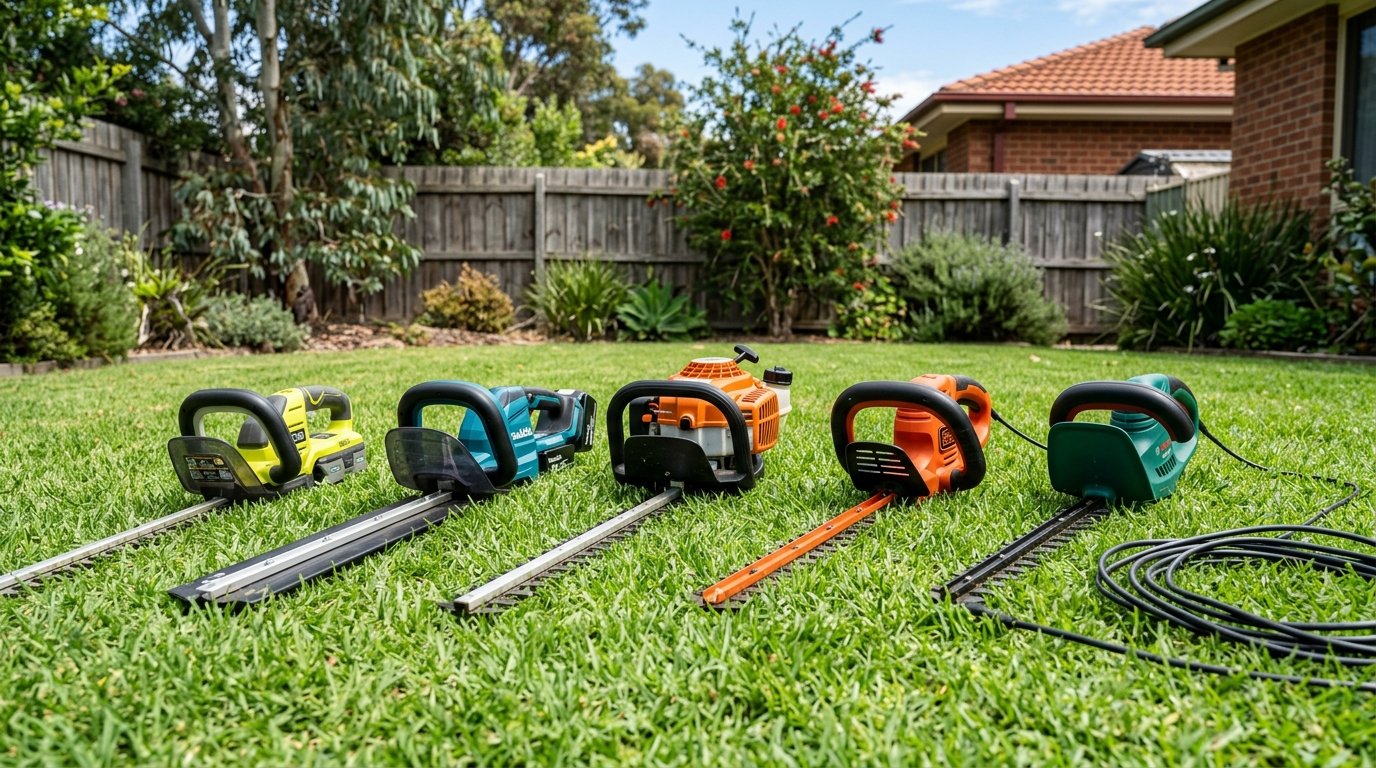
For most Australian home gardens, a cordless battery hedge trimmer is the best all-round starting point: easy to start, quieter than petrol, free from extension leads and capable of handling the regular soft growth produced by Lilly Pilly, Viburnum, Japanese Box and many other common hedges. Petrol still earns its place for long, demanding sessions and coarse neglected growth; corded electric can suit compact gardens close to power; pole trimmers are useful for tall screens; and manual shears remain one of the best tools for precise finishing on small formal hedges.
The right hedge trimmer is not simply the one with the longest blade, biggest battery or highest-looking power specification. A light machine used often on fresh hedge growth may be far more useful than a heavy professional tool bought to cope with one old branch. Match the tool to the hedge you normally maintain, then use secateurs, loppers or a pruning saw for stems outside the trimmer’s intended cutting capacity.
Major tool brands with hedge-trimmer ranges in Australia include STIHL, Husqvarna, Makita, Bosch, Ryobi, Ozito and EGO. Garden Green has not yet joined an affiliate program or completed controlled hands-on model testing, so this guide does not publish retailer links, prices, invented model rankings or unverified runtime claims. Its job is to help you understand the specifications well enough to choose intelligently from whatever current models are available.
Quick pick: which hedge trimmer type suits your garden?
| Scenario | Best starting tool type | Why |
|---|---|---|
| Small formal hedge | Light cordless trimmer or manual shears | Control and precision matter more than maximum cutting capacity |
| Large soft Lilly Pilly or Viburnum hedge | Medium or higher-capacity cordless trimmer | Good balance of mobility, cutting performance and convenience |
| Tall privacy screen | Pole / long-reach hedge trimmer | Better reach for the upper surface without forcing a standard tool overhead |
| Woody neglected hedge | High-capacity cordless or petrol trimmer plus loppers/pruning saw | Heavy old stems should not be forced through a normal trimming blade |
| Occasional light trim in a small garden | Corded electric trimmer | Simple and practical where safe power access is close |
| Fine final shaping | Manual shears | Maximum control for corners, topiary and small corrections |
Battery hedge trimmers: the best fit for many Australian homes
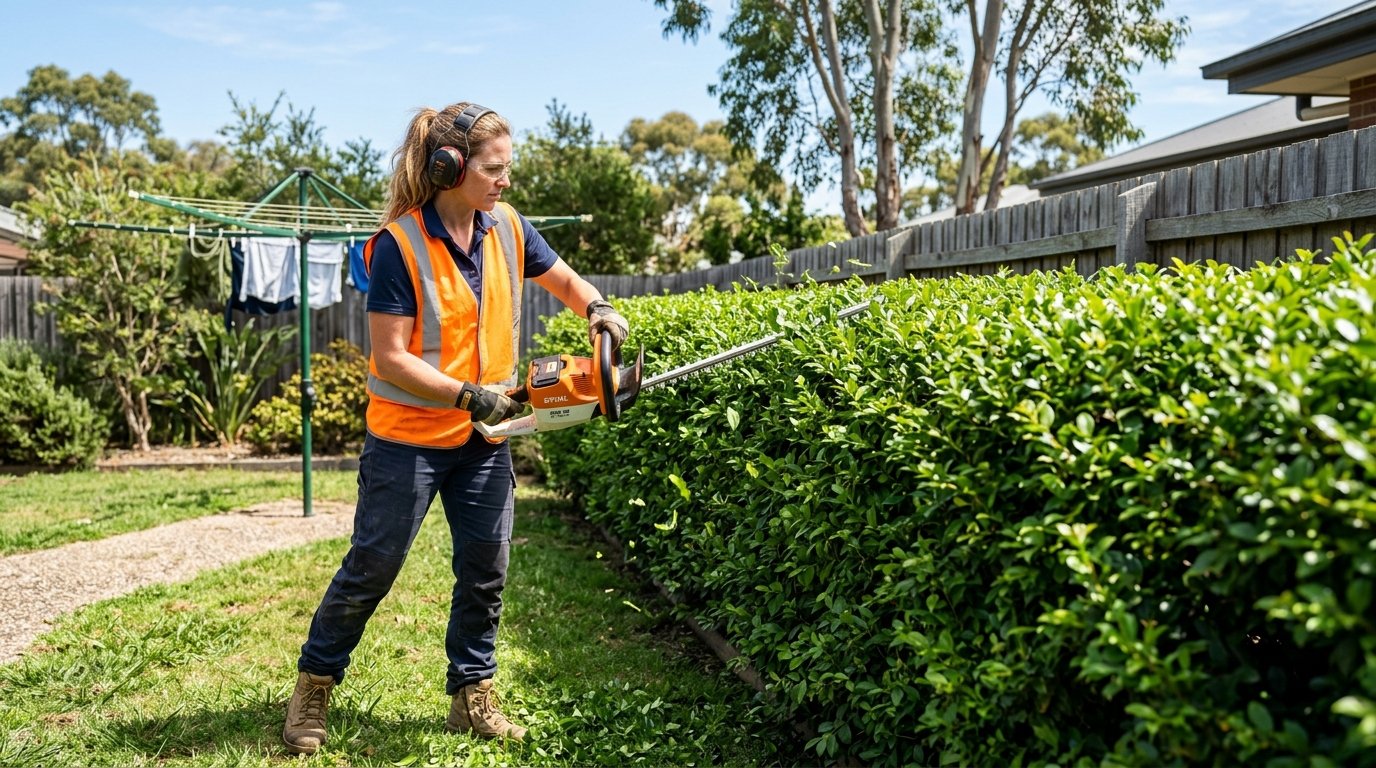
Battery hedge trimmers now cover everything from lightweight homeowner tools to professional machines designed for sustained work. Current Australian ranges from Husqvarna and other major brands include dedicated residential, professional and pole battery trimmers rather than treating cordless tools as light-duty alternatives only.
For a typical suburban garden, cordless has several practical advantages:
- no fuel to store or mix;
- no pull-starting routine;
- no extension cable through the garden;
- lower operating noise than petrol;
- easy stop-start use while moving between hedge sections;
- less engine maintenance;
- batteries may be shared with other tools in the same platform.
The disadvantages are also real. Battery capacity limits working time, larger batteries add weight, and buying into a new battery platform can make the initial purchase substantially less attractive if you do not already own compatible packs and chargers.
Petrol hedge trimmers: still useful for demanding work
Petrol remains a legitimate choice for large properties, contractors and heavy vegetation. Husqvarna Australia still maintains a dedicated petrol hedge-trimmer range and positions professional petrol machines for long hours of demanding use.
Petrol makes the most sense where:
- the hedge area is extensive;
- work sessions are long;
- growth is coarse or repeatedly neglected;
- refuelling is more practical than managing batteries;
- the tool is used commercially or very frequently.
The trade-offs are fuel, exhaust, greater noise, engine servicing and a more involved starting routine.
For a homeowner who trims a healthy hedge regularly, buying petrol purely because it sounds “more powerful” can leave you with more tool than you need.
Cordless versus petrol: the short version
| Factor | Battery | Petrol |
|---|---|---|
| Starting | Usually immediate once controls are engaged | Engine starting procedure required |
| Noise | Generally lower | Generally higher |
| Fuel / energy | Recharge battery packs | Refuel with petrol/fuel mix as specified |
| Routine maintenance | Relatively simple | More engine-related maintenance |
| Long continuous work | Depends on battery inventory and charging | Refuel and continue |
| Typical suburban garden | Excellent fit | Often unnecessary unless workload is heavy |
| Commercial / demanding use | Professional systems increasingly capable | Still a proven option |
A full cordless-versus-petrol hedge-trimmer comparison deserves its own guide because professional battery platforms now overlap with jobs that historically defaulted to petrol.
Corded electric hedge trimmers
Corded electric trimmers still make sense for small properties where the hedge is close to an appropriate outdoor power source.
The benefits are:
- no battery charging;
- no fuel engine;
- continuous power while connected;
- often relatively low tool weight.
The cable is the obvious compromise. Hedge trimming involves moving sideways, working around corners and repeatedly changing direction, so an extension lead can become a trip hazard or enter the cutting area if managed poorly.
For corded tools, use suitable outdoor electrical equipment, inspect cables and plugs before use, keep connections away from water and use appropriate RCD/safety-switch protection. Never continue using a damaged extension lead.
Manual hedge shears still deserve a place
Powered tools are faster, but manual shears remain excellent for small formal hedges.
They are particularly useful on a Japanese Box hedge, where the job is often fine shaping rather than removing large volumes of growth.
Manual shears are useful for:
- small low hedges;
- topiary;
- precise corners;
- final finishing after powered trimming;
- isolated shoots that do not justify starting a machine.
The drawback is fatigue. A tool that is pleasant for a short formal border becomes inefficient on a long privacy screen.
Pole and long-reach hedge trimmers for tall screens
Husqvarna Australia currently offers dedicated pole hedge trimmers with extended or telescopic shafts for tall and wide hedges. The same tool category is available from several other major brands in Australia.
A pole trimmer is worth considering when:
- the hedge top is beyond comfortable reach;
- you regularly need to cut the top surface from ground level;
- one side of the hedge is hard to access;
- an articulating head would improve the cutting angle;
- you are maintaining a tall screening hedge rather than a low border.
This can be especially relevant to Ficus Hillii screens and tall Lilly Pilly hedges.
The trade-off is leverage. Weight carried at the end of a long shaft feels substantially more demanding than the same mass held close to the body. Test working balance rather than judging a pole machine by its catalogue weight alone.
Blade length: longer is not automatically better
A longer cutter bar covers a wider section of hedge in one pass. That is useful for long, flat screens because fewer movements are required to establish a straight surface.
But a long blade can also be:
- heavier;
- more tiring at shoulder height;
- harder to manoeuvre around corners;
- awkward in narrow side passages;
- unnecessary on compact formal hedges.
For a small Japanese Box hedge, we would prioritise control and low weight. For a long Viburnum hedge, additional blade length can be much more useful.
Tooth gap and branch capacity are not the same specification
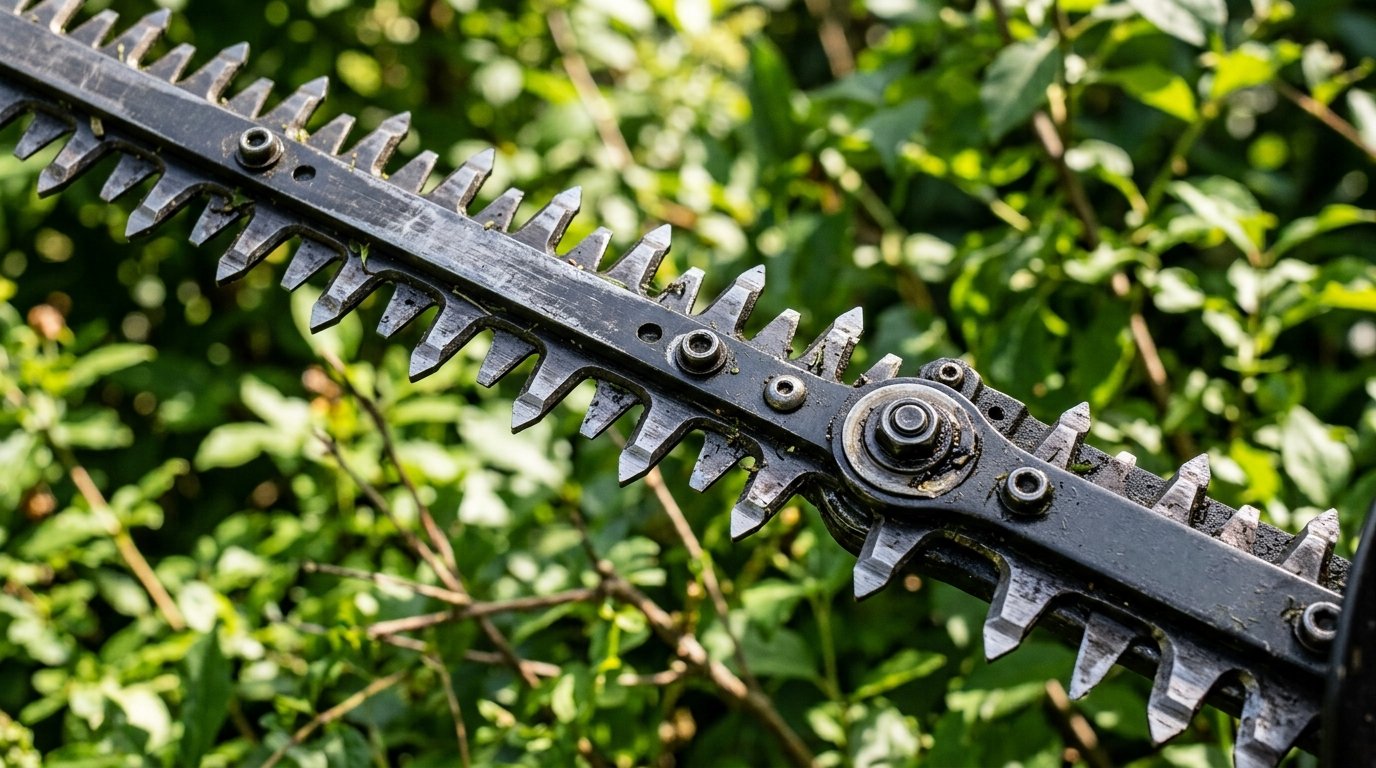
The space between blade teeth gives some indication of the stem sizes the cutter can physically accept, but it should not automatically be interpreted as the manufacturer’s guaranteed maximum cutting diameter.
Use the stated cutting-capacity specification for the actual machine.
A hedge trimmer is primarily designed to cut large numbers of relatively small stems quickly. It is not a substitute for a pruning saw.
If a branch is obviously too thick for the trimmer:
- stop forcing the cutter;
- use secateurs for suitable smaller branches;
- use loppers for heavier individual stems;
- use a pruning saw where required.
Trying to push a large woody branch through a hedge trimmer can stall the blades, damage the tool and leave a poor pruning cut.
Match the machine to the hedge species
| Hedge | Typical trimming character | What matters most |
|---|---|---|
| Japanese Box | Fine formal foliage and small repeated trims | Precision, light weight, balance and control |
| Westringia | Fine-to-medium leafy growth when maintained regularly | Comfortable light trimming before stems become old and woody |
| Viburnum | Vigorous broadleaf hedge growth | Useful blade length and sufficient capacity for fresh shoots |
| Lilly Pilly | Soft new flush that becomes progressively woodier if neglected | Comfort, regular-use capacity and a practical battery system |
| Ficus Hillii | Very vigorous large screen that tolerates hard pruning | Reach, working comfort and sustained cutting ability |
| Old neglected mixed hedge | Leafy outer growth plus coarse old branches | Capable trimmer plus separate pruning tools for oversized wood |
Weight is one of the most important specifications
Hedge trimmers are carried rather than rolled along the ground. Much of the machine is held away from your body and repeatedly moved sideways.
That makes apparently small weight differences important over a long session.
Compare:
- bare-tool weight;
- weight with the intended battery installed;
- blade length;
- front-handle position;
- rear-handle shape;
- how the centre of gravity feels while cutting sideways.
If possible, hold the actual machine with its battery fitted before buying.
A slightly less powerful trimmer that remains comfortable and controllable after repeated passes is often a better homeowner tool than a heavy machine whose capacity is rarely needed.
Balance matters separately from weight
Two machines with similar published weight can feel completely different.
If most mass sits toward the blade, your front arm works harder to keep the cutter level. A large rear battery can shift that balance the other way.
Balance matters especially on vertical hedge faces, where the tool spends considerable time held sideways.
Battery voltage: bigger numbers do not automatically mean a better trimmer
Voltage is one characteristic of a battery platform, not a universal measure of hedge-trimming quality.
Actual cutting performance depends on the complete tool system:
- motor design;
- blade speed;
- gearing;
- tooth geometry;
- stated cutting capacity;
- battery power delivery;
- how the tool is tuned for fine or coarse trimming.
A lightweight tool designed well for formal trimming may be a better choice than a higher-voltage machine if precision and weight are your real priorities.
What battery amp-hours actually tell you
Amp-hours describe charge capacity within a given battery platform.
A higher-capacity compatible battery generally stores more usable energy than a smaller battery of the same voltage system, but the Ah number alone does not tell you exactly how many minutes a hedge trimmer will run.
Runtime changes with:
- stem thickness;
- hedge density;
- blade sharpness;
- power mode;
- battery age;
- temperature;
- how continuously you hold the trigger.
Do not rely on anecdotal runtime from someone cutting a completely different hedge.
The battery ecosystem may matter more than the individual tool
If you already own cordless garden equipment, check whether a suitable hedge trimmer uses the same battery platform.
Major battery ecosystems can cover combinations of:
- hedge trimmers;
- line trimmers;
- blowers;
- mowers;
- chainsaws;
- pole tools;
- other garden or workshop equipment.
Buying into an entirely new system for one small specification advantage can mean buying additional batteries and another charger that provide no value elsewhere.
How many batteries do you need?
For one modest residential hedge, a single suitable battery may be enough.
For a large boundary hedge, two moderate batteries can sometimes be more practical than relying on one very large pack, particularly if the extra-large battery makes the tool uncomfortable.
Professional users may build a workflow around multiple batteries, rapid charging or backpack systems. Most home gardeners do not need that complexity.
Check exact battery compatibility before buying. A brand name alone does not guarantee that every battery works with every tool in that brand’s range.
Dual-action and double-sided blades
Most modern powered hedge trimmers use reciprocating blade systems. You will also see terms such as dual-action, double-sided and single-sided cutting bars.
Husqvarna Australia explains that double-sided bars suit side-to-side trimming, while single-sided professional bars can suit long efficient cuts on larger hedges.
For ordinary residential buying, the practical questions are:
- can you comfortably sweep the blade in both directions?
- is the machine balanced for the hedge faces you need to cut?
- does the blade arrangement suit long straight runs or precision work?
- does the manufacturer describe the tool as residential, professional or heavy-duty?
Anti-vibration and rotating handles are worth considering
Comfort features matter more as hedge size increases.
Look for:
- good front-handle ergonomics;
- a comfortable trigger grip;
- rotating rear handles where offered;
- anti-vibration features;
- a hand guard;
- blade-tip protection;
- a control layout that still works naturally when the tool is sideways.
A specification advantage means little if fatigue makes it difficult to keep the blade level.
Safety features to look for
A hedge trimmer exposes a long reciprocating blade, so safety features should influence the buying decision.
Useful design features can include:
- two-hand operating controls;
- trigger lockouts;
- front hand guards;
- rapid blade stopping;
- blade-tip protection;
- removable battery packs;
- protective blade covers for storage.
Always follow the operating instructions for the specific machine rather than assuming all trimmers behave the same way.
When a pole trimmer makes more sense than a ladder
A long-reach tool becomes especially useful where a hedge top is beyond comfortable standing reach.
The point is not simply convenience. Trying to hold a standard hedge trimmer overhead while balancing on awkward access can reduce control significantly.
A pole trimmer with an articulating head can let you trim:
- the upper face;
- the top surface;
- the far side of a wide hedge;
- lower sections without excessive bending, depending on design.
Husqvarna Australia specifically positions pole hedge trimmers for high or wide hedges that are otherwise difficult to reach.
Do you need a powerful hedge trimmer for old woody growth?
Sometimes, but the better answer is often a combination of tools.
If a neglected hedge contains thick structural branches, use the hedge trimmer to remove the leafy exterior and expose the framework. Then use the appropriate pruning tool on oversized branches.
A practical setup may include:
- hedge trimmer for repeated soft and medium stems;
- secateurs for individual shoots;
- loppers for larger stems;
- pruning saw for heavy branches.
This is usually better than buying an unnecessarily heavy hedge trimmer solely because a neglected plant contains a few large branches.
Budget, homeowner and professional tiers
Occasional homeowner tools
Best suited to one small hedge and infrequent trimming.
Priorities should be:
- light weight;
- simple controls;
- adequate capacity for fresh growth;
- low storage complexity;
- useful battery compatibility if you already own cordless tools.
Large-garden homeowner tools
Suitable for several hedges or a long privacy screen.
Look more closely at:
- balance;
- blade length;
- cutting capacity;
- battery capacity;
- availability of a second battery;
- comfort over longer sessions.
Professional-duty tools
Commercial users usually place more value on:
- durability;
- serviceability;
- ergonomics over long workdays;
- high sustained cutting performance;
- dealer and spare-parts support;
- battery or refuelling workflow.
A professional tool can be excellent without being the right value for someone trimming a short front hedge a few times each year.
Where our recommended hedge-trimmer picks will go
Garden Green has not yet joined an affiliate program and has not completed a controlled side-by-side test of current hedge-trimmer models. We therefore are not publishing a fake “best hedge trimmers” ranking based solely on copied retailer specifications.
When model recommendations are added, they should be grouped by genuine use case—small formal hedge, large soft hedge, tall screen, neglected woody hedge and professional/frequent use—rather than pretending one machine is best for every garden.
Common hedge-trimmer buying mistakes
Buying the longest blade because it looks more capable
A long blade helps on broad hedge faces but can make a small formal hedge harder to control.
Choosing by battery voltage alone
Voltage does not tell you blade quality, gearing, weight, cutting capacity or how pleasant the machine is to use.
Ignoring weight with the battery installed
Compare the machine in its actual working configuration, not bare-tool weight alone.
Buying for one old branch
Choose the hedge trimmer for routine hedge growth and use a pruning saw or loppers for occasional heavy stems.
Starting a new battery ecosystem unnecessarily
Compatibility with tools you already own can be worth more than a small advantage in one specification.
Using a standard trimmer where a long-reach tool is safer
If the hedge is genuinely tall, reach should be part of the purchase decision rather than an afterthought.
Assuming hedge trimmers replace pruning tools
They do not. Hedge trimmers shape the surface; secateurs, loppers and saws deal with branches outside that role.
How hedge type changes the buying decision
A Lilly Pilly hedge produces soft vigorous flushes that are easy to cut when maintained frequently. Leave it too long and more woody growth enters the job.
Viburnum ‘Emerald Lustre’ is similarly vigorous. A comfortable cordless machine with enough blade length for the hedge face often makes more sense than waiting until growth becomes coarse.
Japanese Box needs a different approach. Low weight and precision matter more because the finish is formal and the stems are comparatively fine.
Westringia responds best to regular light trimming while growth is still green. Allowing it to become old and woody creates a pruning problem that should not be solved merely by buying a more aggressive hedge trimmer.
Ficus Hillii is a genuinely vigorous screening tree that handles hard pruning well. For a large Ficus screen, reach, working comfort and sustained cutting performance become much more important.
Cleaning hedge-trimmer blades after use
Leaves and stems deposit sap, resin and fine debris onto hedge-trimmer blades.
Dirty blades create unnecessary friction and eventually reduce cut quality.
After use:
- make sure the tool cannot start—remove the battery, unplug the machine or follow the manufacturer’s petrol-tool shutdown procedure;
- brush away loose leaves and debris;
- remove sticky plant sap with a cleaner suitable for cutting equipment;
- inspect teeth for damage;
- lubricate the cutter as the manufacturer specifies;
- replace the blade cover before storage.
Never place fingers between blade teeth simply because the tool is switched off.
When hedge-trimmer blades need sharpening
A sharp cutter should slice through appropriate hedge growth cleanly.
Warning signs of dull or damaged blades include:
- ragged or frayed stems;
- the same growth requiring repeated passes;
- the machine appearing to struggle more than normal;
- visible tooth damage;
- poor results even after sap and debris have been cleaned off.
Follow the manufacturer’s sharpening procedure. Cutter bars are precision assemblies, and professional servicing is sensible if the blade is damaged or you are unsure how to maintain its geometry.
Hedge-trimmer safety
Before trimming:
- wear eye protection;
- wear sturdy enclosed footwear;
- use hearing protection where the tool manufacturer recommends it;
- keep both hands on the intended operating handles;
- clear children and pets from the work area;
- inspect the hedge for wire, stakes and hidden hard objects;
- check the machine and blade before starting;
- carry and store the tool with its blade cover where provided.
For corded tools, keep the extension cable visible and behind the cutting direction, inspect electrical equipment before use and use appropriate RCD/safety-switch protection.
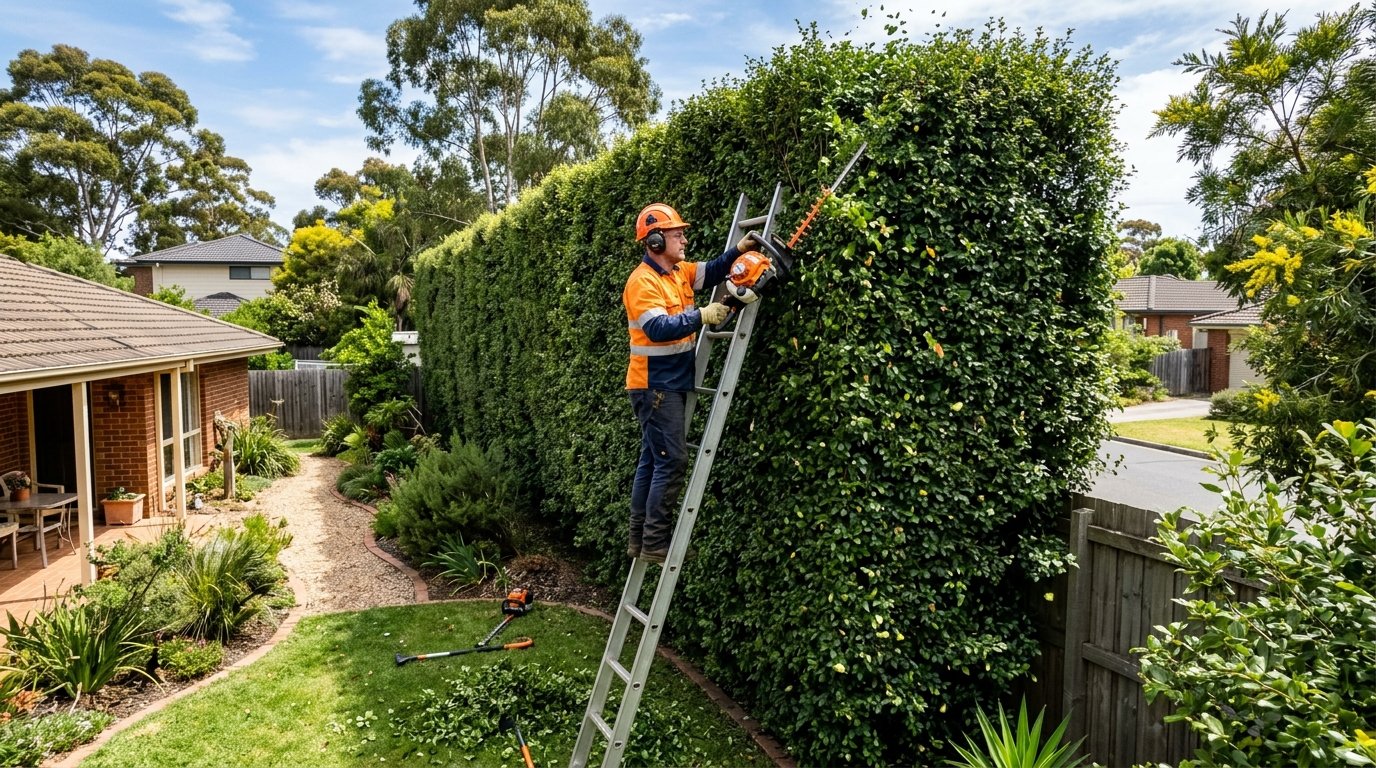
Do not improvise unstable access for a tall hedge. Where safe reach is the problem, a pole trimmer or professional help may be more appropriate than stretching from a ladder while handling a powered cutting bar.
Our quick choice by real garden scenario
| Scenario | Tool type we would start with | Buying priority |
|---|---|---|
| Small formal hedge | Light cordless or manual shears | Precision and manoeuvrability |
| Large soft hedge | Medium/high-capacity cordless | Comfort, blade length and battery system |
| Tall screen | Battery or petrol long-reach trimmer | Reach, articulation and balance |
| Woody neglected hedge | Capable cordless/petrol trimmer plus loppers/saw | Cutting capacity without abusing the trimmer on oversized branches |
| Occasional light trim | Corded electric or compact cordless | Low complexity and light weight |
| Multiple large hedges | Professional battery platform or petrol | Durability, runtime/refuelling workflow and ergonomics |
The best hedge trimmer is the one you can use regularly
The biggest practical advantage of the right tool is not cutting an impossibly thick branch. It is making routine trimming easy enough that the hedge never develops that branch in the first place.
For most garden owners, our buying priorities would be:
- comfortable working weight;
- good balance;
- appropriate blade length;
- sufficient cutting capacity for normal fresh growth;
- safe reach for the hedge height;
- a battery or fuel system that makes sense for the rest of the property.
A powerful hedge trimmer that stays in the shed because it is heavy, awkward or inconvenient is a poor purchase. A lighter machine used regularly can keep a hedge dense, tidy and comfortably within the tool’s intended cutting range.
Frequently asked questions
What type of hedge trimmer is best for most Australian gardens?
A cordless battery hedge trimmer is the best starting point for many Australian home gardens because it combines mobility, simple starting and lower noise with enough cutting ability for regularly maintained hedges. Petrol suits longer or heavier work, while corded tools can work well in compact gardens close to a safe power source.
Is a cordless hedge trimmer powerful enough for Lilly Pilly?
Yes, a suitable cordless hedge trimmer can handle regularly maintained Lilly Pilly growth. Check the manufacturer’s cutting-capacity specification rather than judging the machine by voltage alone. Old branches beyond the trimmer’s capacity should be removed with secateurs, loppers or a pruning saw.
What blade length should I choose for a hedge trimmer?
Choose blade length according to hedge size and how comfortably you can control the machine. Longer blades cover large flat hedge faces more quickly, while shorter blades are easier to manoeuvre around small formal hedges, corners and confined spaces.
Does hedge-trimmer tooth gap equal maximum branch thickness?
Not necessarily. Tooth spacing indicates something about the blade layout, but you should use the manufacturer’s stated cutting capacity for the specific machine. Do not force branches through the cutter simply because they appear to fit between the teeth.
Is battery or petrol better for hedge trimming?
Battery is usually more convenient for residential gardens because there is no fuel handling, extension lead or engine-starting routine, and operating noise is generally lower. Petrol remains useful for long demanding work and heavy vegetation. Professional battery systems increasingly overlap with jobs once dominated by petrol.
When should I buy a pole hedge trimmer?
A pole or long-reach hedge trimmer makes sense when a hedge is too tall or wide to trim comfortably with a standard machine. It is especially useful for tall privacy screens. Check working balance carefully because the extended shaft increases leverage on your arms.
How do I maintain hedge-trimmer blades?
Make the tool incapable of starting, remove leaves and debris, clean off sticky sap or resin with a suitable product, inspect the teeth and lubricate the cutter according to the manufacturer’s instructions. Sharpen or service the blades when cuts become ragged or repeated passes are needed.
Can a hedge trimmer cut thick woody branches?
Only branches within the cutting capacity specified for that machine. Hedge trimmers are primarily designed to shape many smaller stems quickly. Use secateurs, loppers or a pruning saw for individual heavy branches instead of forcing them through the hedge-trimmer blades.


