
Viburnum ‘Emerald Lustre’: Hedge Spacing, Size & Australian Growing Guide

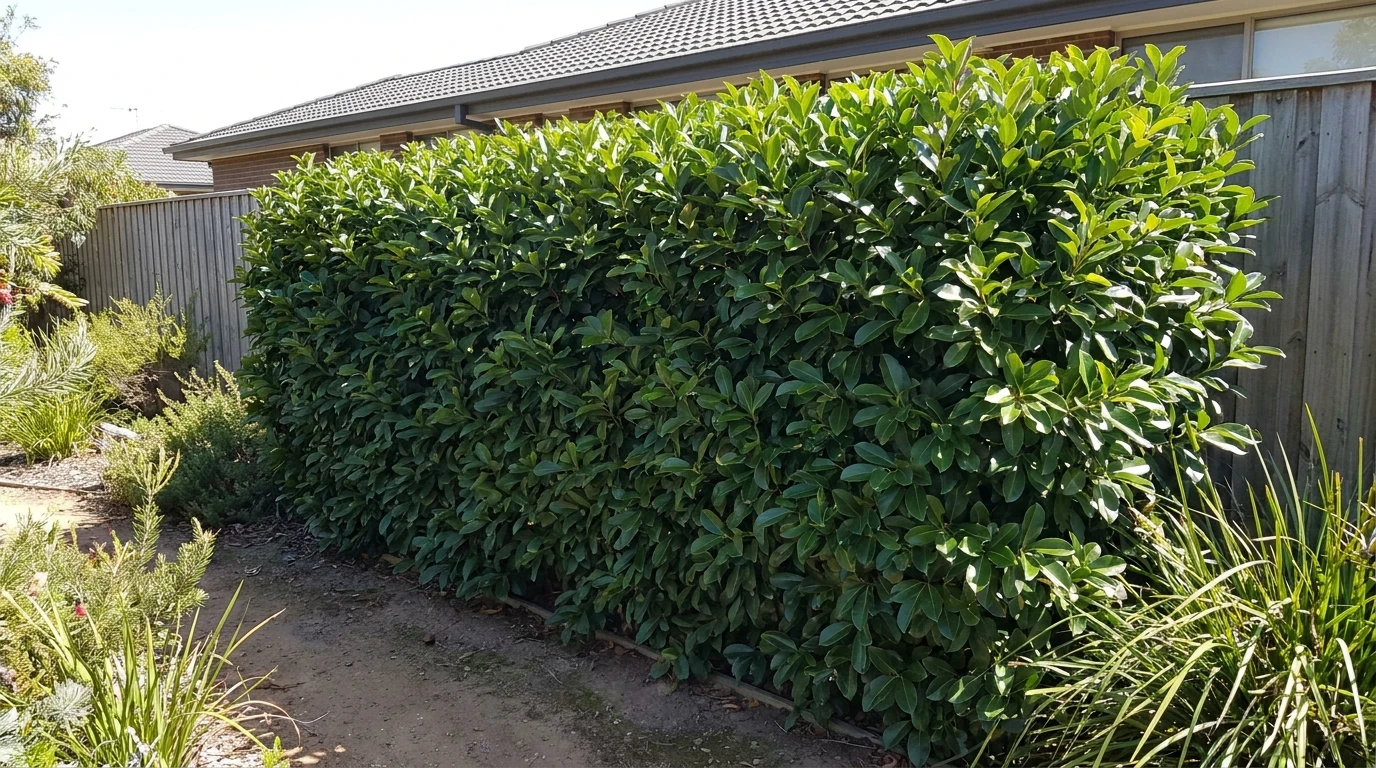
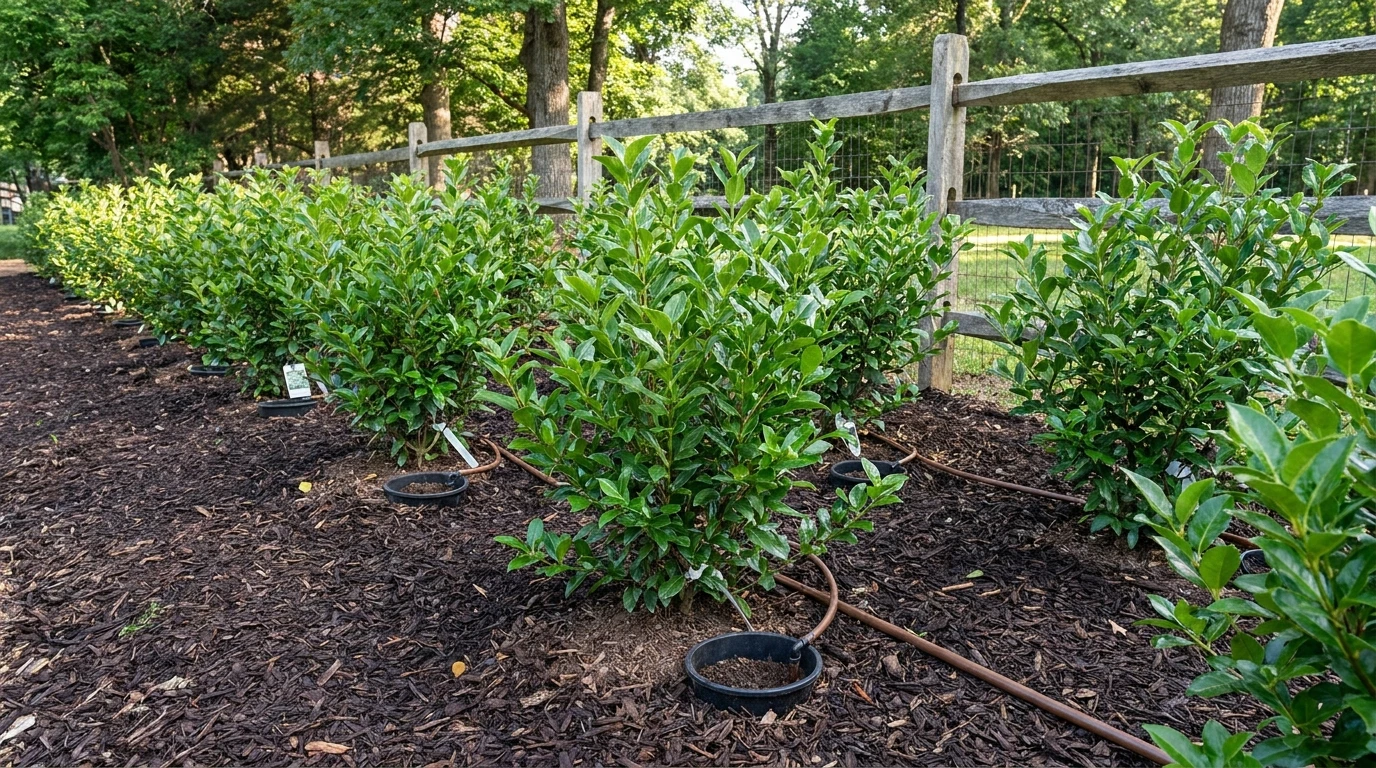
For a clipped 1–2 m Viburnum ‘Emerald Lustre’ hedge, plant about 75 cm–1 m apart; for a taller 3–4 m privacy screen, allow roughly 1.5–2 m between plants. Bamboo Land gives those two spacing ranges specifically for ‘Emerald Lustre’, while Platypus Plants recommends 60 cm–1 m for a hedge and 1–1.5 m for a looser screen.
For a dense evergreen alternative, see our Lilly Pilly hedge guide — a popular Australian screening choice alongside Viburnum.
That distinction matters more than simply asking “how far apart do viburnums go?” ‘Emerald Lustre’ is naturally a substantial shrub. Plantmark publishes approximately 4 m high by 3 m wide, Platypus Plants gives 3–4 m high and wide, and eGardens lists up to 4 m by 4 m. On our jobs, we choose the spacing from the height and finish the client actually wants, then use pruning to build density from low down rather than packing large shrubs unnecessarily close together.
Australian nurseries consistently sell this plant as Viburnum odoratissimum ‘Emerald Lustre’. Kew Plants of the World Online accepts Viburnum odoratissimum as the underlying species, with the accepted typical variety native through parts of tropical and subtropical Asia. ‘Emerald Lustre’ is a named horticultural selection distinguished in the Australian trade by particularly glossy foliage and coppery-bronze new growth; we have not added a PBR claim because we did not find a verified Australian PBR status for ‘Emerald Lustre’ in the material reviewed.
Plant & hedge spacing calculator
Work out how many plants you need and how far apart to space them. Enter a hedge or row length, or a bed area, and choose a plant type — the spacing ranges come from the named Australian sources used across these guides. Adjust the spacing to match the finished height and density you want.
🌿 Plant & Hedge Spacing Calculator
Work out how many plants you need for a hedge, border or mass-planted bed.
What is Viburnum ‘Emerald Lustre’?
Viburnum odoratissimum ‘Emerald Lustre’ is an evergreen screening and hedging shrub selected from the sweet viburnum group. Kew Plants of the World Online accepts Viburnum odoratissimum as a shrub or tree species, while Australian nursery listings consistently distinguish ‘Emerald Lustre’ as the glossy-leaved horticultural form commonly used for screening.
eGardens describes ‘Emerald Lustre’ as having brighter, shinier foliage than straight V. odoratissimum, with coppery-bronze new growth. Platypus Plants similarly describes bright glossy green leaves with lighter copper-green new growth, while Plantmark records leathery glossy dark-green foliage with paler undersides.
That large glossy leaf is central to its landscape effect. A clipped ‘Emerald Lustre’ hedge reads as a broad, lush wall of foliage rather than the finer texture you get from many lilly pillies or small-leaved formal hedging plants.
How big does Viburnum ‘Emerald Lustre’ grow?
Most useful Australian references put an unrestrained ‘Emerald Lustre’ somewhere around 3–5 m, although published width varies. Plantmark’s cultivar page says approximately 4 m high by 3 m wide. Platypus Plants lists 3–4 m high and wide. eGardens gives up to 4 m by 4 m, while Nurseries Online describes approximately 4–5 m with a similar spread.
| Australian source | Published height | Published width | Planning value |
|---|---|---|---|
| Plantmark | Approx. 4 m | Approx. 3 m | Strong practical reference for landscape sizing |
| Platypus Plants | 3–4 m | 3–4 m | Supports use as a substantial privacy shrub |
| eGardens | Up to 4 m | Up to 4 m | Shows how broad an unrestrained plant can become |
| Nurseries Online | 4–5 m | Similar spread | Useful upper-range reference where plants are allowed to grow freely |
| Botanica Nurseries | 4–6 m | Not specified | Shows potential height where plants are not maintained as a hedge |
A maintained hedge is obviously different from an unpruned shrub. We commonly think of ‘Emerald Lustre’ as a plant that can be held substantially below its natural size, but that does not make it a naturally compact shrub. The larger the gap between its natural dimensions and the finished hedge you want, the more regular pruning becomes part of the design.
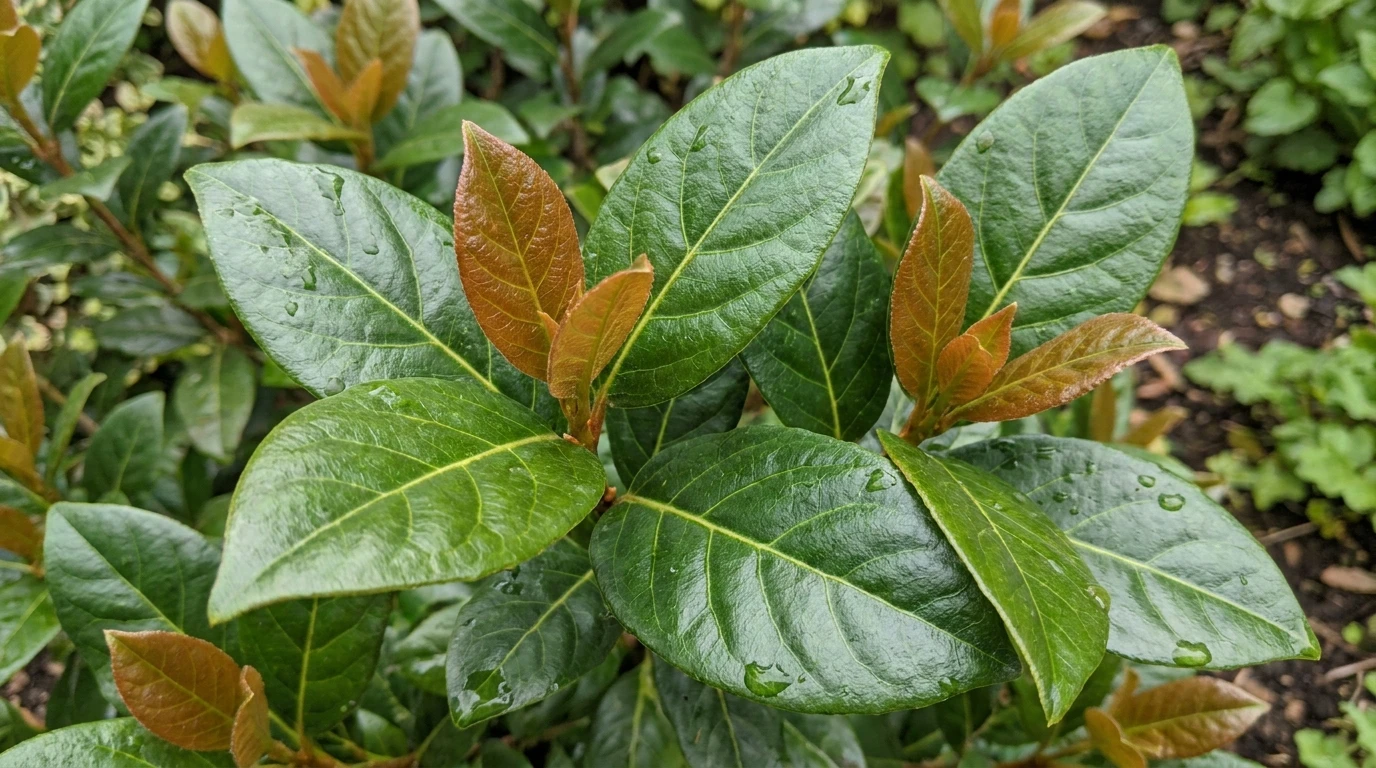
Viburnum ‘Emerald Lustre’ hedge spacing by desired height
Spacing should change with the hedge you are trying to build. Bamboo Land gives one of the clearest cultivar-specific Australian recommendations: 75 cm–1 m apart when ‘Emerald Lustre’ will be maintained at about 1–2 m high, and approximately 1.5–2 m apart when plants are intended to approach their full 4 m height.
Platypus Plants recommends 60 cm–1 m apart for a hedge and 1–1.5 m for an informal screen. eGardens suggests 70 cm spacing where faster closure is wanted. For generic sweet viburnum, Yates Australia recommends about 50 cm for a semi-formal hedge and 1–1.5 m for a screen, which helps explain why spacing figures can look very different online: the intended finished form is different.
| Desired result | Practical spacing range | Why we use it |
|---|---|---|
| Clipped hedge around 1–2 m | About 75 cm–1 m centres | Bamboo Land specifically recommends this range for ‘Emerald Lustre’ kept at 1–2 m. |
| Dense privacy hedge around 2–3 m | About 1–1.2 m centres | Sits between the cultivar-specific hedge and screening ranges published by Platypus Plants and Bamboo Land. |
| Tall informal screen around 3–4 m | About 1.5–2 m centres | Bamboo Land recommends this wider spacing where plants are allowed towards their full height. |
| Individual specimen rather than hedge | Allow roughly 3–4 m overall plant width | Plantmark, Platypus Plants and eGardens all publish substantial mature widths for unrestrained plants. |
On our jobs, we do not automatically plant the tightest possible row just because privacy is urgent. Closer planting can close a visual gap sooner, but it also creates more root competition and a greater pruning burden later. Good nursery stock, early tip pruning and consistent establishment care often matter just as much as shaving another 20 cm off the centres.
How fast does Viburnum ‘Emerald Lustre’ grow?
This is the figure we would be most cautious about turning into a universal centimetres-per-year promise. Australian descriptions do not agree closely enough. Platypus Plants calls ‘Emerald Lustre’ moderate-growing, while eGardens describes it as fast growing and Lake Devon Nursery calls it extremely fast growing. Nurseries Online describes moderate-to-fast growth and reports that well-grown nursery plants around 0.75–1 m high can reach about 2 m in two years under good soil, moisture and feeding.
Some Australian sweet-viburnum guides quote figures around 60–90 cm or even close to 1 m per year, but those figures usually refer to Viburnum odoratissimum generally rather than a controlled growth trial of ‘Emerald Lustre’. We therefore would not publish “Emerald Lustre grows exactly 1 m per year” as a cultivar fact.
The honest planning answer is that ‘Emerald Lustre’ is capable of vigorous screening growth in suitable Australian conditions, but there is no reliable cultivar-specific annual centimetre figure that applies across climates, soils, irrigation levels and pruning regimes.
The useful caveat: “fast growing” and “frost tolerant” are not standardised nursery measurements
The main inconsistency we found in Australian sources concerns performance labels rather than mature size. Growth is described as moderate, moderate-to-fast, fast and extremely fast depending on the supplier. Frost descriptions also range from light-frost tolerant at Platypus Plants and Able Nursery to frost tender in the older Nurseries Online cultivar guide, while Botanica Nurseries describes much broader cold tolerance.
Those words are not equivalent to a replicated trial. For Garden Green planning, we therefore give more weight to the consistent mature-size and spacing information and treat both speed and cold tolerance as site-dependent. In warm coastal, subtropical and mild temperate gardens, ‘Emerald Lustre’ is a familiar vigorous screening choice. In a genuinely hard-frost site, we would want local evidence before specifying a long hedge of it.
Full sun or part shade?
Plantmark lists full sun and semi-shade for ‘Emerald Lustre’. Platypus Plants also specifies full sun to part shade, and Kingdom Horticulture gives the same range.
For a hedge, light affects density. On our jobs we prefer the brighter suitable position when the aim is a thick, uniform privacy wall. Part shade can work well, but very deep shade is a different proposition; Nurseries Online specifically describes sweet viburnum as suitable for full sun to a little shade rather than deep shade.
If one end of a hedge receives much more light than the other, expect some difference in vigour. Pruning can correct shape, but it cannot make two very different growing environments identical.
What soil does ‘Emerald Lustre’ need?
Plantmark lists well-drained soil for ‘Emerald Lustre’. Kingdom Horticulture specifies moist, well-drained soil, while Nurseries Online describes sweet viburnum as favouring humus-rich, well-drained conditions.
That is a useful combination for hedge establishment: organic matter and reliable moisture help support vigorous foliage, but the root zone still needs air. A permanently boggy planting trench is not improved simply by selecting a plant described as hardy.
For a long hedge, we prefer preparing the planting strip consistently rather than creating one excellent hole followed by one compacted hole. The objective is an even root environment so that individual plants do not establish at visibly different rates along the same boundary.
Watering a new viburnum hedge
Yates Australia recommends deep watering once or twice a week depending on weather when establishing viburnum. That is more useful than treating an irrigation calendar as fixed because a hedge planted into sandy soil in warm weather dries differently from one planted into improved loam during a mild period.
On our jobs, we check the root ball itself as well as the surrounding soil. Newly planted advanced stock can sit in a dry nursery root ball even while nearby garden soil looks damp. The objective is to wet both zones deeply enough that roots start moving outwards.
Once established, watering requirements usually reduce, but a hedge being pushed for rapid growth will respond differently from one merely being kept alive. Water, nutrition, sunlight and pruning together explain much of the variation behind those competing “growth rate” claims.
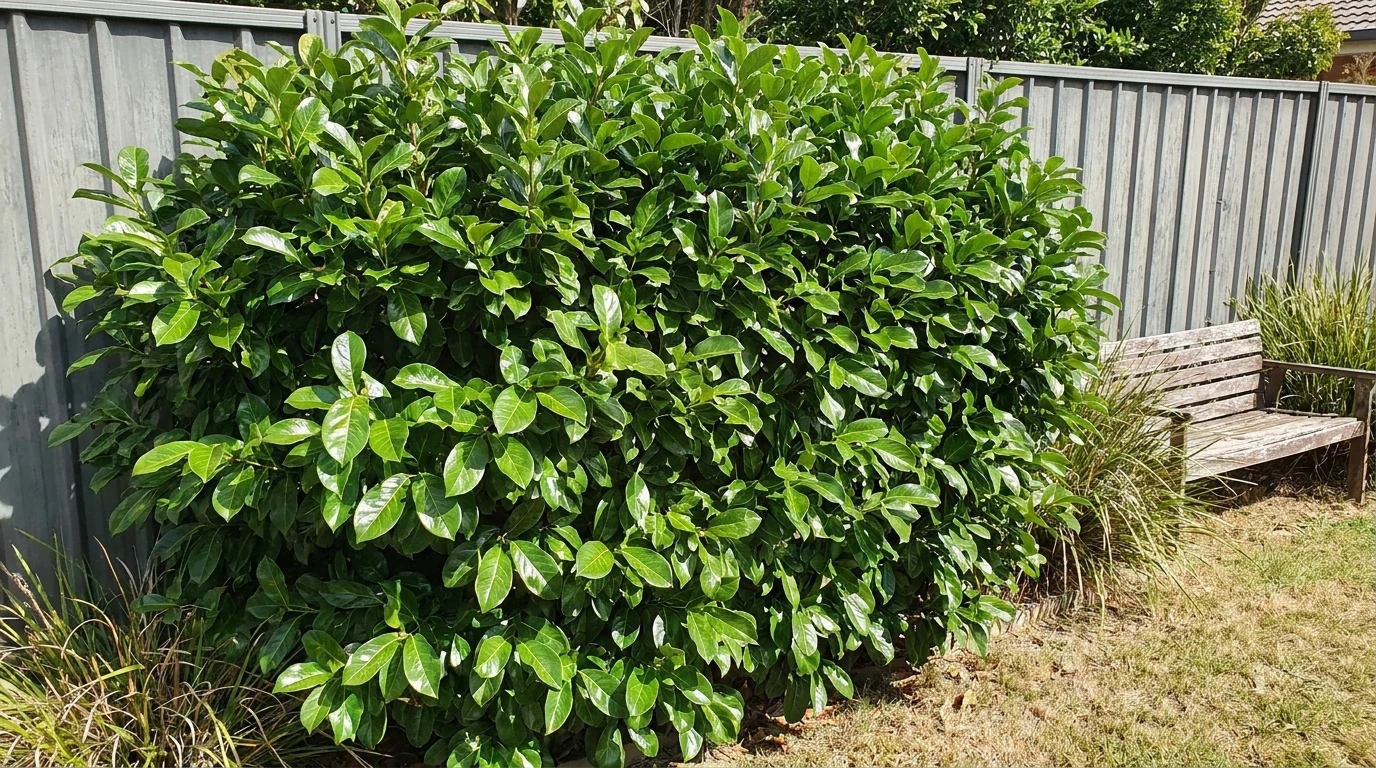
Pruning ‘Emerald Lustre’ for a dense hedge
Spring Colours recommends pruning sweet viburnum once or twice a year in warmer months depending on desired height. Nurseries Online describes ‘Emerald Lustre’ as responding well even to hard pruning, while Yates recommends pruning viburnum after flowering in spring.
For a new hedge, we are more interested in branching than immediate maximum height. If every leading shoot is allowed to race upward untouched, you can reach the fence top quickly but still have an open hedge at knee height. Early tip pruning encourages side branching and gives you a better base to build on.
Once the hedge reaches the required envelope, trimming frequency depends on how formal the finish needs to be. A soft privacy screen can carry some natural extension. A flat architectural hedge needs more regular intervention.
Flowers and berries
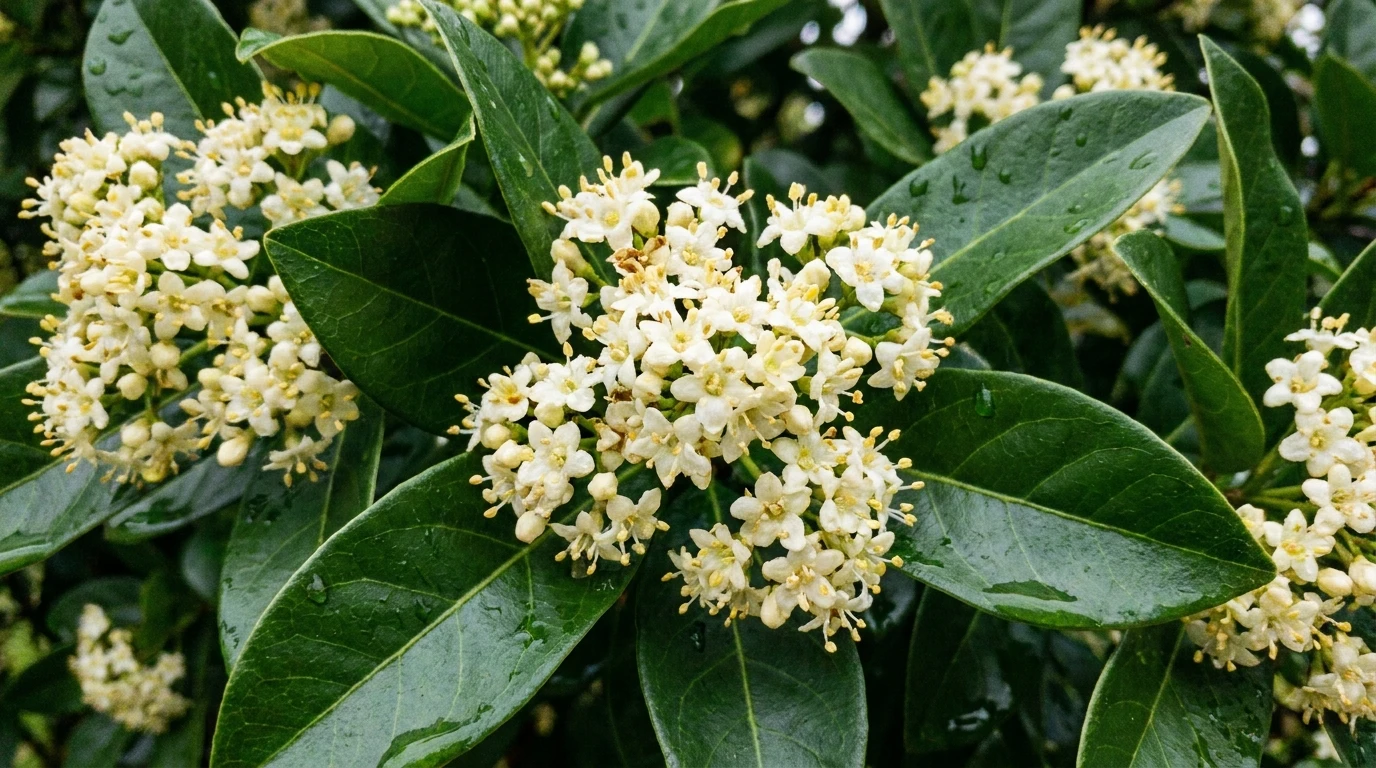
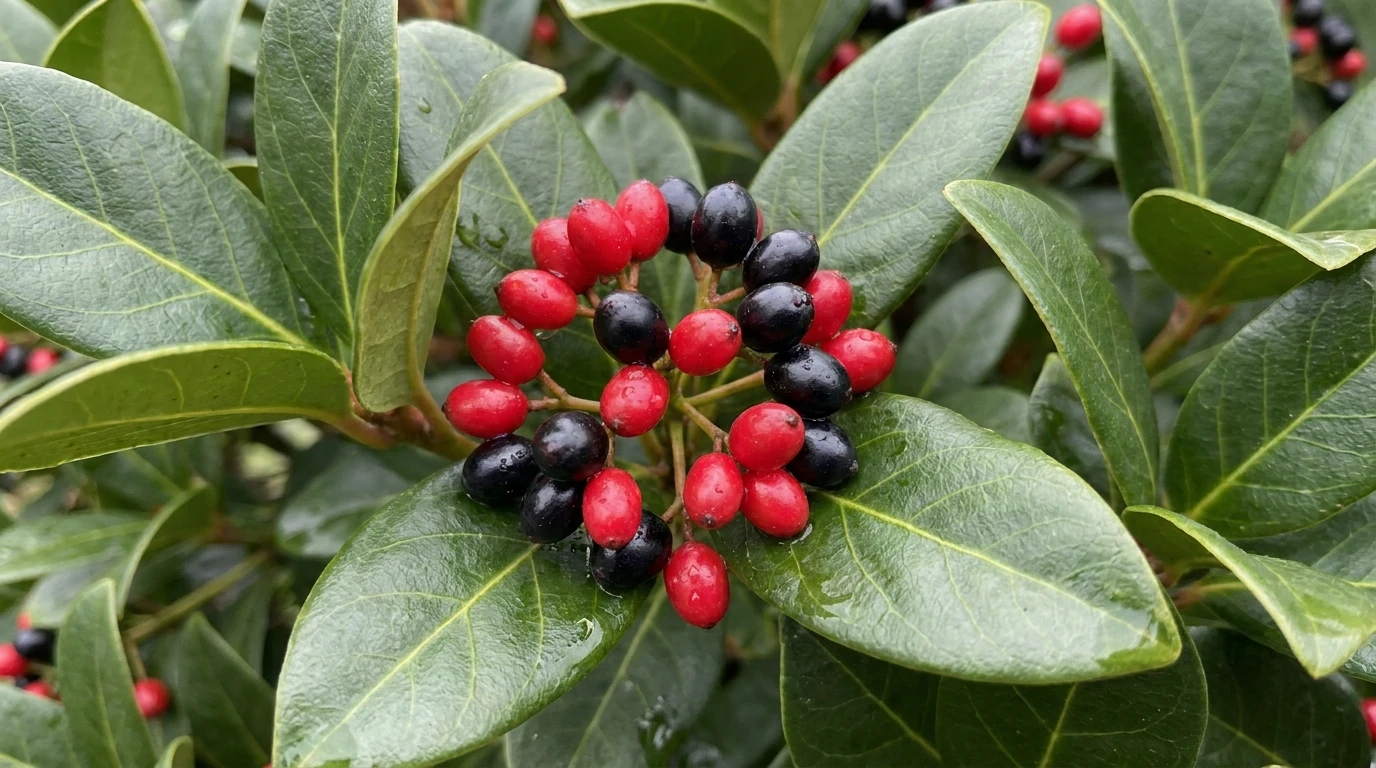
Plantmark describes fragrant white flowers in late spring followed by reddish-black berries. eGardens also records small perfumed white flowers in late spring followed by red berries that darken as they mature. Platypus Plants lists fragrant white spring flowers.
Heavy clipping inevitably changes how much flowering you see because flowers occur on shoot growth that may be removed during shaping. If the primary job of the plant is privacy, that usually matters less than maintaining the hedge. If flowering is important, pruning timing deserves more thought.
Thrips on viburnum: what should Australian gardeners watch for?
Thrips are worth knowing about before planting a long viburnum hedge. Yates Australia identifies thrips as a major viburnum pest and describes the typical symptom as silver or brown speckling, with the insects and dark droppings found on the undersides of leaves.
Professional Plant Supplies reports similar silvery-brown damage on Canberra viburnum hedges from sap-sucking insects including greenhouse thrips and sometimes two-spotted mite. Their advice emphasises maintaining healthy growth and, where treatment is required, reaching the undersides of leaves where the pests feed.
Gardening Australia has also noted thrip and mite problems on viburnums in hot, dry positions, particularly against heat-radiating fences. That matches what we watch for in practice: bronzing or silvery foliage should trigger an inspection, not an automatic assumption that the hedge needs more fertiliser.
Before spraying anything, turn affected leaves over and identify what is actually present. Similar-looking damage can have different causes, and treatment should follow the pest and the product label rather than the plant name alone.
Is ‘Emerald Lustre’ a good choice beside a Colorbond or hot western fence?
It can be, but we would pay attention to reflected heat and irrigation. Gardening Australia specifically notes that hot, dry conditions beside metal fencing can favour thrip and mite problems on viburnums.
A healthy established hedge may eventually shade the fence and modify that microclimate, but young plants begin with exposed roots and relatively little foliage. Mulch, dependable establishment watering and enough soil volume become more important on that sort of boundary.
Where a Viburnum ‘Emerald Lustre’ hedge fits — and where we’d choose something else
| Garden situation | Would we choose ‘Emerald Lustre’? | Why |
|---|---|---|
| 2–4 m privacy screen in a warm or mild climate | Yes | Plantmark, Platypus Plants and eGardens all describe a substantial evergreen shrub well suited to screening. |
| Broad hedge where lush foliage is the priority | Yes | Its large glossy leaves and copper-bronze new growth create the dense tropical look for which ‘Emerald Lustre’ is widely planted. |
| Boundary that receives sun to part shade | Yes | Plantmark and Platypus Plants both list full sun to partial shade. |
| Very narrow bed needing a naturally slim plant | Usually not our first pick | Australian suppliers publish natural widths around 3–4 m, so keeping it genuinely narrow means continuing pruning. |
| Tiny 50–80 cm ornamental hedge | Usually choose something else | ‘Emerald Lustre’ is naturally a large screening shrub; using it as a miniature hedge creates unnecessary maintenance. |
| Hard-frost inland site | We would check local performance first | Australian sources disagree on cold tolerance, although several specifically limit their claim to light frost once established. |
| Garden where only Australian native species are wanted | No | Kew Plants of the World Online records Viburnum odoratissimum as native to Asia, not Australia. |
| Owner wants an almost maintenance-free formal hedge | Probably not | A vigorous large-leaved plant kept well below its natural 3–5 m scale requires ongoing shaping. |
‘Emerald Lustre’ versus newer sweet viburnum hedge cultivars
‘Emerald Lustre’ remains popular because it is proven in the Australian nursery trade and has the big glossy foliage many people specifically want. It is not, however, the only Viburnum odoratissimum option.
Ozbreed lists Dense Fence™ as Viburnum odoratissimum ‘VOC1’ PBR and describes it as having finer leaves, shorter internodes and denser growth than the common form, with a published size of approximately 2.5 m high by 2 m wide and potential to reach about 3.5 m unpruned. Ozbreed also lists Quick Fence™ as Viburnum odoratissimum ‘VOQ1’ PBR and describes it as tighter and more upright than ‘Emerald Lustre’, with a published 4 m by 2.5 m size.
That does not make ‘Emerald Lustre’ obsolete. It simply means plant selection can be more precise now. If we have plenty of width and want the classic big glossy viburnum look, ‘Emerald Lustre’ still makes sense. If bed width is constrained, we would compare the newer narrower selections rather than assuming all sweet viburnums grow identically.
How much room should you leave from a fence or path?
If a maintained ‘Emerald Lustre’ hedge will be around 1 m thick, centring trunks only a few centimetres from a fence gives neither the foliage nor the gardener much working room. Its unrestrained dimensions are substantially larger: Plantmark publishes about 3 m of width and Platypus Plants 3–4 m.
We therefore set the hedge line according to the finished width we intend to maintain, access for pruning and what is on the opposite side of the bed. The exact offset is a design decision, not a universal cultivar measurement.
Beside a driveway or walkway, this matters twice: large glossy leaves look good when intact, but repeated clipping forced by poor placement can leave the outside face looking perpetually cut.
Our take on Viburnum ‘Emerald Lustre’ for Australian screening
‘Emerald Lustre’ makes the most sense when the brief is straightforward: build a substantial evergreen privacy screen, use a lush broad leaf, and accept that regular pruning is part of owning the hedge.
Its strengths are easy to understand. Plantmark puts the plant around 4 m by 3 m; Platypus Plants puts it around 3–4 m; Australian suppliers repeatedly recommend it for hedges and screens; and multiple sources agree on sun to part shade and well-drained soil.
The mistake is treating it as a small hedge simply because it can be clipped small. On our garden plans, we would use ‘Emerald Lustre’ where there is enough soil and enough width for a large screening shrub to do its job. For a 1–2 m clipped hedge, roughly 75 cm–1 m centres is a sensible starting range. For a tall 3–4 m screen, roughly 1.5–2 m gives each plant more room to become the large shrub it naturally wants to be.
Frequently asked questions
How tall does Viburnum ‘Emerald Lustre’ grow?
Plantmark lists Viburnum ‘Emerald Lustre’ at approximately 4 m high, Platypus Plants gives 3–4 m, and Nurseries Online gives about 4–5 m, so it should be planned as a large screening shrub even when it will be maintained at a lower hedge height.
How far apart should Viburnum ‘Emerald Lustre’ be planted for a hedge?
Bamboo Land recommends about 75 cm–1 m apart when Viburnum ‘Emerald Lustre’ will be clipped to around 1–2 m high; for a taller screen approaching 4 m it recommends approximately 1.5–2 m centres.
How fast does Viburnum ‘Emerald Lustre’ grow?
Australian sources variously describe Viburnum ‘Emerald Lustre’ as moderate, moderate-to-fast or fast growing, but we found no reliable cultivar-specific annual centimetre figure that applies across Australian climates, soils, watering and pruning regimes.
Can Viburnum ‘Emerald Lustre’ grow in shade?
Plantmark and Platypus Plants both list Viburnum ‘Emerald Lustre’ for full sun to part shade, although we prefer the brighter suitable position when maximum hedge density is the priority.
What soil is best for Viburnum ‘Emerald Lustre’?
Plantmark specifies well-drained soil, Kingdom Horticulture recommends moist well-drained soil, and Nurseries Online describes sweet viburnum as favouring humus-rich well-drained conditions.
Is Viburnum ‘Emerald Lustre’ frost tolerant?
Platypus Plants and Able Nursery state that established Viburnum ‘Emerald Lustre’ tolerates light frost, but Australian sources differ on stronger cold tolerance, so we would check proven local performance before using it extensively in a hard-frost climate.
What causes silver or brown leaves on a viburnum hedge?
Yates Australia identifies thrips as a major cause of silver-brown speckling on viburnum leaves, while Professional Plant Supplies also reports greenhouse thrips and two-spotted mite causing similar damage, so affected leaves should be checked carefully, especially on their undersides.
Is Viburnum ‘Emerald Lustre’ good for privacy screening?
Yes. Plantmark, Platypus Plants, eGardens and other Australian nurseries all recommend Viburnum ‘Emerald Lustre’ for hedging or screening, and its natural 3–5 m scale makes it particularly useful where a substantial evergreen privacy barrier is wanted.


