
Hakea laurina ‘Mini Pini’: Dwarf Pincushion Hakea for Small Australian Gardens

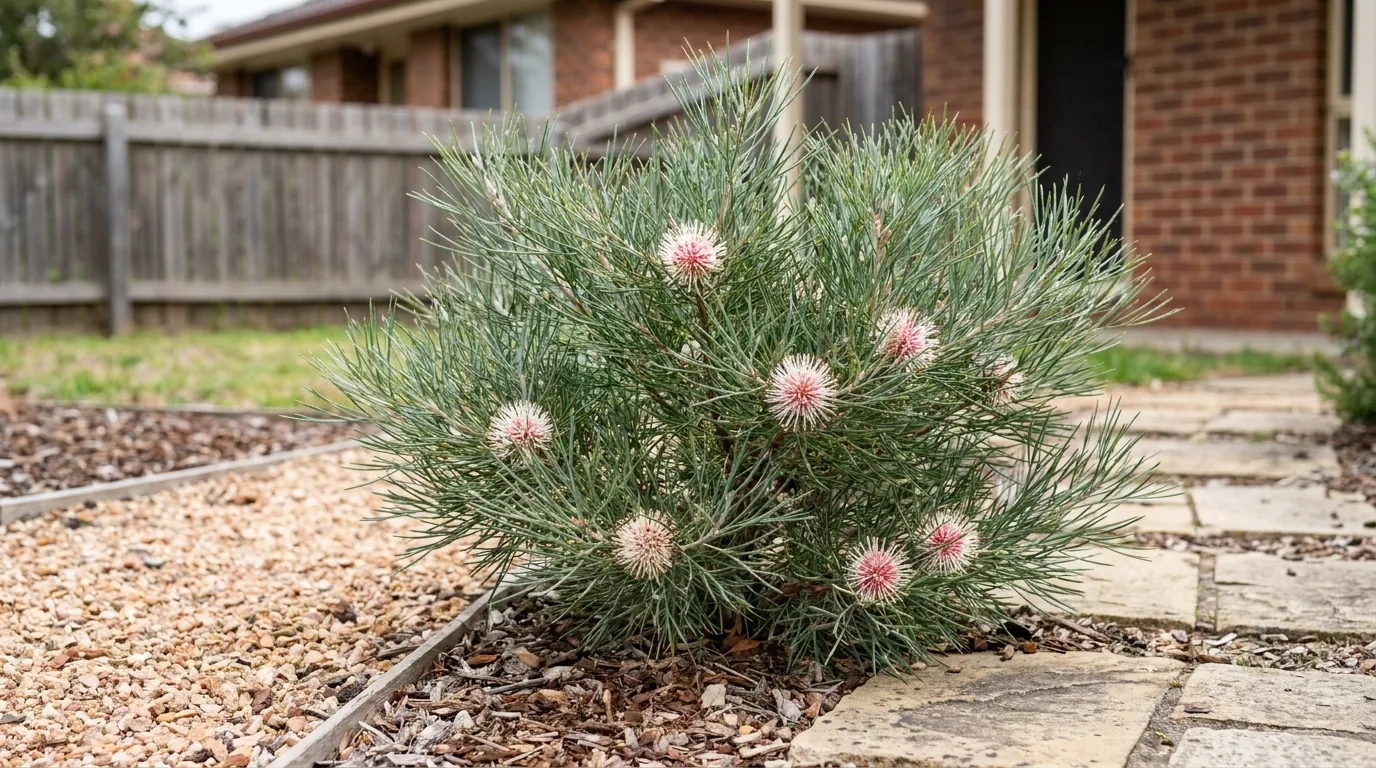
Hakea laurina ‘Mini Pini’ is the compact Pincushion Hakea to choose when you want the flowers of the full-sized species without a 4–6 metre shrub. Australian references put Mini Pini at roughly 0.4–0.8 m high and 0.4–0.5 m wide in the Gardening With Angus plant database, while Gardening Australia and Water Corporation WA describe it more broadly as growing to about 1 metre high.
That difference in published size is small compared with the difference between the cultivar and ordinary Hakea laurina. Gardening Australia describes common forms at 4–5 m, and Kings Park records the species to a maximum of 6 m. In practice, that is why we use Mini Pini in the small-shrub layer rather than treating it as a miniature version of a screening tree.
Mini Pini and ordinary Hakea laurina are very different garden plants
| Feature | Hakea laurina ‘Mini Pini’ | Ordinary Hakea laurina |
|---|---|---|
| Published height | 0.4–0.8 m from Gardening With Angus; about 1 m from Gardening Australia and Water Corporation WA | 4–5 m from Gardening Australia; up to 6 m from Kings Park |
| Published width | 0.4–0.5 m from Gardening With Angus | 2–3 m from Water Corporation WA; 3–4 m from SA Plant Selector |
| Best-supported garden role | Low hedge, small feature shrub, pot | Large shrub, screen or small tree |
| Cultivar flowering period | Winter, according to Gardening With Angus | Autumn–winter in Water Corporation WA; late April–August at Kings Park |
This is the first thing we check when someone says they want “a small Hakea”. A young ordinary Pincushion Hakea can look quite restrained in a nursery pot, but its eventual scale is completely different. If the label only says Hakea laurina or Pincushion Hakea, we would not assume it is the dwarf cultivar.
Where Mini Pini earns its place
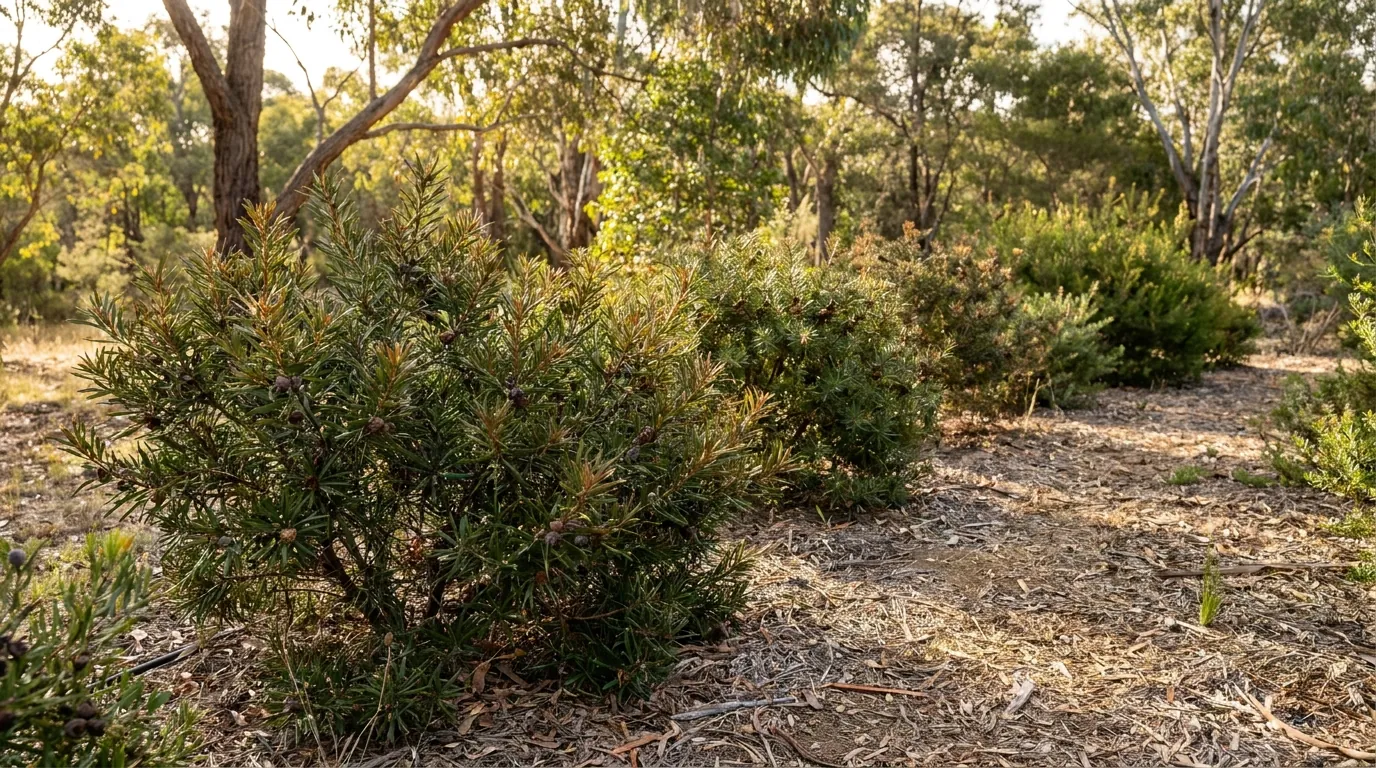
Mini Pini is useful because it fits situations where the normal species creates a long-term size problem. Gardening Australia specifically recommends it as a low-maintenance hedge around the 1 m scale, while Lullfitz Nursery places it in its small 1 m hedge group. Lullfitz also lists the cultivar among plants suitable for medium and small patio pots.
In compact native beds, that smaller scale is the real advantage. We can use the flower form and leathery Hakea foliage near a path, patio or lower planting layer without designing around a shrub that eventually wants several metres of canopy.
It also makes more sense beneath low sightlines. We would rather choose a plant whose natural size suits the space than install ordinary Hakea laurina and spend years cutting it back to a height it was never meant to maintain.
There is no reliable Mini Pini growth-rate figure
You will find plenty of websites calling dwarf Hakeas “fast”, “moderate” or giving generic growth advice, but I could not verify a credible Australian source publishing a measured annual centimetres-per-year rate specifically for Hakea laurina ‘Mini Pini’.
That means we are not going to invent one.
For this cultivar, mature scale is a much better planning tool: Gardening With Angus publishes 0.4–0.8 m high by 0.4–0.5 m wide, while two other established Australian sources describe it at about 1 m high.
On our own jobs and growing observations, we judge establishment by whether the plant is producing healthy extension growth, holding good foliage and gradually building its mound rather than trying to force it to meet an unsupported annual growth figure.
The flowers are the reason to grow it
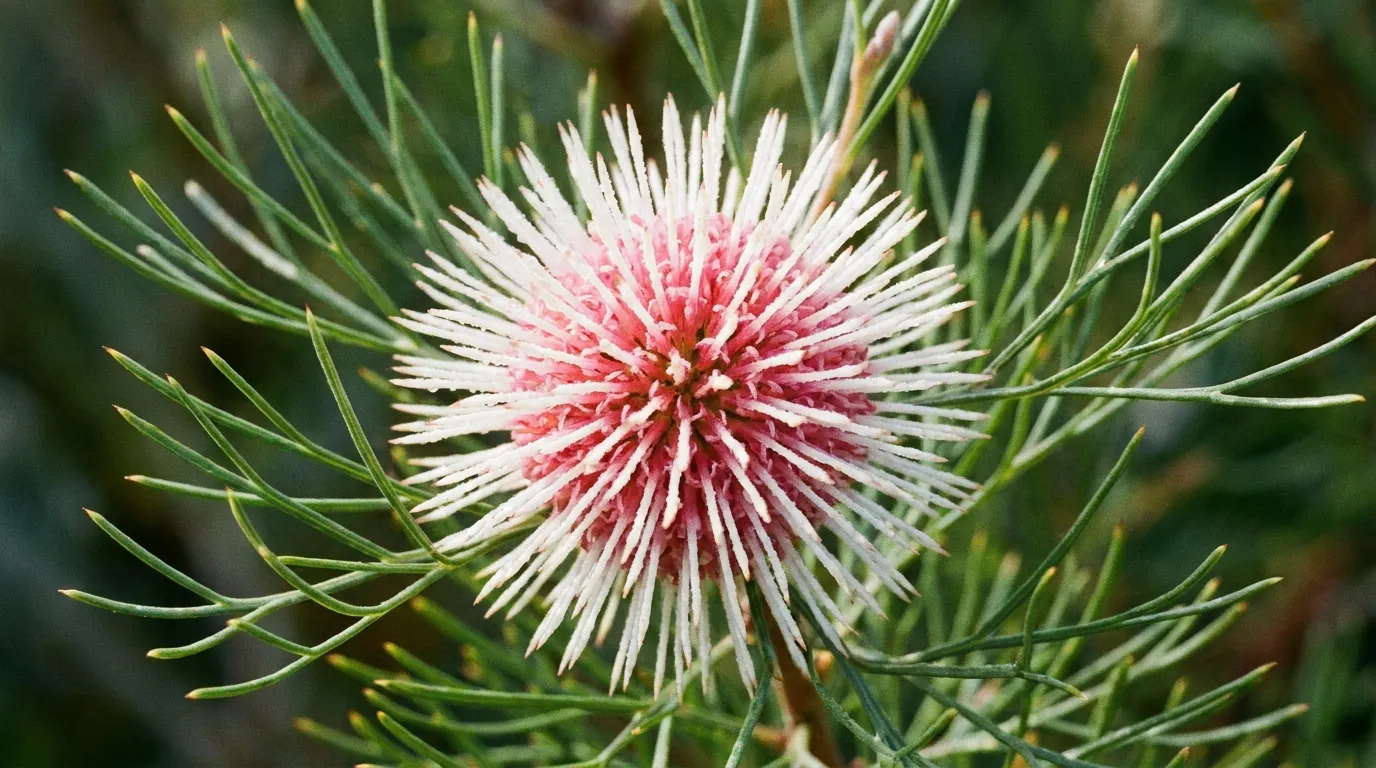
Mini Pini keeps the rounded pincushion-style flowers that make Hakea laurina distinctive. Gardening With Angus lists the cultivar’s flowering period as winter and records pink and white flower colouring.
The best quantified flower data available are for the parent species rather than the dwarf cultivar. Kings Park records ordinary Hakea laurina flower heads up to 5 cm across, appearing from late April until August. Those numbers are useful for understanding the species, but we would not relabel them as Mini Pini-specific measurements without cultivar-level evidence.
The wildlife value is better supported at cultivar level: Gardening With Angus lists Mini Pini as attracting bees and nectar-feeding birds. That makes it particularly useful in a small native garden where every plant needs to contribute more than foliage alone.
Sun gives Mini Pini its best chance to flower well
Gardening With Angus specifies a sunny position for Mini Pini. The species evidence points in the same direction. At the Australian National Botanic Gardens, full-sun Hakea laurina developed a more compact rounded head and flowered more strongly than long-established plants grown in light shade.
That matches what we look for in practice. If flowering is the reason for planting Mini Pini, we prioritise useful direct light and airflow rather than squeezing it into the darkest spare corner of a garden.
Some shade is not the same thing as failure—the full-sized species is listed for sun to part shade by Water Corporation WA—but Mini Pini’s strongest cultivar-specific light recommendation is sun.
Dry summer air suits it better than humid summer weather
This is one of the most valuable pieces of cultivar-specific information in the ranking set. Gardening With Angus states plainly that Mini Pini does not like summer humidity. The Garden Gurus likewise describes the dwarf Hakea as disliking summer-rainfall climates.
That changes how we would use the plant around Australia.
| Australian climate situation | How we would approach Mini Pini |
|---|---|
| Perth and other dry-summer Mediterranean-type gardens | A natural fit for the cultivar’s WA background, provided drainage is good |
| Adelaide and many temperate southern gardens | Worth considering in a sunny, freely drained position |
| Melbourne and cooler temperate gardens | Gardening With Angus lists Mini Pini for cool-temperate climates; prioritise sun and drainage |
| Sydney and warmer east-coast gardens | Site selection matters more; maximise airflow and avoid persistently wet soil during humid weather |
| Humid subtropical and tropical summer-rainfall areas | A more cautious choice because cultivar-specific sources flag summer humidity/rainfall as a weakness |
Those are climate interpretations based on the cultivar’s published warm-temperate/cool-temperate suitability and its humidity warning, not claims that the plant succeeds or fails at every address in a particular city. Microclimate still matters.
What about frost?
This is another place where it pays to separate species evidence from cultivar evidence.
Gardening With Angus leaves the Mini Pini frost-tolerance field blank, so there is no honest basis for publishing a precise cultivar frost temperature. For ordinary Hakea laurina, the SA Plant Selector lists moderate frost tolerance.
We treat that as useful background, not as a guaranteed Mini Pini rating. In a frost-prone garden, we would give a young Mini Pini a sunny, reasonably sheltered position and judge its response locally rather than quoting a made-up temperature threshold.
Good drainage is non-negotiable
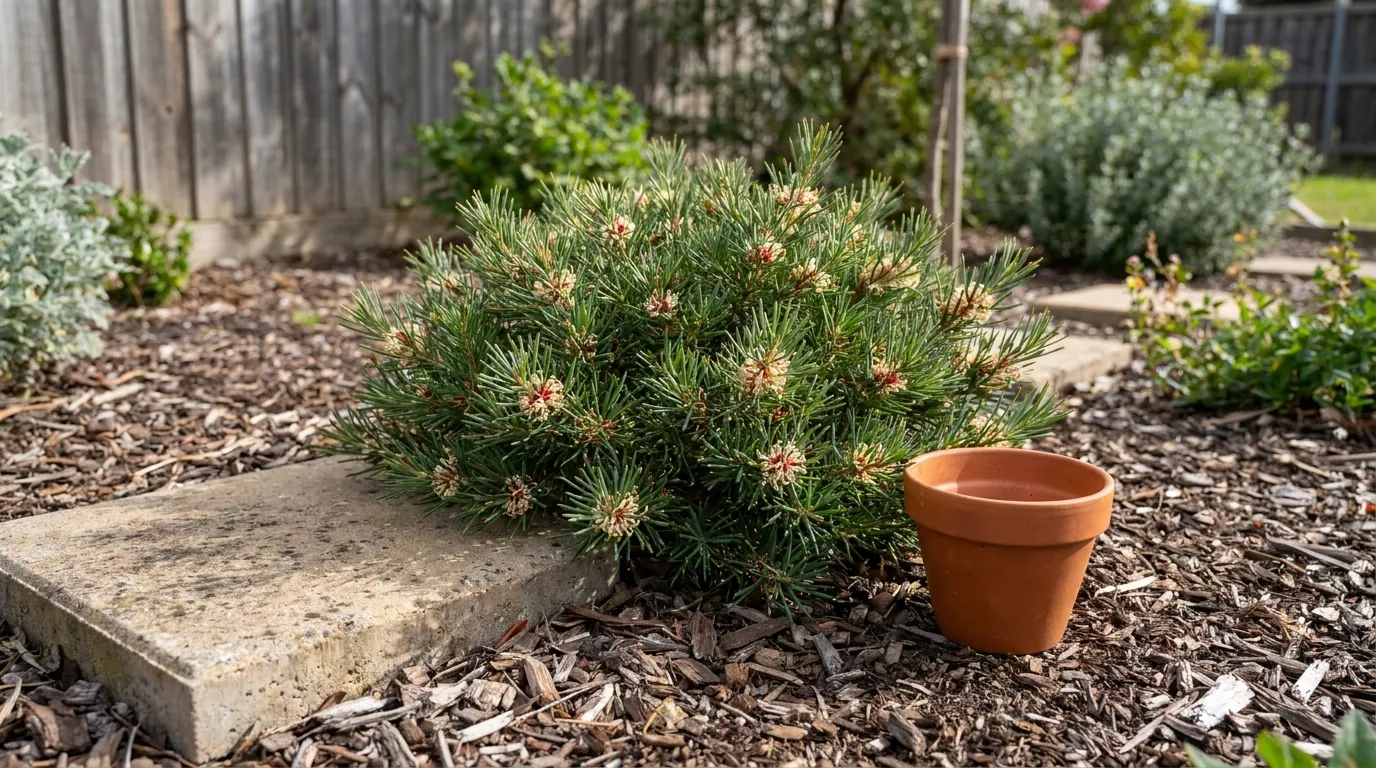
Gardening With Angus lists Mini Pini for sandy, loamy and sandy-loam soils, with acid to neutral pH and a well-drained root zone. Kings Park similarly describes the ordinary species as tolerant of a range of soils provided they drain well.
On jobs, this is the first physical thing we check. We are much more concerned by a site that stays saturated after rain than by soil that is simply not “rich”. Hakeas do not need a heavily improved vegetable-bed environment to perform.
Where clay holds water around the planting hole, we would rather improve the broader drainage or raise the planting position than dig a deep pocket that collects water around the roots.
Our Hakea laurina growing and landscaping guide covers the full-sized species in more detail.
The fertiliser rule is simple: keep phosphorus conservative
Hakeas belong to the Proteaceae family. Water Corporation WA warns that some Proteaceae can be damaged by phosphorus and advises caution when fertilising Hakea laurina. The South Australian Plant Selector goes further for the species, stating that Pincushion Hakea does not like phosphorus fertiliser.
For Mini Pini, we use a fertiliser formulated for phosphorus-sensitive Australian natives when feeding is genuinely needed, and we follow the product label rather than increasing the dose to chase faster growth.
In our experience, a plant struggling because the root zone is wet, shaded or poorly aerated does not improve because more fertiliser is added. Fix the site problem first.
A practical establishment routine
There is no reliable cultivar-specific “water every X days” schedule, and Australian conditions vary too much for one to be useful. We establish Mini Pini the same way we approach other small woody natives: wet the original root ball thoroughly at planting, then keep an eye on the soil while roots begin moving into the surrounding bed.
The parent species is described by Kings Park as drought tolerant once established. That is the end point, not the starting instruction. A new nursery plant still has a compact root system and needs establishment moisture.
For dry-summer climates, Gardening Australia’s WA-native feature makes another useful point: native plants are often easier to establish when planted through the cooler autumn/winter period rather than immediately before the harshest dry weather.
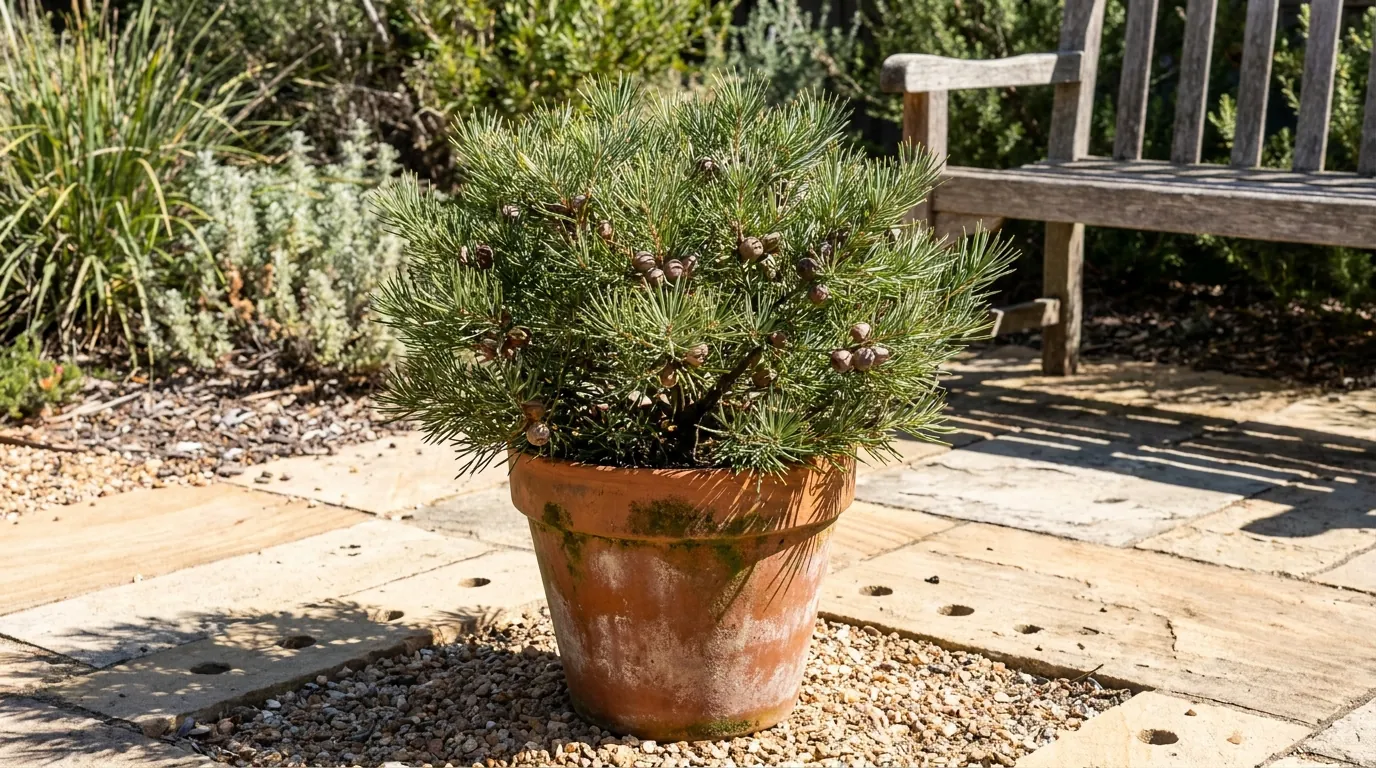
In a pot, the equation changes. Lullfitz specifically recommends Mini Pini for medium and small patio containers, but a pot has a much smaller moisture reserve than open ground. We check container plants more frequently during warm, windy weather and make sure drainage holes stay clear.
Mini Pini makes sense as a low hedge—but don’t invent the spacing
Gardening Australia calls Mini Pini a low-maintenance hedge, and Lullfitz places it in the small 1 m hedge category. That is strong support for the use.
What the stronger Australian sources do not give is an authoritative Mini Pini hedge-spacing number. One lower-quality ranking article recommends 1.5–2 m spacing while also describing dwarf Hakea at a much larger size than the better cultivar sources. We would not carry that figure into a Garden Green installation guide.
When we lay out a low native hedge, we work from the actual stock in front of us, the cultivar’s published mature width and the finish the client wants. A clipped continuous line, a loose flowering row and individual specimen mounds are three different layouts.
Until we have a reliable Mini Pini-specific spacing source—or our own documented installation measurements—we would rather explain the decision than publish a false centimetre-perfect rule.
Prune for shape, not to make the wrong plant fit
Mini Pini’s compact habit should reduce the amount of corrective pruning you need. For the ordinary species, the Australian National Botanic Gardens says moderate pruning and shaping can be carried out as required, while Water Corporation WA recommends pruning to maintain shape.
We apply that conservatively to the cultivar: tidy uneven shoots, maintain the line of an informal hedge and remove damaged material, but do not turn a naturally flowering native shrub into a plant that depends on constant hard clipping.
If a Mini Pini repeatedly needs severe pruning simply to stay inside its position, we would question the layout before blaming the plant.
Mini Pini or the full-sized Pincushion Hakea?
| What you need | Better fit | Why |
|---|---|---|
| Low native hedge around the 1 m scale | Mini Pini | Gardening Australia and Lullfitz specifically support this use |
| Small feature shrub | Mini Pini | Published cultivar height is below or around 1 m |
| Patio container | Mini Pini | Gardening With Angus and Lullfitz both support container growing |
| Multi-metre screen | Ordinary Hakea laurina | Australian sources put the species broadly in the 2–6 m height range depending on reference |
| Small tree or large background shrub | Ordinary Hakea laurina | Its natural scale suits that role |
For us, this is the clearest buying decision in the whole guide. Mini Pini is not simply a “smaller Hakea”. It is the version that lets you use the Pincushion Hakea look in the lower garden layer, a low hedge or a container without planning around a multi-metre canopy.
Frequently asked questions
How big does Hakea laurina ‘Mini Pini’ grow?
Gardening With Angus lists Mini Pini at 0.4–0.8 m high and 0.4–0.5 m wide. Gardening Australia and Water Corporation WA give a broader figure of about 1 m high, so it is best planned as a compact shrub in roughly the one-metre garden layer.
Is Mini Pini the same as ordinary Hakea laurina?
No. Mini Pini is a dwarf selection of Hakea laurina. Gardening Australia describes ordinary forms at 4–5 m high, while Kings Park records the species to 6 m; Mini Pini stays around or below the one-metre scale in cultivar-specific Australian sources.
Can Mini Pini be used as a hedge?
Yes. Gardening Australia specifically describes it as a low-maintenance hedge, and Lullfitz Nursery places Hakea laurina ‘Mini Pini’ in its small 1 m hedge category. Reliable cultivar-specific spacing figures are harder to verify, so spacing should be based on the actual stock and the finish you want.
Can Hakea Mini Pini grow in a pot?
Yes. Gardening With Angus lists Mini Pini for container growing, and Lullfitz Nursery includes it among plants suitable for medium and small patio pots. Use a freely draining native potting mix and remember that container moisture changes faster than moisture in open ground.
When does Mini Pini flower?
Gardening With Angus lists winter as the flowering period for Mini Pini. The parent species has a broader autumn-to-winter flowering period in Australian botanical references, but those species dates should not be treated as an exact cultivar schedule.
Does Mini Pini tolerate humid summers?
Humidity is one of the cultivar’s clearer limitations. Gardening With Angus says Mini Pini does not like summer humidity, while The Garden Gurus warns against summer-rainfall climates. In humid areas, prioritise airflow, sun and excellent drainage and avoid a persistently wet root zone.
Is Hakea Mini Pini frost tolerant?
There is no solid Mini Pini-specific frost temperature in the Australian sources reviewed. The full-sized species is listed as having moderate frost tolerance by the South Australian Plant Selector, but we would not turn that species rating into a guaranteed cultivar threshold. Use a sheltered position for young plants in frost-prone gardens.
What fertiliser should I use for Mini Pini?
Use a fertiliser formulated for phosphorus-sensitive Australian native plants when feeding is needed. Hakeas are Proteaceae, and Australian sources specifically warn that excess phosphorus can damage members of this family.


Where an I buy Mini Pini in Sth West WA. I live in Busselton