
Part of our complete guide: Devil’s Ivy (Pothos) care in Australia.
Pest control starts with identification and isolation, not with spraying. Work out what is actually on the leaf, separate the plant from the rest of your collection, then match the treatment to the pest. Reaching for a spray before you know what you are treating is how people damage the plant and leave the infestation running.
Devil’s Ivy is not a pest magnet. But indoors, with no predators and steady warmth, a small problem becomes a collection-wide problem fast — usually because it was misidentified, or because the plant was not isolated. This page covers five common pests and pest-like problems worth checking on Devil’s Ivy in Australian homes, and is honest about the limits of the home remedies people recommend. For the wider context, see our complete Devil’s Ivy care guide.
First Steps, Before Any Treatment
- Move the plant away from the others. First, not last. Many infestations are introduced on new plants or potting materials, particularly when a new plant joins the collection without being isolated first.
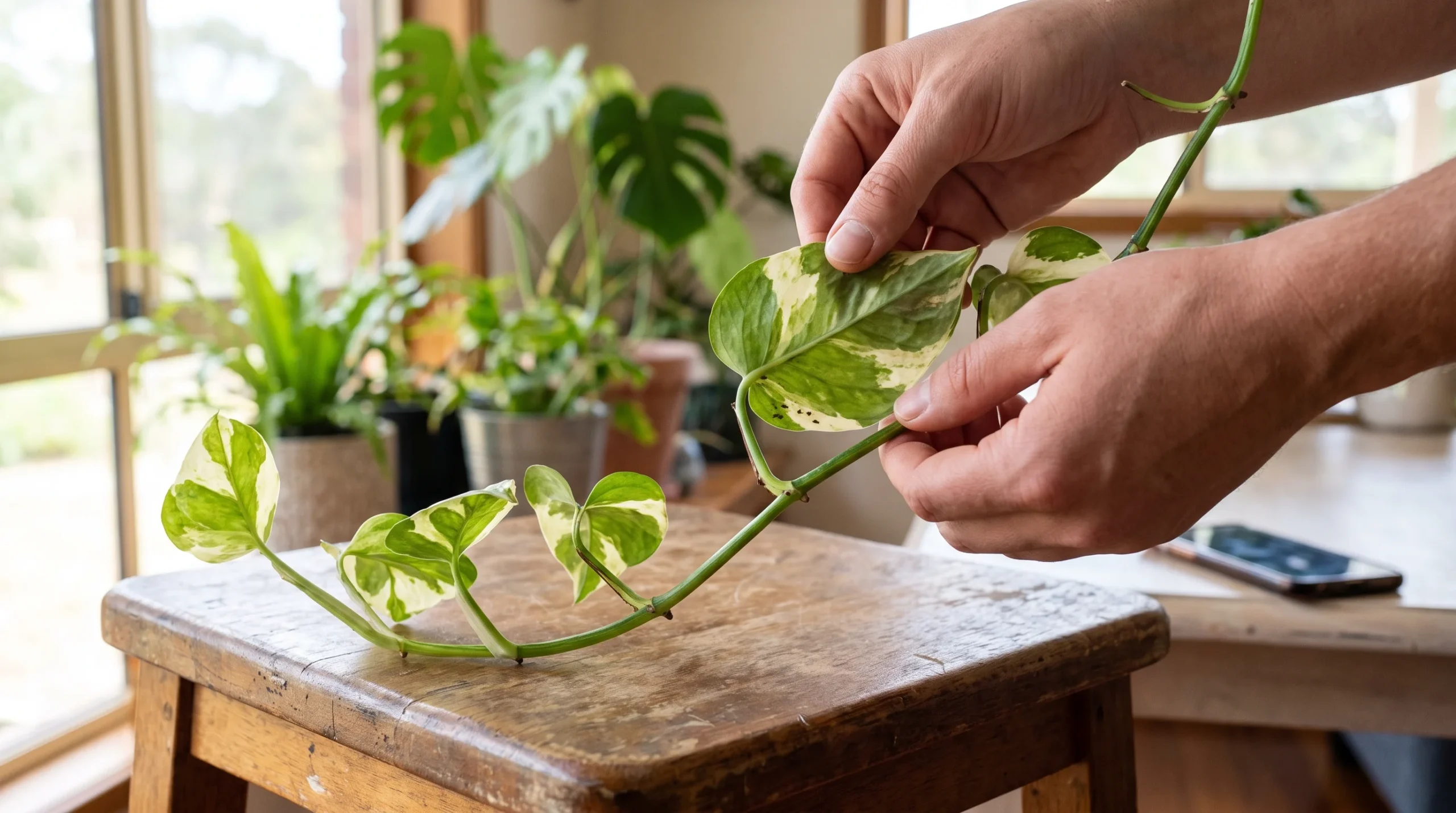
- Inspect properly. Turn leaves over. Check undersides, the nodes where leaf meets stem, and the newest growth — a top-down glance misses all three.
- Check the neighbours, including anything a trailing vine could reach.
- Wipe the shelf and nearby surfaces. Mealybug and scale crawlers travel short distances.
- Photograph the symptoms before treating, so you have something to compare against in a fortnight.
Identify What You Have
No single visual sign proves a diagnosis. Use the table to form a hypothesis, then confirm it on leaf undersides and new growth.
| Pest | What you may see | Common damage or sign |
|---|---|---|
| Mealybugs | White cotton-like clusters, often in nodes and leaf joins | Sticky residue, distorted new growth |
| Spider mites | Fine webbing; tiny moving specks on undersides | Stippled, dull or bronzed leaves |
| Scale | Fixed brown or tan bumps that do not move | Sticky honeydew, yellowing |
| Fungus gnats | Small dark flies around the mix surface | Larvae in the growing medium |
| Thrips | Slender insects; small black specks of frass | Silvery scarring, distorted new leaves |
Not all leaf damage is a pest. Yellowing from the base with no insects visible points to the roots — see yellow leaves and root rot. Damage confined to edges and tips is a different problem again: see brown crispy tips.
Pest by Pest
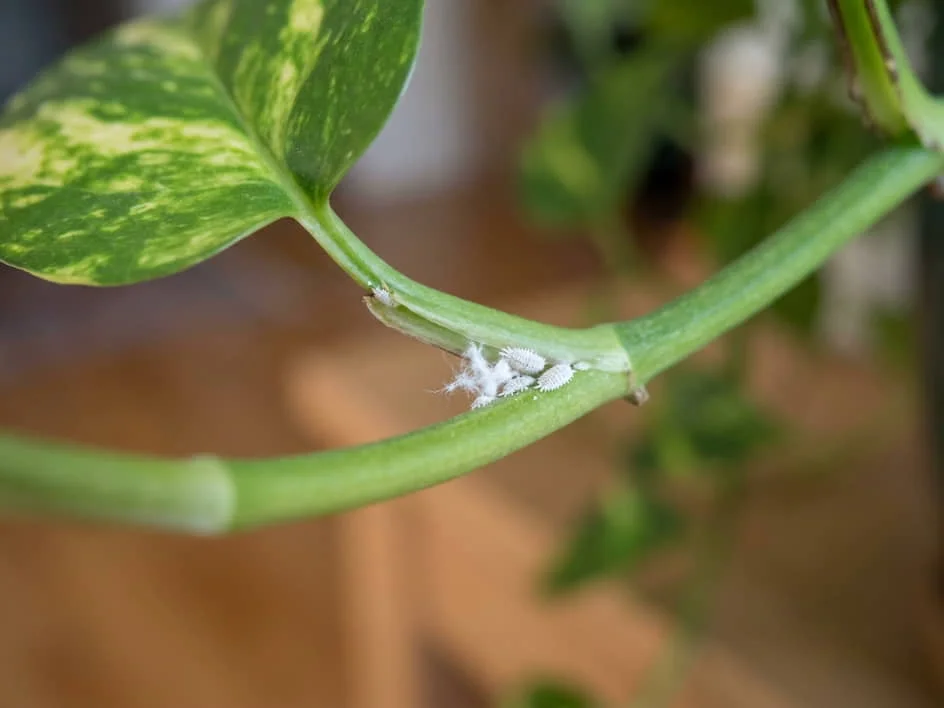
Treat: for light infestations, dab individual mealybugs with a cotton bud dipped in diluted isopropyl alcohol. Extension guidance is a solution of 70 per cent or less, patch-tested on a small area a day or two beforehand to check the plant does not burn.
Do not: saturate the foliage with alcohol. It works on contact only, has no residual action, and can damage leaves.
Repeat: yes. Eggs hatch over the following weeks, so one pass rarely finishes it.
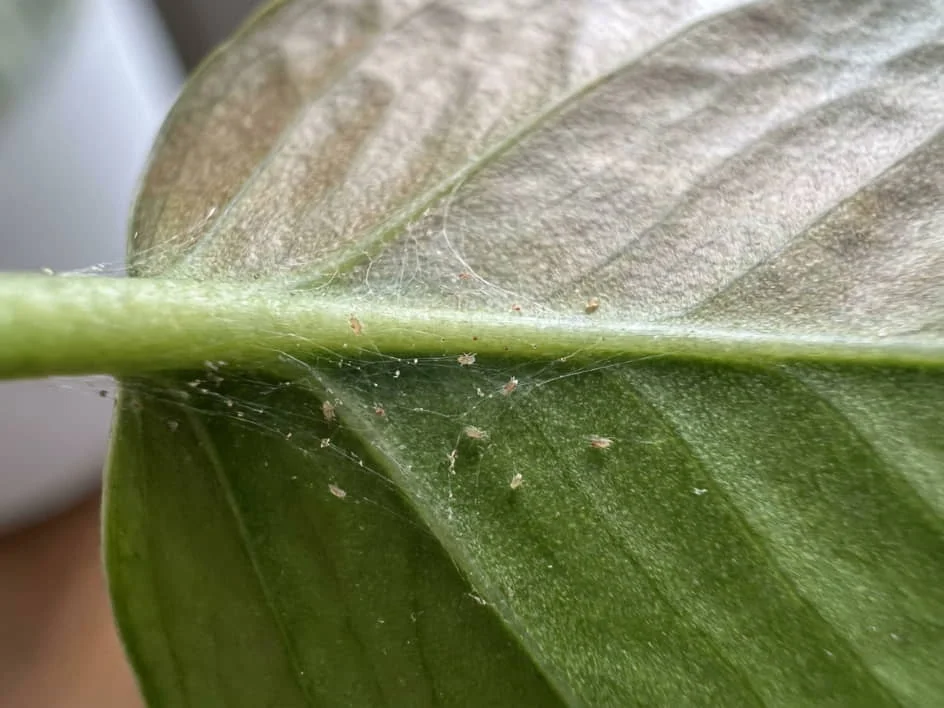
Treat: physical removal. Wash the plant thoroughly, undersides included, with a firm spray of water, repeated over several weeks. That is what actually drives populations down.
Do not: treat “raise the humidity” as the cure. Dry, warm conditions may favour mites, but increasing humidity alone will not clear an established infestation, and misting is not a reliable way to raise humidity anyway. Identification, washing and repeated monitoring are still required.
Repeat: yes — and keep checking well after you think it is over.
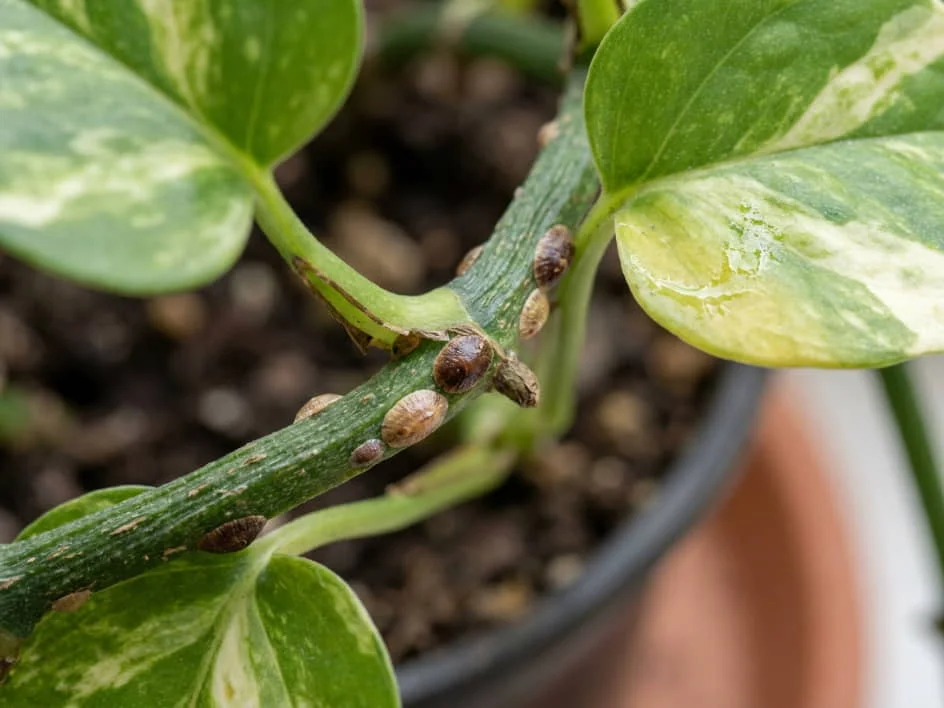
Treat: the adult bumps sit under a hard covering, which is why sprays often disappoint. Remove what you can see by wiping or scraping, and target the vulnerable crawler stage with a registered horticultural oil or insecticidal soap, used per its label.
Do not: assume the plant is clear because the bumps stopped multiplying. Dead scale stays stuck to the stem.
Repeat: yes. Scale is a persistence problem more than a product problem.
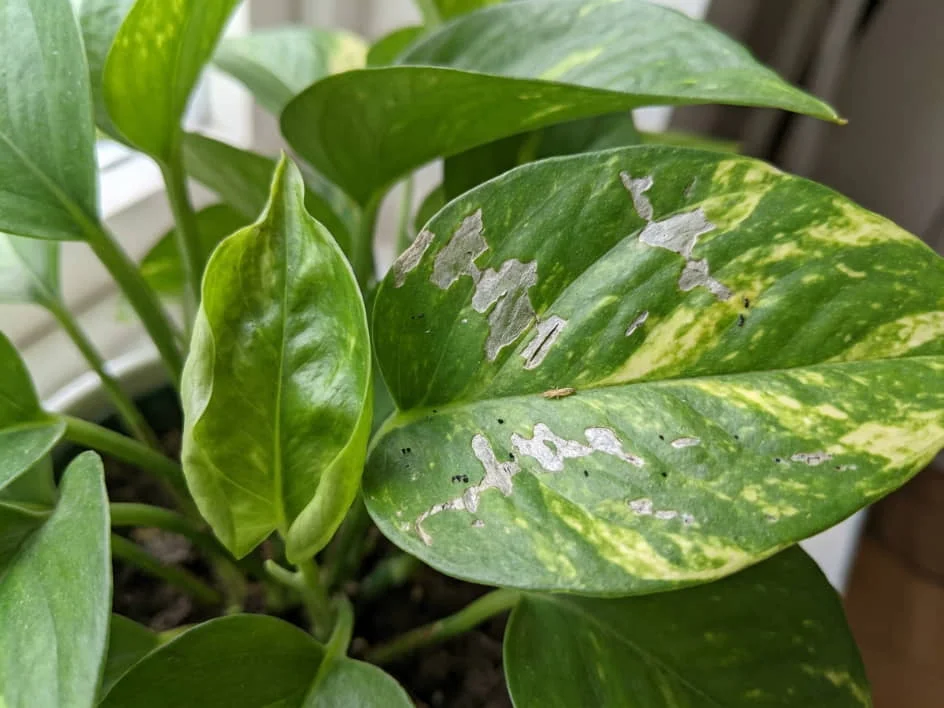
Treat: the damage — silvery scarring, distorted new leaves — is usually noticed before the insect. Isolate, remove badly affected leaves, use a registered product per its label, and monitor adults with sticky traps.
Do not: judge success by the old damaged leaves. They will not heal. Judge it by whether the new leaves come through clean.
Repeat: yes, and check nearby plants — thrips move.
These are a different kind of problem, and widely misdiagnosed. The adults flying around the pot are mostly a nuisance; the larvae live in the growing medium.
They do not always mean you are overwatering. Persistently moist mix favours them — but they also arrive in contaminated potting mix, which is not sterilised and can pick up gnats in transit or on the shelf. So “gnats, therefore overwatering” is not a safe inference, even though moisture management is part of the fix.
Treat: let the upper mix dry further between waterings where the plant tolerates it (see the watering guide), use yellow sticky traps to monitor and reduce adults, and if you treat the larvae, use a product registered in Australia for fungus gnats in potting mix.
Do not treat them like a sap-sucking leaf pest. Spraying foliage does nothing about larvae in the mix.
Treatment Safety
- Patch-test any soap, oil or alcohol treatment on a small area and wait a day or two before doing the whole plant.
- Follow the product label — it is the legal instruction, and it is specific to that product.
- Do not saturate leaves with rubbing alcohol. Spot treatment, not a drench.
- Do not mix household chemicals to invent a spray.
- Keep treatments away from children and pets. Devil’s Ivy is itself toxic if chewed.
- Do not treat in harsh sun or extreme heat — oils and soaps are far more likely to burn foliage, which matters through an Australian summer.
A Note on Neem in Australia
This is where overseas advice does not transfer, and it is worth getting right.
Neem oil itself is not registered as an insecticide in Australia. The APVMA has not registered neem oil products, citing concerns about impurities and the fact that the processing used to obtain the oil destroys most of its insecticidal activity.
What is registered are products based on azadirachtin, the extracted active constituent — Eco-Neem, for instance, is APVMA-registered for uses including two-spotted mite and aphids on ornamentals and fungus gnats in potting mix, in the home garden.
So the rule is not “neem is good” or “neem is bad”. It is: use a product registered in Australia for the pest you actually have, and follow its label. A bottle of raw neem oil is not the same thing as a registered azadirachtin insecticide.
When Disposal Is Reasonable
Most infestations on an otherwise healthy plant are worth treating. But the common line that disposal is hardly ever warranted is poor advice if you keep other plants. Disposal can be the sensible call when the infestation is severe and keeps returning after proper treatment; when many nearby plants are at risk and the infested plant is the reservoir; when there is little healthy growth left to save; or when the treatment burden simply exceeds what the plant is worth to you. Devil’s Ivy is inexpensive and easy to replace, and a badly infested specimen sitting in a collection is a source, not a patient. If you do dispose of one, bag it rather than shaking it out near the others.
Prevention
- Quarantine every new plant for a few weeks before it joins the others. Quarantining new plants for a few weeks can reduce the risk of spreading pests through the collection.
- Inspect new growth regularly — problems announce themselves there first.
- Avoid crowding. Touching foliage is a bridge.
- Clean secateurs and scissors between plants.
- Manage watering. Persistently wet mix favours fungus gnats and root problems alike.
- Watch plants near open windows or returning from outdoors — they may be more exposed to pests, so inspect them carefully.
- Isolate cuttings before adding them to a collection, including gifts from friends.
Frequently Asked Questions
Most likely mealybugs, especially if clustered in the nodes with sticky residue nearby. Confirm the insect before treating the symptom.
No. Ordinary spiders visit houseplants too. Mites are indicated by fine webbing on leaf undersides together with stippled, dull leaves and moving specks — not by webbing alone.
Adults are mainly a nuisance. Larvae feed on fungi and organic matter in the mix and can chew roots, which matters most for cuttings, seedlings and already-weak plants. On an established, healthy plant they are usually an irritation — but a signal worth reading.
Yes — as a diluted, patch-tested spot treatment on mealybugs. It kills on contact with no residual effect, so it does not protect the plant afterwards. Do not saturate the leaves.
In Australia the question is not whether neem is “safe” but whether the product is registered. Neem oil is not an APVMA-registered insecticide here; azadirachtin products are. Use a product registered for your pest and follow the label.
Follow the label of the product you are using — intervals differ, and a number borrowed from a different product is not guidance. As a principle, repeat treatment is normal: eggs hatch after the adults are killed.
It can help for a persistent fungus-gnat problem, since the larvae live in the medium and a contaminated bag may have been the source. It does nothing for mealybugs, mites, scale or thrips, which do not live in the mix.
Sources
- Australian Pesticides and Veterinary Medicines Authority (APVMA) — registration status of neem oil and azadirachtin products.
- University of Maryland Extension — mealybugs; diluted isopropyl alcohol and patch-testing for phytotoxicity.
- University of Minnesota Extension — spider mites; washing as the primary physical control.
- UC Statewide IPM Program — fungus gnats; larvae in the growing medium, moisture management, sticky-trap monitoring.
- University of Wisconsin Horticulture — potting mix as a source of infestation.
- Colorado State University Extension — houseplant pests, including scale and thrips.