
Why Is My Teddy Bear Magnolia Not Flowering? Age, Light, Pruning and Bud Problems

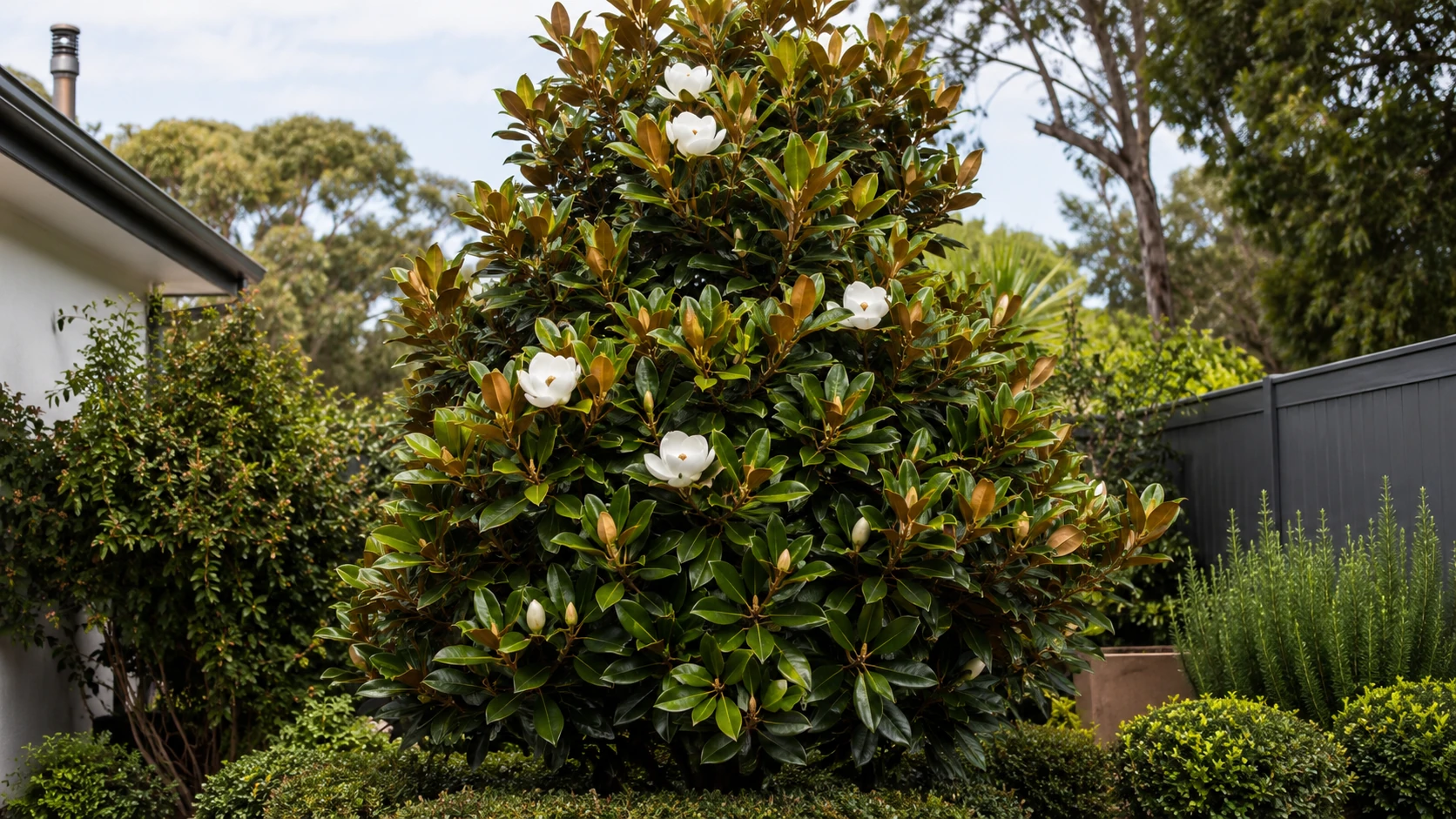
A Teddy Bear Magnolia can look healthy, grow new leaves and still refuse to flower. That does not automatically mean it needs fertiliser—or that anything is seriously wrong.
The most common explanations are simpler: the tree is still young, it has not settled after planting, it receives less direct light than expected, flower-bearing growth has been pruned away, or root stress is diverting energy from flowering.
The first step is to work out whether the tree is producing no buds at all, or whether buds form and then fail to open. Those are different problems and should not be treated in the same way.
Quick answer: Do not reach for a bloom booster first. Check the tree’s age and starting size, sunlight, planting history, soil moisture, drainage and pruning. A young or recently planted Teddy Bear Magnolia may need time, while a mature tree with healthy foliage but no buds often needs its light or pruning history reviewed.
🌸 How Long Does Teddy Bear Magnolia Take to Flower?
Teddy Bear is the trade name commonly associated with Magnolia grandiflora ‘Southern Charm’.
In the original US plant patent, the breeders reported that ‘Southern Charm’ began flowering during its third year of growth, compared with the first year for Little Gem. This is useful cultivar history, but it is not a guaranteed timetable for Australian gardens. The patent records breeder observations under its own nursery trial conditions, not an independent Australian landscape trial.
A tree’s labelled pot size also does not tell you exactly how old it is. Two plants sold at a similar height may have been propagated at different times, grown under different conditions or pruned into different shapes.
Once planted, flowering may also be delayed while the root system adjusts to a new site. A larger nursery specimen is not automatically closer to flowering if it has recently been moved or is struggling with circling roots, poor drainage or other establishment stress.
For a detailed size comparison, see our Teddy Bear vs Little Gem Magnolia guide.
🔍 First Check: Does the Tree Produce Flower Buds?
Look at the ends and upper sections of the branches.
No flower buds are forming
- a young or recently established tree
- insufficient sunlight
- repeated trimming
- vigorous leafy growth encouraged by excessive nitrogen
- continuing root-zone stress
- a tree putting energy into establishment rather than flowering
Buds form but turn brown, dry out or fall
- sudden heat, frost or drying wind
- irregular root-zone moisture
- recent transplant stress
- damaged or weakened shoots
- a localised branch-health problem
Do not reach for a bloom booster first. Check the tree’s age and starting size, sunlight, planting history, soil moisture, drainage and pruning.
Before changing its care, inspect the ends and upper sections of the branches.
No flower buds are forming
This points more towards:
- a young or recently established tree
- insufficient sunlight
- repeated trimming
- vigorous leafy growth encouraged by excessive nitrogen
- continuing root-zone stress
- a tree putting energy into establishment rather than flowering
Buds form but turn brown, dry out or fall
This points more towards:
- sudden heat, frost or drying wind
- irregular root-zone moisture
- recent transplant stress
- damaged or weakened shoots
- a localised branch-health problem
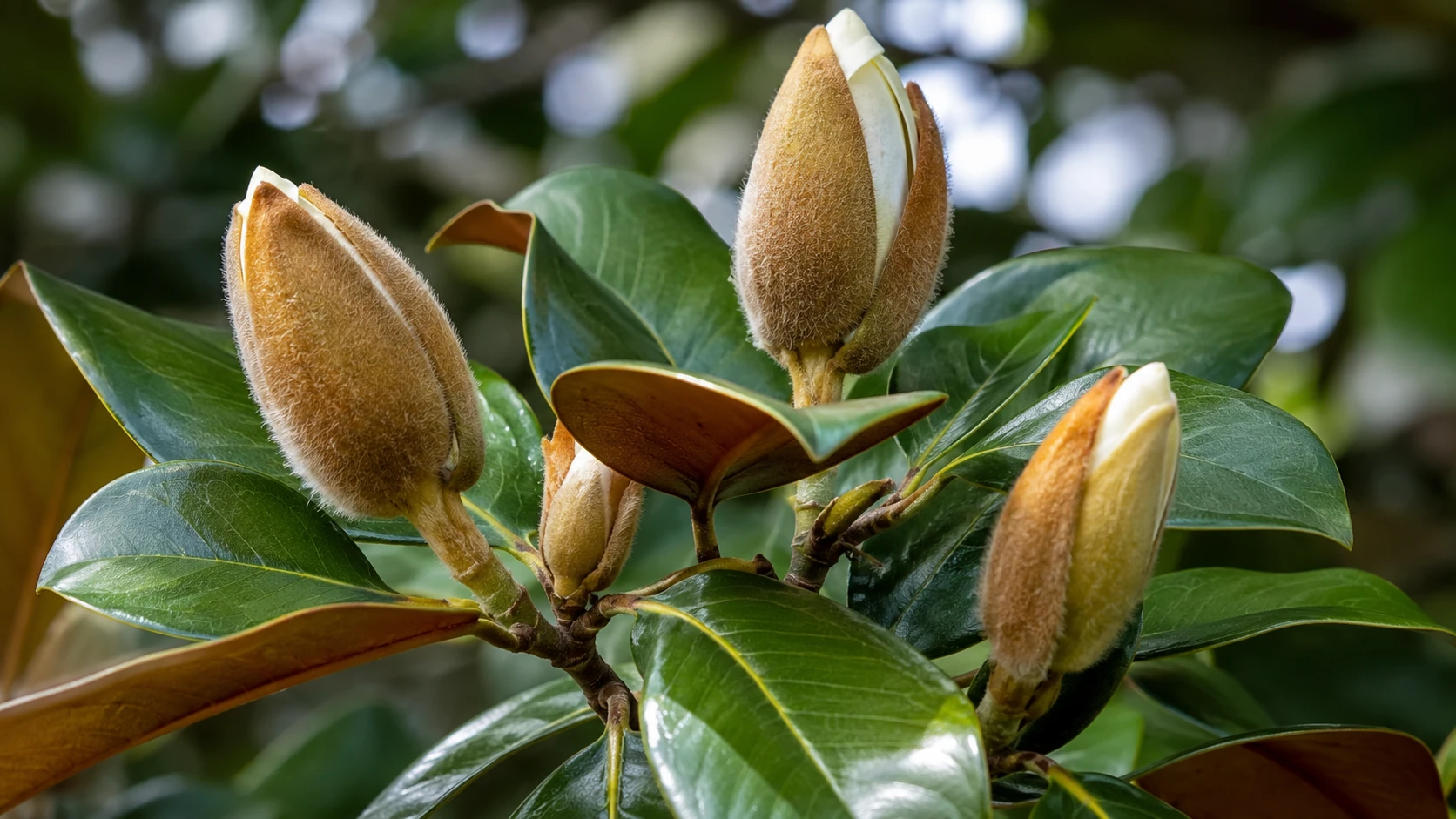
Magnolia flower buds can be affected by harsh weather, and a newly planted tree may take time to establish before flowering reliably. Evergreen Magnolia grandiflora also performs best for flowering in a warm, reasonably sunny position. (RHS)
Do not diagnose the cause from one fallen bud. Look at the whole tree, the soil and what happened in the weeks before the buds failed.
The Tree May Still Be Too Young
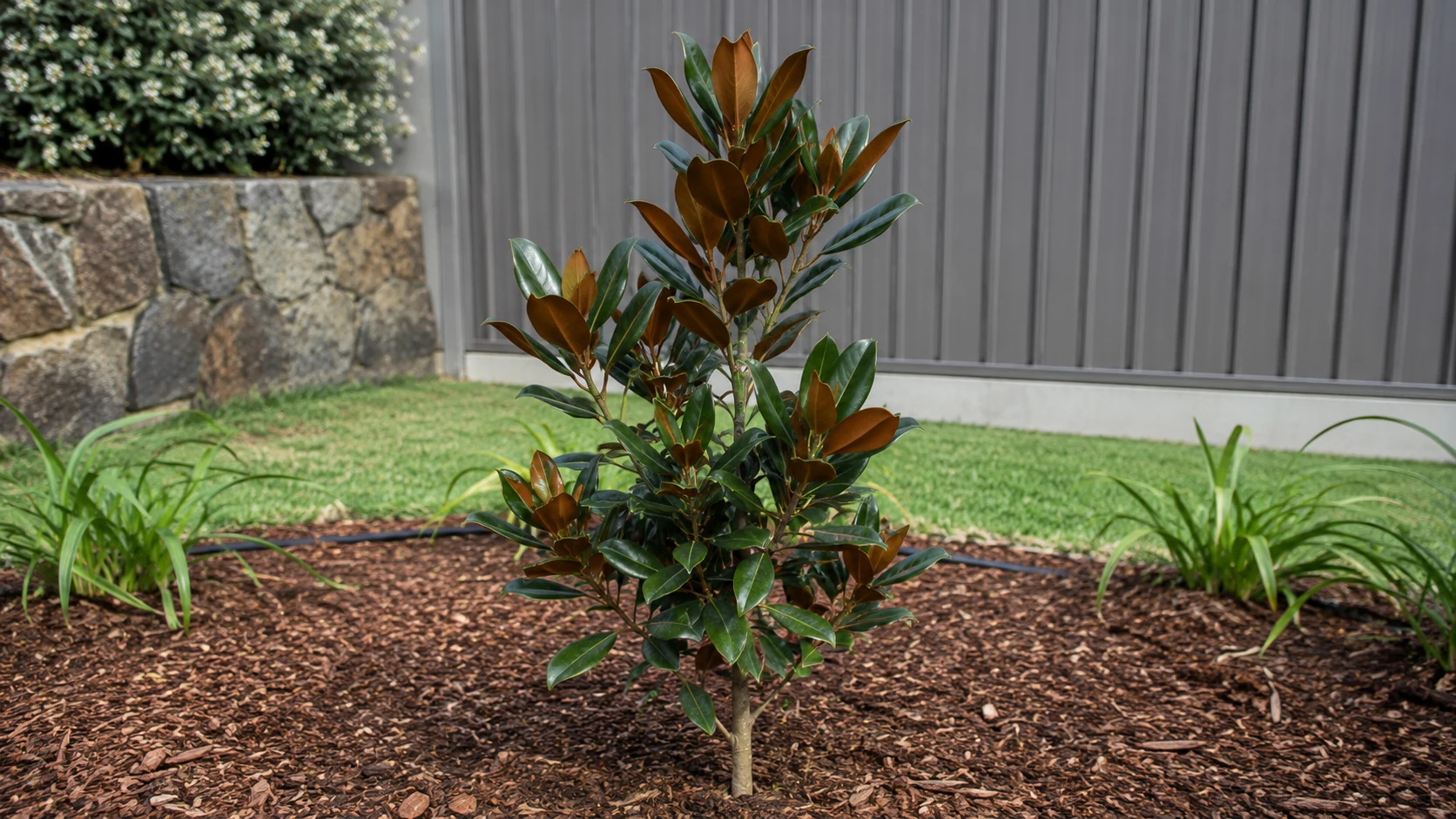
A Teddy Bear Magnolia can establish foliage and structure before producing a worthwhile flower display.
This is especially likely when:
- it was purchased as a small plant
- it has been in the ground for only a short time
- it was recently moved from a container
- it has spent its first seasons recovering from heat, wind or planting stress
- the root ball is not yet growing freely into the surrounding soil
Do not count only the years since planting. The tree’s propagation history, nursery age, starting size and establishment conditions all influence when flowering begins.
Healthy extension growth, firm green leaves and a gradually filling canopy are more encouraging than a calendar date. If the tree is steadily establishing, patience may be more useful than another product.
It May Not Be Receiving Enough Sunlight
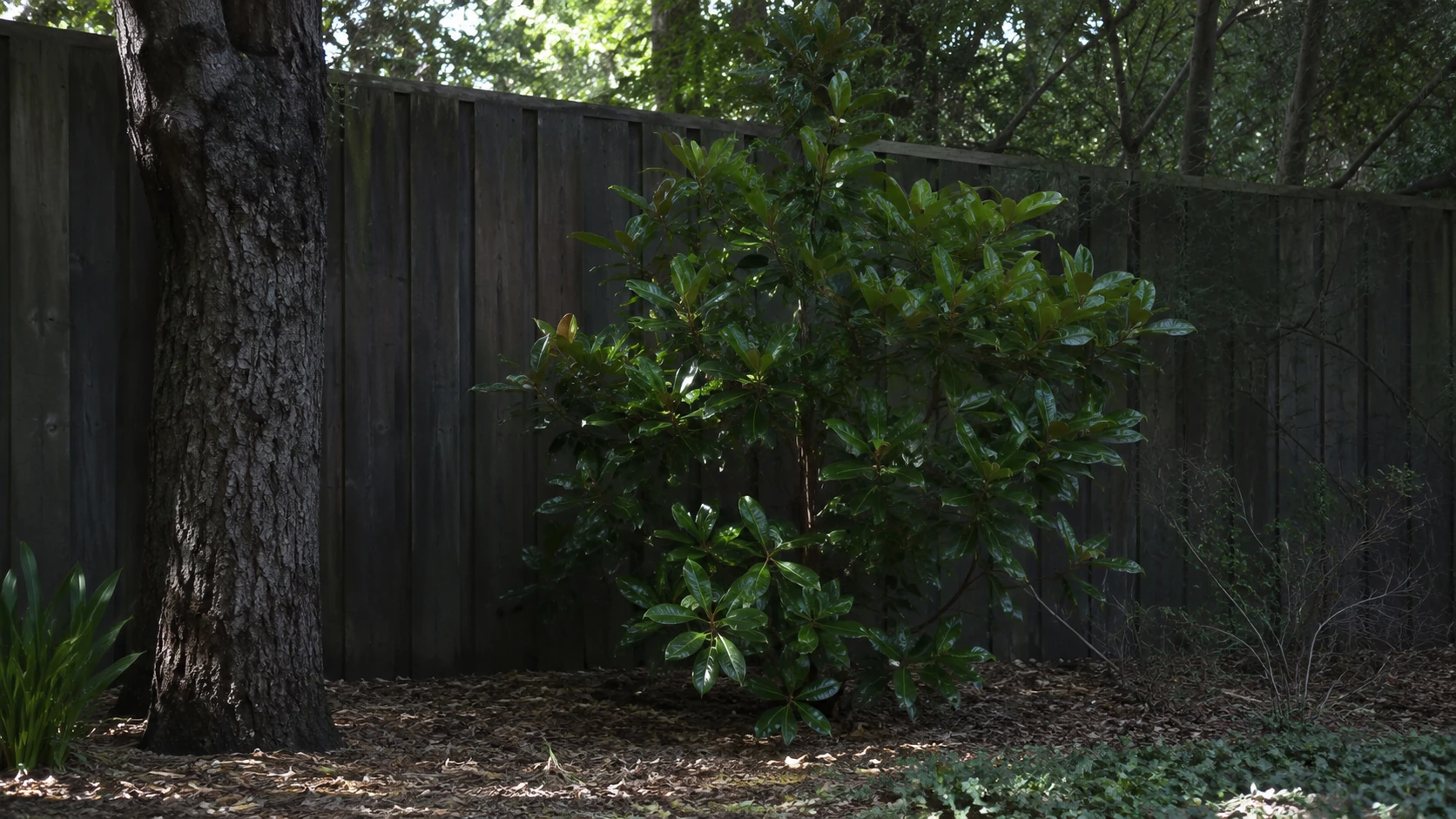
Teddy Bear can grow in some light shade, but surviving and flowering strongly are not the same thing.
A position that looked sunny when the tree was planted may now be shaded by:
- a growing hedge
- an adjacent tree
- a new fence or structure
- the house during part of the day
- its own increasingly dense canopy
- surrounding buildings in winter
Southern Magnolia is grown in full sun to part shade, but warm, sunny conditions support flowering, while deeper shade can produce a thinner plant with fewer blooms. (Missouri Botanical Garden)
Observe the site over a full day rather than judging it at midday. Also consider seasonal change: a spot receiving useful summer light may be shaded for much longer during cooler months.
Do not rush to transplant a settled tree simply because another position appears brighter. Moving an established Magnolia can create a larger problem. First determine whether nearby vegetation can be selectively managed without damaging either plant.
Root Stress Can Delay Flowering
Flowering is not the tree’s first priority when its root zone is under pressure.
Check for:
- soil that remains wet long after rain
- a planting hole acting like a sump
- a buried root flare
- mulch piled against the trunk
- compacted soil
- a root ball drying internally while surrounding soil appears wet
- circling roots in a long-term container
- recent disturbance from digging, paving or construction
Southern Magnolia prefers moist but well-drained soil and does not perform well at either wet or dry extremes. (Missouri Botanical Garden)
A waterlogged tree may still produce foliage for some time, but weak roots can reduce growth and flowering. The opposite can also happen: water may run around a dry nursery root ball without properly soaking it.
Check below the surface rather than watering by a fixed schedule.
Our Teddy Bear Magnolia planting and establishment guide explains how planting depth, drainage and the original root ball affect establishment.
Pruning May Be Removing Flowering Growth
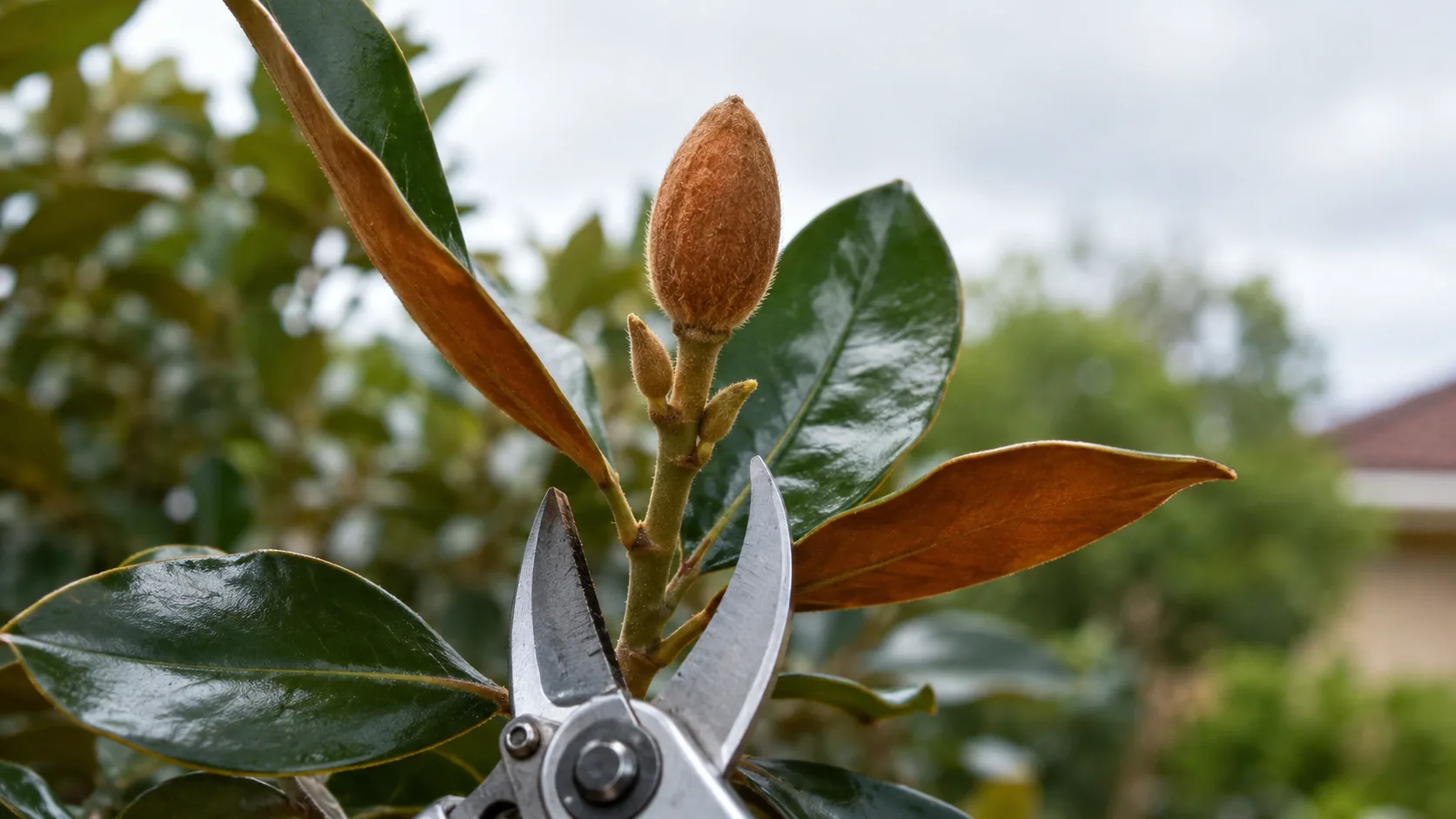
Teddy Bear Magnolia generally needs less pruning than a formal hedge, but it is often trimmed repeatedly to hold a compact shape.
That can reduce flowering when:
- branch tips are removed before their buds open
- the whole canopy is clipped into a tight outline
- pruning is repeated whenever new growth appears
- a large amount of foliage is removed at once
- hard pruning forces the tree to rebuild vegetative growth
Evergreen Magnolias usually require only limited pruning. The Royal Horticultural Society recommends keeping pruning modest and notes that hard pruning can inhibit flowering. It also advises delaying cuts where shoots are carrying flower buds. (RHS)
Before pruning, inspect the shoot tips. Flower buds are usually plumper and more rounded than narrow leafy buds.
For a tree grown as a screen, accept that maximum flowering and a tightly clipped surface may compete with each other. A light selective trim is different from repeatedly shearing every new shoot.
Too Much Nitrogen Can Produce Leaves Instead of Flowers
A dark green canopy does not always mean the tree is ready to flower.
Repeated high-nitrogen feeding can encourage soft leafy growth without solving the actual reason flowering is poor. It can also make new shoots more vulnerable to stress and some pests.
Do not fertilise simply because:
- the calendar says it is time
- the tree did not flower this season
- a product is labelled as a bloom booster
- neighbouring plants are being fed
- the leaves look green but flowers are absent
First inspect light, maturity, pruning, drainage and root health.
Feed only where growth, leaf condition, soil condition or a soil test suggests a genuine need. Fertiliser cannot correct deep shade, poor drainage, a buried root flare or repeated removal of flower-bearing shoots.
High-phosphorus “bloom” fertiliser should not be applied automatically. Poor flowering is not proof of phosphorus deficiency.
Flower Buds May Be Damaged Before Opening
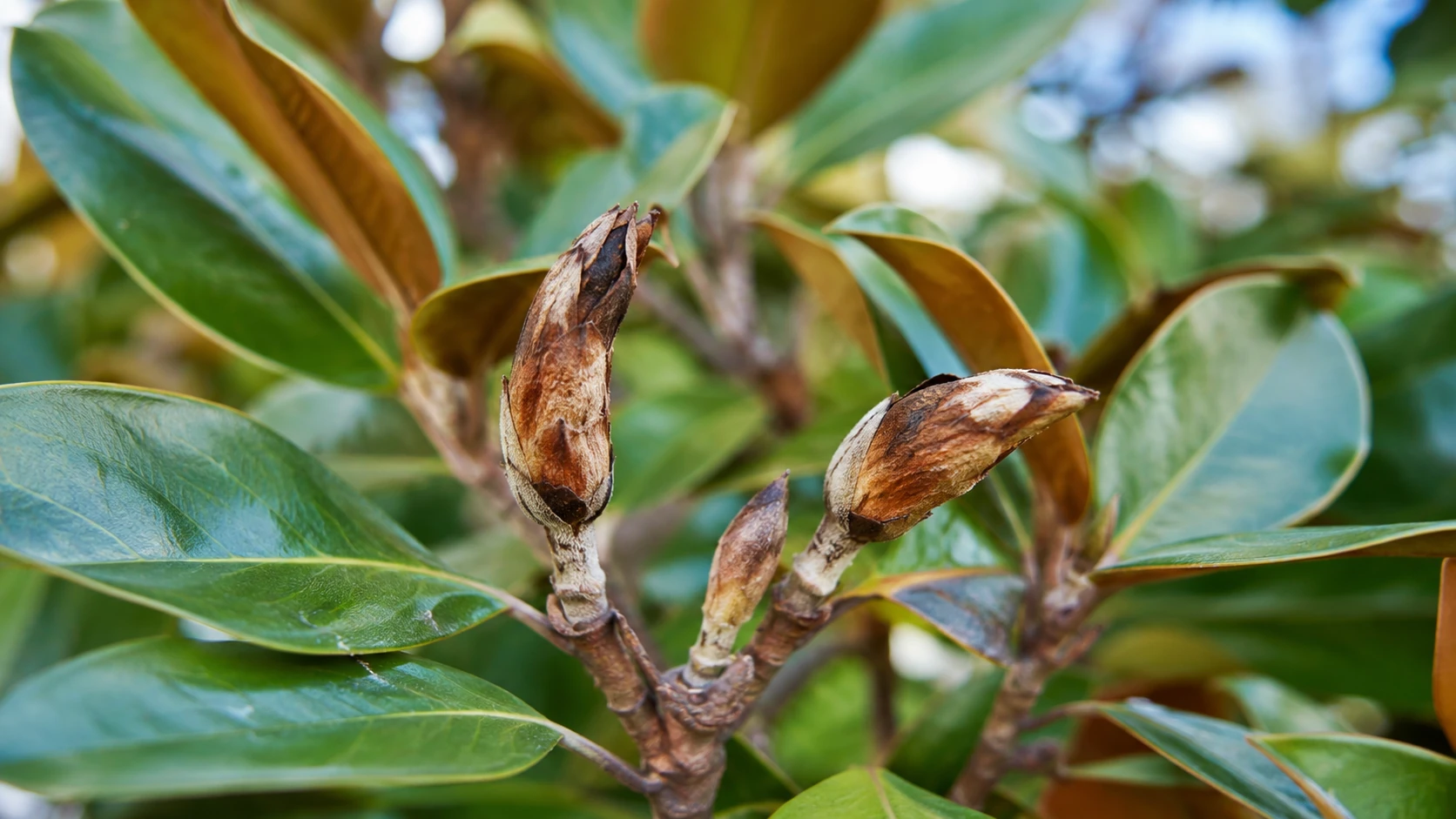
A Magnolia can form buds and still fail to produce a flower.
Possible clues include:
- buds turning brown after a cold night
- buds drying on the side exposed to hot wind
- bud failure after an extended dry period
- several buds failing after the root zone remained saturated
- damage limited to one branch rather than the whole canopy
Frost can brown Magnolia buds and flowers, while poor growing conditions can also interfere with flowering. (RHS)
In warmer Australian locations, reflected heat and dry wind may be more relevant than frost. A tree beside paving, a west-facing wall or an exposed boundary can experience much harsher conditions than the general weather report suggests.
Do not remove every closed bud immediately. Check whether it is firm and alive before assuming it has failed.
Teddy Bear Magnolia Does Not Flower Like a Deciduous Magnolia
Some gardeners expect the whole canopy to be covered in flowers at once.
That is not usually how evergreen Magnolia grandiflora flowers. It tends to produce large individual blooms intermittently through its flowering period rather than one complete spring display. (Missouri Botanical Garden)
This means:
- one flower may finish before another opens
- blooms can be hidden within dense foliage
- flowers high in the canopy may be missed from ground level
- the first flush may be stronger than later flowers
- a young tree may produce only a small number at first
Look through the canopy from more than one side before deciding that the tree has not flowered at all.
📋 Quick Diagnostic Table
| What you can see | What it may suggest | What to inspect next |
|---|---|---|
| Healthy foliage but no flower buds | Immaturity, shade or repeated trimming | Tree history, daily sunlight and pruning |
| Very vigorous soft green shoots | Excess nitrogen or strong vegetative growth | Recent feeding and soil condition |
| Buds form but turn brown | Weather exposure or root stress | Recent frost, heat, wind and soil moisture |
| Buds disappear after trimming | Flower-bearing shoot tips may have been removed | Pruning timing and method |
| Recently planted tree with no flowers | Establishment may still be the priority | Root ball moisture, drainage and planting depth |
| Yellow leaves with poor flowering | Root stress, drainage or soil-pH issue | Moisture pattern, drainage, leaf pattern and soil pH |
| A few scattered flowers only | May be normal for an evergreen Magnolia | Check the entire canopy over time |
| One branch stops budding | Local branch damage or disease | Bark injury, dieback and branch health |
For yellow leaves, branch decline or root problems, use our Teddy Bear Magnolia problems and fixes guide rather than treating poor flowering in isolation.
✅ What to Do Before the Next Flowering Period
Record what the tree is doing
Take clear photographs of:
- branch tips
- possible flower buds
- the whole canopy
- yellow or damaged leaves
- the trunk base
- the surrounding soil
This makes it easier to tell whether the tree is improving and whether buds are forming before they disappear.
Check the light across the day
Observe where shadows fall in the morning, middle of the day and afternoon. Do this again when the season changes if nearby buildings or evergreen trees affect the site.
Check the root zone
Inspect whether the root flare is visible and whether water drains away. Check the original root ball as well as the surrounding soil because they may hold moisture differently.
Pause unnecessary feeding
Do not add another fertiliser simply because the first one did not produce flowers. Repeated feeding can confuse the diagnosis and encourage more leafy growth.
Avoid routine clipping
Leave healthy shoot tips intact unless there is a clear reason to prune. Remove dead or damaged wood when it can be identified safely, but do not reshape the entire tree while investigating a flowering problem.
Give a recently planted tree time
A tree establishing well may simply need to complete more root and canopy growth. The Teddy Bear Magnolia size and growth guide explains why growth rates and nursery estimates vary.
⚠️ When the Lack of Flowers May Signal a Larger Problem
Poor flowering deserves closer investigation when it appears alongside:
- continuing branch dieback
- loose or unstable root ball
- persistent waterlogging
- severe interveinal yellowing
- a buried or damaged trunk base
- large areas of scorched foliage
- sudden decline after the tree previously flowered well
- bark damage or sap movement on one branch
- very little new growth over more than one active season
In those cases, the flowers are not the main problem. Diagnose the tree’s health and root environment first.
For a large or structurally important specimen, an experienced arborist may be more useful than adding another fertiliser or treatment.
💬 Frequently Asked Questions
❓ How many years does a Teddy Bear Magnolia take to flower?
The original US plant patent reports that ‘Southern Charm’, sold under the Teddy Bear trade name, began flowering during its third year of growth in the breeder’s trials. That is not a guaranteed timetable for Australian gardens. Starting size, propagation, sunlight, establishment, pruning and local conditions can all change when flowering begins.
❓ Does Teddy Bear Magnolia need full sun to flower?
It can grow in full sun or some light shade, but a warm position with useful direct sunlight generally supports stronger flowering. A tree in deeper shade may remain alive and leafy while producing fewer blooms.
❓ Will fertiliser make my Teddy Bear Magnolia flower?
Not necessarily. Lack of flowers does not prove a nutrient deficiency. Check maturity, sunlight, pruning, drainage and root health before feeding. Do not apply a bloom fertiliser automatically.
❓ Can pruning stop a Teddy Bear Magnolia from flowering?
Yes. Repeated clipping or removing shoot tips carrying buds can reduce flowering. Evergreen Magnolias usually need only limited pruning, and healthy bud-bearing shoots should not be removed without a clear reason.
❓ Why do Magnolia flower buds turn brown before opening?
Buds may be damaged by frost, intense heat, dry wind, irregular moisture or root stress. Inspect the whole tree and recent site conditions rather than assuming one cause from a single brown bud.
❓ Does Teddy Bear Magnolia need another Magnolia nearby to flower?
No second tree is required for it to produce flowers. Pollination becomes relevant after flowers open and affects successful seed formation, not whether the tree develops flower buds. Southern Magnolia flowers contain both male and female reproductive structures. (US Forest Service)
❓ Why does my Teddy Bear Magnolia produce only a few flowers at a time?
Evergreen Magnolia grandiflora usually flowers sporadically rather than covering the entire canopy at once. A few large flowers may open at different times, and some can be hidden inside dense foliage.
Final Thoughts
A Teddy Bear Magnolia that is not flowering does not automatically need more fertiliser.
First decide whether it is still young, newly planted, shaded, repeatedly clipped or dealing with root-zone stress. Then look for the difference between no buds forming and buds forming but failing.
That distinction usually tells you more than the calendar does.
A healthy young tree may simply need time. A mature tree producing vigorous leaves but no buds needs its sunlight, pruning and feeding history reviewed. A tree with failing buds, yellow leaves or branch decline needs its growing conditions investigated before flowering becomes the priority.