
When and How to Prune Teddy Bear Magnolia in Australia

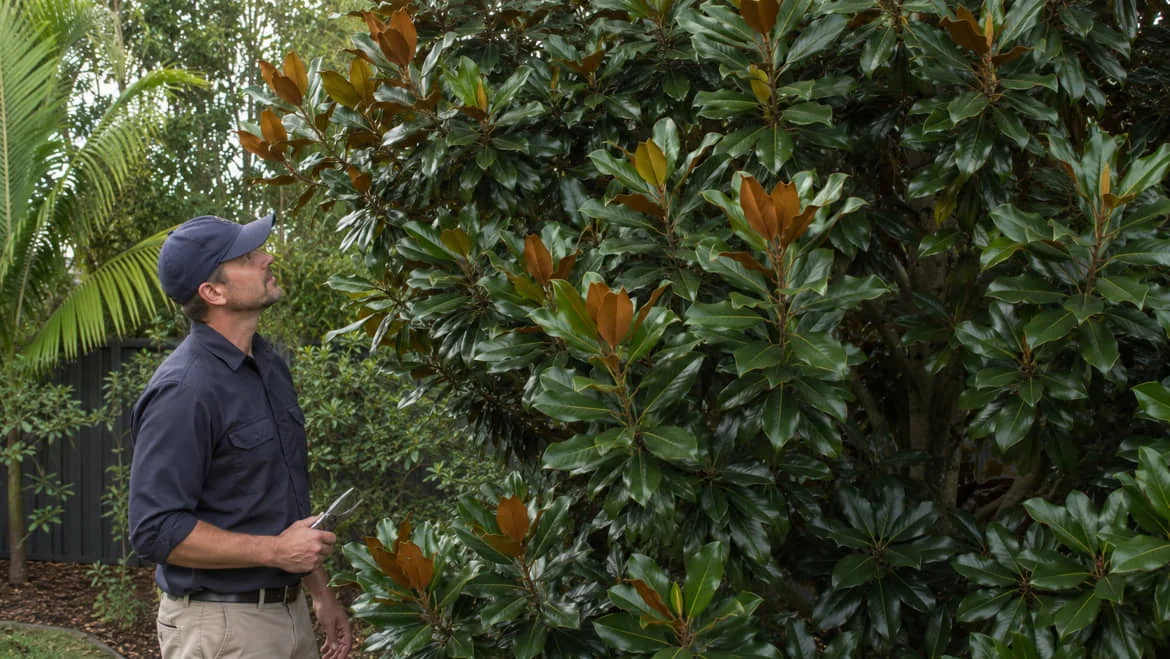
A Teddy Bear Magnolia rarely needs regular hard pruning.
Its naturally dense, rounded habit is one of the reasons Australians choose it for front gardens, courtyards, screens and compact feature planting. Most trees need only occasional corrective work: removing dead or damaged growth, preventing branches from rubbing, keeping access clear, or making small adjustments while the plant is young.
The biggest pruning mistake is treating it like a fast-growing hedge and repeatedly cutting every new shoot back to the same outline. That can remove developing flower buds, expose previously shaded bark, create dense regrowth and gradually replace the Magnolia’s natural form with a clipped shell.
Quick answer: For ordinary shaping, inspect the tree around or after its main flowering flush and prune lightly during mild growing conditions. Dead, broken or hazardous branches should be dealt with when safety requires it. Avoid hard pruning during heatwaves, severe drought, frost-prone conditions, waterlogging or active transplant stress.
The right question is not simply, “What month should I prune?”
It is:
Why does this branch need to be cut, and what will be left after I remove it?
First Decide Whether Pruning Is Actually Needed
Teddy Bear Magnolia is a compact selection of Magnolia grandiflora and normally forms a dense, upright-to-rounded canopy without frequent intervention.
Pruning is justified when it solves a specific problem.
Good reasons to prune
Consider pruning when you need to:
remove dead, split or storm-damaged branches
remove a branch with a confirmed localised problem
stop two branches rubbing together
correct a weak or awkward branch while the tree is young
provide modest clearance from a path, gate or building
gradually expose a short section of trunk
reduce a shoot that is growing strongly outside the natural canopy
correct earlier poor pruning
maintain a lightly shaped screen without repeatedly shearing every tip
Weak reasons to prune
Think twice when the reason is:
the calendar says it is “pruning season”
the tree has produced normal uneven new growth
bronze leaf undersides make the canopy look brown
a few old leaves are dropping
you want to force more flowers
you want a mature tree to remain permanently at nursery size
the tree is stressed and you hope cutting will “balance” it
a fertiliser or pruning package recommends annual trimming
A healthy Teddy Bear Magnolia does not need branches removed simply to prove that it is being maintained.
Quick Pruning Decision Table
| What you want to achieve | Is pruning justified? | Best approach | Main risk | Check before cutting |
|---|---|---|---|---|
| Remove a dead or broken branch | Usually yes | Remove back to a suitable branch union or just outside the branch collar | Tearing bark or cutting into living trunk tissue | Confirm where dead wood ends and whether the branch can fall safely |
| Preserve flowering | Usually minimal pruning | Wait until visible flowers and buds have been assessed; remove only necessary growth | Cutting off plump terminal flower buds | Inspect shoot tips before every cut |
| Improve shape on a young tree | Sometimes | Use a small number of selective thinning or reduction cuts | Creating a rigid or unnatural outline | View the tree from several directions first |
| Keep a mature tree much smaller | Often not realistic | Seek an arborist assessment or reconsider the available space | Repeated topping, weak regrowth and large wounds | Compare the tree’s mature size with the site |
| Lift lower branches | Sometimes | Remove gradually, beginning with genuinely obstructive branches | Exposing trunk and bark too suddenly | Check shade, privacy and screening value before removal |
| Make a hedge neater | Sometimes | Lightly shorten selected protruding shoots | Repeatedly removing flower-bearing tips | Check whether a softer natural screen would work |
| Correct crossing or rubbing branches | Usually yes while young | Retain the better-positioned branch and remove the competing one | Removing too much foliage from one area | Check which branch has the stronger attachment and direction |
| Help a stressed or recently planted tree | Usually no immediate shaping | Diagnose moisture, roots, drainage and establishment first | Adding wounds to an already stressed tree | Check root-ball moisture and recent growth |
| Remove a large structural branch | Professional assessment advised | Use a qualified arborist | Personal injury, structural imbalance and decay | Check branch size, height, targets and attachment |
When Is the Best Time to Prune in Australia?
Australian nursery and gardening advice is inconsistent. Some sources recommend late winter or early spring, while others advise pruning after flowering.
That contradiction exists because different writers are answering different questions:
winter or early-spring advice often relates to structural visibility or pruning before a growth flush
after-flowering advice prioritises preserving the current display and avoiding obvious flower buds
deadwood and storm damage follow safety needs rather than a flowering calendar
Australia has several climates, so one national month cannot describe every garden
For Teddy Bear Magnolia, timing should follow the type of pruning.
Light shaping
For light shaping, a practical window is after you have assessed the main flowering flush and while the tree is actively growing under mild conditions.
This approach lets you:
see which shoot tips carried flowers
avoid removing unopened, plump flower buds blindly
evaluate the canopy after its main display
make small cuts while the tree is not under severe weather stress
Teddy Bear Magnolia can flower in flushes through the warmer part of the year, so “after flowering” may not mean waiting until every possible bloom has finished. It means choosing a sensible point after the main display when the benefit of shaping outweighs the loss of a few later buds.
Dead, broken or hazardous growth
Dead or broken branches do not need to remain attached merely because the tree is flowering.
Remove small, accessible deadwood when:
you can clearly identify the dead section
conditions are safe
the tree is not being subjected to unnecessary additional pruning
the branch can be removed without tearing bark or damaging nearby growth
Large, hanging, split or storm-damaged branches require an arborist rather than a calendar.
Conditions when pruning should wait
Postpone non-urgent pruning when the tree is experiencing:
extreme heat
hot, drying wind
severe drought stress
waterlogged soil and root decline
recent transplant shock
active widespread branch dieback
expected frost or cold injury
unexplained canopy thinning
major construction or root disturbance
Pruning does not correct the cause of those problems. It adds another demand for wound closure and canopy rebuilding.
Will Pruning Reduce Teddy Bear Magnolia Flowers?
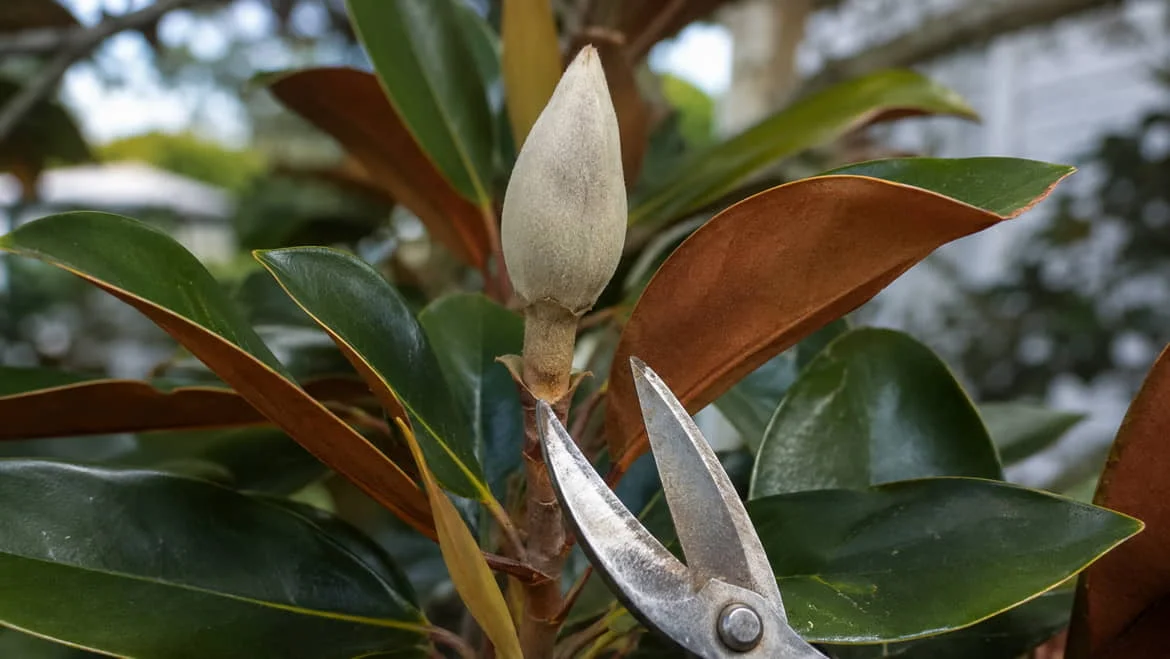
It can.
Teddy Bear Magnolia produces conspicuous flower buds near shoot tips. Removing those tips before the buds open removes the flowers attached to them.
Flowering may be reduced when:
the whole canopy is clipped into a tight outline
every outward shoot is shortened
pruning is repeated whenever fresh growth appears
visible plump terminal buds are cut off
large amounts of canopy are removed
hard pruning forces the tree to rebuild leafy growth
lower and outer flowering branches are removed to create a bare trunk
Before pruning, compare flower buds with leaf buds.
Flower buds are generally fuller, rounder and more substantial than narrow vegetative buds. Inspect several shoots rather than assuming every terminal bud is the same.
Our guide to why Teddy Bear Magnolia may not be flowering explains the difference between no flower buds forming and buds forming but failing.
Shaping Is Different From Shearing
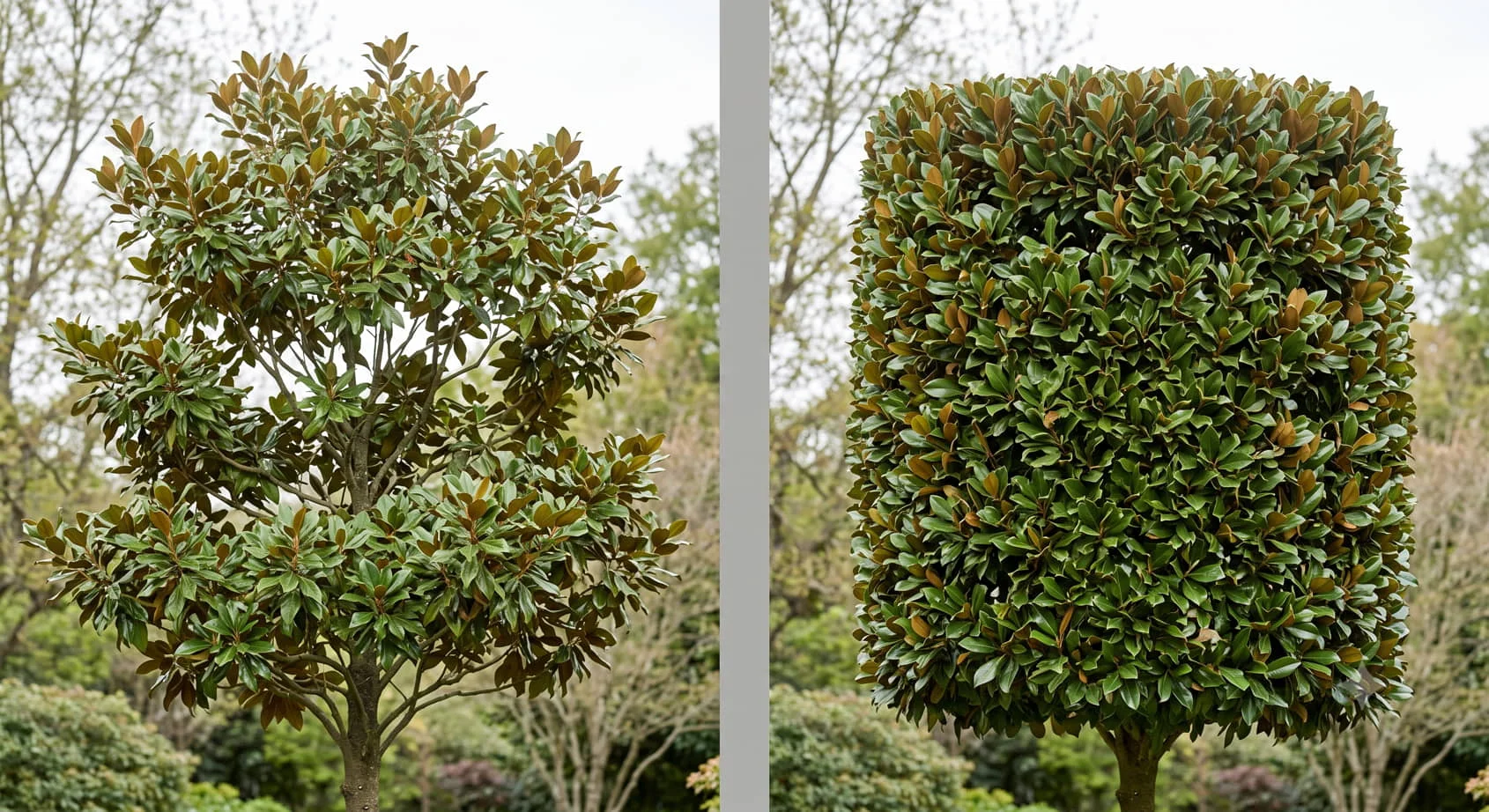
Selective shaping removes individual branches or shoots for a reason.
Shearing cuts everything that extends beyond an imposed surface.
Selective shaping
Selective shaping preserves the layered structure of the canopy.
A gardener might:
remove one badly directed shoot
shorten one overextended branch to a suitable side branch
remove one of two rubbing branches
correct a lopsided young tree gradually
retain flower-bearing tips wherever possible
The finished tree should still look like a Magnolia rather than a clipped box.
Repeated shearing
Repeated shearing can create:
dense twiggy growth near the outside
shaded or sparse growth inside
many cut leaf edges
repeated loss of terminal flower buds
an artificial shell that requires more frequent maintenance
vigorous shoots emerging below previous cuts
A Teddy Bear Magnolia used as a screen can be lightly managed, but a soft natural boundary is usually easier to sustain than a rigid hedge line.
Pruning a Young Teddy Bear Magnolia
Young trees offer the best opportunity to correct structure with small cuts.
Establish the desired form first
Decide whether you want:
a dense shrub-like screen
a low-branched feature tree
a modestly lifted canopy
a single visible trunk
a naturally branched multi-stem effect
Do not remove low branches automatically. They contribute to the dense screening habit, shade the trunk and help the plant retain its characteristic form.
Correct problems while cuts are small
On a young tree, consider removing:
damaged nursery growth
narrow, weak competing shoots
branches rubbing firmly against each other
one of two shoots occupying exactly the same space
a branch directed into a wall, path or permanent obstruction
suckers or clearly unwanted shoots arising below the intended framework
Do not strip the trunk bare in one session.
If lower clearance is needed, lift the canopy gradually as the tree gains height and trunk strength.
Recently planted trees
Do not begin shaping a newly planted Teddy Bear Magnolia simply because some branches look uneven.
First confirm:
the root ball is stable
the root flare is not buried
moisture inside and outside the root ball is suitable
new shoots are forming
leaves remain firm
the tree is not experiencing transplant stress
Only broken, dead or seriously damaged branches normally need immediate attention.
Pruning an Established Teddy Bear Magnolia
Established trees should be approached more conservatively because every cut is larger and changes more of the canopy.
Focus on:
deadwood
broken branches
confirmed localised damage
rubbing limbs
modest clearance
a limited number of clearly overextended shoots
Avoid trying to transform an established, broad tree into a narrow column.
If the tree has outgrown its position, repeated hard reduction may create a permanent cycle of regrowth and re-pruning. In that situation, an arborist should assess whether limited crown reduction is realistic or whether replacement is the more responsible long-term decision.
How to Shorten an Overextended Branch
Do not cut a branch at an arbitrary point merely because that point matches the desired outline.
Trace it back to:
a suitable lateral branch
an outward-facing shoot
a healthy branch union
a point that can continue the natural line of growth
A reduction cut should leave a functioning side branch capable of assuming the terminal role.
Avoid leaving a long bare stub. A stub has no useful foliage and cannot close over in the same way as a correctly positioned cut near a branch union.
How to Remove a Whole Branch
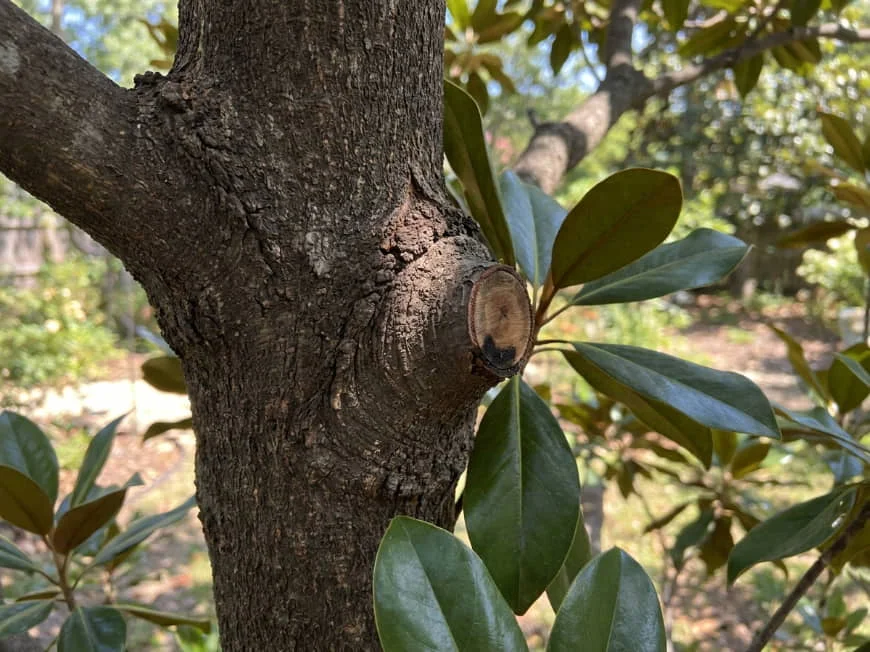
A whole branch should normally be removed just outside its branch collar.
The branch collar is the slightly swollen or ridged area where the branch joins the trunk or a larger limb. It contains specialised tissues involved in the tree’s response to the wound.
Do not make a flush cut
A flush cut removes the branch collar and cuts into trunk tissue.
It creates a larger wound and can interfere with the tree’s natural compartmentalisation response.
Do not leave a long stub
A long stub prevents wound tissue from closing efficiently around the cut and may die back towards the supporting branch.
The final cut belongs:
outside the branch collar
beyond the branch bark ridge
without cutting into the collar
without leaving a protruding stub
Australian council tree-management guidance similarly requires final branch-removal cuts outside the collar rather than through it. Randwick City Council
Use the Three-Cut Method for Heavier Branches
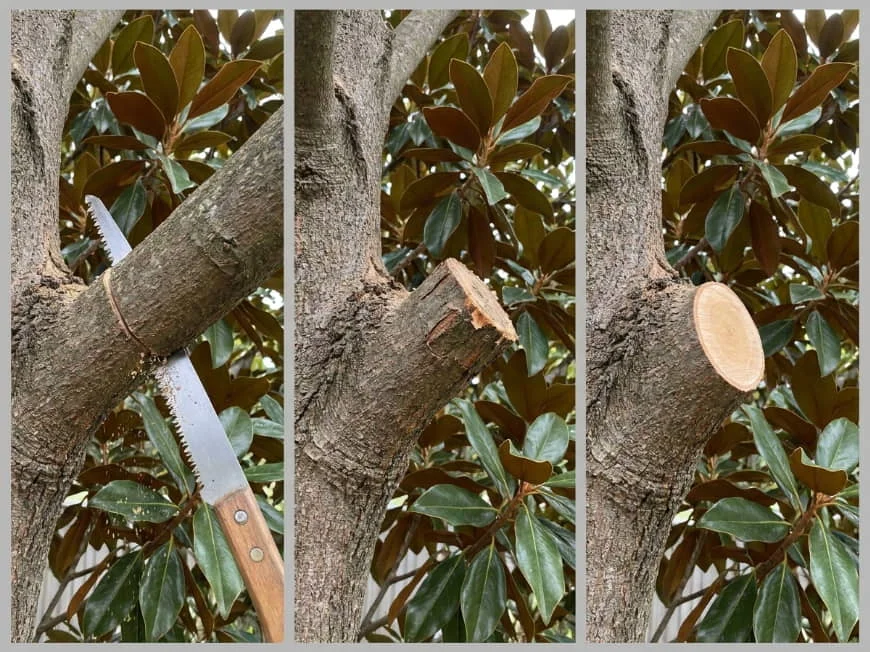
A heavier branch can tear bark down the trunk if it is cut once from the top.
Use the three-cut method only when the branch is within your safe DIY capacity.
Cut 1: Undercut
Make a shallow cut on the underside of the branch, away from the final branch collar cut.
This interrupts a bark tear if the branch begins to fall.
Cut 2: Remove the weight
Move farther out from the undercut and cut down from above.
The outer branch should break away between the two cuts without stripping bark down the trunk.
Cut 3: Make the final cut
Remove the remaining stub just outside the branch collar.
The final cut should be clean and should not remove the collar.
University extension pruning guidance recommends this sequence for branches heavy enough to tear bark under their own weight. Colorado State Forest Service
Removing Lower Branches
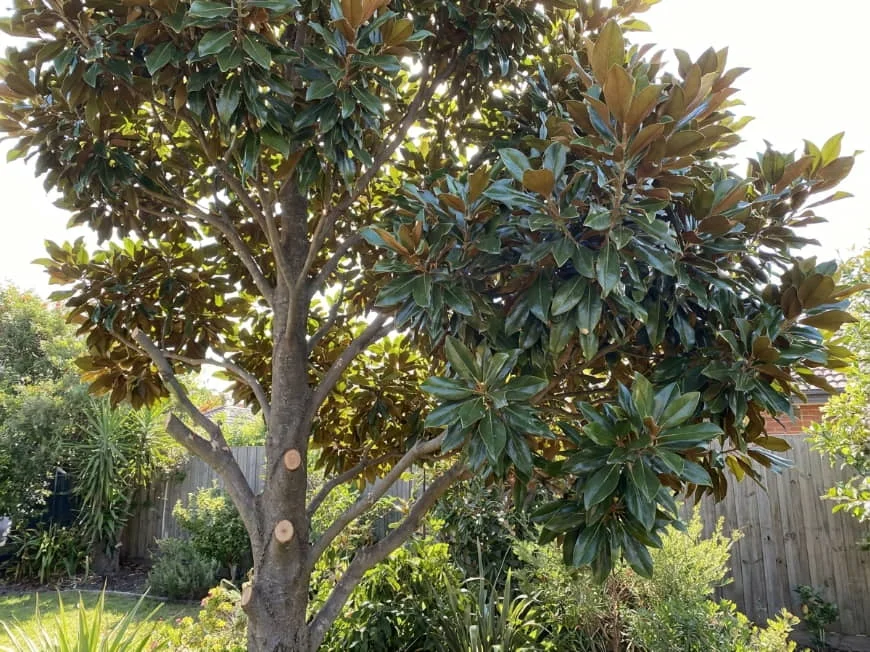
Lower branches are not automatically defects.
On Teddy Bear Magnolia they can:
create privacy
hide fallen leaves
shade the root zone
protect the trunk
support the dense, rounded form
reduce visibility of sparse growth near the base
Remove lower branches only when there is a clear reason, such as access, visibility, building clearance or a planned tree form.
Lift the canopy gradually
Avoid removing every lower branch in one session.
A sudden high canopy can:
expose previously shaded bark
make the tree top-heavy in appearance
reduce privacy
reveal a thin trunk
remove a substantial amount of foliage
permanently change the natural form
Australian research commentary notes that bark and branches newly exposed by pruning can suffer sun injury, particularly on hotter north- and north-west-facing aspects. University of Melbourne
Pruning a Teddy Bear Magnolia Hedge or Screen
Teddy Bear Magnolia can be used as a soft screen, but it does not behave like a fast-recovering formal hedge plant.
Keep the base wider than the top
Where a screen is shaped, avoid allowing the top to become broader than the base.
A slightly narrower upper canopy allows more light to reach lower foliage and reduces the risk of a dense top shading the base.
Do not clip every new flush
Instead:
identify shoots genuinely breaking the intended outline
shorten selected shoots
retain some natural variation
inspect for flower buds
step back frequently
stop before the canopy becomes a flat wall
If flowering matters, accept that a heavily formal screen and maximum bloom display are competing goals.
What About Dead, Diseased or Cankered Branches?
Do not prune merely because a leaf is spotted.
The cut should be based on branch condition.
Remove a small branch when it is:
clearly dead
broken
split beyond recovery
rubbing badly
structurally weak
affected by a localised lesion that has already killed growth beyond it
Before removing a branch with possible disease:
photograph the symptoms
find the transition between dead and living growth
check whether several branches are affected
inspect the trunk and root zone
consider whether a diagnostic sample may be needed
Our guide to Teddy Bear Magnolia branches dying explains how to distinguish a local branch problem from whole-tree decline.
For leaf-surface symptoms that have not entered the bark or wood, use the Teddy Bear Magnolia leaf-spots guide.
Should Pruning Tools Be Disinfected?
Start with clean, sharp tools.
Blunt blades crush or tear tissue instead of making a controlled cut.
Disinfection is particularly sensible when:
moving from visibly diseased material to healthy growth
working on more than one tree
pruning branches with oozing, cankered or unusual lesions
tools have contacted soil or decayed tissue
Follow the disinfectant manufacturer’s directions for concentration, contact time, rinsing and tool compatibility. Do not mix cleaning chemicals.
Dry metal tools after cleaning and maintain moving parts where needed.
Do Magnolia Pruning Cuts Need Paint or Sealant?
Routine pruning cuts generally should not be coated with wound paint or sealant.
Correct cut placement is more important.
Extension and Australian arboricultural guidance report that wound dressings usually provide no benefit and may retain moisture or interfere with closure. Purdue University Extension
Do not apply:
household paint
bitumen
glue
silicone
general garden paste
fungicide merely because a cut exists
A specific treatment should be used only when justified by a qualified professional for a defined problem.
How Much Can Be Pruned at Once?
There is no single safe percentage for every Teddy Bear Magnolia.
The amount a tree can tolerate depends on:
age
health
root condition
branch size
recent transplanting
weather
previous pruning
whether the removed foliage is concentrated in one area
whether large wounds are being created
The correct principle is:
Remove the least amount necessary to achieve the justified objective.
A few small corrective cuts on a vigorous young tree are different from removing several major branches from a stressed mature tree.
Stop and reassess if:
the canopy begins to look hollow
one side becomes much lighter than the other
previously shaded trunk or limbs are suddenly exposed
the planned work requires several large cuts
the tree is already declining
you are removing branches primarily to compensate for a poor planting location
Should You Top a Teddy Bear Magnolia?
No.
Topping means cutting major upright branches back to arbitrary stubs without retaining suitable lateral branches.
It can produce:
large exposed wounds
vigorous shoots below the cuts
weakly attached regrowth
a permanently altered form
repeated maintenance
decay entering through large stubs
loss of flowering canopy
If height is the underlying problem, use selective reduction by a qualified arborist or reconsider whether the tree suits the available space.
Do not turn a compact Magnolia into a damaged pole in an attempt to keep it permanently below its natural size.
What to Do After Pruning
After pruning:
collect damaged or suspect material
leave healthy fallen Magnolia leaves as mulch only where appropriate
keep mulch away from direct contact with the trunk
check soil moisture rather than watering automatically
avoid fertilising simply to force replacement growth
watch the cut edges and remaining canopy
record photographs for comparison
inspect for bark exposure after major clearance
Do not apply a fixed “recovery” watering or feeding schedule.
A tree in free-draining soil during hot weather may need different support from one growing in wet clay after rain.
Use our Teddy Bear Magnolia planting and care guide when root-zone conditions may be influencing recovery.
When to Call an Arborist
Use a qualified arborist when:
a branch is too high to reach from the ground
a chainsaw or ladder would be required
the branch can strike a person, building, vehicle or fence
power lines are nearby
a major structural limb is split
several large branches need removal
the tree requires crown reduction
the trunk or major branch has a canker
the tree is leaning or unstable
roots were damaged during construction
pruning would remove a substantial part of the canopy
local council approval may be required
Professional amenity-tree pruning in Australia should follow appropriate arboricultural practice, including correct branch-collar cuts and avoidance of topping or unnecessary damage.
A Practical Pruning Sequence
1. Define the reason
Write down what problem the pruning must solve.
2. Inspect flower buds
Check shoot tips before removing outward growth.
3. Inspect the whole tree
Look at the canopy from several directions.
4. Check tree health
Postpone cosmetic pruning if the tree is stressed, waterlogged, recently transplanted or declining.
5. Mark proposed cuts
Use removable ties or photographs to preview the effect without cutting.
6. Start with dead and damaged growth
Remove only clearly justified material.
7. Make selective cuts
Cut to a suitable lateral branch or just outside the branch collar.
8. Step back after every few cuts
Stop before the tree looks hollow, lopsided or overexposed.
9. Do not seal routine cuts
Allow correctly positioned cuts to close naturally.
10. Monitor rather than immediately re-pruning
Give the tree time to respond before making another round of changes.
For the cultivar’s expected size and natural habit, see our Teddy Bear Magnolia size and growth guide.
Frequently Asked Questions
When should I prune a Teddy Bear Magnolia in Australia?
For ordinary light shaping, inspect and prune around or after the main flowering flush during mild growing conditions. Dead or hazardous branches follow safety needs rather than a flowering calendar. Avoid unnecessary pruning during heatwaves, drought stress, waterlogging, frost-prone conditions or transplant shock.
Does Teddy Bear Magnolia need pruning every year?
No. Teddy Bear Magnolia naturally forms a compact, dense canopy and usually needs only occasional corrective pruning. Annual cutting is unnecessary unless it is being maintained as a deliberately shaped screen.
Can I prune Teddy Bear Magnolia in winter?
Small corrective work may be possible in suitable winter conditions, but pruning before flowers open can remove visible flower buds. Inspect the shoot tips and consider whether the work can wait until after the main flowering display.
Should I prune Teddy Bear Magnolia after flowering?
After the main flowering flush is often a practical time for light shaping because you can see which shoots flowered and avoid blindly removing unopened buds. Flowering can continue in later flushes, so the decision should still depend on the purpose of the cut and the condition of the tree.
Can I cut the top off a Teddy Bear Magnolia?
Do not top it. Cutting major upright branches back to arbitrary stubs can create large wounds, weak regrowth and a permanently damaged form. Height reduction should use selective cuts and may require an arborist.
Can I remove the lower branches?
Yes, where clearance or a tree-form appearance is genuinely needed, but remove them gradually. Lower branches contribute to privacy, trunk protection and the naturally dense form of Teddy Bear Magnolia.
Will pruning stop my Teddy Bear Magnolia flowering?
Pruning can reduce flowering when plump terminal buds and flower-bearing shoot tips are removed. Repeated shearing and hard pruning are more likely to reduce the display than a few selective corrective cuts.
How do I prune a thick Magnolia branch without tearing the bark?
Use the three-cut method: make an undercut away from the trunk, remove the branch’s weight with a second outer cut, then remove the remaining stub just outside the branch collar. Large or elevated branches should be handled by an arborist.
Should I paint Magnolia pruning cuts?
Routine cuts generally should not be coated with wound paint or sealant. Make a clean, correctly positioned cut outside the branch collar and avoid creating unnecessary wounds.
Can I hard-prune an overgrown Teddy Bear Magnolia?
Hard pruning is risky, particularly on an established or stressed tree. If several large branches must be removed to fit the space, seek an arborist’s assessment and consider whether the tree has outgrown its location.
Final Thoughts
Teddy Bear Magnolia is naturally compact. The best pruning is usually selective, limited and connected to a clear purpose.
Before cutting, decide whether you are:
removing a genuine defect
preserving access
correcting young structure
lightly shaping a screen
or trying to force the tree into a space it cannot sustainably occupy
Inspect the flower buds, branch collar, tree health and final canopy balance.
Then remove the least amount needed.
A few well-placed cuts can preserve the tree’s shape and flowers. Repeated shearing, topping and unnecessary large wounds can create a maintenance problem that did not previously exist.