
 Huma Naveed
Devil’s Ivy is one of the most common houseplants in Australia, and often the first one people own, and for good reason: it will forgive a fortnight of neglect, it copes with a dim hallway where fussier plants sulk, and you can turn one plant into several with a pair of scissors and a jar of water.
But “hard to kill” is not the same as “impossible to kill”, and it is more often lost to too much attention than too little. It is tolerant, not indestructible. What it actually needs also shifts depending on where in the country you live — a plant in a humid Brisbane bathroom and one in a heated Melbourne flat in July are having completely different experiences.
This guide covers both halves of owning one: the routine care that keeps it healthy, and the specific problems that bring people here in a panic. Where a problem needs a proper answer, we hand you off to a dedicated guide rather than skimming it.
⚡ Devil’s Ivy Care at a Glance
Practical starting points, not rules. Every one of these shifts with your conditions.
🩺 Choose Your Problem
Something wrong? Find the symptom, then go straight to the guide that deals with it.
🌿 The Core Care, Section by Section
1. Light
Bright indirect light is where it is genuinely happy. It survives low light — that is the whole reason it is famous — but surviving and thriving are different things. In a dim corner it grows slowly, the gaps between leaves stretch out, and a variegated plant may put out plainer, greener leaves, because the pale parts cannot photosynthesise. Direct summer sun through glass will scorch it. A useful test: stand where the plant is and look towards the window. If you can see a decent patch of open sky, the light is probably adequate. Full light guide →
2. Watering
Overwatering is one of the most common causes of decline in Devil’s Ivy, particularly in low light and during cooler periods when the potting mix dries more slowly. Forget a weekly schedule. Water when the upper mix has partly dried and the pot feels noticeably lighter. In large or deep containers, a dry surface does not always mean the root zone is ready for water, so use pot weight and the condition of the mix together. Drying time varies with season, light, pot size, root mass and the type of potting mix. Full watering guide →
3. Potting mix and drainage
A free-draining indoor mix suits it. If your mix stays sodden for a week after watering, cut it with perlite or bark until water runs through rather than sits. Devil’s Ivy roots want air as much as they want moisture — that is the whole story of root rot in one sentence.
4. Pot choice
5. Repotting
Repot when roots are circling the pot or coming out the drainage holes, when water runs straight through because there is more root than mix, or when growth has stalled despite decent light. Go up one size only — an oversized pot holds a reservoir of wet mix around the roots and invites rot. Spring or early summer is the easy time, but indoors it is not critical.
6. Feeding
Light feeding during active growth is plenty. A balanced indoor-plant fertiliser at the rate on the label, through the warmer months, and nothing much over winter when it is barely growing. Do not feed a struggling plant. A plant with brown tips or yellow leaves is not hungry, and fertiliser salts building up in the mix are themselves a cause of brown tips.
7. Pruning and shaping
Prune whenever you like. Cut just above a node (the small bump where a leaf meets the stem) and the plant will usually push new growth from that point, which is how you get a fuller, bushier plant instead of four long bare strings. Pruning encourages branching — but it does not replace light. If the plant is stretched because the corner is dark, cutting it back only gives you shorter stretched growth.
8. Propagation (the short version)
Cut a section with at least one node, strip the lowest leaf, and put the node in water or straight into mix. It roots readily — it does not need rooting hormone. Where people go wrong is cutting a leaf off by its stalk with no node attached: that will not root — without a node there is nothing for roots to grow from. Full propagation guide, including exactly where to cut →
9. Climbing and trailing
Left to hang, it tends to keep its smaller juvenile leaves. Given something to climb, it matures and the leaves get bigger — though indoors the difference is real but modest, and it depends far more on light than on the pole itself. A moss pole in a dark corner will not do anything useful. Full climbing and moss-pole guide →
10. Common symptoms, decoded
The single most useful distinction: yellow and soft points to too much water, brown and crispy points to too little water or dry air. Get that right and you have diagnosed most cases. Yellow leaves and root rot → · Brown crispy tips →
11. Pests
Common Devil’s Ivy pests include mealybugs, spider mites, scale, thrips and fungus gnats. Because their symptoms can overlap with watering, root and light problems, identify the pattern before treating. The ones you will meet most often: mealybugs (white cottony fluff in the leaf joints), spider mites (fine speckling and delicate webbing under the leaves, in hot dry air) and fungus gnats (little black flies). Fungus gnats breed in the growing medium. Persistently moist mix can support them, but they can also arrive in potting mix, so their presence does not prove you have overwatered. Quarantine any new plant for a few weeks. Many infestations are introduced on new plants or potting materials, though quarantine reduces the risk rather than removing it. Full pest guide →
12. Pet safety
13. Outdoor growing and weed responsibility
Indoors it is completely fine. Outdoors, in warm and humid parts of Australia, it is a genuine environmental problem — it has naturalised in Queensland, climbs and smothers native trees, and spreads from dumped cuttings and stem fragments that root in damp ground. Keep it in pots, never plant it into the ground near bushland, and bin or council-green-waste your prunings rather than tipping them over the fence. Full guide to weed status and safe disposal →
14. Australian seasonal care
The plant slows right down in winter and barely drinks — but the watering habit usually does not slow down with it, so watering habits that worked in warmer weather may leave the roots wet for too long. In summer, growth is fast and the mix dries quickly, so check more often. Feed in the warm months, not the cold ones.
15. Varieties you will see in Australian nurseries
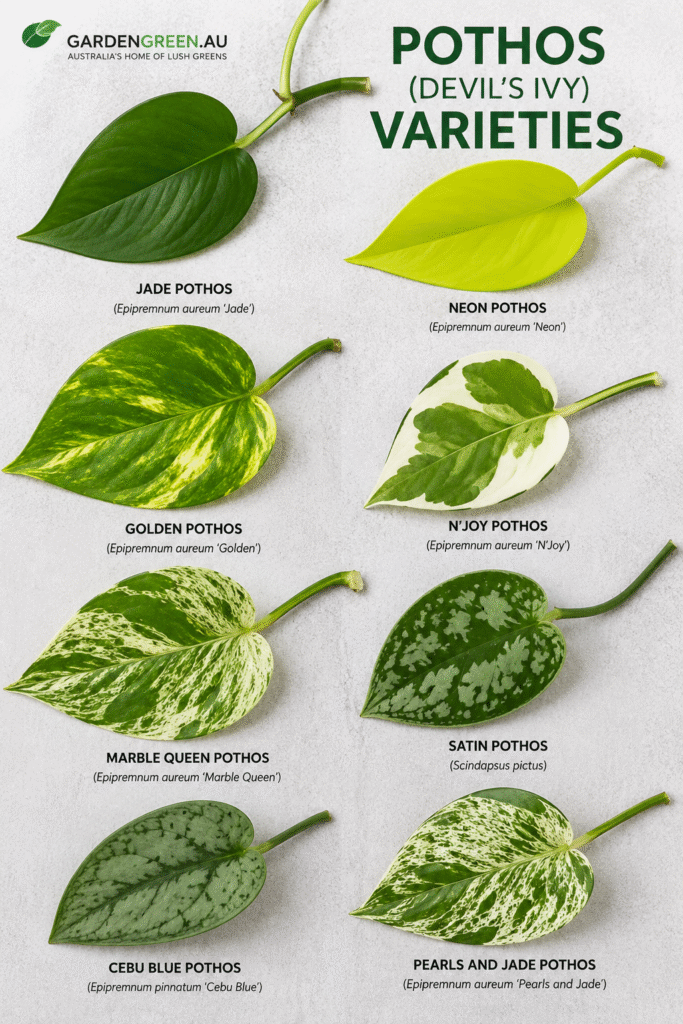
Golden Pothos (the classic, gold-splashed green) is the toughest and most forgiving. Marble Queen is heavily white-marbled, slower growing, and needs more light to hold its variegation. Neon is a solid chartreuse green and keeps its colour better in lower light. Cebu Blue and Manjula turn up less often and usually cost more. The care is the same across all of them — the difference is that the more white a plant carries, the more light it needs to sustain itself.
🌏 How Australian Climate Changes the Advice
The plant does not read postcodes. What actually changes is how fast the mix dries, how hard your heating and cooling work, and whether an escaped cutting could survive outdoors. Find the description that matches your conditions.
♻️ Growing It Responsibly
This is the part almost no care guide mentions, and it matters more here than in most countries. Devil’s Ivy spreads vegetatively — a single node in damp ground will strike. It rarely flowers in Australia, so it is not seed doing the damage. It is us, throwing cuttings away carelessly.
✅ Do
- Keep it in pots, indoors or contained.
- Bin prunings, or use council green waste.
- Let cuttings dry out fully before disposal.
- Tip propagation water down the sink.
- Check your state and council weed guidance.
❌ Don’t
- Plant it into the ground in a warm region.
- Tip trimmings over the fence or into bush.
- Dump an unwanted plant in a reserve.
- Empty propagation jars into a creek or drain.
- Dump viable cuttings in compost, bushland, waterways or vacant land without checking local disposal guidance.
Weed status varies by state and council and the lists change, so check locally rather than treating any guide — including this one — as a legal position. More on weed status and disposal →
🔎 The Smaller Questions People Ask
Slower growth can be normal during cooler, darker periods. At other times, check light levels, root crowding, watering and root health rather than assuming a single cause.
Smaller new leaves are the plant telling you it has less energy to spend than it used to — usually light, sometimes an exhausted, root-bound pot.
Curling inwards usually means the plant is trying to reduce water loss: it is too dry, too hot, or sitting in a draught from a heater or air-con vent. Check the mix before you assume thirst.
This is the important one. Wet mix plus a wilting plant often means the roots are failing and can no longer take up water. Watering again while the mix is still wet can worsen the root damage.
Fix the light, then prune above nodes to force branching, then plant the rooted cuttings back into the top of the same pot. That last trick is what turns a straggly plant into a full one.
A harmless saprophytic fungus, but it is a symptom worth reading: the surface is staying too damp with too little airflow. Scrape it off, let the mix dry further between waters, and improve air movement.
Water much less, stop feeding, keep it off cold glass, and move it away from the direct blast of a heater. Do not repot a plant that is not growing.
❓ Frequently Asked Questions
❓ Are Devil’s Ivy and Pothos the same plant?
Yes. Same plant (Epipremnum aureum), different common names. You will also see it sold as Golden Pothos or Money Plant.
❓ Can it really live in a dark room?
It will survive far longer than most plants, but it will not thrive: slow growth, stretched vines, and variegation fading to green. If a room has no useful natural light, a cheap LED grow lamp on a timer solves it.
❓ Can it live permanently in water?
It can, though it grows more slowly and needs a different routine from a potted plant — water roots and soil roots are not the same thing, and a plant moved from one to the other often sulks for a while.
❓ Does it damage walls?
Aerial roots will attach to textured or porous surfaces, and wall clips can mark paint. On a rental, keep it on a pole or trellis rather than training it directly onto the wall.
❓ Is it safe around cats and dogs?
No — it is toxic if chewed, causing mouth irritation, drooling and vomiting. Keep it well out of reach, and ring the Animal Poisons Helpline (1300 869 738) or your vet if your pet eats some.
🔗 The Complete Devil’s Ivy Library