
When comparing Magnolia Little Gem vs Teddy Bear, the biggest differences are mature size, growth speed, flowering habit, and suitability for pots or hedging. For most small Australian gardens, Teddy Bear is the better feature tree, while Little Gem is usually the better screening magnolia.
Both are compact, fully evergreen cultivars of *Magnolia grandiflora*. Both produce large creamy white fragrant flowers and hold glossy foliage year-round. But planted in the wrong spot, either one will work against you within a few years.
This guide covers everything: size, growth rate, flowering, pots, hedging, climate by state, watering, pruning, and pests — with a straight answer on which suits your situation.
⚖️ Magnolia Little Gem vs Teddy Bear: Quick Answer
Choose Teddy Bear if :
- You have a small garden, courtyard, or narrow space
- You want a statement feature tree
- You want a magnolia that grows well in a pot long-term
- You prefer low maintenance with minimal pruning
- You want the larger, more spectacular individual flowers
Choose Little Gem if :
- You need a privacy screen or hedge along a fence line
- You want faster growth and earlier coverage
- You have a larger block with room to fill
- You want more frequent flowering across the full season
- You’re planting multiple trees and budget is a factor
🌿 Teddy Bear vs Little Gem — Quick Comparison
💡 Quick tip: If your space is under 3 metres wide — go Teddy Bear. If you need fast privacy screening — go Little Gem.
📏 Size & Growth: The Core Difference
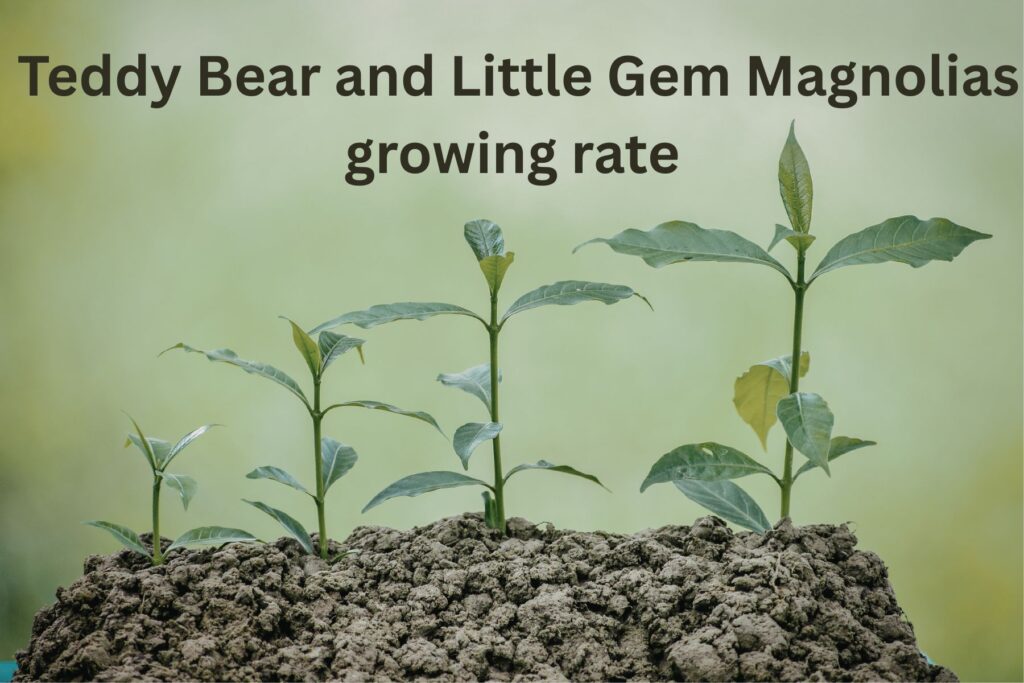
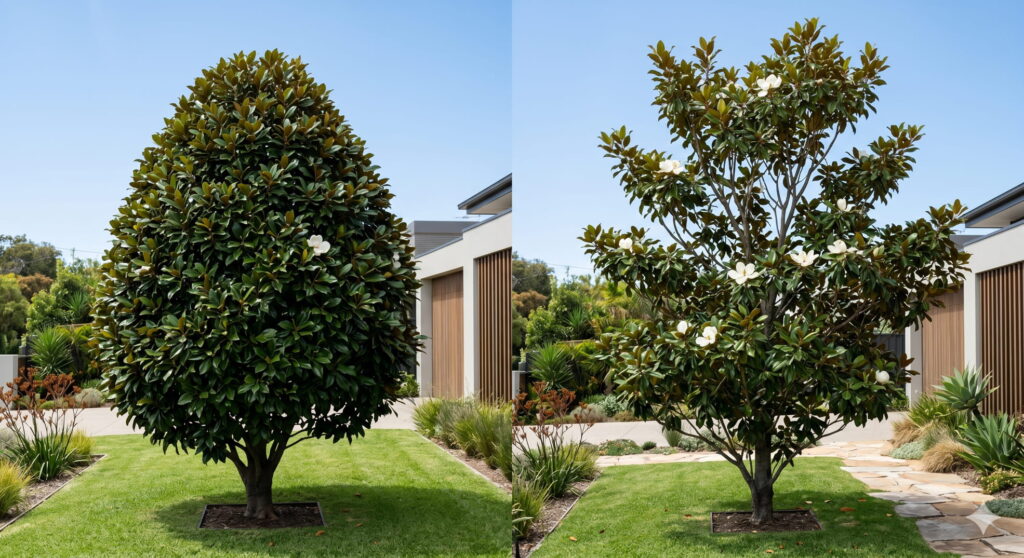
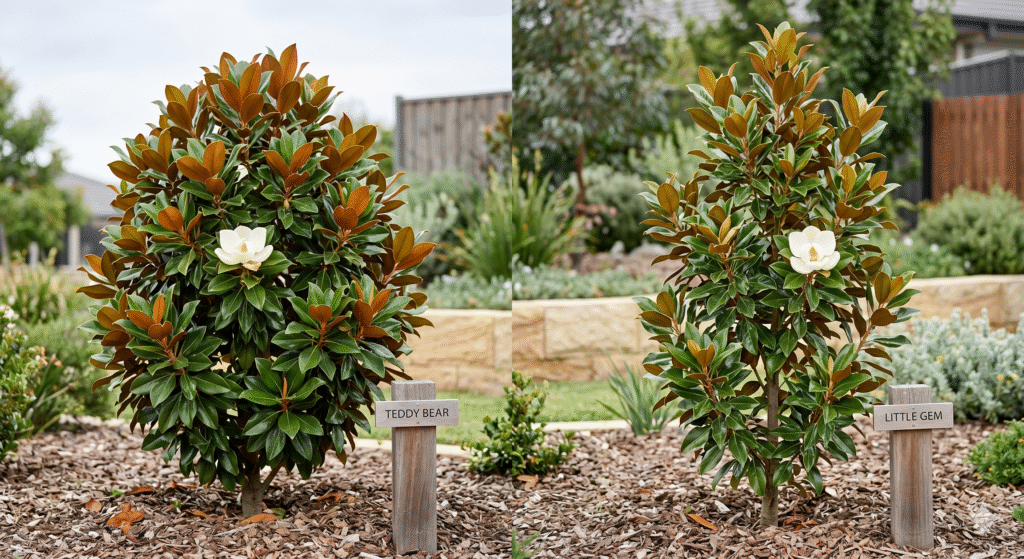
Australian nursery specifications vary, but Teddy Bear Magnolia is commonly listed at roughly 3–6 metres tall and around 2–3 metres wide at maturity. The lower figures often reflect maintained landscape size, shorter observation periods or particular growing conditions. Its natural shape is a tight, dense, rounded cone that holds form well with minimal pruning. Growth is slow to moderate — generally 15 to 50 cm per year depending on soil quality and climate.
Australian nursery specifications differ: published estimates range from about 4 metres to 6 metres tall, depending on the grower and how mature size is defined. See, for example, Speciality Trees (4 × 3 m), Evergreen Trees Direct (4–5 m × 2.5–3.5 m) and Plants for Spaces (3–4.5 m). These are examples of published variation, not a single agreed figure.
Little Gem typically reaches 4 to 6 metres tall with a narrower, more upright columnar habit. It grows noticeably faster at 30 to 75 cm per year — useful for establishing a screen quickly, but it can become open and sparse at the base without occasional light trimming.
Typical Growth by Age (Australian Garden Conditions)
The figures below are typical ranges for well-established trees in Australian gardens. Growth varies with soil preparation, climate zone, and watering.
| Age | Teddy Bear (typical height) | Little Gem (typical height) |
|---|---|---|
| 2 years | 0.8–1.2 m | 1.2–1.8 m |
| 4 years | 1.5–2.2 m | 2.5–3.5 m |
| 7 years | 2.5–3.2 m | 3.8–5.0 m |
| Mature | 3.0–4.0 m | 4.0–6.0 m |
🌳 Real Australian Garden Examples
These examples come from gardens observed by our team and measurements shared by Australian gardeners and landscapers. They show how the cultivars performed at particular sites, not how every tree will grow. Starting plant size, soil, irrigation, climate, pruning and the way measurements were taken can all affect the result.
| 📍 Location | 🌿 Variety | ⏱ Age | 📏 Height | 🗒 Notes |
|---|---|---|---|---|
| Melbourne, VIC | Teddy Bear | 5 years | ~2.6 m | Courtyard · Full sun · Minimal pruning |
| Brisbane, QLD | Little Gem | 5 years | ~4.2 m | Privacy fence line · Loamy soil |
| Sydney, NSW | Little Gem | 3 years | ~2.4 m | Side passage hedge · Part shade |
| Perth, WA | Teddy Bear | 4 years in pot | ~1.8 m | 65 cm container · Western aspect |
💬 Have you measured your own Teddy Bear or Little Gem? Drop your location, age, and height in the comments — it helps every Aussie gardener make the right decision!
Flowers: What to Expect
Both produce the classic Southern Magnolia flower — large, creamy white, beautifully fragrant — from late spring through summer (October to February in most Australian states), with some repeat blooming into autumn.
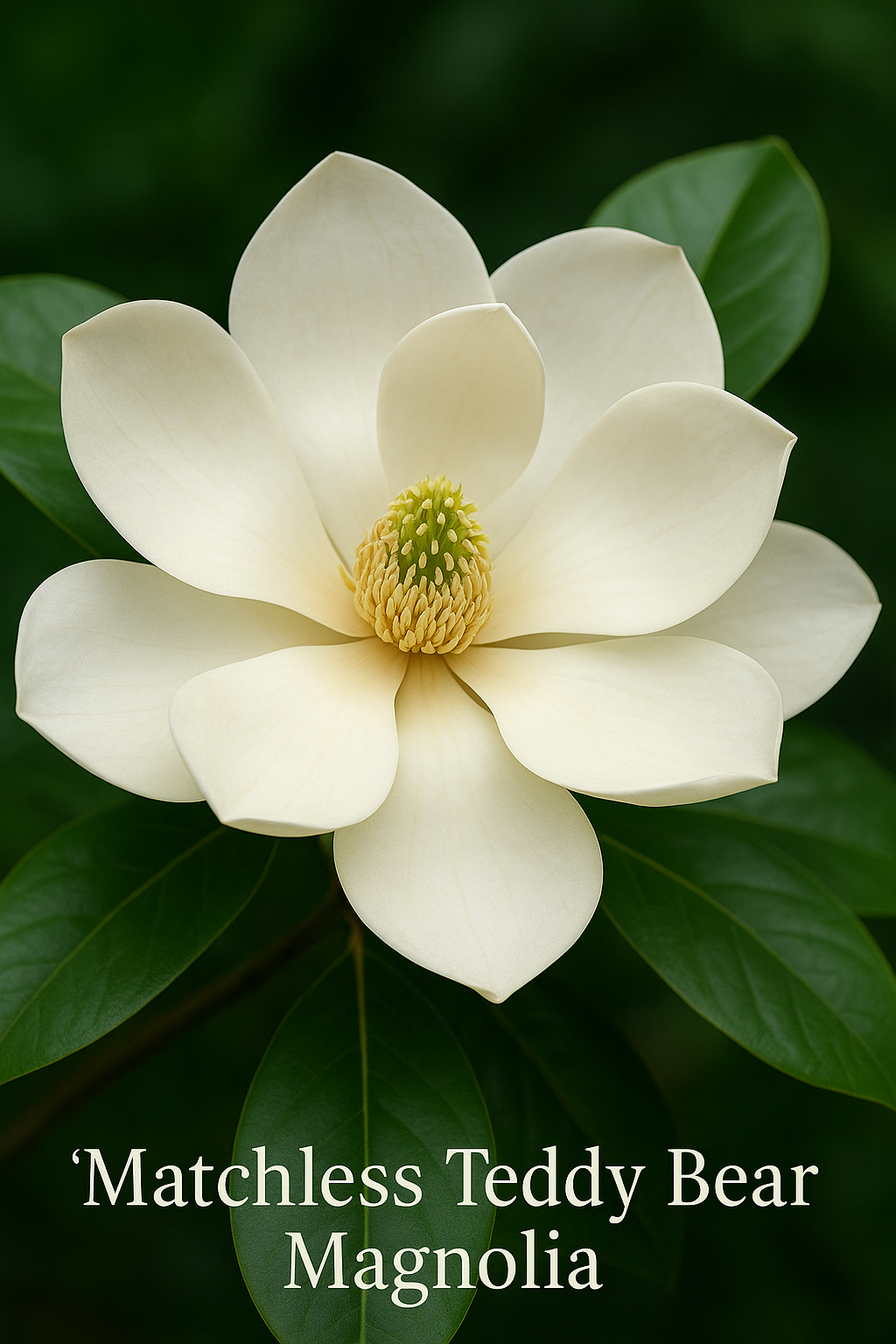
Teddy Bear produces fewer flowers overall, but they’re bigger — cup-shaped blooms up to 20 cm across with an intense lemony fragrance. The deep cinnamon-bronze leaf undersides add year-round ornamental contrast, making it a genuine feature even outside flowering season.
Little Gem flowers more consistently and over a longer period. Blooms are smaller (10–15 cm) and more star-shaped with a sweet scent. For ongoing colour and fragrance across the full warm season, Little Gem typically delivers more reliably.
Breeder-reported flowering difference: In the original US plant patent for Magnolia grandiflora ‘Southern Charm’—the cultivar sold under the Teddy Bear trade name—the breeders reported flowering beginning in the third year of growth, compared with the first year for Little Gem. This is a breeder observation from the patent trials, not a guaranteed flowering timetable for Australian gardens. Actual flowering can vary with propagation method, starting plant size, sunlight, establishment, pruning and local growing conditions. (US Plant Patent 13,049)
Pots & Containers
Teddy Bear is generally the better long-term pot choice.
Its slower growth and compact root system mean it handles container life well — typically remaining productive in a quality 60–75 cm container for many years with proper care.
Little Gem can be grown in pots
and performs well for the first 2–3 years. After that it commonly becomes root-bound, showing yellowing leaves and reduced flowering. For long-term container growing, Teddy Bear is the more sustainable choice.
🪴 Container Setup Guide
| 🌱 What | ✅ What You Need |
|---|---|
| 📏 Pot Size | Minimum 60 cm diameter (75 cm preferred) |
| 🌿 Potting Mix | Premium native potting mix — low phosphorus formula |
| 💧 Watering | Water deeply · Let top layer dry between sessions |
| 🌸 Fertiliser | Slow-release for acid-loving plants (camellia/azalea formula) · Apply early spring |
| 🍂 Mulch | Lucerne or sugar cane mulch on surface to retain moisture |
| 🕳️ Drainage | Keep drainage holes clear — magnolias are sensitive to waterlogged roots |
⚠️ Important: Waterlogged roots are the number one killer of potted magnolias in Australia. Always check your drainage holes are clear before and after heavy rain.
Foliage Differences
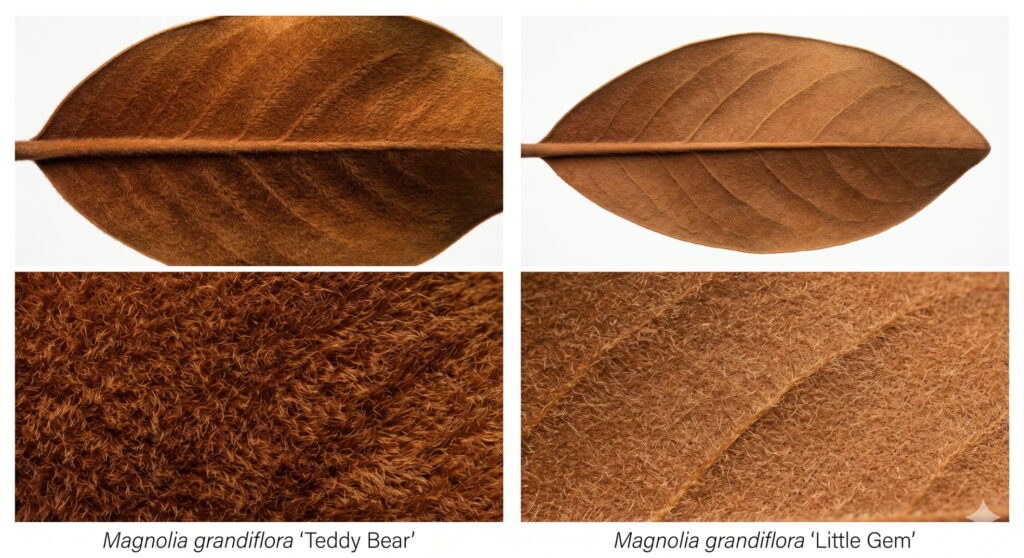
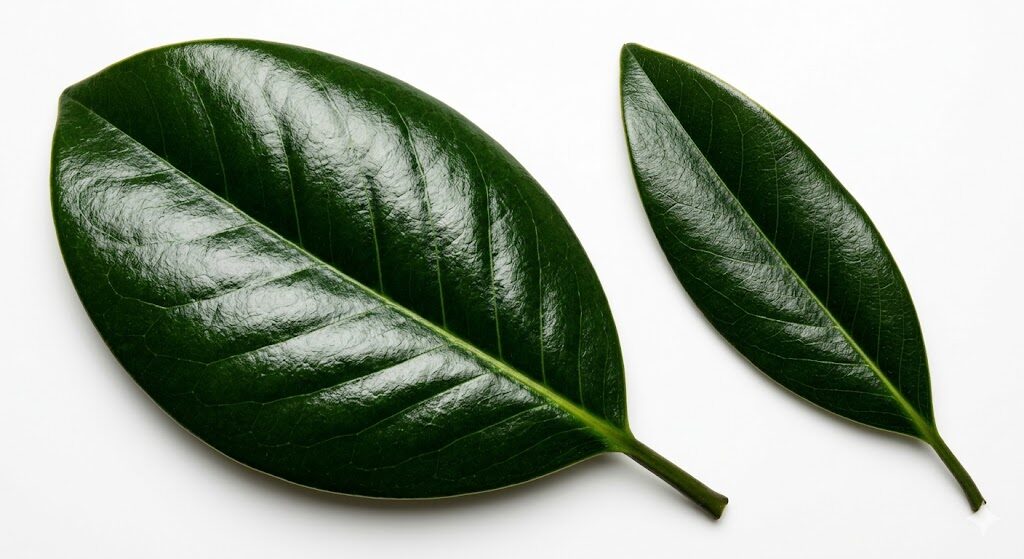
Teddy Bear has larger, rounder leaves. The topside is deep glossy green; the underside is thick, velvety, deep cinnamon-bronze — almost fur-like to the touch, which is exactly where the name comes from. This textural contrast is particularly striking against rendered walls, pale pavers, or light timber fencing common in modern Australian gardens.
Little Gem has smaller, more elongated leaves with a lighter rust-coloured underside. The finer leaf texture gives a more formal, refined look — well-suited to clipped hedges and tight screens where a neater appearance is the goal.
🌏 🗺️ Climate Guide by Australian State
Neither cultivar is simply “better” in a given city. The column below is our usual pick for the most common situation we see in each region — but the site conditions beside it matter far more than the postcode.
| 🏙️ Region | 🌿 Our usual pick | 📝 Site considerations |
|---|---|---|
| 🌊 Sydney / NSW Coast | Either | Both handle warm, humid conditions well |
| 🥶 Melbourne / VIC | 🐻 Teddy Bear | In many Melbourne gardens, Teddy Bear maintains a denser winter appearance; Little Gem can look more open in cold conditions |
| ☀️ Brisbane / QLD | 💎 Little Gem | Humidity and warm-season growth are the main factors; give plants room and airflow, and watch for scale and the honeydew that leads to sooty mould |
| 🌵 Perth / WA | 🐻 Teddy Bear | Compact form suits urban gardens; handles dry summers once established |
| 🍷 Adelaide / SA | Either | Both reliable in mild Mediterranean-style conditions |
| ❄️ Canberra / ACT | 🐻 Teddy Bear | Frost exposure and cold, open sites are the main considerations here; protect young trees while they establish |
| 🏔️ Tasmania | 🐻 Teddy Bear | Handles cool-temperate conditions well |
🌏 Aussie Tip: Teddy Bear is the stronger performer in cooler southern climates. Little Gem thrives in Queensland’s warmth — just watch for sooty mould in humid summers.
Both handle light frost without significant damage. In cooler southern climates, Teddy Bear’s denser foliage tends to maintain a fuller winter appearance.
Hedging & Screening
For privacy and screening, **Little Gem is generally the more practical choice** — faster growth gets coverage sooner, and its upright columnar habit fills vertical space efficiently.
Hedge Spacing Guide for Little Gem
| Spacing | Result |
|---|---|
| 1.0 m apart | Dense formal hedge — maximum coverage |
| 1.5 m apart | Standard privacy screen — most common |
| 2.0 m apart | Informal screen — more open, natural feel |
Teddy Bear can also be hedged and produces a beautifully dense result per metre of width. But its slower growth means patience. If you need screening within 18 months, Little Gem is the faster solution. If you have 3–4 years and want a hedge that holds shape with minimal pruning, Teddy Bear is worth considering.
Soil prep before planting your hedge: Fork in compost to 30 cm depth, confirm free drainage, and mulch heavily immediately after planting. Good preparation at the start typically results in noticeably faster establishment.
Watering
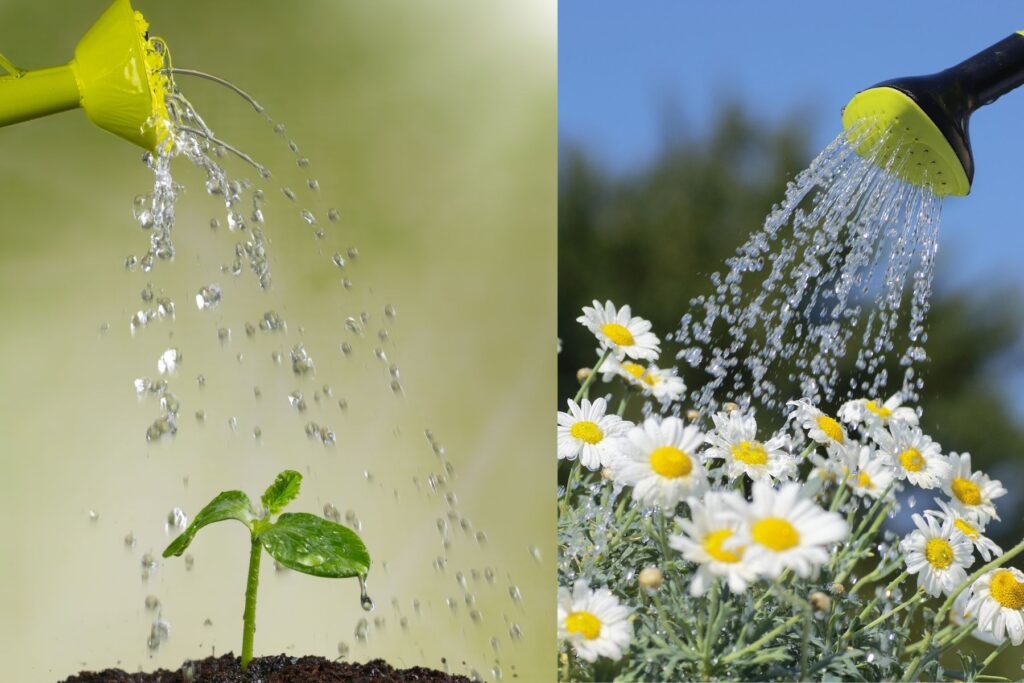
Both are reasonably drought-tolerant once established. The first two summers after planting are the critical window.
During establishment: Deep soak once a week under normal conditions. In summer heatwaves, increase to twice a week. The goal is deep root growth, not surface moisture. A dripper timer is ideal through the Australian summer.
Once established: Water during extended dry spells (10+ days without meaningful rain). Both are resilient once properly rooted.
Avoid: Waterlogged soil. Root rot is among the most common magnolia failures in Australian gardens. If your soil holds water after heavy rain, fix drainage before planting.
Fertilising & Mulching
Neither cultivar needs feeding simply because a calendar date has arrived. Feed only where growth, leaf condition or a soil test indicates a need, and avoid using fertiliser to compensate for poor drainage, unsuitable light or root stress. When feeding is warranted, a slow-release fertiliser for acid-loving plants — the same formula used for camellias and azaleas — works well. Avoid heavy nitrogen feeding as it promotes soft, pest-vulnerable growth and can reduce flower fragrance.
Apply a 7–10 cm layer of organic mulch around the base (kept clear of the trunk). Lucerne or sugar cane mulch works well and improves soil structure as it breaks down. Top up once a year.
Pruning
Teddy Bear: Very little needed. Its naturally dense, tidy habit means most gardeners only remove crossing branches or dead wood once a year — late winter/early spring before new growth begins, or lightly after the main flowering flush.
Little Gem: Light trim once or twice a year to maintain density, particularly at the base. Main session after the primary flowering flush (late summer to autumn) promotes denser regrowth. Both varieties respond well to pruning and recover quickly.
Technique: Clean, sharp secateurs or loppers. Cut back to a healthy outward-facing bud or lateral branch. Regular light trimming consistently produces better long-term results than occasional heavy cutting.
Pests & Common Problems
Sooty mould — Black coating on leaves following scale insect activity. Treat the underlying scale (waxy white lumps on stems/leaf undersides) with white oil spray — two applications a fortnight apart. More common on Little Gem in humid Queensland conditions. Good airflow spacing reduces incidence.
Scale insects — White oil applied in the cooler part of the day. Good plant spacing helps prevent it.
Root rot — Caused by poor drainage or overwatering. Prevention is far easier than treatment: free-draining soil, no waterlogging, pots never sitting in saucers of water.
Yellowing leaves — Most common cause: waterlogged soil. If drainage is fine, test pH — both varieties prefer slightly acidic conditions (pH 5.5–6.5). High pH causes iron deficiency; treat with chelated iron.
Leaf scorch — Brown, dry leaf edges on newly planted trees, usually from intense afternoon sun before establishment. Afternoon shade in the first summer helps in hot western aspects.
Best Uses at a Glance
Choose Teddy Bear for:
- Feature tree in a courtyard, front yard, or narrow garden
- Long-term pot planting on a balcony, deck, or paved area
- Formal entrance planting flanking a driveway or front door
- Low-maintenance planting that holds shape without regular intervention
- Any space under 3 metres wide
Choose Little Gem for:
- Fast-growing privacy screen or formal hedge along a boundary
- Height to screen a two-storey neighbour within 2–3 seasons
- Open backyard or large lawn
- Ongoing flowering across the full warm season
- Larger planting projects where multiple trees are needed
Pros & Cons
Teddy Bear Magnolia
- ✅ Compact and genuinely self-managing
- ✅ Excellent long-term pot variety
- ✅ Large, spectacular, intensely fragrant blooms
- ✅ Beautiful deep bronze foliage year-round
- ✅ Handles cool southern climates well
- ✅ Minimal pruning required
- ❌ Slower to reach full height
- ❌ Fewer flowers than Little Gem
- ❌ Higher nursery price
Little Gem Magnolia
- ✅ Faster growing — privacy coverage sooner
- ✅ More frequent flowering across the season
- ✅ Excellent for formal hedging and screening
- ✅ Widely available and more affordable
- ✅ Narrow upright form suits tight planting lines
- ❌ Needs light pruning to stay dense at the base
- ❌ Not suited to pots beyond 2–3 years without sizing up
- ❌ Higher sooty mould risk in humid climates without good spacing
—
What to Plant Underneath
Whichever of the two you choose, you are left with the same question: what goes at its feet. Both magnolias cast dense shade and hold a fairly shallow root mat near the trunk, so the plants that do well underneath tend to be low, shade-tolerant and happy to be left alone once established.
We cover the planting combinations that actually work in Australian conditions in our guide to companion plants for magnolias.
Frequently Asked Questions
Common questions from Australian gardeners choosing between Teddy Bear and Little Gem Magnolia — answered honestly.
🌳 Which magnolia is better for Australian gardens overall?
🌿 Is Little Gem good for hedging in Australia?
🪴 Can I grow Teddy Bear Magnolia in a pot?
🪴 Can I grow Little Gem in a pot?
🚀 Which magnolia grows faster?
📏 How far apart should I plant Little Gem for a hedge?
🥶 Which magnolia handles Melbourne winters better?
☀️ Which magnolia handles Queensland humidity better?
🌱 Do magnolias have invasive roots?
🍂 Why are my magnolia leaves turning yellow?
💰 Which magnolia is cheaper?
🍃 Are Teddy Bear and Little Gem magnolias evergreen?
🌸 When do magnolias flower in Australia?
🏊 Which magnolia is better near a pool?
🏗️ Can I plant magnolias near a fence or retaining wall?
🎯 Which Magnolia Should You Buy? Decision Guide
| Your Situation | Best Choice |
|---|---|
| Small courtyard or narrow space | Teddy Bear |
| Balcony or paved area pot | Teddy Bear |
| Front yard feature tree | Teddy Bear |
| Privacy screening hedge | Little Gem |
| Fast coverage needed | Little Gem |
| Large open backyard | Little Gem |
| Low maintenance priority | Teddy Bear |
| More flowers across the season | Little Gem |
| Budget is a factor | Little Gem |
| Modern or coastal garden aesthetic | Teddy Bear |
The Verdict
Choose Teddy Bear for compact spaces, pots, courtyards, front yards, or any situation where you want a naturally tidy, low-maintenance feature tree with spectacular large blooms. It’s the more self-managing of the two and the better long-term investment for confined or designed spaces.
Choose Little Gem for privacy hedging, fast screening, larger open gardens, or where budget and growth speed are priorities. It’s a vigorous, reliable tree that responds well to light management and delivers ongoing flowering across the full season.
Both are excellent, long-lived trees well-suited to Australian conditions. The right choice depends on your space, your timeline, and what you need the tree to do.
No soil? No sunlight? No problem. If your space genuinely can’t support a live magnolia — think indoor foyers, rooftop terraces, or heavy-shade courtyards — Garden Green’s premium artificial magnolia trees deliver the same glossy, structured look with zero maintenance.
Preparing your soil before planting? See our Guide to Australian Soil for Trees and Natives. Choosing a pot? See our Top Pots for Balcony and Courtyard Trees.