
Best Pruning Saws Australia: How to Choose

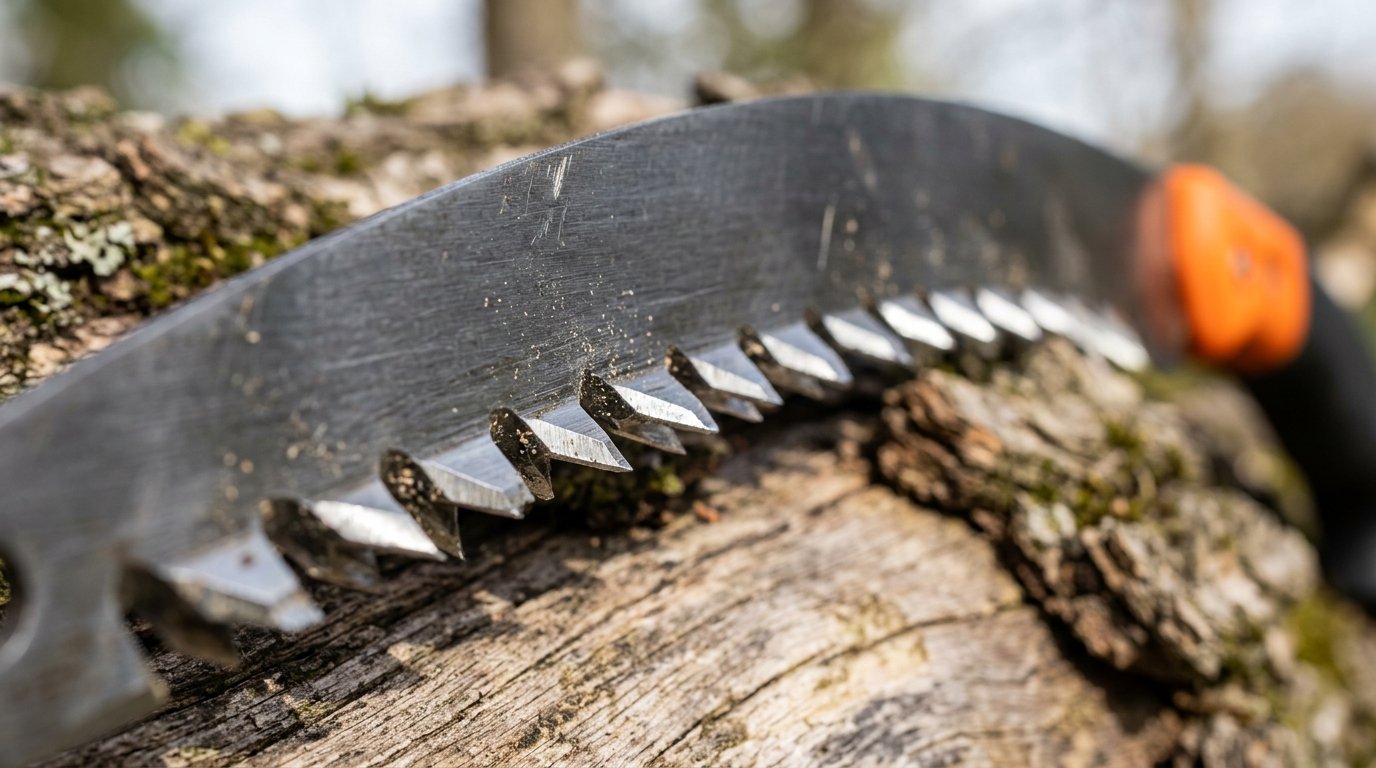
For most Australian gardeners, a folding pruning saw is the best all-round choice for branches that are too thick for secateurs but do not justify a chainsaw. A fixed-blade saw is better for frequent heavier pruning, a pole saw is the safer option for branches beyond comfortable reach, and a bow saw suits fast cutting on larger accessible wood. The right tool depends on branch size, access, wood condition and how often you prune.
Pruning saws are not miniature carpentry saws. Most modern garden pruning saws are designed for fast cutting through green wood, often with aggressive teeth that cut primarily on the pull stroke. Used properly, they make clean cuts with much less effort than forcing oversized stems through secateurs or loppers.
Brands widely available in Australia include Silky, Bahco, ARS, Felco, Fiskars, STIHL, Corona and Cyclone. Garden Green has not yet joined an affiliate program or completed controlled side-by-side testing of current pruning saws, so this guide does not publish live retailer links, prices, invented cutting-speed tests or fake “best saw” rankings. Its purpose is to help you choose the right saw type and use it safely.
Quick pick: which pruning saw suits the job?
| Scenario | Best starting saw type | Why |
|---|---|---|
| Occasional small branches | Folding pruning saw | Compact, safe to carry and useful for general garden pruning |
| Regular hedge renovation | Fixed-blade pruning saw | Faster access and a stronger dedicated handle for repeated work |
| Tall screen branches | Pole saw | Extends reach without unsupported overhead sawing |
| Dry deadwood | Fine-to-medium tooth pruning saw or bow saw | Cleaner control on harder dry timber |
| Heavy accessible branches | Bow saw or powered pruning saw where appropriate | Useful when hand-pruning volume becomes substantial |
When should you use a pruning saw?
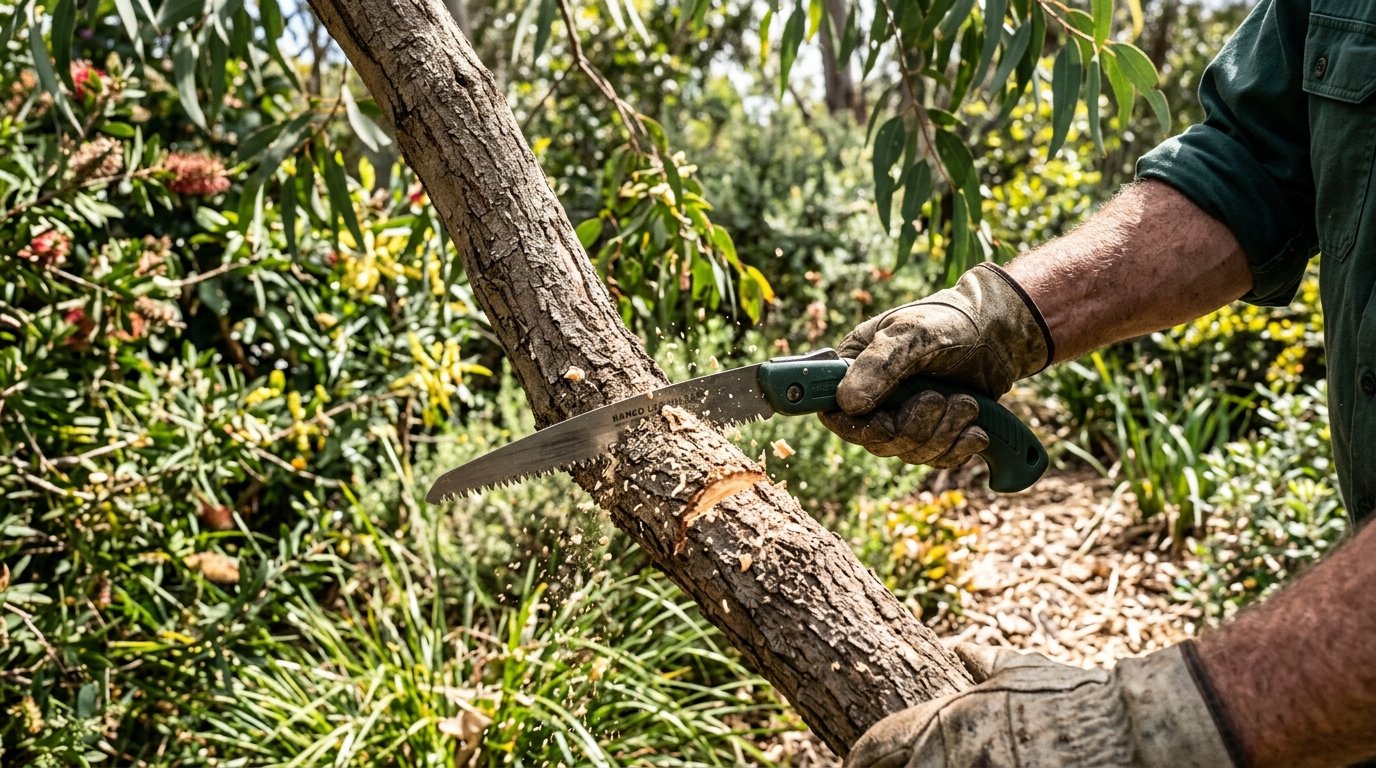
A pruning saw becomes the right tool when the branch is too large for comfortable secateur or lopper use.
Do not force small hand tools beyond their intended capacity. If a branch needs excessive squeezing, twisting or both hands on a pair of secateurs, you have probably moved beyond the right tool category.
For smaller live stems, see our secateur buying guide. For shaping a hedge face rather than removing structural branches, our hedge-trimmer guide is the better starting point.
Folding pruning saws
Folding saws are ideal for general home gardening because the blade folds into the handle for transport and storage.
They are useful for:
- small-tree pruning;
- hedge renovation;
- removing individual woody stems;
- garden clean-up;
- carrying in a tool belt or toolbox.
The key safety feature is the locking mechanism.
A good folding saw should lock securely when open and should also remain safely closed when carried.
Fixed-blade pruning saws
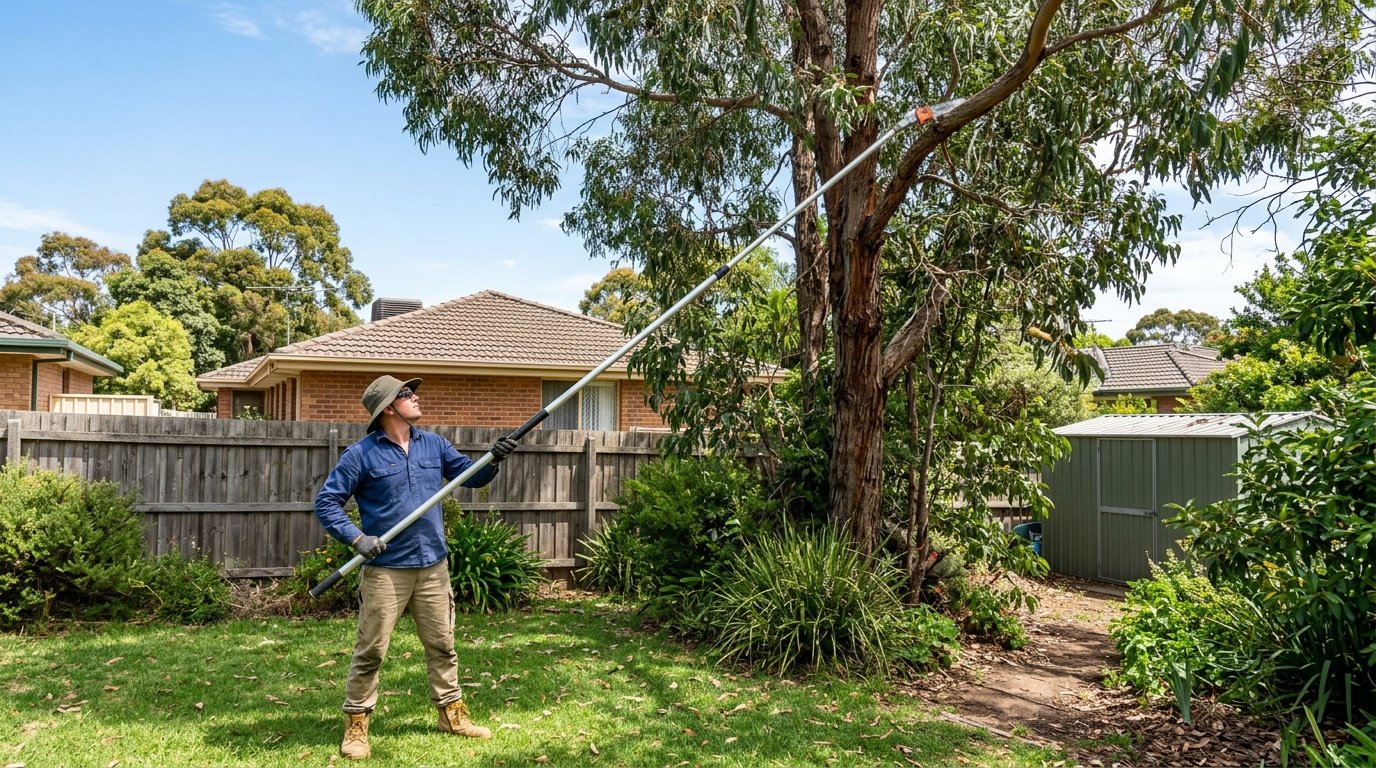
A fixed-blade saw does not fold. The blade remains permanently attached to the handle and is usually stored in a scabbard.
This design is useful for frequent pruning because:
- there is no hinge to unfold;
- the handle can be larger and more secure;
- the blade is ready immediately;
- the scabbard can be worn on a belt.
The downside is size. A fixed saw takes up more storage space and needs a proper sheath to protect both the blade and the user.
Bow saws
A bow saw uses a tensioned blade in a metal frame.
It is useful for:
- larger accessible branches;
- cutting dead wood;
- garden clean-up after pruning;
- reducing cut branches into manageable lengths.
Its frame can make it awkward inside dense shrubs or hedge interiors, where a narrow pruning saw has better access.
Pole saws for tall branches
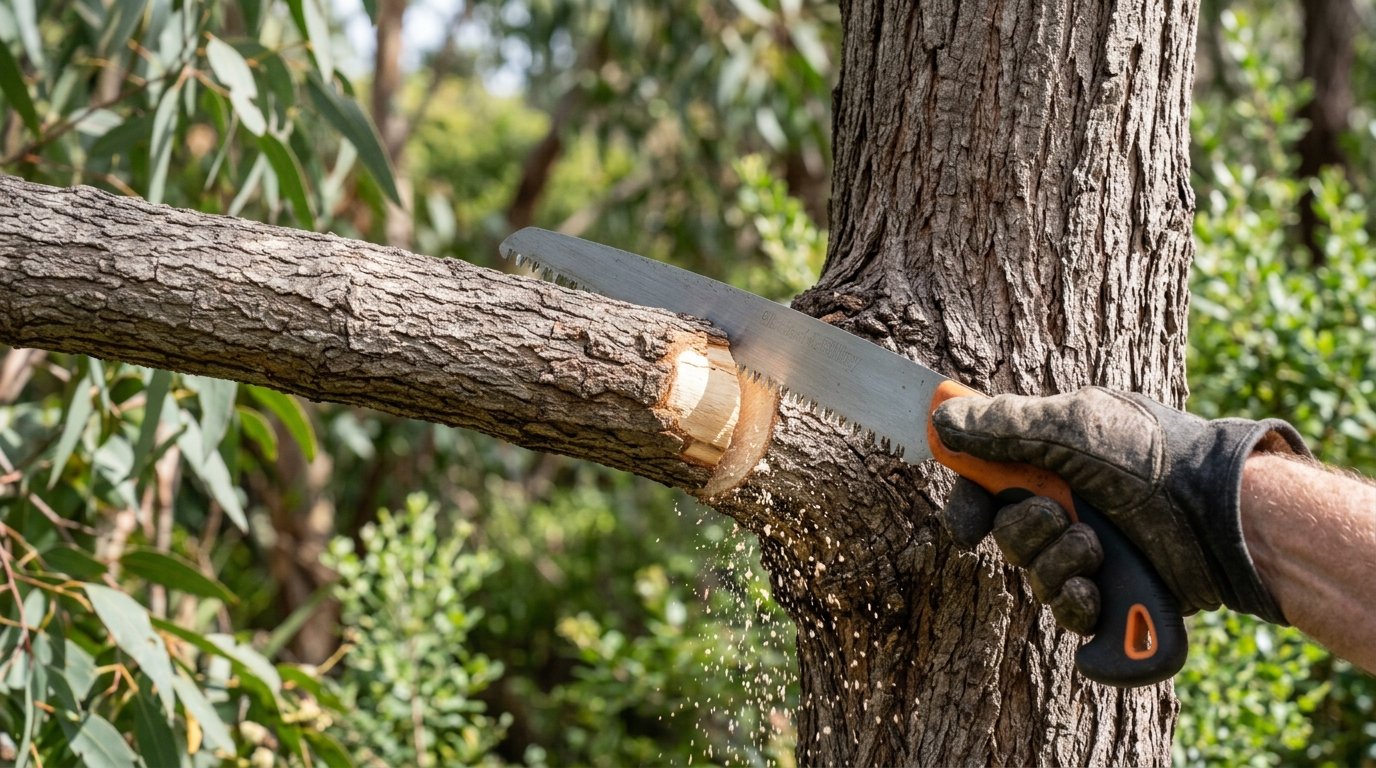
Pole saws place a pruning blade on the end of an extension shaft.
They are useful for tall screens such as Ficus Hillii and larger Lilly Pilly plantings where individual branches sit beyond comfortable ground-level reach.
The advantage is reach. The disadvantage is control.
A long pole magnifies movement, weight and vibration. It also means the branch being cut may fall from above.
Use a pole saw only where you can:
- stand on stable ground;
- keep clear of the drop zone;
- see the cut clearly;
- avoid power lines and structures.
Never prune near power lines yourself
Branches near overhead electrical infrastructure are not a normal DIY pruning job.
Do not use:
- metal pole saws;
- powered pruning tools;
- ladders;
- long-handled tools
near live power lines.
Use a qualified professional or the relevant utility-approved contractor.
Powered pruning saws and mini chainsaws
Compact battery-powered pruning saws sit between hand saws and full chainsaws.
They can be useful for:
- high-volume orchard or garden pruning;
- repeated woody branch removal;
- renovation work where many cuts are required.
They are faster than hand saws but introduce additional hazards:
- powered chain or blade movement;
- battery activation;
- kickback risk on some designs;
- more serious injury potential.
Do not treat a mini chainsaw as simply a faster hand saw. Follow the exact manufacturer’s PPE and operating instructions.
Pull-stroke versus push-stroke saws
Many modern pruning saws, especially Japanese-style designs, cut primarily on the pull stroke.
This matters because pulling keeps the blade in tension rather than compression.
A pull-stroke blade can therefore be:
- thinner;
- less prone to buckling;
- easier to control;
- efficient with relatively little force.
Do not force a pull saw aggressively on the push stroke.
Let the teeth do the work as you draw the blade toward you.
Why pull saws feel easier
On a pull stroke, your arm naturally draws the tool toward your body while the blade remains tensioned.
This can produce a controlled cut with less downward pressure.
The technique is:
- start with short light strokes;
- establish a groove;
- lengthen the stroke once the blade tracks cleanly;
- avoid bending the blade sideways.
Tooth count and TPI: what it means
Tooth count is commonly described as teeth per inch, or TPI.
In general:
- coarser teeth remove material faster;
- finer teeth leave a smoother cut;
- very fine teeth can clog more easily in wet green wood.
Pruning saw manufacturers may describe tooth patterns differently, so do not rely on TPI alone.
Coarse teeth for green wood
Fresh green branches contain moisture and fibres that can clog fine teeth.
Coarse pruning-saw teeth create larger spaces for sawdust and wet fibres to clear.
This suits:
- live hedge branches;
- fruit-tree pruning;
- Lilly Pilly renovation;
- Ficus pruning.
Finer teeth for dry wood and cleaner finishing
Dry, hard timber can be easier to control with a finer tooth pattern.
Finer teeth can also leave a smoother cut on smaller branches.
The trade-off is slower cutting through large fresh stems.
Tooth geometry matters as much as tooth count
Modern pruning saw teeth can be:
- tri-ground;
- razor-ground;
- curved;
- set or unset depending on design.
These details affect:
- cutting speed;
- sawdust clearance;
- how aggressively the blade bites;
- cut smoothness.
Choose a saw designed specifically for pruning rather than comparing garden saws only by TPI.
Blade length: match it to the branches you actually cut
A short blade is easier to control in a dense hedge.
A longer blade allows longer strokes and can cut larger branches more efficiently.
But unnecessarily long blades can be awkward around:
- fences;
- dense branch structures;
- small shrubs;
- formal hedges.
For general suburban use, control usually matters more than owning the longest blade possible.
Curved versus straight pruning-saw blades
Curved blades can help keep the teeth engaged as you pull through a branch, especially when working:
- above shoulder height;
- on larger branches;
- with a pole saw.
Straight blades can feel easier to control in confined spaces and for precise cuts.
Neither shape is universally better.
Impulse-hardened teeth
Many quality pruning saws use impulse-hardened teeth.
The tips are hardened to improve edge retention.
The benefit is long-lasting sharpness.
The trade-off is that these teeth are generally not intended to be resharpened with an ordinary file.
When they eventually become dull or damaged, the practical solution is usually to replace the blade.
Replaceable blades matter
A quality handle can outlast several blades.
Before buying, check whether replacement blades are readily available in Australia.
This is particularly important with premium pruning saws that use hardened tooth profiles.
Blade materials and coatings
Pruning-saw blades are commonly made from hardened steel.
Some also use coatings intended to reduce:
- friction;
- sap build-up;
- surface corrosion.
A coating does not eliminate maintenance.
Green wood can still leave sticky sap that needs cleaning.
Rust resistance matters in humid gardens
Even a high-quality blade can corrode if stored wet.
After pruning:
- remove sap;
- dry the blade;
- apply a light protective oil where appropriate;
- store the saw in its sheath or dry toolbox.
Handle ergonomics
A pruning saw handle should let you pull firmly without your hand sliding toward the blade.
Look for:
- textured grip;
- enough handle length for your hand;
- a hooked or shaped end that resists slipping;
- good balance with the blade.
A saw that cuts aggressively but has an uncomfortable handle becomes tiring quickly.
Folding locks are a real safety feature
A folding saw should lock securely when open.
Ideally, the blade should also be retained safely when closed.
A weak lock can allow:
- the blade to fold toward your fingers;
- the blade to open unexpectedly in a pocket or toolbox.
Check the locking catch before every use.
When to use secateurs, loppers or a saw
| Branch situation | Best starting tool |
|---|---|
| Small live stem | Secateurs |
| Medium branch needing leverage | Loppers |
| Branch too large for comfortable lopper use | Pruning saw |
| Very large, heavy or hazardous branch | Qualified arborist |
The safest pruning tool is usually the smallest tool that can make the cut comfortably and cleanly without excessive force.
When to call an arborist instead
Do not turn a garden renovation into an unsafe tree-removal job.
Professional help is appropriate where:
- the branch is heavy enough to damage property;
- the branch is over a roof, pool, car or fence;
- the cut is above safe ground-level reach;
- power lines are nearby;
- the tree could become unstable;
- large structural branches are involved.
The three-cut method for heavier branches
Heavy branches can tear bark down the trunk if they break before the saw cut is complete.
The three-cut method helps prevent this.
Cut 1: the undercut
Make a shallow cut on the underside of the branch a short distance out from the final pruning point.
This interrupts the bark so that if the branch begins to split, the tear stops at the undercut.
Cut 2: the top cut
Move a little further outward and cut from the top until the branch separates.
The heavy outer branch is now removed without tearing bark into the trunk.
Cut 3: the final cut
Remove the remaining stub with a clean cut just outside the branch collar.
This produces a smaller, better-positioned wound than trying to saw through the entire heavy branch at the collar in one cut.
Do not cut the branch collar off
The branch collar is the slightly swollen area where a branch joins the trunk or larger limb.
It contains tissue important to the tree’s natural wound response.
A flush cut slices that structure away and creates a larger wound.
Make the final pruning cut just outside the branch collar.
Do not leave a long stub either
Leaving a long branch stub creates dead wood that the plant has difficulty sealing around.
The goal is neither:
- flush against the trunk;
- nor several centimetres out for no reason.
Cut just outside the collar.
Clean cuts support better recovery
No pruning cut is literally “healed” like animal skin. Trees compartmentalise wounds and gradually grow tissue around them.
A clean correctly positioned cut gives the plant a better starting point than:
- torn bark;
- crushed wood;
- ragged saw marks;
- unnecessary oversized wounds.
Pruning-saw hygiene matters
Saw teeth and blades contact sap and diseased plant tissue.
Where a transmissible disease is suspected, clean and disinfect the saw before moving to healthy plants.
This is particularly relevant when removing:
- box-blight-affected branches;
- Myrtle-rust-infected growth;
- fungal dieback;
- unknown cankers or lesions.
Clean physical sap and debris first, then disinfect using an appropriate method and allow the blade to dry.
Do not carry disease through the hedge row
Pruning one infected plant and then cutting every healthy plant with the same dirty saw can move contaminated material unnecessarily.
Tool hygiene matters most when disease is genuinely suspected.
For healthy routine pruning, the priority is simply keeping the saw clean, sharp and dry.
Hedge renovation: Ficus Hillii is forgiving
Ficus Hillii is vigorous and generally responds strongly to substantial pruning when healthy.
A pruning saw can therefore be useful when renovating an oversized Ficus hedge by removing individual structural stems before the new canopy is reshaped.
That does not mean every branch should be sawed back indiscriminately. Keep enough healthy framework to rebuild a balanced screen.
Westringia needs the opposite approach
Westringia should not be treated like Ficus.
Old Westringia can be reluctant to reshoot from completely bare old wood.
If a Coastal Rosemary hedge has become woody, a pruning saw is not permission to cut the entire plant back to leafless branches.
Formative light pruning is much safer than severe late renovation.
Lilly Pilly renovation
A mature Lilly Pilly hedge can develop heavier framework branches that are beyond hedge-trimmer or secateur capacity.
A pruning saw is useful for selective thinning or height reduction.
Remove structural stems deliberately rather than shearing repeatedly into thick wood with a hedge trimmer.
Safety when hand-sawing
Pruning saw teeth are extremely sharp.
Use:
- eye protection;
- sturdy gloves suitable for the job;
- secure footwear;
- stable footing.
Keep the free hand out of the saw path.
Never hold the branch immediately behind the blade where your fingers could be hit if the saw jumps through the cut.
Do not saw unsupported above your head
A hand saw used directly overhead creates several risks:
- reduced control;
- sawdust falling into your face;
- the branch dropping toward you;
- difficulty seeing the branch collar.
Use a pole saw from a safe position or hire a professional instead.
Control where the branch will fall
Before cutting a substantial branch, identify:
- its weight;
- its natural lean;
- what is underneath;
- whether another branch will catch it;
- whether it could swing toward you.
If you cannot confidently control the outcome, it is no longer a simple DIY pruning cut.
Cleaning pruning saws
After pruning:
- remove sawdust and plant fragments;
- clean sticky sap and resin with a suitable cleaner;
- dry the blade;
- apply light protective oil where appropriate;
- check the teeth for damage;
- store the blade folded or inside its scabbard.
Sharpening versus replacing the blade
Traditional saw teeth can sometimes be sharpened.
Impulse-hardened pruning-saw teeth usually cannot be sharpened effectively by ordinary hand filing because the hardened tooth tips are specifically treated.
When an impulse-hardened blade becomes worn or damaged, replace the blade.
This is another reason replacement-blade availability matters when choosing a premium saw.
Common pruning-saw buying mistakes
Buying the longest blade available
Long blades help with larger branches but are awkward inside dense hedges.
Using fine teeth for heavy wet green wood
Coarse pruning teeth generally clear fresh fibres more effectively.
Assuming all saws cut on the push stroke
Many modern pruning saws are pull saws. Forcing them forward can buckle or damage the blade.
Ignoring replacement blades
A premium handle has little long-term value if replacement blades are unavailable.
Using a saw instead of loppers on easy cuts
Use the simplest safe tool for the branch.
Sawing into old bare Westringia
Some hedge species do not recover reliably from severe old-wood pruning.
Cutting heavy branches in one pass
Use the three-cut method to reduce bark tearing.
Doing arborist work from a ladder
Large, overhead or structurally important branches require professional assessment.
Where our recommended pruning-saw picks will go
Garden Green has not yet joined an affiliate program and has not completed controlled hands-on comparisons of current pruning-saw models. We therefore are not publishing a fake “best pruning saws” list assembled from product pages.
When recommendations are added, they should be grouped by genuine use case: compact folding saw, frequent fixed-blade pruning saw, pole saw, dry-wood saw and high-frequency professional use.
Quick pick by scenario
| Scenario | Saw type to prioritise |
|---|---|
| Occasional small branches | Folding pull-stroke pruning saw |
| Regular hedge renovation | Fixed-blade pruning saw with replaceable blade |
| Tall screen branches | Pole saw |
| Dry deadwood | Medium/fine tooth pruning saw or bow saw |
| Heavy accessible work | Bow saw or suitable powered pruning saw |
| Large hazardous branch | Qualified arborist, not a bigger DIY saw |
The best pruning saw is the one matched to branch size and access
For most gardeners, our buying order would be:
- decide whether you need folding, fixed or pole reach;
- choose tooth geometry suited to live or dry wood;
- match blade length to the branches you actually prune;
- check the lock and handle ergonomics;
- confirm replacement blades are available;
- use the correct three-cut technique on heavier branches;
- call an arborist when weight, height or infrastructure turns pruning into a hazard.
A pruning saw is most useful when it fills the gap between loppers and professional tree work. It should make a difficult branch manageable—not encourage you to tackle a branch that is unsafe to control.
Frequently asked questions
What type of pruning saw is best for most Australian gardens?
A folding pruning saw is the best starting point for many gardeners because it is compact, safe to store and suitable for branches that are too large for secateurs or loppers. Frequent pruning work may justify a fixed-blade saw, while high branches are better handled with a pole saw.
Why do pruning saws cut on the pull stroke?
Many modern pruning saws use Japanese-style pull cutting because pulling keeps the thin blade in tension, which improves control and reduces the chance of buckling. Start with light strokes and let the teeth cut rather than forcing the blade forward.
Are coarse or fine teeth better for pruning?
Coarse teeth are generally better for fast cutting through live green wood because they clear wet fibres and sawdust more easily. Finer teeth can give better control and a smoother cut on smaller or dry branches. Choose according to the wood you prune most often.
Can impulse-hardened pruning saw teeth be sharpened?
Usually not with normal hand sharpening. Impulse-hardened tooth tips are treated for long edge life and are generally replaced when they become dull or damaged. Check that replacement blades are available before buying a premium saw.
What is the three-cut method for pruning branches?
First make a shallow undercut, then make a top cut slightly further out to remove the heavy branch, and finally remove the remaining stub just outside the branch collar. This reduces the risk of bark tearing down the trunk as the branch falls.
Should I cut a branch flush with the trunk?
No. Avoid cutting through the branch collar. Make the final cut just outside the collar so the tree retains the tissues involved in its natural wound response. Also avoid leaving an unnecessarily long dead stub.
When should I use a pruning saw instead of secateurs or loppers?
Use secateurs for small stems, loppers where extra leverage is enough, and a pruning saw when the branch is too large for comfortable lopper use. Very large, heavy, overhead or hazardous branches should be handled by a qualified arborist rather than by simply choosing a bigger saw.
Do pruning saws need to be disinfected between plants?
Yes when pruning diseased material or moving from an infected plant to a healthy one. Clean sap and debris first, then disinfect appropriately and dry the blade. This is especially important with transmissible problems such as box blight, Myrtle rust and fungal dieback.


