
Best Tap Timers Australia: How to Choose

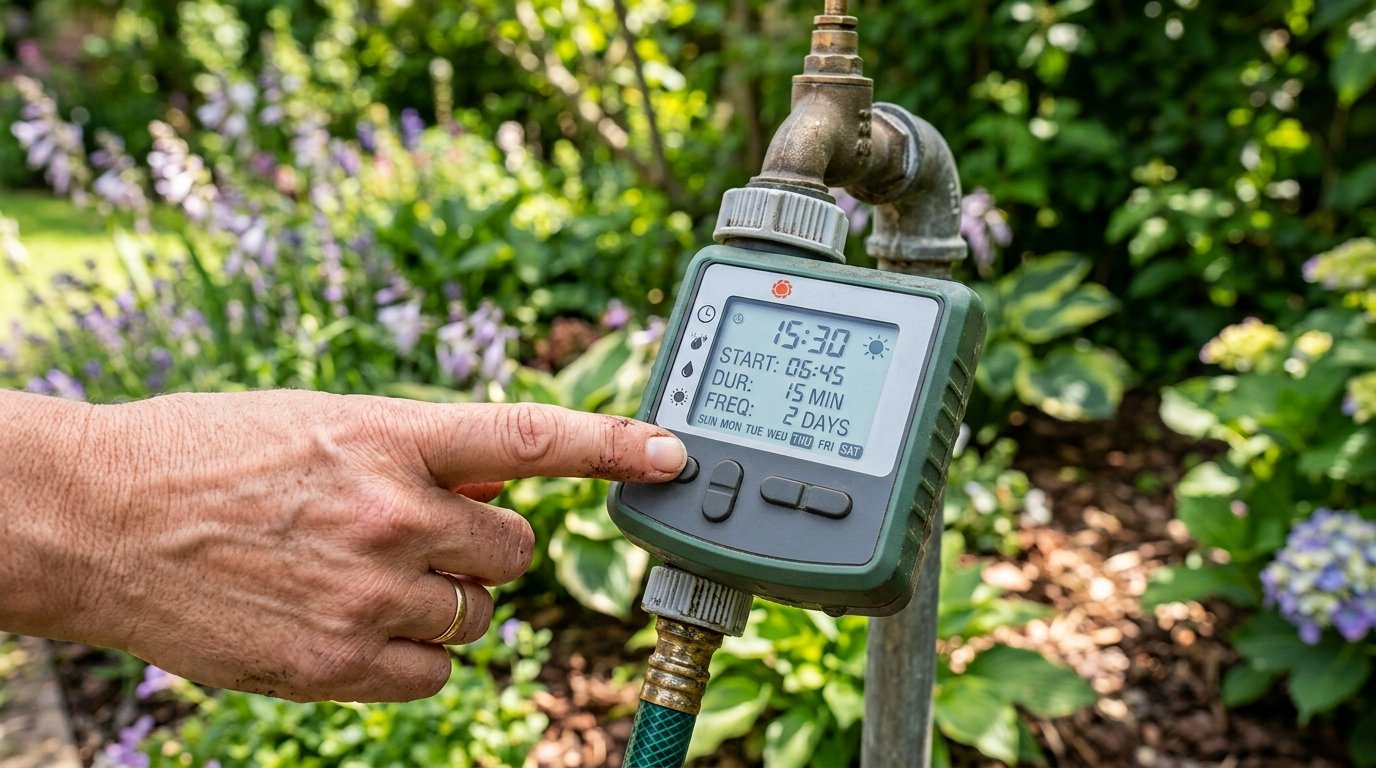
For most Australian gardens, a simple digital tap timer is the best starting point because it can water on set days, at set times and for a set duration without requiring a full irrigation controller. Mechanical countdown timers suit one-off watering, dual-outlet timers suit two separate zones from one tap, Bluetooth models add phone control nearby, and Wi-Fi smart timers make more sense when you want remote access, weather-aware skipping or several automated watering points.
The most important reason to use a timer is consistency. New hedges and young trees do not care whether you were busy, away for the weekend or simply forgot to water. A timer removes that human failure point—but it also introduces new ones: flat batteries, stuck valves, grit, pressure limits and incorrect programming can all stop watering or, in a worst case, leave water running.
Brands commonly available in Australia include Gardena, Holman, Hoselink, Pope, Nylex, Hunter, Rain Bird and Orbit. Garden Green has not yet joined an affiliate program or completed controlled side-by-side timer testing, so this guide does not publish live retailer links, prices, invented battery-life claims or fake “best timer” rankings. Instead, it explains which timer type fits which garden and which specifications actually matter.
Quick pick: which irrigation timer suits your garden?
| Scenario | Best starting timer type | Why |
|---|---|---|
| Single new hedge | Digital single-outlet tap timer | Reliable scheduled start, frequency and duration |
| Front and back watering from one tap | Dual-outlet / two-zone tap timer | Two independently controlled watering circuits |
| Going on holiday | Digital or smart timer with dependable schedules and fresh batteries | Automates watering while you are away |
| Want weather or moisture-aware watering | Wi-Fi smart timer with rain/moisture integration | Can reduce unnecessary watering after rain |
| Want phone setup but no home hub | Bluetooth timer | App programming while within wireless range |
| Simplest possible one-off watering | Mechanical countdown timer | No complex schedule programming required |
Mechanical tap timers: simple countdown watering
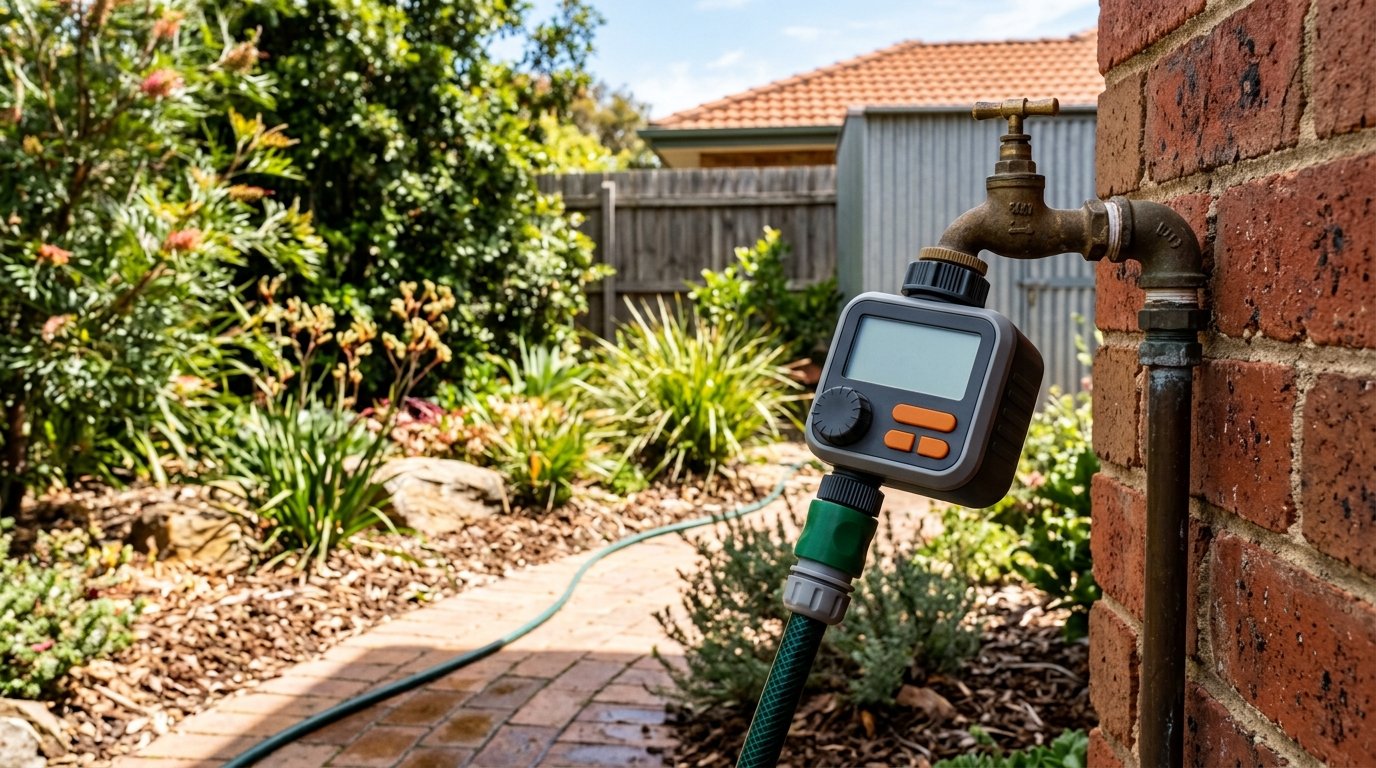
A mechanical tap timer is the simplest form of automatic shut-off.
You turn a dial to choose how long the water should run, and the timer closes after that period.
It is useful for:
- one-off sprinkler watering;
- soaking a garden bed while you do something else;
- preventing the classic “I forgot the tap was on” problem;
- gardeners who do not want digital programming.
The limitation is important: a basic mechanical countdown timer usually does not create a repeating weekly watering schedule.
You have to activate it each time.
Digital single-outlet tap timers
For most home irrigation jobs, digital single-outlet timers offer the best balance of automation and simplicity.
Typical programmable functions can include:
- watering start time;
- watering duration;
- selected days;
- watering interval or frequency;
- manual override.
Hoselink’s current Australian automatic timer range, for example, supports scheduled watering and manual watering between programmed events, while Holman sells electronic digital timers alongside mechanical and smart systems.
This type is well suited to a single hedge, drip line, sprinkler zone or garden bed.
Dual-outlet and two-zone tap timers
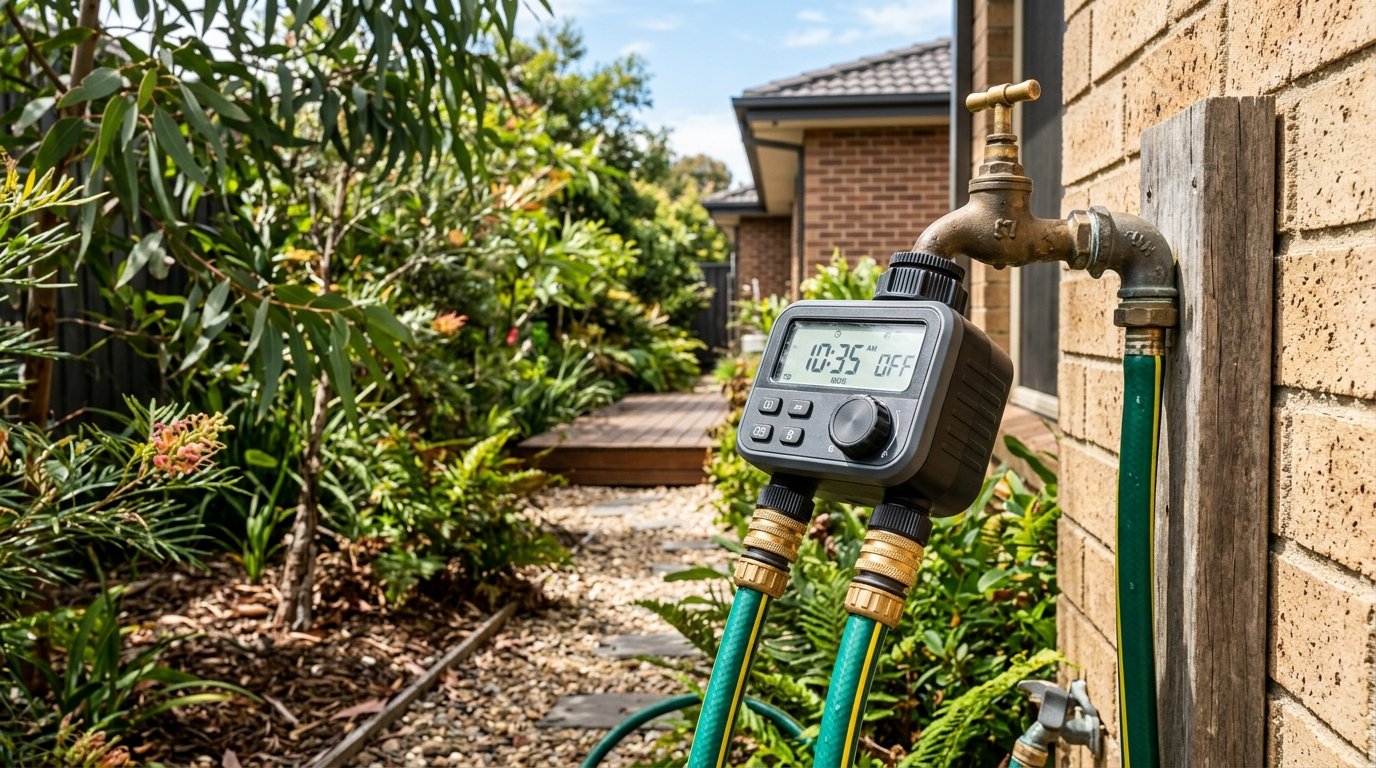
A dual-outlet timer lets one tap supply two separate watering circuits.
That can be useful where one outlet runs:
- a front hedge;
- and the second runs a lawn, rear garden or vegetable bed.
The value is independent control.
A new hedge may need a different schedule from an established lawn. Running both from one simple splitter with the same timing can overwater one area or underwater the other.
Before buying a multi-zone timer, check whether the outlets are genuinely independently programmable rather than simply two connections controlled by one shared schedule.
Bluetooth tap timers
Bluetooth timers move the programming interface from tiny buttons on the timer to a smartphone app.
That can make scheduling easier, particularly if the tap is low, cramped or difficult to read.
Current Australian products from Holman and Hoselink include Bluetooth tap timers with app-based programming and manual override.
Bluetooth is best understood as nearby wireless control.
You usually need to be within Bluetooth range unless the system also uses a separate Wi-Fi gateway.
Wi-Fi smart tap timers
Wi-Fi-connected systems add remote access.
Holman’s current Australian WX range, for example, uses a Wi-Fi hub to let users control compatible tap timers remotely and can integrate with a soil-moisture sensor.
A Wi-Fi timer can be useful when:
- you travel frequently;
- several taps need central control;
- you want to change watering remotely during unexpected weather;
- you want moisture-sensor or other smart automation;
- you prefer app-based schedules over physical timer buttons.
The trade-off is complexity.
You now depend on:
- the timer;
- batteries;
- the app;
- wireless connection;
- possibly a hub;
- the manufacturer continuing to support the software.
For one small hedge, that may be unnecessary.
Smart does not automatically mean better watering
A poorly programmed Wi-Fi timer can overwater just as efficiently as a simple digital timer.
The real advantage is not the app itself.
It is the ability to combine:
- reliable schedules;
- manual changes;
- weather awareness;
- soil-moisture information;
- several watering zones.
If you do not need those features, a simpler timer can be more robust and easier to troubleshoot.
Why timers matter for new hedge establishment
A timer is especially useful during the establishment period because new plants have a limited root system and can dry out much faster than mature hedges.
A newly planted Lilly Pilly hedge needs consistent root-zone watering while roots expand beyond the original nursery root ball.
Waterhousea floribunda also appreciates reliable establishment moisture because of its rainforest and riparian background.
A timer helps remove the “forgot to water” failure, but it does not remove the need to check the soil.
If a timer is running faithfully into waterlogged clay, automation simply makes the overwatering more consistent.
Deep watering versus frequent shallow watering
The goal for many new hedges is to wet the actual root zone rather than repeatedly dampening only the top layer.
A timer can help by running an appropriate drip or soaker system for a deliberate period.
But there is no universal runtime that suits every Australian garden.
Watering needs change with:
- soil type;
- weather;
- plant size;
- mulch;
- dripper output;
- root development;
- recent rainfall.
Use the timer to deliver consistency, then verify the result by checking soil moisture.
Rain sensors and rain-skip features
Watering after substantial rain is usually wasteful and can contribute to wet-root problems.
Some tap timers use a physical rain sensor. Hoselink’s current Australian automatic timer range includes a rain-sensor version designed to cancel scheduled watering when wet weather is detected.
Other smart systems can integrate weather, moisture or rain information through connected sensors or software.
The useful goal is the same:
skip irrigation when the garden has already received enough water.
Rain skip versus weather-based automation
These are related but not identical.
A physical rain sensor reacts to local wet conditions at the sensor.
A smart weather-based system may use:
- weather forecasts;
- rainfall data;
- connected soil sensors;
- user-set thresholds.
Weather-based automation can be more flexible, but it is also more dependent on connectivity and software.
Soil-moisture sensors can be more useful than forecast data
A weather forecast tells you what may have fallen from the sky.
A soil-moisture sensor can tell the irrigation system something about conditions where the roots actually are.
Holman’s current smart watering system includes compatible moisture sensors that report soil moisture and temperature to supported timers.
That can be useful where:
- rainfall is uneven;
- garden beds sit under eaves;
- soil retains water for a long time;
- automatic schedules risk running when the root zone is already wet.
Water restrictions still apply to automated timers
A tap timer does not override local watering rules.
Australian water restrictions vary between:
- states;
- water authorities;
- councils;
- drought-response levels.
Some rules specify allowed days, times, sprinkler use or trigger-nozzle requirements.
Holman markets some timer functions as water-restriction friendly because they allow specific day selection, but you still need to program the timer to comply with the current rules where you live.
Always check your local water authority rather than copying a schedule from another city.
Battery type: check before you buy
Most tap timers use replaceable household batteries rather than mains power.
Depending on design, current Australian timers may use:
- AA batteries;
- AAA batteries;
- 9V batteries;
- other specified battery arrangements.
There is no single standard.
Hoselink’s current automatic and Bluetooth timers, for example, use AA batteries on some models, while Holman’s Bluetooth and Wi-Fi timers also use replaceable AA batteries in current ranges.
Use the battery type specified by the manufacturer.
Why battery condition matters more than expected
The battery does more than power a display.
On many electronic timers it also provides the energy needed to operate the internal valve.
A weak battery can therefore lead to:
- missed watering;
- failure to open;
- failure to close properly;
- lost programming on some designs;
- unreliable operation.
Hoselink specifically warns on some current timer products that lower-voltage rechargeable batteries may not operate the internal valve correctly and recommends the battery type stated for the timer.
That is why “whatever battery fits” is not good enough.
Does a timer fail open or fail closed?
This is one of the most important questions to ask before relying on a timer while you are away.
Different valve designs can behave differently when:
- the battery becomes flat;
- electronics fail;
- the mechanism jams.
Do not assume every timer automatically closes safely on low battery.
Check the manufacturer’s manual for:
- low-battery behaviour;
- valve position on battery failure;
- backup memory;
- manual shut-off procedure.
Hoselink’s own current guidance for one manual timer advises reducing tap pressure when leaving home for long periods because any product can fail and water loss is possible.
That is a sensible reminder that automatic irrigation should not be treated as zero-risk plumbing.
Solenoid valves versus purely mechanical timers
Electronic tap timers commonly use a solenoid-operated internal valve.
The timer tells the valve when to open and close.
This allows detailed schedules but creates dependence on:
- battery voltage;
- clean water passages;
- sufficient operating pressure;
- the solenoid moving freely.
A simple mechanical countdown timer uses a different mechanism and can avoid some electronic failure modes, but it also offers much less scheduling control.
Water pressure requirements matter
Not every tap timer will work correctly at every pressure.
Current Australian timer specifications show that manufacturers commonly state both minimum and maximum operating pressure.
Hoselink and Holman, for example, publish operating-pressure ranges for current timer models.
This matters where:
- the property has unusually low pressure;
- the timer is fed by a gravity tank;
- the water supply uses a pump;
- pressure is unusually high;
- several downstream devices restrict flow.
Check the actual timer specification instead of assuming it will operate on any tap.
Minimum pressure is particularly important for tank systems
A timer that works perfectly on mains water may fail to open or close reliably when supplied by low-pressure gravity feed.
If your garden runs from:
- a rainwater tank;
- a header tank;
- a low-pressure pump;
verify the minimum operating pressure before buying.
Timers also restrict flow
Every timer places a valve and internal passages into the water path.
That introduces some restriction.
This may not matter for a short drip line, but it can become relevant with:
- long hoses;
- multiple sprinklers;
- wide garden zones;
- already low supply pressure.
Your garden hose, timer and downstream irrigation all form one hydraulic system.
Filters and washers prevent grit problems
Many tap timers use a small inlet screen, filter washer or similar protection.
Its job is to stop grit and debris reaching the valve.
That matters because particles can:
- prevent a valve sealing fully;
- cause slow leaks;
- jam internal components;
- reduce flow.
Check and clean the inlet filter periodically, especially where the water source carries sediment.
A stuck-open timer may just have debris in the valve
If a timer continues passing water after it should have closed, possible causes include:
- grit on the valve seat;
- low battery voltage;
- mechanical damage;
- solenoid failure;
- excessive pressure.
Turn the tap off first, then troubleshoot according to the manufacturer’s instructions.
Do not leave a faulty timer pressurised while hoping it corrects itself.
Connecting a timer to drip irrigation
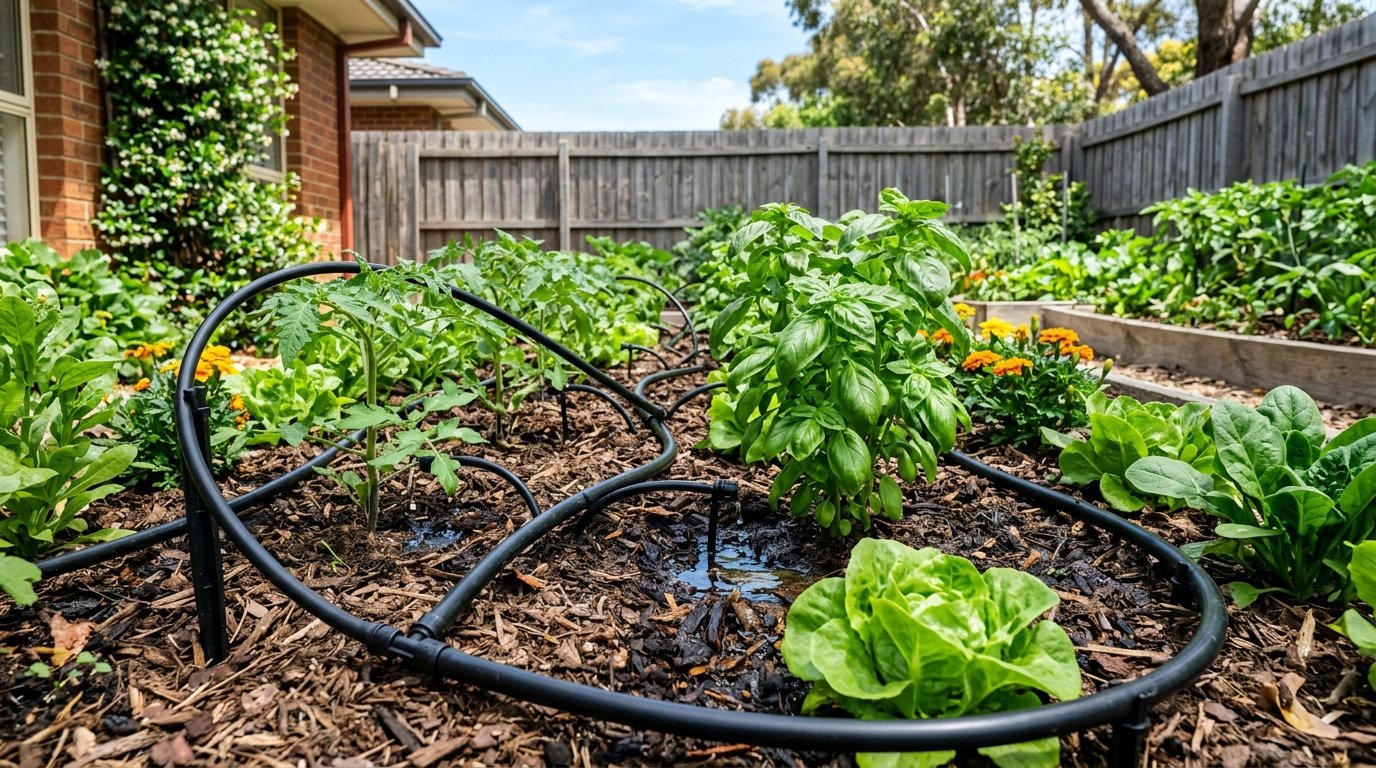
Tap timers work particularly well with drip systems because both are designed around slow, repeatable root-zone watering.
A typical setup can be:
- tap;
- timer;
- pressure regulator where required;
- filter;
- irrigation tube;
- drippers.
Some kits combine several of these components.
Follow the irrigation manufacturer’s pressure requirements because some drip components need regulation downstream of mains pressure.
Connecting a timer to a soaker hose
A soaker or weeper hose can work well for hedges where water needs to be distributed along a line.
The useful combination is:
- timer for schedule;
- soaker hose for slow distribution;
- regular soil checks to confirm the full row is receiving water.
Do not assume water reaches the end of a very long soaker line evenly. Layout, pressure and hose length all affect performance.
Connecting a timer to sprinklers
Sprinklers often demand more flow than drip systems.
If sprinkler throw becomes poor after adding a timer, check:
- available pressure;
- timer flow restriction;
- hose bore;
- hose length;
- connector restrictions;
- how many sprinklers are running simultaneously.
Sometimes the timer is not faulty—the watering system is simply asking for more flow than the supply can deliver.
Manual override is more useful than it sounds
A good timer should let you water manually without deleting the programmed schedule.
That is useful when:
- a newly planted shrub needs extra water;
- you have just applied fertiliser;
- weather has been unusually hot;
- you want to test a drip line;
- you need water immediately while working in the garden.
Current timers from Holman and Hoselink include manual watering or bypass functions on various models.
Two zones can solve more problems than one smart zone
Different parts of a garden often need genuinely different watering.
For example:
- a new Waterhousea screen may need reliable establishment moisture;
- an established native bed may need far less frequent irrigation;
- a lawn may have completely different timing again.
A two-zone timer can be more useful than an expensive smart single-zone timer if the actual problem is separating those watering requirements.
Multiple smart zones
For larger properties, Wi-Fi ecosystems can control several tap timers from one hub.
Holman’s current Australian smart range, for example, supports multiple compatible timers through its Wi-Fi hub.
This can help organise:
- front hedge;
- rear hedge;
- vegetable garden;
- pots;
- lawn.
The more zones you add, the more important clear naming and schedule documentation become.
Cold weather and frost
Tap timers contain valves and internal passages that hold water.
If that trapped water freezes, expansion can damage the body or valve.
Current Holman Bluetooth and Wi-Fi timer specifications explicitly state that those models should not be used in freezing conditions.
In frost-prone areas:
- disconnect timers where the manufacturer recommends it;
- drain water from them;
- store them protected from freezing conditions;
- reinstall after severe frost risk has passed.
Australian sun and heat
A tap timer spends its life in one of the harshest garden positions: attached to exposed plumbing, often with no shade.
Australian summer conditions can subject the housing to strong UV and high temperatures.
Look for:
- outdoor-rated construction;
- weather-resistant battery seals;
- a suitable IP/weather rating where provided;
- UV-resistant materials;
- a tap position that avoids unnecessary western-sun exposure where practical.
Do not wrap a timer in a sealed plastic bag to “protect” it unless the manufacturer specifically recommends that method; trapped condensation can create its own problems.
Common tap-timer problems
The valve stays closed
Check:
- battery condition;
- programming;
- minimum water pressure;
- manual mode;
- inlet filter blockage.
The valve stays open
Turn the tap off and inspect for:
- debris;
- low battery;
- valve failure;
- damaged seals.
The timer leaks at the tap
Check:
- thread alignment;
- washer condition;
- tap adaptor size;
- cracks from overtightening.
The timer keeps resetting
Likely causes include:
- weak battery;
- poor battery contact;
- water entering the battery compartment;
- electronic fault.
The irrigation barely flows
Check the whole system:
- water pressure;
- timer restriction;
- filter blockage;
- hose diameter;
- downstream regulators;
- too many emitters or sprinklers.
Holiday watering: automate carefully
A timer is one of the most useful tools for keeping a garden alive while you are away.
But do not install it for the first time the night before leaving.
Run the complete system beforehand and check:
- every programmed start;
- every zone;
- drip-line coverage;
- leaks;
- battery condition;
- what happens when watering stops.
For a long absence, consider replacing batteries with fresh manufacturer-recommended cells before leaving.
If practical, reduce unnecessary risk by having someone periodically inspect the garden and watering system.
Where our recommended tap-timer picks will go
Garden Green has not yet joined an affiliate program and has not completed controlled long-term comparisons of current irrigation timers. We therefore are not publishing a pretend “best timers” ranking based only on product descriptions.
When recommendations are added, they should be grouped by genuine use case: basic countdown, single-zone digital, dual-zone, Bluetooth, Wi-Fi/weather-smart and low-pressure-compatible watering.
Common timer-buying mistakes
Buying smart features when you only need a countdown
More electronics are not useful if the watering job is simple.
Ignoring minimum operating pressure
This is especially important for rainwater tanks and low-pressure systems.
Assuming batteries only power the display
Electronic valves may depend on correct battery voltage to open and close.
Failing to check low-battery behaviour
Know whether the timer fails open, closed or unpredictably before trusting it unattended.
Ignoring the inlet filter
Small amounts of grit can interfere with valve sealing.
Running every garden zone on the same schedule
New hedges, lawns, vegetables and established shrubs rarely need identical watering.
Leaving frost-sensitive timers outside through freezing conditions
Drain and remove them where the manufacturer requires winter protection.
Programming around someone else’s water restrictions
Check your own local authority’s current watering rules.
Quick pick by scenario
| Scenario | Timer type to prioritise |
|---|---|
| Set-and-forget single hedge | Digital single-outlet timer |
| Multiple zones from one tap | Dual-outlet / two-zone timer |
| Going on holiday | Digital or smart timer with proven schedules and fresh batteries |
| Want weather-smart watering | Wi-Fi timer with rain/moisture integration |
| Want phone setup nearby | Bluetooth timer |
| Simplest possible shut-off | Mechanical countdown timer |
| Rainwater tank / low pressure | Timer specifically compatible with the available pressure |
Build the whole watering system together
A timer is only one component.
A practical automated setup may include:
- tap;
- timer;
- filter;
- pressure regulator where required;
- garden hose or irrigation tube;
- hose reel where manual watering is also used;
- drippers, soaker hose or sprinkler;
- soil checks to confirm the schedule is actually working.
Automation is useful only when the physical watering system underneath it is sound.
The best timer is the simplest one that reliably fits your watering job
For most buyers, our decision order would be:
- decide how many independent watering zones you need;
- check the available water pressure;
- choose mechanical, digital, Bluetooth or Wi-Fi according to the level of control you genuinely need;
- check battery requirements and low-battery behaviour;
- look for manual override;
- add rain or moisture skipping where overwatering is a realistic risk;
- program it within current local water restrictions;
- verify the soil rather than trusting the timer blindly.
The best timer is not the one with the most app features. It is the one that opens when it should, closes when it should and helps your plants receive consistent water without turning the garden into a permanently wet automated system.
Frequently asked questions
What type of tap timer is best for a new hedge?
A digital single-outlet tap timer is the best starting point for many new hedges because it can run on selected days, at selected times and for a set duration. Pair the schedule with soil checks so establishment watering remains consistent without keeping the root zone permanently wet.
Are mechanical tap timers automatic?
A basic mechanical timer usually provides automatic shut-off after a selected run time, but it does not normally create a repeating weekly schedule. You set it manually each time. Choose a digital timer if you want recurring watering without returning to the tap.
Is Bluetooth or Wi-Fi better for an irrigation timer?
Bluetooth is useful for app-based programming while you are near the timer. Wi-Fi is better when you want remote access, several connected watering points or smart weather/moisture functions. Wi-Fi systems are more complex and may require a hub or reliable home network.
Will a tap timer work with low water pressure?
Only if the timer’s specified operating range includes your available pressure. Electronic valve timers often require a minimum pressure to operate reliably. This is particularly important with gravity-fed rainwater tanks and low-pressure pump systems.
What happens if the battery dies in a tap timer?
Behaviour depends on the timer design. A weak or flat battery may prevent an electronic valve from opening or closing correctly, and some timers may lose settings. Check the manufacturer’s low-battery and fail-safe behaviour rather than assuming every timer automatically fails closed.
Can I connect a tap timer to drip irrigation or a soaker hose?
Yes. Tap timers work well with drip irrigation and soaker hoses because they provide repeatable scheduled watering. Check whether the downstream system also needs a filter or pressure regulator, and inspect the soil periodically to make sure water is reaching the full root zone.
Should I use a rain sensor with an irrigation timer?
A rain sensor or weather/moisture skip can help prevent unnecessary watering when the garden is already wet. It is especially useful on automatic systems that would otherwise run regardless of rainfall. The timer should still be programmed to comply with current local water restrictions.
Can I leave a tap timer outside all winter?
Not always. Some current Australian tap timers specifically warn against use in freezing conditions because trapped water can damage the valve or housing. In frost-prone areas, follow the manufacturer’s instructions about disconnecting, draining and storing the timer during severe cold.


