
Waterhousea floribunda: Weeping Lilly Pilly Size, Hedge and Growing Guide Australia

Related lilly pilly guide: growing and hedging Syzygium australe (the classic lilly pilly).
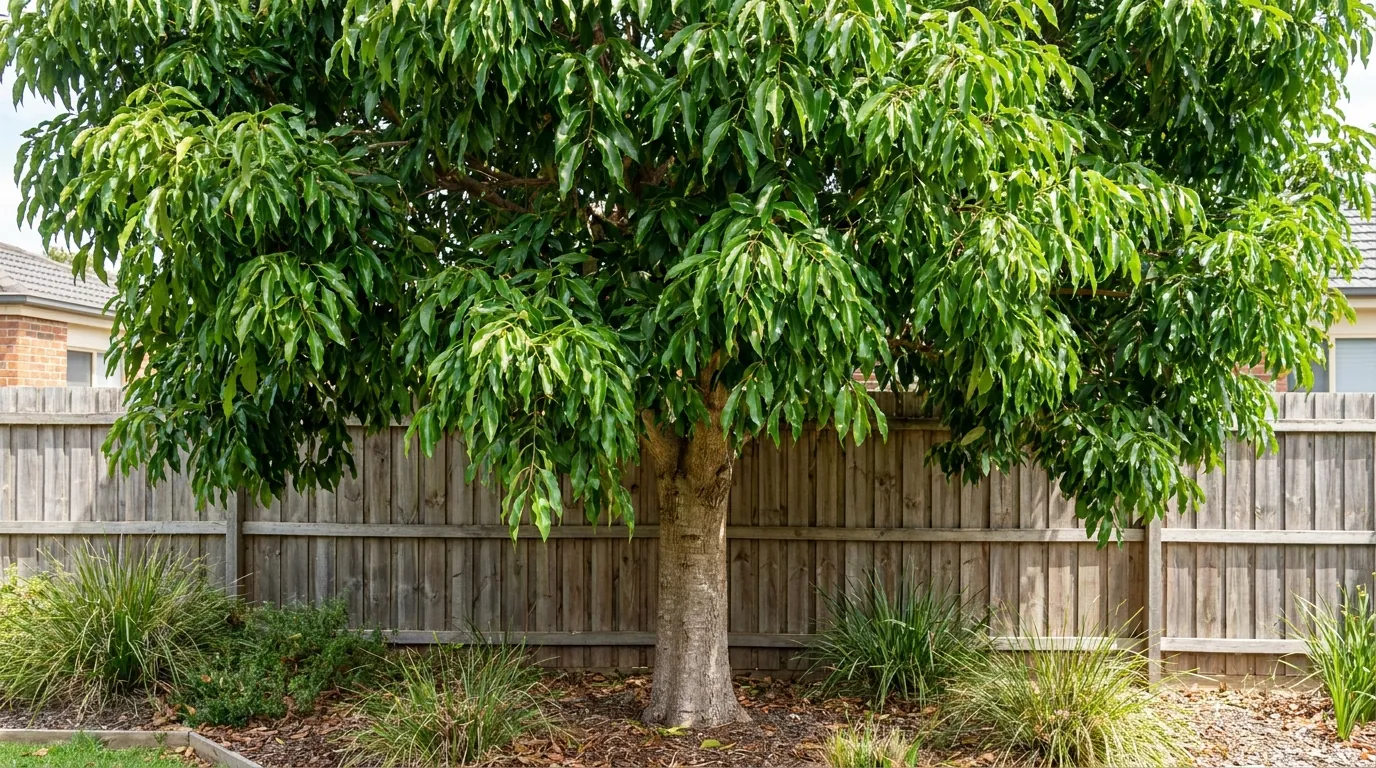
Waterhousea floribunda, the Weeping Lilly Pilly, is a large evergreen Australian tree that is commonly grown as a privacy screen or clipped hedge. For garden planning, the South Australian Plant Selector+ lists about 7–8 m high and 2.5–3 m wide, while commercial landscape sources commonly publish unpruned heights of roughly 8–12 m or more. Plantmark says it can be maintained as a dense 4–5 m hedge when planted at about 1.5 m centres.
That distinction matters. We do not think of Waterhousea as a naturally small hedge plant. It is a substantial tree that happens to tolerate pruning very well. Used in enough space, its pendulous foliage makes a soft, deep screen; planted too tightly against a building or narrow path, its natural scale eventually becomes the main maintenance problem.
Tree size and hedge size are two different things
| Australian source | Published height | Published width / hedge detail |
|---|---|---|
| SA Plant Selector+ | 7–8 m | 2.5–3 m spread |
| Plantmark | 4–10 m mature profile | 4–10 m profile; can be maintained as a 4–5 m hedge |
| Arbornet | 6–12 m | Size estimate given at 10 years |
| Warners ‘Warners Select’ | To 12 m | To 7 m wide |
| Nursery Warehouse | 10–15 m | 4–8 m wide |
The published numbers vary because some nurseries are describing selected forms, some are describing managed landscape trees, and others are allowing for much larger unpruned specimens. The useful conclusion is not to choose one “correct” maximum. It is to allow for a large tree unless you are deliberately committing to hedge maintenance.
On jobs, this is where we separate a screening plant from a screening strategy. Waterhousea can make an excellent hedge, but the hedge stays at 4 or 5 metres because somebody keeps it there—not because the species naturally stops at that height.
Its natural habitat explains a lot about how it grows
NSW PlantNET records Waterhousea floribunda as widespread in riverine rainforest, often lining stream banks from the Hunter Valley north through coastal New South Wales and into Queensland.
Queensland Government vegetation mapping goes further: in some riverine forest communities, Waterhousea is a predominant or dominant tree along stream channels.
That background helps explain three garden traits at once: it appreciates reliable moisture, it develops into a real canopy tree when allowed to grow, and it handles the deep, fertile conditions found along watercourses better than many dryland screening plants.
It does not mean the garden root zone should remain stagnant. The best landscape results still come from soil that holds useful moisture but also drains and stays aerated.
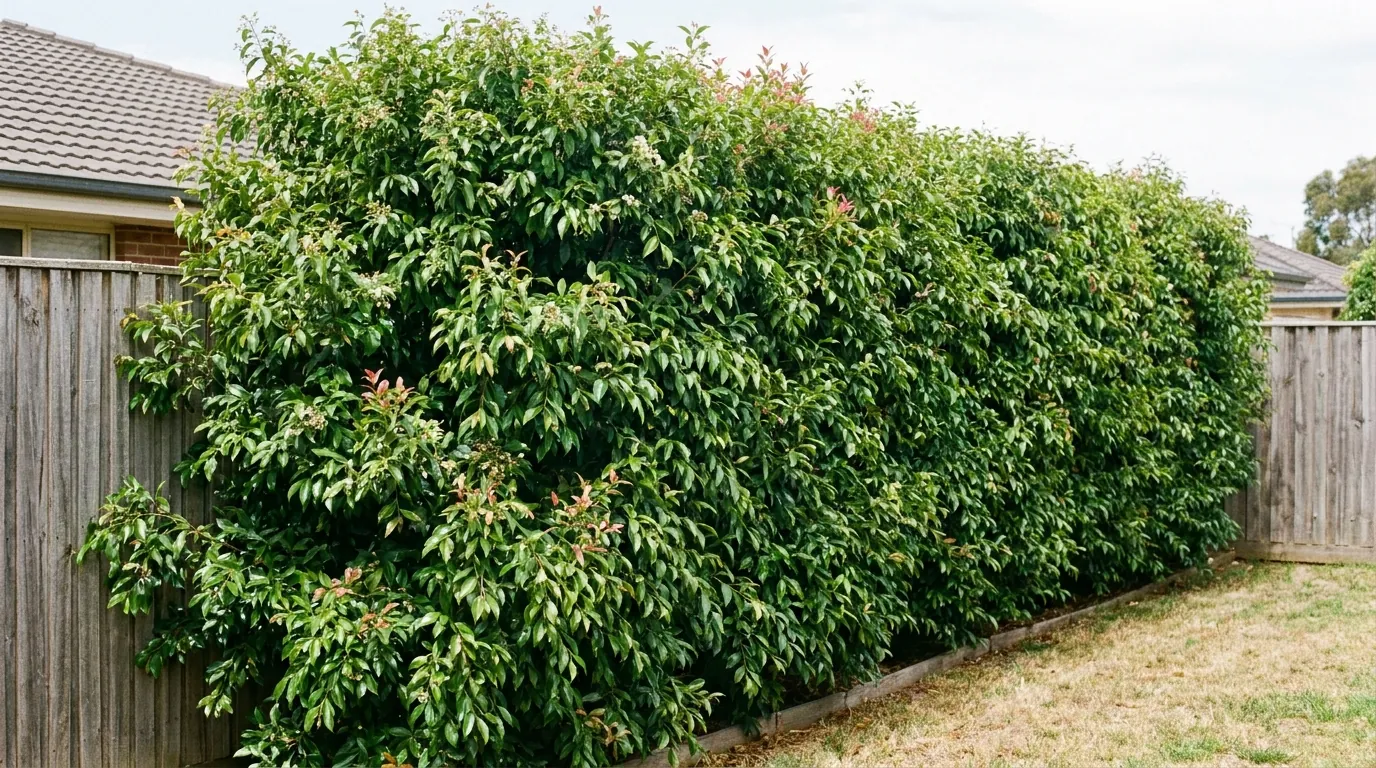
For a hedge, 1–1.5 m spacing is the useful Australian range
Plantmark publishes 1.5 m spacing for hedging. Budget Wholesale Nursery gives roughly 1–1.5 m for dense screens using larger stock, while its smaller-stock listing suggests around 0.8–1 m where a tighter hedge and faster visual closure are wanted.
That gives us a real-number planning range rather than a vague “plant close together” instruction.
| Planting approach | Published spacing | Likely design effect |
|---|---|---|
| Tighter formal hedge | About 0.8–1 m | Quicker overlap; more pruning and competition later |
| Dense privacy screen | About 1–1.5 m | Common balance between closure and mature clump space |
| Individual trees / avenue use | Several metres apart | Allows separate crowns instead of one continuous hedge |
In our own layouts, we do not choose spacing from the number alone. We also look at the starting stock size, how high the hedge is meant to finish, how much maintenance access remains behind it and whether the client wants a clipped wall or a softer weeping screen.
A Waterhousea hedge planted tightly against a fence can look excellent from the front and still become difficult to reach from the back. Access is part of the design.
The weeping habit is what separates it from a boxy Lilly Pilly hedge
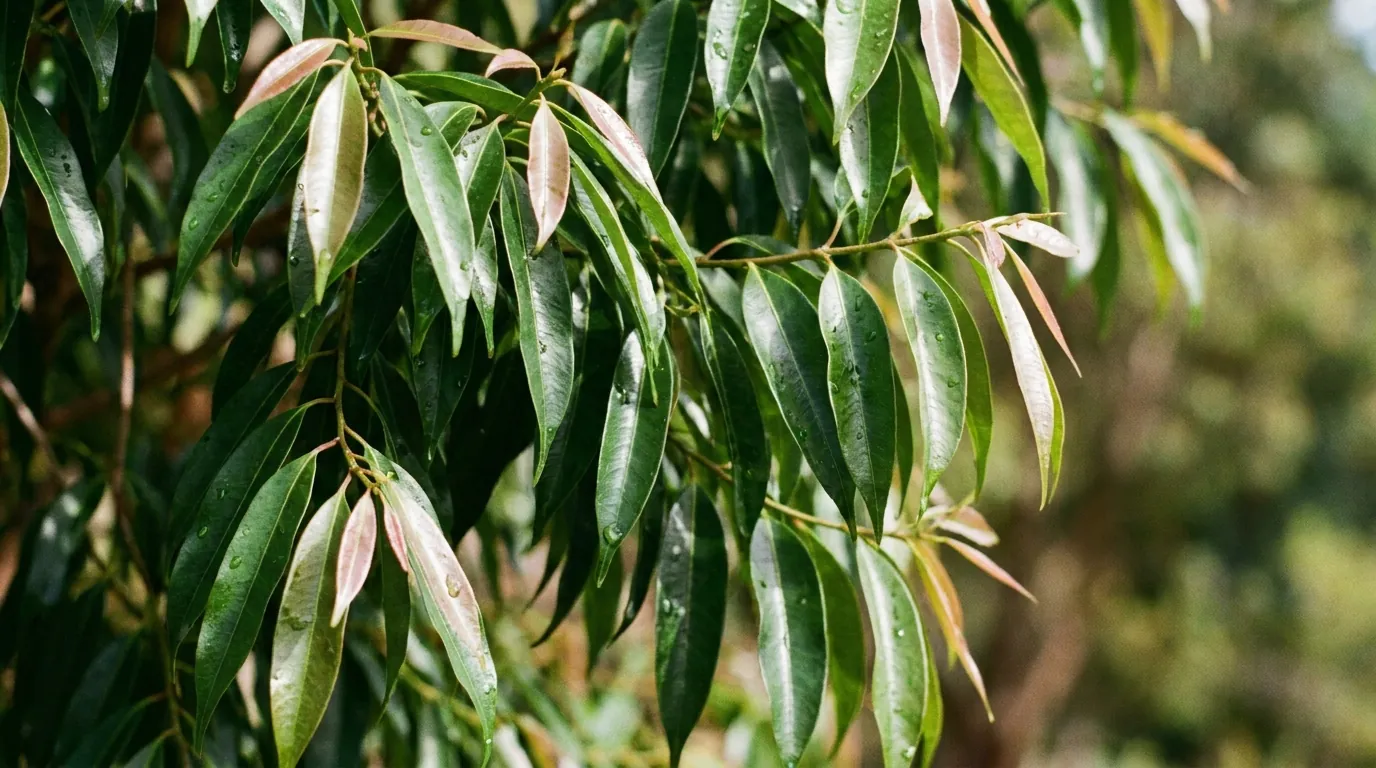
Waterhousea naturally develops pendulous outer growth. Plantmark describes the habit as pendulous, and the species is widely sold specifically for the softer effect this creates in screening and avenue planting.
That is what we try to preserve when using it informally. If every new shoot is repeatedly clipped into a rigid vertical face, the plant still functions as a hedge, but much of the reason for choosing Waterhousea over a more upright Lilly Pilly has been lost.
For a formal boundary we prune more frequently and keep the outline controlled. For an informal screen, we let the outer foliage hang and move, trimming mainly to manage height, density and encroachment.
There is no trustworthy species-wide centimetres-per-year growth rate
You will find commercial pages claiming annual growth figures. One Australian nursery currently gives 50–80 cm per year for its landscape material, while a selected ‘Green Avenue’ listing gives 30–60 cm per year. Australian Plants Society NSW, however, says the species may be slow growing while remaining long-lived in suitable conditions.
Those numbers and descriptions are too inconsistent to present as if the species has one measured national growth rate.
We would rather judge Waterhousea by what matters on the site: whether new shoots are extending through the warm season, whether tip pruning is producing denser branching, and whether the screen is beginning to close at the target height.
If a supplier provides a growth figure for a named selection grown in its own production system, treat it as supplier guidance for that material—not a biological constant for every Waterhousea floribunda in Australia.
Starting stock can change the screening timeline dramatically
Arbornet’s advanced-tree size chart is useful because it shows what larger nursery stock can look like before planting. It lists examples around 1–1.5 m in 15 L to 30 cm/25 L stock, around 1.5–2 m in 25–45 L stock, and around 2–2.5 m in 45–75 L containers.
Those are nursery size references, not fixed pot-size rules. They illustrate the same principle we see on installations: a client buying a 2 m plant is buying time as well as biomass.
For a tall privacy job, advanced stock can change the garden immediately. Smaller plants are easier and cheaper to handle, but the hedge has more vertical and horizontal filling to do after installation.
Flowers and fruit are attractive—but pruning changes how much you see
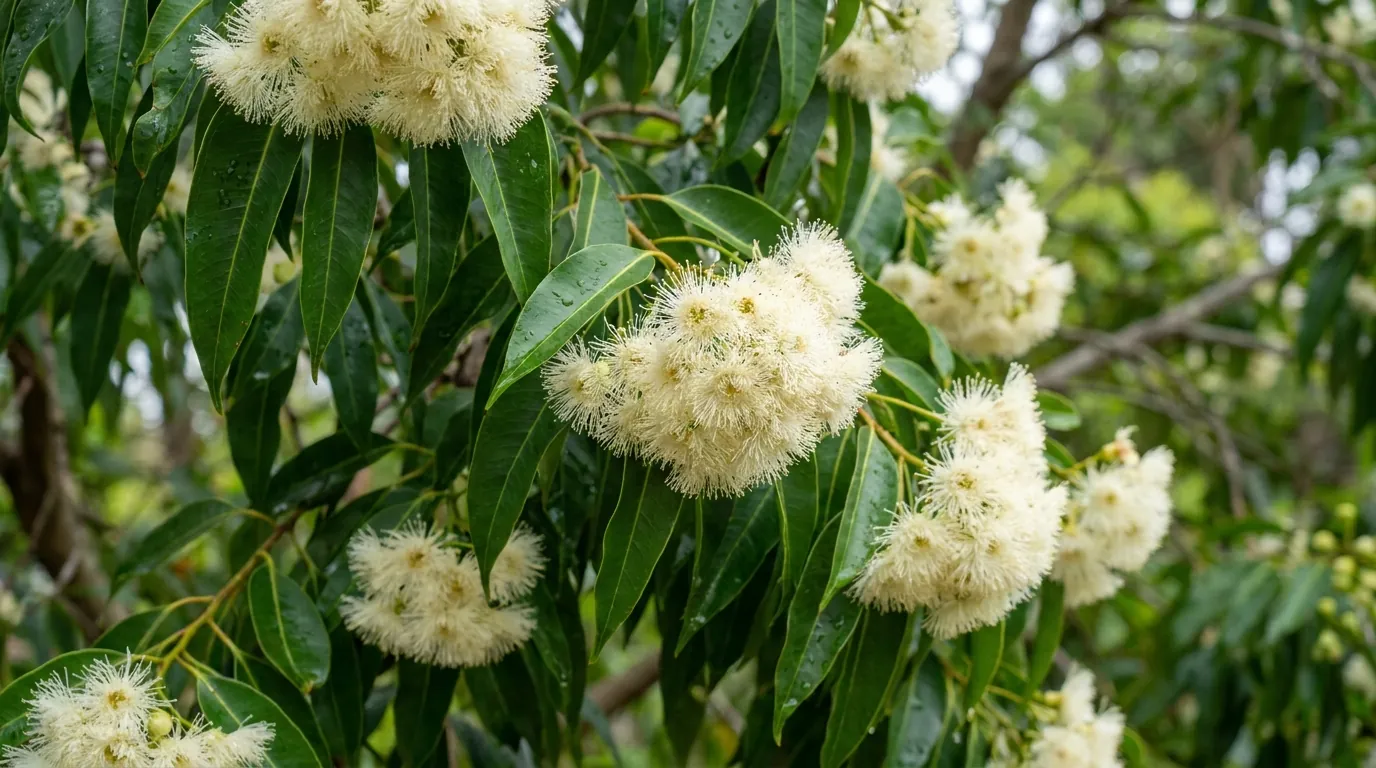
PlantNET records flowering in the species from August to October in its NSW flora treatment. The flowers are white, with stamens around 3–7 mm long. The same botanical source records rounded fruit around 15–20 mm in diameter, green with a reddish tinge as it matures.
Garden and nursery descriptions often extend visible flowering into spring and summer, which reflects both climate and cultivated material. We would therefore describe Waterhousea as a spring-to-early-summer flowering tree in garden use rather than promising one calendar window nationwide.
Pruning matters too. A heavily clipped hedge sacrifices some flowers simply because flowering material is being removed. Warners specifically notes that pruning at flowering can be used where fruit is not wanted.
If wildlife and seasonal flowers are part of the reason for planting it, leave at least some sections long enough to flower instead of clipping every new flush immediately.
The fruit and canopy support wildlife
Australian Plants Society NSW lists Waterhousea as attractive to birds, while Queensland Government riverine-forest information identifies Waterhousea-dominated communities as important habitat for fruit-eating birds.
The tree also produces a dense evergreen canopy, which adds shelter as well as food value.
In our mixed native screens, we prefer that combination over planting a single-species green wall wherever space allows. Waterhousea can provide the tall evergreen framework while lower shrubs and flowering natives diversify the habitat beneath and in front of it.
Full sun or part shade both work
The South Australian Plant Selector+ lists full sun and part shade, as do Plantmark and several current Australian landscape nurseries.
For screening, we favour useful light because it supports denser foliage. Australian Plants Society NSW notes that Waterhousea can become leggy and develop gaps if it is not pruned appropriately, and insufficient light can make that open appearance harder to correct.
Part shade is entirely workable. Deep shade behind buildings or under established tree canopies is different; the plant may survive, but expecting the same dense hedge you would get in brighter conditions is unrealistic.
Waterhousea likes moisture, but it is not limited to wet ground
Its riverbank ecology can make Waterhousea sound like a plant that needs permanently wet soil. Garden sources paint a more useful picture.
The South Australian Plant Selector+ lists clay, loam and sand across acidic, neutral and alkaline soil categories. Mackay Regional Council says the species performs best with regular watering but can tolerate extended dry periods once established. Australian Plants Society NSW recommends supplementary water particularly during hot, dry conditions.
On jobs, we aim for consistent establishment moisture, mulch to reduce evaporation and enough drainage that the soil does not remain airless. Once the tree has established a much larger root system, it is considerably more resilient than the newly planted nursery specimen.
A practical watering and feeding rhythm
There is no useful Australia-wide rule such as “water twice every week forever”. The establishment stage, soil texture and weather matter too much.
- After planting: Water deeply through the original root ball and surrounding soil and keep checking that zone while roots establish.
- Spring: As active growth increases, a suitable slow-release fertiliser can support new foliage; Warners recommends a spring application for its Waterhousea selection.
- Summer: Supplement water during hot or dry periods, especially for young hedges where the roots have not spread far beyond the planting holes.
- Autumn and winter: Match irrigation to actual soil moisture and growth rather than carrying a summer schedule into cool, wet weather.
We prefer a moist, mulched root zone over frequent shallow sprinkling. Mulch should sit over the soil rather than being piled against the trunk.
Pruning determines whether you get a tree or a hedge
Plantmark says Waterhousea can be kept as a dense 4–5 m hedge, and the South Australian Plant Selector+ says pruning can maintain shape and produce thicker foliage. Australian Plants Society NSW similarly recommends pruning for denser growth and warns that unpruned plants can become leggy.
That matches what we see. Early tip pruning matters more than waiting until a screen is several metres tall and then cutting huge sections off it. Small repeated cuts encourage branching closer to the body of the hedge and make it easier to keep foliage lower down.
For major reshaping, commercial Sydney guidance favours active growth through spring and summer. We avoid severe pruning during extreme heat or drought stress, when the tree has fewer resources available for recovery.
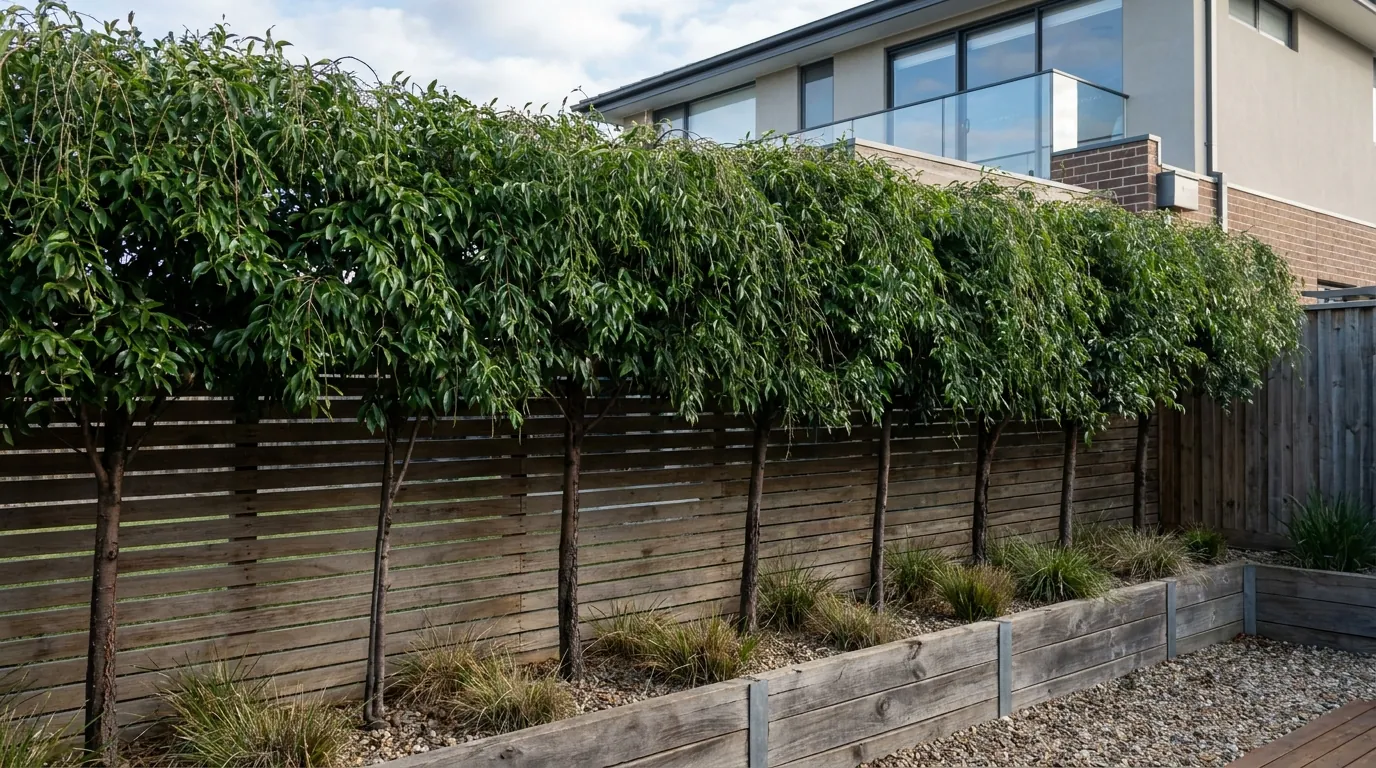
Can it be pleached?
Yes. Plantmark specifically lists Waterhousea as suitable for pleaching because the foliage can be retained low or the trunks can be cleared to create a raised screen.
That gives the species another useful landscape role: privacy above a fence or sightline while keeping the lower garden visually open.
It is a different maintenance strategy from hedging. Instead of forcing foliage from ground level upward, the lower branches are progressively removed and the upper canopy is trained into the screening plane.
Be cautious with “non-invasive roots” claims
Several commercial nursery listings describe Waterhousea roots as non-invasive or non-aggressive. We would not use that wording as a guarantee for siting a large tree beside pipes, paving or foundations.
What authoritative ecology tells us is that Waterhousea naturally grows along creek banks and its root systems help stabilise those banks. It is also used as a substantial urban street and shade tree by Australian councils.
That is enough reason to plan for a real tree-sized root system.
There is no authoritative universal setback distance that applies to every soil, structure and Waterhousea specimen, so we do not publish a made-up “safe at X metres” rule. Around buildings, retaining walls, pools or drainage infrastructure, mature tree size and site-specific advice matter more than the word “non-invasive” on a nursery page.
Frost and drought: tougher than its rainforest origin suggests
The South Australian Plant Selector+ lists Waterhousea as tolerant of moderate frost and drought, while Australian Plants Society NSW reports tolerance of light frost and cool climates. Warners says established plants can tolerate light frost although tender new growth may still be affected.
Those are useful garden observations, but this remains a species native to northern NSW and Queensland riverine rainforest. We would expect an established tree in a sheltered temperate garden to cope better with cold than a young plant facing repeated hard frost.
In frost-prone areas, protect young trees during establishment and avoid interpreting a general “frost tolerant” label as immunity to every cold event.
Psyllids and Myrtle Rust deserve watching
Waterhousea is sometimes marketed as being free from the psyllid problems associated with other Lilly Pillies, particularly selected cultivars. The broader species evidence is not that simple.
Australian Plants Society NSW states that Waterhousea floribunda can be attacked by psyllids and also notes susceptibility to Myrtle Rust.
We therefore inspect distorted new growth rather than assuming the species is automatically psyllid-proof. A selected cultivar may perform differently from ordinary seed-grown Waterhousea, so cultivar-specific nursery claims should remain attached to that cultivar.
Waterhousea or a smaller Lilly Pilly?
| If you need… | Waterhousea floribunda makes sense when… |
|---|---|
| A tall 4–5 m clipped screen | You have the width and are willing to prune regularly |
| A large informal privacy tree | You can accommodate a canopy several metres wide |
| A pleached screen | You want privacy above an open lower trunk |
| A narrow 1.5–2 m suburban hedge | A naturally smaller Lilly Pilly cultivar will usually be easier to maintain |
| A feature shade tree | You have room for its mature canopy and weeping form |
For us, this is the key buying decision. Waterhousea is excellent when the landscape genuinely needs a large evergreen screen or graceful shade tree. It is a poor choice when the available space demands a permanently narrow little hedge and every metre of growth will have to be fought with pruning.
Frequently asked questions
How big does Waterhousea floribunda grow?
The South Australian Plant Selector+ lists about 7–8 m high and 2.5–3 m wide in cultivation. Australian commercial tree sources commonly publish larger unpruned dimensions of around 8–12 m or more, so treat Waterhousea as a substantial tree unless it will be kept smaller by pruning.
How far apart should Weeping Lilly Pillies be planted for a hedge?
Current Australian landscape sources commonly use about 1–1.5 m centres for dense screening. Some nurseries recommend around 0.8–1 m for a tighter formal hedge. Closer spacing fills sooner but also creates more long-term competition and pruning.
How tall can a Waterhousea hedge be kept?
Plantmark specifically says Waterhousea floribunda can be maintained as a dense 4–5 m high hedge. Lower hedges are possible with more regular pruning, but for permanently small screens a naturally smaller Lilly Pilly cultivar is usually easier to manage.
How fast does Waterhousea floribunda grow?
There is no reliable species-wide annual rate. Australian commercial estimates range from about 30–60 cm to 50–80 cm per year for particular nursery material, while Australian Plants Society NSW says the species may be slow growing. Treat supplier rates as guidance for that stock rather than a universal biological figure.
When does Weeping Lilly Pilly flower?
NSW PlantNET records flowering from August to October in the wild NSW flora treatment. Garden and nursery sources often describe flowering through spring into summer, so the exact display varies with climate, pruning and cultivated material.
Does Waterhousea floribunda have invasive roots?
There is not enough authoritative evidence to promise that a large Waterhousea has universally “non-invasive” roots. It is naturally a riverbank tree with a substantial stabilising root system. Give it sensible room from structures and seek site-specific advice around foundations, pools, retaining walls or drainage infrastructure.
Is Waterhousea floribunda frost tolerant?
Australian garden references describe it as tolerant of light to moderate frost once established. Young trees and tender new growth are more vulnerable, so frost-prone gardens should provide extra protection during establishment.
Can Waterhousea floribunda be grown as a pleached screen?
Yes. Plantmark specifically lists Waterhousea as suitable for pleaching. Lower branches can be removed progressively while the upper canopy is trained and clipped to create elevated privacy above an open trunk.


