
Best Hose Reels Australia: How to Choose

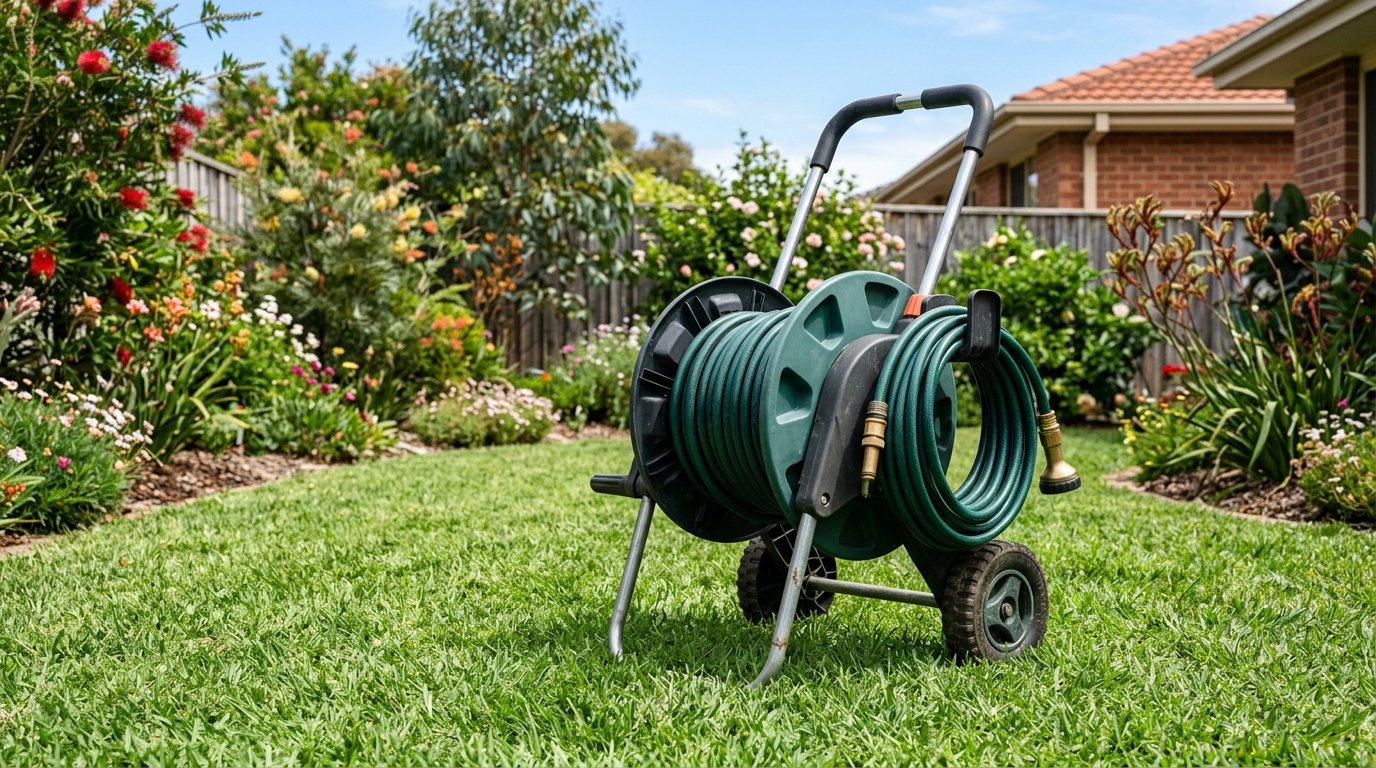
For most Australian homes with one regularly used outdoor tap, a wall-mounted retractable hose reel is the most convenient option because it stores the hose neatly, keeps much of it out of direct sun and removes the need to hand-wind after every watering session. A manual reel is simpler and easier to service, a cart reel suits properties where the watering point moves, and a basic hose hanger can be all you need for a short hose in a small courtyard.
The best hose reel is not simply the one with the longest hose or biggest plastic housing. The important questions are whether the reel suits your wall, tap position, hose length, garden layout and willingness to maintain the rewind mechanism. In Australian conditions, UV exposure and heat also matter because both the hose and the reel housing can age quickly if left exposed year-round.
Brands widely available in Australia include Hoselink, Gardena, Pope, Nylex and Hills. Garden Green has not yet joined an affiliate program or completed controlled long-term testing of current hose-reel models, so this guide does not publish live retailer links, prices, invented rewind-cycle tests or unverified durability claims. Instead, it explains how each reel type works and what to check before buying.
Quick pick: which hose reel type suits your garden?
| Scenario | Best starting reel type | Why |
|---|---|---|
| Small courtyard | Simple hose hanger or compact wall reel | Minimal storage footprint and easy access |
| One fixed outdoor tap used often | Wall-mounted retractable reel | Fast storage and convenient daily use |
| Large garden with several watering zones | Portable cart reel or multiple fixed reels | Mobility or distributed access reduces long hose runs |
| Need to move between taps or areas | Cart / free-standing reel | Easy relocation without permanent mounting |
| Harsh full-sun position | Enclosed UV-resistant wall reel or shaded manual reel | Protects more of the hose from direct sun |
| Want simple repairability | Manual hand-wind reel | Fewer moving parts than an auto-retractable system |
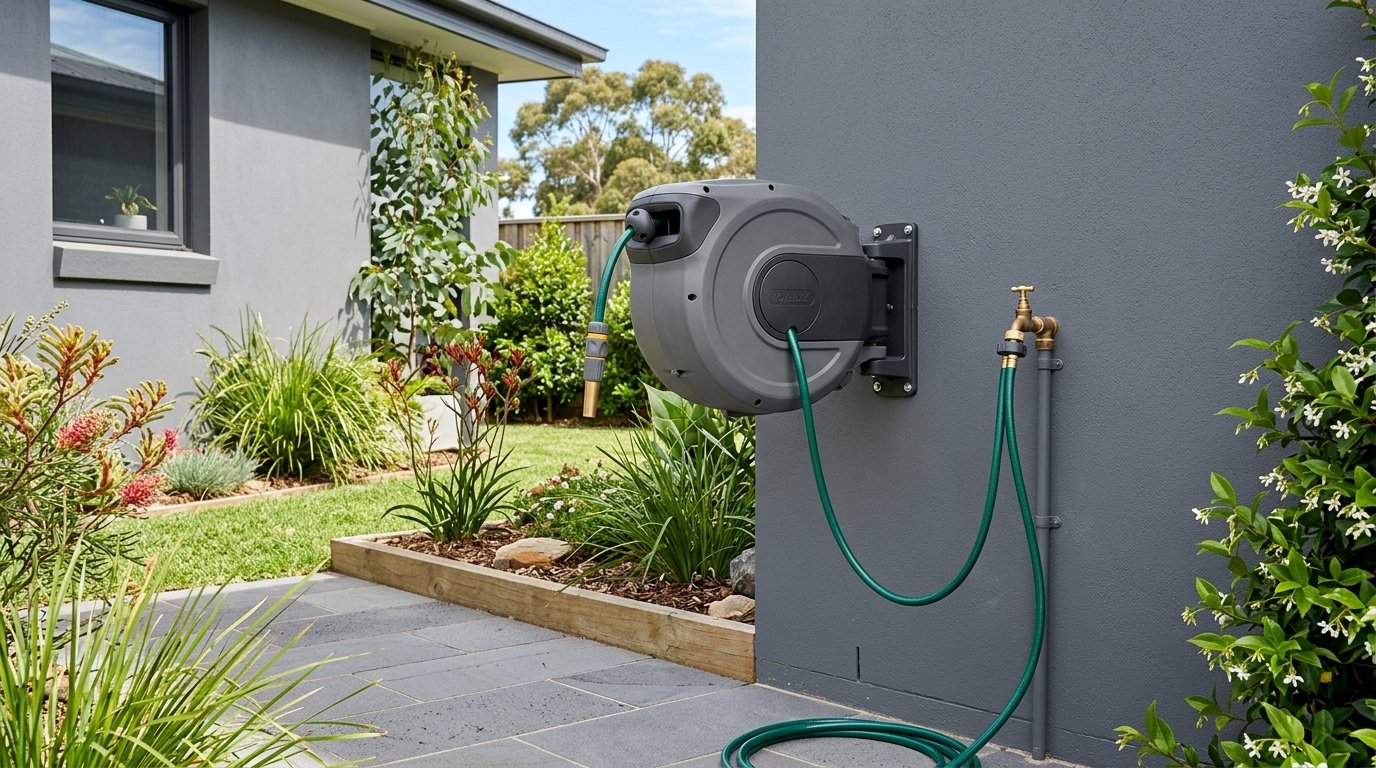
Wall-mounted retractable hose reels
Retractable reels are popular because they solve one of the biggest practical problems with garden hoses: people are far more likely to put the hose away if storage takes only a few seconds.
The usual system combines:
- a wall-mounted housing;
- a spring-loaded rewind mechanism;
- a locking or ratchet system that holds the hose at selected lengths;
- a swivel bracket so the reel follows the direction of pull;
- a short leader hose connecting the reel to the tap.
For regular watering of hedges, lawns and garden beds, that convenience can be more valuable than small differences in hose specifications.
How auto-rewind mechanisms work
Most retractable hose reels use an internal spring that stores energy as the hose is pulled out.
A locking or ratchet mechanism lets the user stop the hose at useful positions. When the lock is released, the spring rewinds the hose into the housing.
The exact mechanism varies by manufacturer, but the buying questions are similar:
- does the hose lock reliably at practical lengths?
- does the reel rewind evenly?
- does it guide the hose across the spool rather than pile it in one place?
- does the return feel controlled rather than violent?
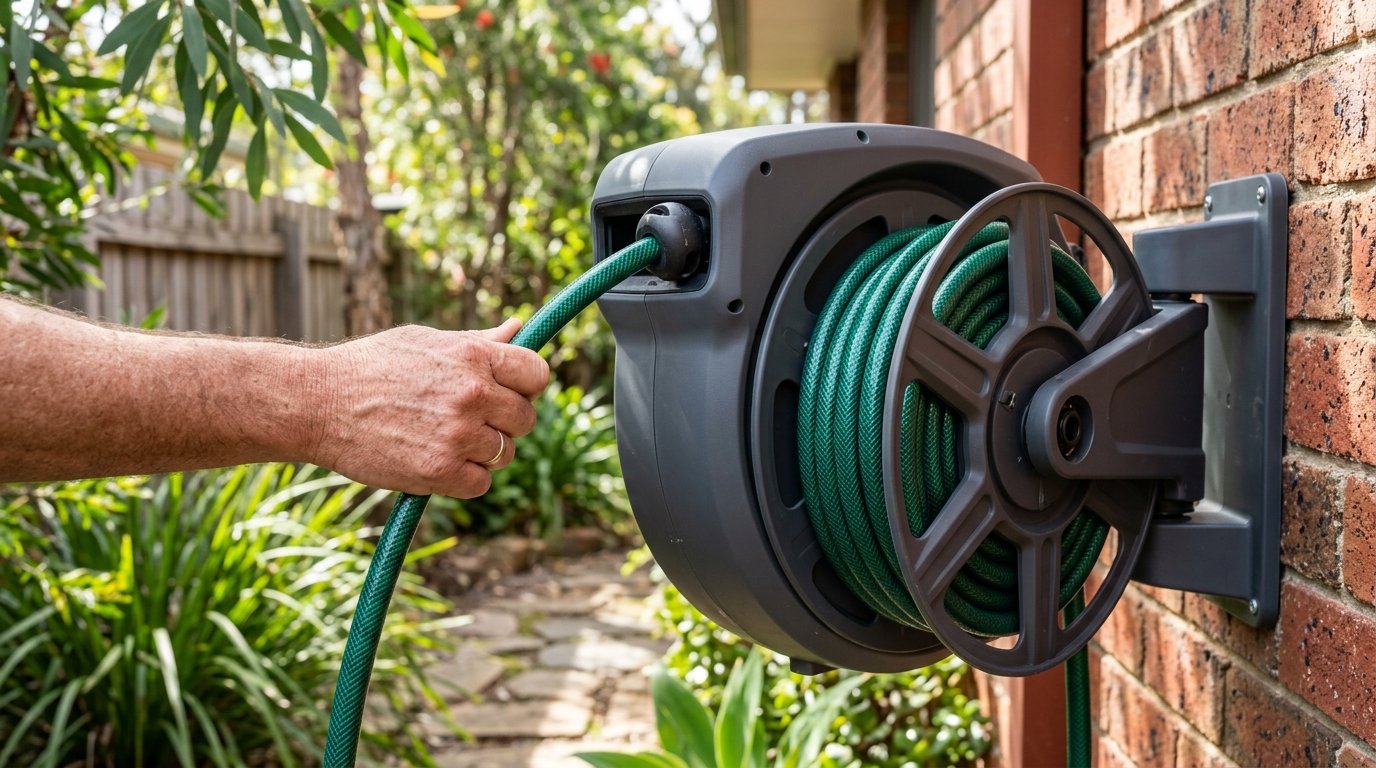
Controlled slow-return is a genuine safety feature
A hose under strong spring tension can move quickly if released carelessly.
A fast uncontrolled rewind can:
- whip the hose end;
- strike nearby objects;
- drag fittings across paving;
- surprise children or pets;
- damage the spray gun if it is allowed to hit the housing.
Many better retractable systems use controlled or slowed return mechanisms to reduce this behaviour.
Whatever reel you buy, guide the hose back rather than simply releasing it and walking away.
Manual wall-mounted hose reels
Manual reels use a crank or handle rather than an internal spring.
The main advantages are simplicity and serviceability.
There is no automatic rewind mechanism to fail, and the user controls exactly how quickly the hose is wound.
They suit gardeners who want:
- fewer moving parts;
- the ability to choose and replace the hose separately;
- a fixed storage point without the complexity of spring rewind;
- long-term simplicity over maximum convenience.
The disadvantage is effort. Winding a long wet hose can become noticeably harder, especially when the hose is heavy or dragging across grass.
Portable cart reels
A cart reel carries the hose on a wheeled frame rather than fixing it permanently to one wall.
This is useful where:
- there are several taps;
- the property is large;
- one reel needs to serve front and back gardens;
- permanent wall mounting is not practical;
- the user wants to store the hose indoors or in a shed after use.
The downside is that the reel itself becomes another object to move and store.
Cart reels on grass and gravel
Small hard wheels that roll perfectly on paving can be awkward on:
- soft lawn;
- loose gravel;
- mulch;
- uneven paths.
If the cart will cross rough ground regularly, wheel size and frame stability matter more than appearance.
Simple hose hangers and hose pots
Not every garden needs a mechanical reel.
A simple wall hanger can work well for:
- short hoses;
- small courtyards;
- occasional watering;
- gardeners happy to coil by hand.
Hose pots provide a decorative alternative where the hose needs to disappear visually when not in use.
The limitation is that poor hand-coiling can introduce twists and kinks, so the hose still needs to be stored with large relaxed loops.
Auto retractable versus manual: the real trade-off
| Factor | Auto retractable | Manual reel |
|---|---|---|
| Convenience | Very high | Moderate |
| Rewind effort | Low | User provides the effort |
| Mechanical complexity | Higher | Lower |
| Serviceability | Depends heavily on design | Usually simpler |
| Hose replacement | May be model-specific | Usually straightforward |
| Upfront simplicity | Integrated system | Reel and hose can be chosen separately |
For a homeowner who waters several times a week, auto-retract convenience can be worth the extra mechanism. For someone who values long-term simplicity and easy hose replacement, a manual reel can be the better system.
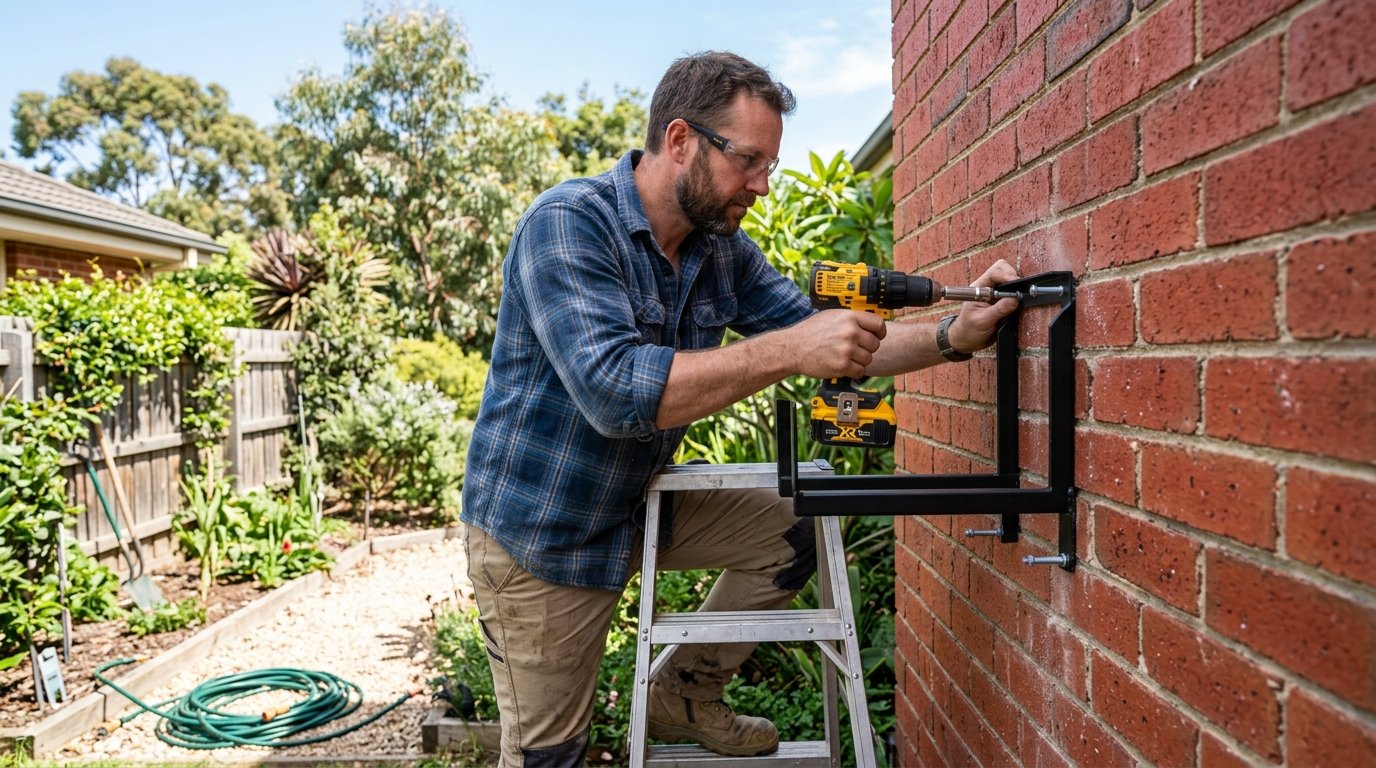
Mounting a wall reel correctly
Mounting quality is more important than many buyers realise.
A full reel places continuous load on the bracket, and pulling the hose adds sideways force.
The mounting surface must be suitable for the fasteners and the total load.
Possible surfaces include:
- brick or masonry;
- concrete;
- solid timber framing;
- appropriate structural posts.
Do not assume thin cladding or decorative timber alone can support a heavy reel.
Use the manufacturer’s mounting instructions and suitable fixings for the wall material.
Swivel brackets improve coverage
A reel that pivots toward the direction of pull reduces sideways strain on both the hose and the mounting bracket.
This is particularly useful when one tap serves garden areas in different directions.
Before mounting, imagine the hose being pulled:
- left along a boundary hedge;
- right toward a lawn;
- straight out toward a driveway garden.
Make sure nearby walls, downpipes or fences do not prevent the reel from swivelling through the useful range.
Position the reel close enough to the tap
Most wall-mounted systems use a short leader hose between the tap and reel.
If the reel is mounted too far away, you may need extra connectors or a longer leader hose, creating additional leak points.
Mounting too close can also be awkward if the reel blocks access to the tap.
Plan for:
- tap access;
- leader-hose routing;
- swivel clearance;
- comfortable hose pull direction.
Check total reach before drilling holes
Before mounting a fixed reel, confirm that its hose reaches the furthest watering point along the actual garden route.
As explained in our garden hose buying guide, unnecessary hose length adds weight and resistance, but insufficient length makes a fixed reel frustrating.
Measure around corners, garden beds and structures rather than using a straight-line distance.
Hose capacity matters on manual reels
Manual reels are often sold for a maximum hose length at a specified hose diameter.
Do not assume the same reel will hold the same length of every hose.
A wider or heavier hose takes more spool space.
Check:
- recommended hose diameter;
- maximum hose length;
- whether the reel becomes difficult to wind when completely full.
Does the reel include the hose?
Retractable reels are commonly sold as an integrated hose-and-reel system.
Manual reels and carts may be:
- sold empty;
- bundled with a hose;
- available in both forms.
This matters because an included hose may influence the real value more than the reel itself.
Do not compare an empty manual reel directly with a complete retractable system without noticing what is included.
Can the hose be replaced?
This is one of the most important long-term questions.
Hoses wear. If the hose eventually cracks or is damaged, the ideal system lets you replace it without discarding the entire reel.
Before buying a retractable system, check whether:
- the hose is replaceable;
- the manufacturer sells replacement parts;
- the rewind system is serviceable;
- the swivel and leader hose can be replaced.
A convenient reel becomes expensive waste if one damaged internal hose makes the whole unit disposable.
Hose bore compatibility
A reel designed for a common household hose bore may not comfortably accept a much wider high-flow hose.
Wider hoses:
- occupy more spool space;
- weigh more when full of water;
- place greater load on the rewind mechanism.
If you need the higher-flow benefits of a larger-bore hose described in our hose guide, make sure the reel is actually designed for it.
Leader hoses and tap connectors
The short connection from tap to reel is easy to overlook.
Check:
- leader-hose length;
- tap-thread compatibility;
- quick-connect compatibility;
- whether the swivel connection is replaceable;
- how easily O-rings can be serviced.
A leak at the swivel or leader connection can waste more water than a perfectly good main hose ever will.
UV and weather durability matter in Australia
A hose reel mounted outdoors is exposed to:
- UV radiation;
- summer heat;
- rain;
- dust;
- temperature cycling.
An enclosed reel helps protect the hose from sunlight, but the housing itself still needs to tolerate outdoor exposure.
Look for:
- UV-resistant housing materials;
- corrosion-resistant internal parts where exposed;
- drainage so water does not remain trapped inside;
- a mounting position that avoids unnecessary all-day western sun where possible.
No plastic housing is improved by being baked against a hot wall every afternoon if a shaded mounting point would work equally well.
A reel helps hose longevity because it improves storage
One of the biggest benefits of a reel is not mechanical—it is protection from poor storage habits.
Our garden hose guide explains why Australian UV and heat can harden hose materials over time.
A reel encourages the hose to be:
- off hot paving;
- out of walkways;
- stored in controlled loops;
- protected from mower damage;
- partly or fully shaded.
That alone can make a reel worthwhile.
Manual winding gets harder with long or wet hoses
A hose is heavier when it contains water.
Dragging a long wet hose across lawn also creates resistance.
That means manual winding effort increases with:
- hose length;
- hose diameter;
- remaining water;
- surface friction;
- tight bends around garden corners.
If you dislike hand-winding after watering, be realistic about whether you will actually use a manual reel properly.
Common retractable-reel problems
The hose will not retract fully
Possible causes include:
- twisted hose entering the housing;
- debris interfering with the mechanism;
- spring tension problems;
- hose bunching unevenly;
- internal mechanical wear.
Do not dismantle a spring-loaded reel casually. Stored spring energy can make some mechanisms hazardous to open without proper instructions.
The hose retracts too quickly
Guide the hose during rewind.
If the mechanism lacks controlled return or has developed a fault, allowing the nozzle to whip back toward the reel can damage fittings or injure someone nearby.
The hose tangles inside
This may happen when:
- the hose enters twisted;
- the guide mechanism is not distributing it correctly;
- the hose has been pulled at an awkward side angle.
A swivel bracket and controlled rewind help reduce this.
Leaks at the swivel
The rotating water connection is one of the mechanically complex parts of a reel.
Leaks may come from:
- worn O-rings;
- loose connectors;
- cracked fittings;
- swivel wear.
Replacement seals or swivel assemblies improve the long-term value of the reel.
Sun-brittle reel housings
Outdoor plastics can become brittle after prolonged heat and UV exposure.
Warning signs include:
- fading;
- surface chalking;
- small cracks around mounting points;
- brittle clips or covers.
If the reel must live in strong sun, prioritise outdoor-rated UV-resistant construction and inspect the mounting points periodically.
Large gardens: one huge reel or several smaller watering zones?
One very long hose can serve a large property, but it also creates:
- more dragging;
- more flow resistance;
- more storage mass;
- more chance of snagging on plants and corners.
Sometimes the better system is:
- two taps;
- two moderate reels;
- or a portable cart reel moved between zones.
This can be especially useful when establishing long screening areas such as Lilly Pilly hedges or large Ficus Hillii screens.
Reel choice for new hedges
During establishment, consistency matters more than fancy watering accessories.
A reel that makes watering easy is valuable because young hedges need regular root-zone checks and timely watering.
For a long new hedge, we would prioritise:
- enough hose length to reach the entire row;
- reliable flow;
- easy rewind;
- a nozzle or wand that allows controlled root-zone watering.
A reel that is frustrating to use can indirectly create poor watering habits.
Where our recommended hose-reel picks will go
Garden Green has not yet joined an affiliate program and has not completed controlled long-term comparisons of current hose reels. We therefore are not publishing a pretend ranking based only on retailer listings.
When recommendations are added, they should be grouped by actual use case: compact courtyard, wall-mounted auto retractable, simple manual reel, portable cart, harsh full-sun mounting and large-property watering.
Common hose-reel buying mistakes
Mounting before measuring reach
Confirm the hose reaches every important watering area before drilling into masonry or timber.
Mounting into weak material
A heavy reel needs structural support, not decorative cladding alone.
Ignoring swivel clearance
A nearby fence, downpipe or corner can stop the reel following the hose direction properly.
Buying a reel that cannot accept your hose bore
Wide hoses take more spool capacity and place more load on the reel.
Assuming the internal hose is replaceable
Check before buying. Some integrated systems are much easier to service than others.
Letting auto-rewind happen uncontrolled
Guide the hose back instead of allowing the nozzle to whip toward the housing.
Mounting the reel in unnecessary full sun
A shaded position can improve both hose and housing life.
Choosing a manual reel you will never wind
A technically durable reel does not help if the hose is left across the driveway because winding feels like too much work.
Quick pick by scenario
| Scenario | Reel type to prioritise |
|---|---|
| Small courtyard | Compact wall reel or simple hanger |
| One fixed tap used frequently | Wall-mounted auto-retractable reel |
| Large garden with multiple zones | Cart reel, multiple fixed reels or zoned taps |
| Need mobility | Portable cart reel |
| Want maximum simplicity | Manual hand-wind reel |
| Harsh full-sun exposure | Enclosed UV-resistant reel mounted in the most sheltered practical position |
| Long establishment hedge | Easy-rewind reel with enough measured reach for the full row |
Think about the whole watering system
A hose reel works best as part of a complete setup:
- tap;
- leader hose;
- reel;
- main hose;
- connectors;
- nozzle or watering wand.
A premium reel cannot compensate for a leaking tap connector or an undersized hose.
Start with the hose itself using our garden hose buying guide, then choose storage around the hose length and bore you genuinely need.
Once hedge establishment is complete, the same practical-tool approach applies to maintenance. Our hedge-trimmer guide covers how to choose a powered cutting tool without overbuying.
The best hose reel is the one that makes putting the hose away easy
For most gardeners, our buying order would be:
- measure the actual hose reach required;
- choose fixed or portable storage according to garden layout;
- confirm the mounting surface and swivel space;
- check hose bore and capacity compatibility;
- check whether the hose and service parts can be replaced;
- prioritise controlled rewind and UV-resistant construction for outdoor wall reels.
A reel earns its place when it makes watering easier and storage automatic enough that the hose is no longer left in the sun, across paths or twisted around garden beds.
Frequently asked questions
Are retractable hose reels worth it?
They are worth considering if you water frequently and value fast storage. The main benefit is convenience: the hose is more likely to be rewound and protected after use. Manual reels are simpler and often easier to service, so the better choice depends on how much you value automatic rewind.
What is the best hose reel for a small courtyard?
A compact wall-mounted reel or simple hose hanger is usually enough for a small courtyard. There is little benefit in installing a large retractable unit if the hose run is short and storage space is limited.
Can a retractable hose reel be mounted on any wall?
No. The wall and fixings must be able to support the reel and the sideways force created when the hose is pulled. Masonry, concrete and properly located structural timber can be suitable when the correct fixings are used. Decorative cladding alone may not be strong enough.
Is controlled slow rewind important on a hose reel?
Yes. A controlled return reduces the chance of the hose or nozzle whipping back quickly toward the reel. Even with a slow-return mechanism, guide the hose during rewind rather than releasing it completely.
Should I buy a manual or automatic hose reel?
Choose automatic if convenience and quick storage are priorities. Choose manual if you prefer fewer moving parts, easier hose replacement and simpler long-term maintenance. Both can work well when matched to the garden and hose length.
Can I replace the hose inside a retractable reel?
It depends on the model. Some systems are designed so the internal hose and service parts can be replaced, while others are more integrated. Check parts availability before buying because replaceability greatly affects long-term value.
Does a hose reel protect a garden hose from Australian sun?
An enclosed reel can protect much of the hose while it is stored, which reduces unnecessary UV and heat exposure. The reel housing itself still needs to be suitable for outdoor use, and mounting it in a shaded position where practical can further improve durability.
What hose reel is best for a large garden?
A portable cart reel can suit a large property where the hose needs to move between zones, while several fixed reels may be better where multiple taps are available. Avoid automatically choosing one extremely long hose if shorter zoned setups would be easier to handle and provide better flow.


