
Best Garden Hoses Australia: How to Choose

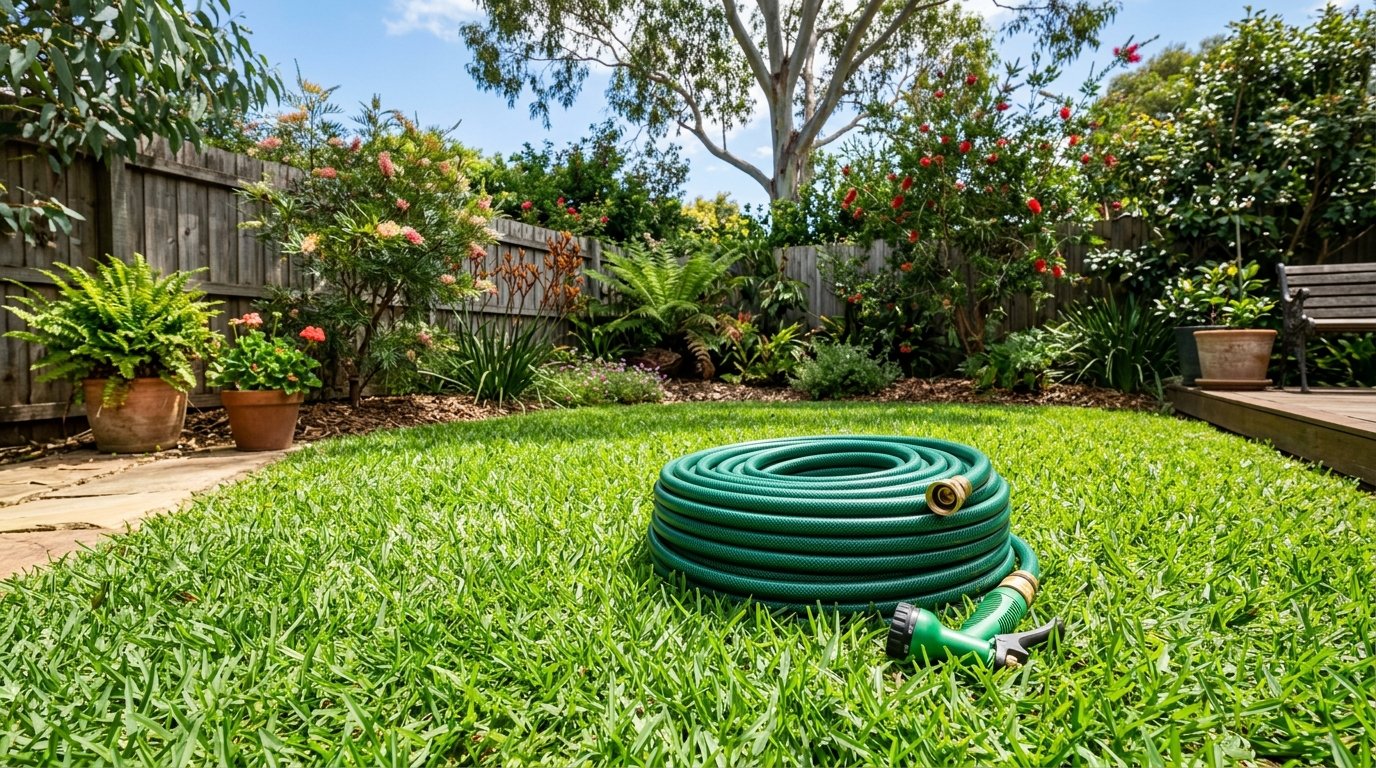
For most Australian gardens, the best hose is not the longest or heaviest one on the shelf: it is a UV-resistant, reinforced hose that reaches the furthest watering point without excessive spare length, stays flexible in heat, resists kinking and uses fittings that remain secure under normal household pressure. A compact courtyard may only need a short standard hose, while a large garden, new hedge or tree-establishment job benefits more from reliable flow, durable construction and enough length to reach every root zone without constantly dragging or joining extensions.
Australian conditions make hose durability unusually important. Strong sun, hot paving and repeated outdoor exposure can harden and degrade lower-quality materials over time. Current Australian ranges from brands such as Hoselink, Pope, Nylex, Gardena, Hills and Neta include reinforced, UV-resistant, retractable and drinking-water-safe options, but the right choice depends on how you actually water.
Garden Green has not yet joined an affiliate program or completed controlled side-by-side hose durability testing, so this guide does not publish live retailer links, prices, invented burst-pressure comparisons or fake “tested for five summers” claims. Instead, it explains the features that matter so you can compare current hoses honestly.
Quick pick: which garden hose suits your situation?
| Garden situation | Hose feature to prioritise | Why |
|---|---|---|
| Small courtyard or balcony | Short, flexible, lightweight hose | Easy handling matters more than maximum flow or length |
| Typical suburban garden | Reinforced UV-resistant standard-bore hose | Good balance of flow, weight, flexibility and durability |
| New hedge and tree establishment | Durable hose with good flow and secure fittings | Reliable deep watering matters more than decorative features |
| Large garden or long runs | Wider-bore hose where flow demand justifies it | Helps reduce flow restriction over longer distances |
| Vegetable garden / potable-water use | Hose explicitly rated for drinking-water contact | Ordinary garden hoses should not automatically be assumed potable-safe |
| Harsh full-sun exposure | UV-resistant construction plus shaded storage or reel | Keeping the hose out of sun is as important as buying UV-resistant material |
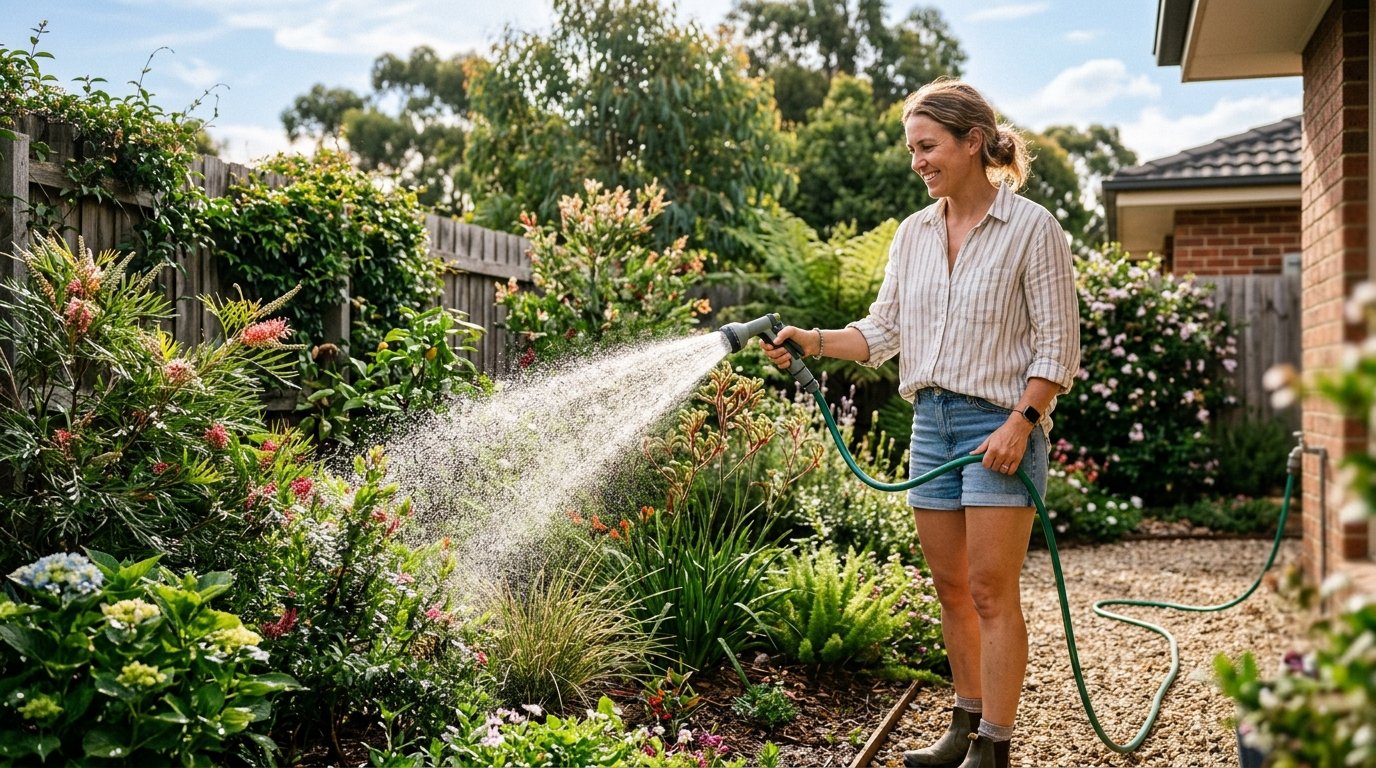
Start with hose length: buy enough, not as much as possible
Hose length is one of the easiest specifications to overbuy.
A longer hose gives reach, but it also adds:
- weight;
- drag across paths and garden beds;
- more material to coil or store;
- more opportunity for loops and kinks;
- greater frictional resistance to water flow.
The useful way to choose length is to measure from the tap to the furthest watering point following the route the hose will actually take—not a straight line through walls, furniture or garden beds.
Add a sensible amount for movement around plants, but avoid buying many unnecessary metres “just in case”.
Longer hoses can reduce usable flow
Water loses pressure as it travels through a hose because the moving water rubs against the hose wall. The effect increases with longer hose runs and smaller internal diameter.
In an ordinary hand-watering job, a modest difference may not matter. It becomes more noticeable when:
- the hose is very long;
- the bore is narrow;
- household water pressure is already modest;
- a sprinkler or irrigation device needs a reasonable flow rate;
- multiple fittings or restrictions are added.
This is why “buy the longest hose available” is not automatically good advice.
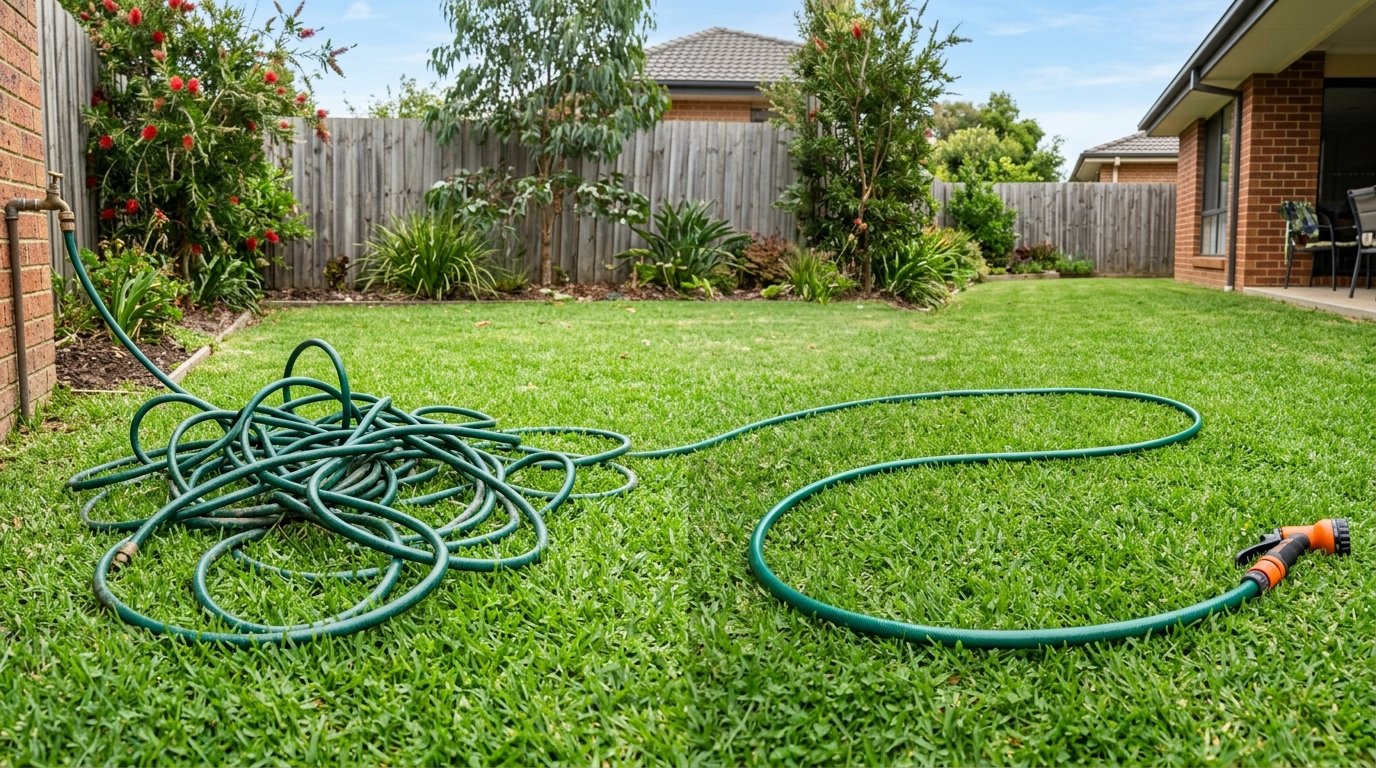
Hose diameter: 12–13 mm versus 18–19 mm
Australian hose ranges use slightly different nominal sizes depending on manufacturer. Common household hoses are often around 12–13 mm internal diameter, while larger-flow options may be around 18–19 mm.
Gardena Australia, for example, currently sells both 13 mm and 19 mm hose categories.
The practical difference is flow resistance.
| Hose bore | Best suited to | Trade-off |
|---|---|---|
| About 12–13 mm | General hand watering, courtyards, suburban gardens | Lighter and easier to handle, but more restrictive over very long runs |
| About 18–19 mm | Longer runs, higher-flow applications, larger properties | Higher potential flow but heavier and bulkier |
A larger hose does not magically increase the pressure supplied by your property. It simply reduces some of the flow restriction created by the hose itself.
Do you actually need a wide-bore hose?
Probably not if you are:
- hand-watering pots;
- watering a small courtyard;
- using a short hose;
- running a normal spray nozzle.
A wider-bore hose makes more sense where:
- the distance from tap to garden is substantial;
- you regularly fill tanks or large containers;
- you run sprinklers that need stronger flow;
- you are establishing a large hedge or several trees;
- your existing long narrow hose noticeably restricts output.
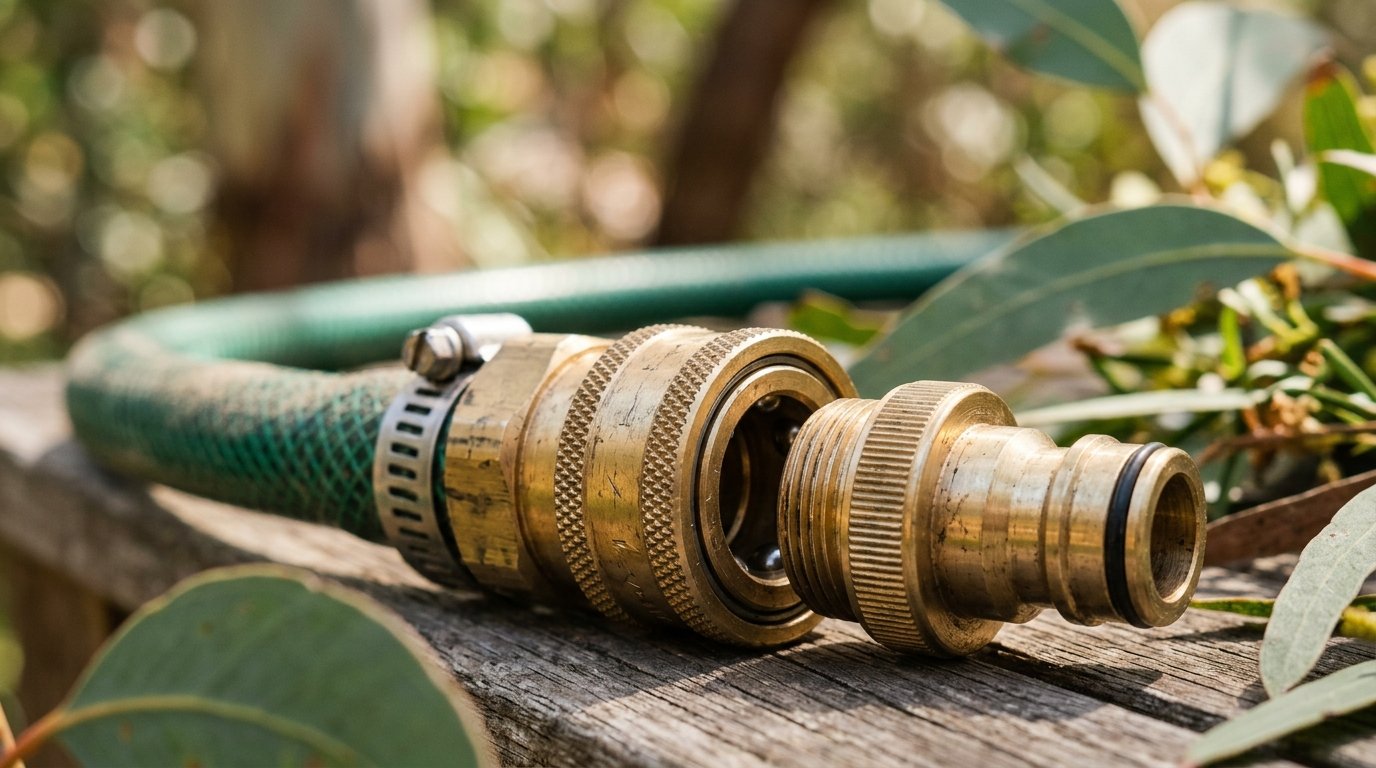
Material and construction matter more than colour
Garden hoses are usually made from combinations of flexible polymers with reinforcing layers.
Common constructions include:
- PVC or vinyl-based hoses;
- multi-layer reinforced hoses;
- rubber or rubber-like flexible compounds;
- hybrid polymer hoses;
- textile-covered lightweight hoses.
No material automatically wins every category.
The useful questions are:
- does it remain flexible in heat?
- is it reinforced against expansion and twisting?
- is it UV resistant?
- is the hose rated for the pressure it will experience?
- does it recover from being coiled?
- how heavy is it at the length you need?
Why multi-layer reinforcement matters
Reinforcement helps a hose keep its shape when pressurised and can improve resistance to twisting and kinking.
Current Australian products illustrate this clearly. Gardena describes textile or spiral mesh reinforcement in several Australian hose ranges, while Hoselink’s current flexible hose uses a multi-layer construction with woven reinforcement and a UV-protected outer layer.
Layer count by itself is not a reliable quality ranking because manufacturers use different materials and construction methods.
Look at the whole specification rather than assuming “five layers” is automatically better than “four”.
Kink resistance should be near the top of your checklist
Kinking is one of the most frustrating real-world hose failures.
A kink temporarily collapses the hose wall, stops or reduces flow and often forces you to walk back along the hose to straighten it.
Repeated severe kinking can also create permanent weak points.
The best defence is a combination of:
- good hose construction;
- adequate wall strength;
- internal reinforcement;
- reasonable flexibility;
- correct coiling and storage.
Even manufacturers of premium kink-resistant hoses generally avoid claiming that every hose is literally impossible to kink. Hoselink’s current Australian guidance, for example, describes its flexible hose as highly kink resistant rather than completely kink proof.
Why cheap hoses often kink more easily
A very soft lightweight hose may feel pleasant when new but can collapse more easily when:
- it loops tightly;
- it is dragged around a corner;
- it softens in hot sun;
- water pressure changes;
- the material ages.
At the opposite extreme, a very stiff heavy hose can resist kinking but become unpleasant to handle.
The better compromise is a hose that bends willingly without flattening easily.
Australian sun and UV are a real durability issue
A garden hose left across hot paving year after year has a much harder life than one stored in shade after use.
UV radiation and heat can contribute to:
- hardening;
- surface cracking;
- colour degradation;
- loss of flexibility;
- eventual splitting.
For Australian gardens, we would prioritise an explicitly UV-resistant hose—but we would still store it out of direct sun wherever practical.
Gardena Australia currently specifies UV-resistant construction across its Australian garden-hose ranges, and Hoselink likewise uses UV-resistant materials in current hose products.
UV resistance improves durability; it does not make permanent full-sun exposure harmless.
Hot paving is hard on hoses
A hose lying on dark paving can become much hotter than the surrounding air.
Heat softens some hose materials, increases the chance of deformation and also heats the water sitting inside.
Before watering heat-sensitive plants, let very hot stagnant water run out until cooler water reaches the nozzle.
This is especially relevant when the hose has been lying in direct summer sun.
Fittings and connectors: where many hoses actually fail
A durable hose is frustrating if the tap connector leaks every time you move it.
Look at the entire watering system:
- tap adaptor;
- hose-end connector;
- sprayer connection;
- O-rings;
- clamping or gripping mechanism;
- compatibility with existing accessories.
Plastic versus brass hose fittings
Good-quality plastic fittings can be light, corrosion-resistant and perfectly suitable for normal garden use.
Brass fittings can offer excellent durability and a solid connection but add weight and can cost more.
The material alone does not guarantee quality.
A well-designed engineering-polymer fitting may be more reliable than a poorly made metal one.
Quick-connect systems
Quick-connect fittings let you move between:
- spray guns;
- sprinklers;
- watering wands;
- hose reels;
- irrigation attachments.
Before buying into a particular system, check whether replacement fittings and accessories are easy to obtain in Australia.
Compatibility matters more as the watering setup grows.
The Hoselink-style no-burst connector concept
Some systems use a connector that mechanically grips or threads onto the hose rather than relying on the common click-on fitting arrangement.
Hoselink is a well-known Australian example of this approach and markets its proprietary fittings around secure, leak-resistant hose connections.
The practical buying question is whether you want:
- broad compatibility with common click-on fittings;
- or a more proprietary connection system designed around one brand ecosystem.
Neither approach is automatically best for every garden. If you already own many sprinklers and fittings, compatibility can matter as much as leak resistance.
Retractable hose reels versus standard loose hoses
A retractable reel combines the hose and storage system.
Its major advantage is behavioural: the hose is more likely to be put away after every use.
That can reduce:
- UV exposure;
- trip hazards;
- messy coils;
- accidental mower damage;
- kinks caused by poor storage.
Retractable reels can be excellent for frequently used watering points, but they are more complex than a plain hose and reel. The rewind mechanism, swivel, mounting position and replaceability of internal parts all become part of the purchase decision.
A dedicated hose-reel buying guide is worth treating separately because mounting, rewind systems and hose replacement deserve more detail than they can get here.
Standard hose on a manual reel
A conventional hose paired with a simple reel is still one of the most flexible setups.
You can choose the hose independently from the storage system and replace either component later.
This suits gardeners who value:
- simple repair;
- easy hose replacement;
- freedom to choose bore and length;
- fewer mechanical parts.
Flat hoses: compact but specialised
Flat hoses collapse when empty and take up very little storage space.
They can be useful for:
- caravans;
- temporary watering;
- compact storage;
- occasional use.
The disadvantages are that some need to be largely unrolled before use, may be awkward for frequent stop-start garden watering and can be less convenient than a conventional round hose for everyday dragging around plants.
Expandable hoses: convenient but understand the compromise
Expandable hoses become longer when pressurised and contract again when emptied.
The appeal is obvious:
- very light storage;
- easy handling;
- small footprint.
But they are not automatically the best choice for heavy everyday gardening.
Potential limitations include:
- greater dependence on water pressure to reach full length;
- more complex inner and outer construction;
- less suitability for abrasive dragging;
- difficulty repairing some designs;
- variable durability between products.
For frequent hedge establishment and long-term garden watering, we generally prefer a durable conventional or reel hose unless compact storage is the overriding need.
Drinking-water-safe hoses: when potable rating matters
Do not assume an ordinary garden hose is designed for drinking water.
If water will be used for:
- people to drink directly;
- caravan or camping water supply;
- pet drinking containers;
- food preparation;
- applications where potable-water compatibility specifically matters;
choose a hose explicitly sold as drinking-water safe.
In Australia, products intended for contact with drinking water may reference compliance with AS/NZS 4020. Current Australian potable-water hoses are available with AS/NZS 4020:2018 compliance.
Do not infer potable-water suitability simply because a hose says “lead free” or “garden safe”. Look for an explicit drinking-water rating or relevant certification.
What about vegetable gardens?
Many ordinary garden hoses are routinely used to water vegetable beds because the hose water is applied to soil and plants rather than consumed directly from the hose.
If you want the additional assurance of drinking-water-contact materials—particularly where children or pets may drink from the hose—choose a product specifically rated for potable water.
Gardena Australia currently describes several hose ranges as free of specified harmful plasticisers and heavy metals and suitable for vegetable-garden use, while dedicated potable-water hoses sold in Australia go further by carrying drinking-water compliance claims.
Water pressure versus water flow
Pressure and flow are related but not interchangeable.
Pressure is the force pushing water through the system.
Flow is the amount of water delivered over time.
A narrow or kinked hose can restrict flow even when tap pressure is reasonable.
A wider hose can reduce some resistance, but it cannot create pressure that the property does not have.
Why sprinklers expose hose limitations
A hand spray gun may still feel usable with a restricted hose because you are standing close to the nozzle.
A sprinkler makes poor flow more obvious because its throw and coverage depend on adequate water supply.
If you regularly run sprinklers or irrigation equipment, pay more attention to:
- hose diameter;
- total run length;
- kinks;
- restrictive connectors;
- the available supply at the tap.
Watering a new Lilly Pilly hedge
Newly planted hedges need establishment watering because their roots still occupy a relatively small soil volume.
A Lilly Pilly hedge should be watered into the root zone rather than receiving a quick splash across the leaf surface.
For a long hedge, a hose that reaches the full row comfortably is more useful than one requiring repeated reconnection.
Use a watering wand, trigger nozzle or suitable slow-flow attachment so you can apply water deliberately around each root ball without washing soil away.
Watering Waterhousea during establishment
Waterhousea floribunda naturally comes from moist riparian and rainforest environments and appreciates reliable moisture, particularly while establishing.
That does not mean keeping the planting hole stagnant.
A good hose setup should let you water the root zone thoroughly and then allow the soil to drain.
For larger trees and screens, flow and reach matter more than whether the hose comes in the smallest possible package.
Watering a Ficus Hillii hedge
Ficus Hillii is vigorous once established, but young plants still need consistent establishment water.
The mistake we want to avoid is shallow, frequent wetting that never penetrates the original root ball.
Apply enough water to wet the actual root zone, then check soil moisture before automatically watering again.
A hose makes this easier when the nozzle allows flow to be reduced without repeatedly walking back to the tap.
Deep watering does not mean flooding the plant
“Deep watering” means applying water slowly enough and long enough to wet the intended root zone.
It does not mean creating a puddle that remains stagnant around the plant.
For establishment watering:
- check whether the soil is already wet;
- apply water at a manageable rate;
- allow it to soak in;
- check that the root ball and surrounding soil are both receiving moisture;
- adjust frequency according to weather, soil and plant establishment.
Water restrictions vary across Australia
Water-use rules differ between states, councils, water authorities and drought conditions.
Restrictions may affect:
- when hoses can be used;
- whether trigger nozzles are required;
- sprinkler use;
- watering times;
- new-garden exemptions.
Check your current local water authority rather than assuming a rule from another Australian city applies to you.
Where our recommended garden-hose picks will go
Garden Green has not yet joined an affiliate program and has not completed controlled long-term testing of current hose models. We therefore are not publishing a fake “best hoses” ranking based on copied retailer descriptions.
When recommendations are added, they should be grouped by real use case—small courtyard, general garden, large property, retractable system, high-UV exposure and drinking-water-safe use—rather than pretending one hose is ideal for every Australian garden.
Common garden-hose buying mistakes
Buying far more length than you need
Extra hose means extra weight, storage and resistance. Measure your real watering route first.
Ignoring internal diameter
For long runs and high-flow jobs, a small bore can become the restriction even if the hose looks heavy-duty.
Assuming “kink proof” literally means impossible to kink
Construction can greatly improve kink resistance, but poor storage and tight loops can still kink many hoses.
Leaving the hose permanently in full sun
Even UV-resistant material lasts better when unnecessary heat and sunlight exposure are reduced.
Buying incompatible fittings
Check whether your taps, spray guns, sprinklers and reels use the same connection system.
Choosing the hose but ignoring the fittings
Leaks often occur at connectors and O-rings rather than in the middle of the hose.
Assuming every hose is drinking-water safe
If potable use matters, look for an explicit drinking-water rating or appropriate compliance statement.
Using an expandable hose for heavy abrasive work
Lightweight expandable designs are convenient, but not every one is intended to be dragged daily across rough paving and garden edges.
Maintenance: make a good hose last longer
A few habits matter more than elaborate maintenance products.
- Do not leave the hose pressurised unnecessarily after use.
- Drain excess water before long-term storage.
- Store it out of direct sunlight where practical.
- Avoid tight folds and sharp kinks.
- Keep fittings off soil where grit can damage seals.
- Replace worn O-rings rather than tolerating leaks.
- Inspect the first metre near the tap, where repeated bending commonly occurs.
Coiling a hose properly
Do not force a hose into tight loops smaller than it naturally wants to form.
Large relaxed coils reduce twisting and help prevent permanent kinks.
If the hose repeatedly fights the coil, allow it to straighten and remove twists before winding it up.
A reel can make this much easier for longer hoses.
Should the hose stay connected to the tap?
Leaving a hose permanently connected is convenient, but it can leave fittings under weather exposure and encourage users to leave the hose pressurised.
If you leave it attached:
- turn the tap off after use;
- release pressure from the hose;
- check connectors periodically;
- keep the hose stored rather than stretched across the garden.
Quick pick by scenario
| Scenario | Feature to prioritise |
|---|---|
| Small courtyard | Short length, low weight, flexibility and compact storage |
| Large garden | Correct measured length, durable reinforcement and adequate bore |
| Hedge and tree establishment | Good flow, secure connectors and easy flow control at the nozzle |
| Vegetable garden / possible drinking use | Explicit drinking-water-safe or relevant potable-water compliance where needed |
| Harsh full-sun position | UV-resistant construction plus reel or shaded storage |
| Long sprinkler run | Wider bore where needed and minimal restrictive fittings |
| Frequent daily watering | Kink resistance, durable fittings and easy storage |
Build a watering system, not just a hose collection
The hose is only one part of a useful garden setup.
A good system may include:
- a reliable tap fitting;
- a hose matched to the required distance;
- a trigger nozzle or watering wand;
- a reel or shaded storage point;
- sprinkler or irrigation attachments where appropriate.
The same logic applies to other garden tools. If you are maintaining the hedge after it establishes, see our guides to choosing a hedge trimmer and choosing secateurs rather than buying each tool without considering the overall maintenance system.
The best garden hose is the shortest durable hose that comfortably reaches the job
For most buyers, our order of priorities would be:
- measure the real length required;
- choose enough bore for the flow and distance;
- prioritise kink-resistant reinforced construction;
- look for UV resistance in Australian conditions;
- choose reliable fittings compatible with your watering system;
- store the hose properly rather than expecting materials alone to defeat years of sun exposure.
A heavy-duty 40 m hose is not an upgrade if your furthest garden bed is 12 m from the tap. The best hose is the one that reaches comfortably, delivers the flow you need and is easy enough to handle that you actually put it away after watering.
Frequently asked questions
What size garden hose is best for most Australian homes?
A hose around the common 12–13 mm bore is suitable for many ordinary hand-watering jobs and suburban gardens. Larger 18–19 mm hoses can reduce flow restriction over longer runs or higher-flow applications, but they are heavier and bulkier. Choose according to distance and water demand rather than assuming bigger is always better.
Are kink-resistant garden hoses really worth it?
Yes, especially if the hose is used frequently. Reinforcement and better construction can reduce the tendency to collapse when the hose loops or twists. No flexible hose should automatically be assumed completely impossible to kink, so correct storage and avoiding sharp bends still matter.
How long should my garden hose be?
Measure from the tap to the furthest watering point along the actual route the hose will take, then add a modest amount for movement. Avoid buying much more length than necessary because extra hose adds weight, storage bulk and water-flow resistance.
Does a longer garden hose reduce water pressure?
A longer hose creates more frictional resistance, which can reduce the usable flow available at the far end. The effect is greater with narrow hoses and long runs. A wider-bore hose can reduce some of that restriction, but it cannot create pressure that is not available from the water supply.
What type of hose lasts best in Australian sun?
Look for explicitly UV-resistant construction and reinforced materials suited to outdoor use, but do not rely on UV resistance alone. Hoses generally last longer when stored on a reel or in shade rather than being left permanently across hot paving in direct sun.
Can I drink water from a normal garden hose?
Do not assume a normal garden hose is potable-water safe. If people or pets will regularly drink directly from the hose, choose a product explicitly rated for drinking-water use. In Australia, drinking-water-contact products may reference compliance with AS/NZS 4020.
Is a retractable hose reel better than a normal garden hose?
A retractable reel is convenient because it makes storage fast and keeps much of the hose protected when not in use. A standard hose on a manual reel is simpler and lets you replace the hose independently. The better choice depends on how often you water, where the reel can be mounted and how much you value automatic rewind.
What hose is best for watering a new hedge?
Choose a hose long enough to reach the whole hedge comfortably, with reliable flow, kink resistance and a nozzle or wand that lets you control the water at each root zone. New Lilly Pilly, Waterhousea and Ficus hedges need consistent establishment watering, but the soil should still be checked so plants are not kept permanently waterlogged.


