
Silver Banksia (Banksia marginata): Size, Flowers and Growing Guide for Australian Gardens

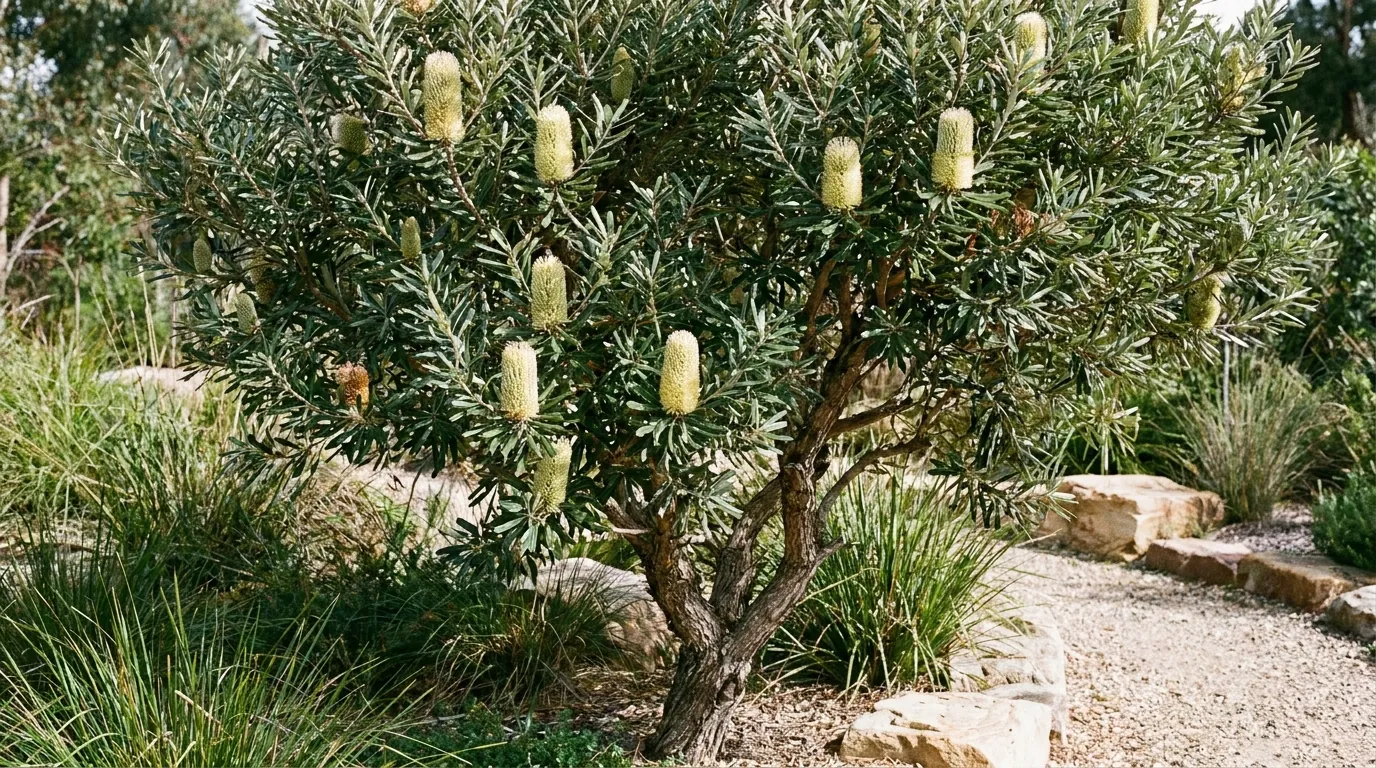
Silver Banksia (Banksia marginata) can be anything from a low shrub to a tree around 12 m tall, depending on the form and where it comes from. That extraordinary variation is the first thing to understand before buying one. VicFlora records the species to about 12 m, while the Australian National Botanic Gardens describes forms from roughly 1–12 m. In ordinary garden cultivation, the Australian Plants Society says a suitable form will often finish closer to 3–4 m.
So we do not treat “Silver Banksia” as one predictable 4 m plant. On Garden Green jobs, the first question we ask is where the plant was propagated from and what mature size the nursery expects from that particular form. A locally appropriate provenance can make a far better garden plant than buying solely on the species name.
There is no single “mature size” for Silver Banksia
Banksia marginata has one of the broadest growth habits in the genus. The VicFlora botanical treatment records it as a shrub or tree to about 12 m high. The South Australian Plant Selector+ goes further in explaining the variation: it notes dwarf forms below 1 m, rounded bushy forms around 4 m and straggly tree forms around 8 m.
| Australian source | Published size | What the figure tells you |
|---|---|---|
| VicFlora | To about 12 m high | Botanical species maximum, not a normal suburban guarantee |
| ANBG | About 1–12 m high | Shows the full natural variability of the species |
| SA Plant Selector+ | Below 1 m to about 8 m depending on form | Explicitly separates dwarf, bushy and tree forms |
| Australian Plants Society NSW | About 3–4 m in a garden | Useful garden expectation for appropriately selected forms |
| Great Ocean Road Nursery | 4–8 m high × 3–5 m wide | Example of a larger nursery-sold form |
| Faceys Nursery | 5 m high × 2.5 m wide | Another commercial landscape form |
That table is why we would never design a tight garden bed from a generic search result saying “Silver Banksia grows to 4 m”. The species name alone does not tell you enough.
Provenance matters more here than with most garden shrubs
The Australian Native Plants Society specifically recommends choosing a form from a climate similar to your own. Its cultivation notes give a practical example: coastal and mountain forms from New South Wales perform well around Sydney, while forms originating in drier western Victorian conditions can be much more difficult there.
The Australian National Botanic Gardens makes the same point and recommends selecting high-altitude material when frost hardiness is important, or coastal material where salt resistance is needed.
That is exactly how we think about Silver Banksia in practice. If two plants share the name Banksia marginata but come from very different natural populations, we should not expect them to behave identically once planted.
When buying, ask the nursery three things if they know them:
- the expected mature height of that form,
- whether its provenance is known, and
- whether it was selected for local or comparable conditions.
Those answers are more useful than choosing the plant because the label simply says “hardy Australian native”.
The silver is underneath the leaf
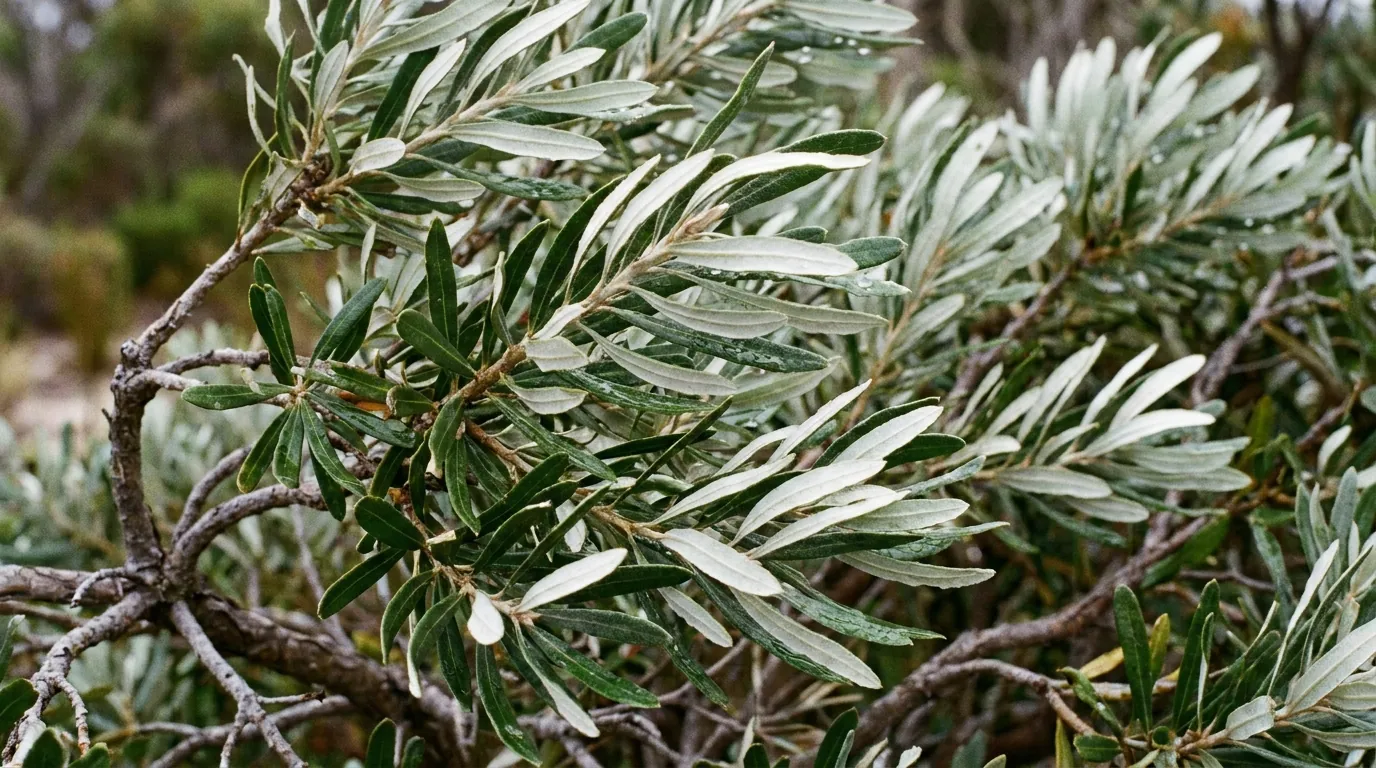
Silver Banksia does not have silver foliage in the same way as a grey-leaved saltbush. The upper leaf surface is dark green; the pale effect comes from the dense white hairs underneath.
VicFlora records leaves approximately 1–8 cm long and 3–15 mm wide. The Australian Native Plants Society gives a commonly encountered range of about 15–60 mm long and 3–13 mm wide.
In a breeze, leaves turn enough to expose those pale undersides. That shifting green-and-silver effect is one of the reasons we like the species in naturalistic native plantings—it has foliage interest even when there are no fresh flowers open.
The flowers are smaller than many people expect from a Banksia
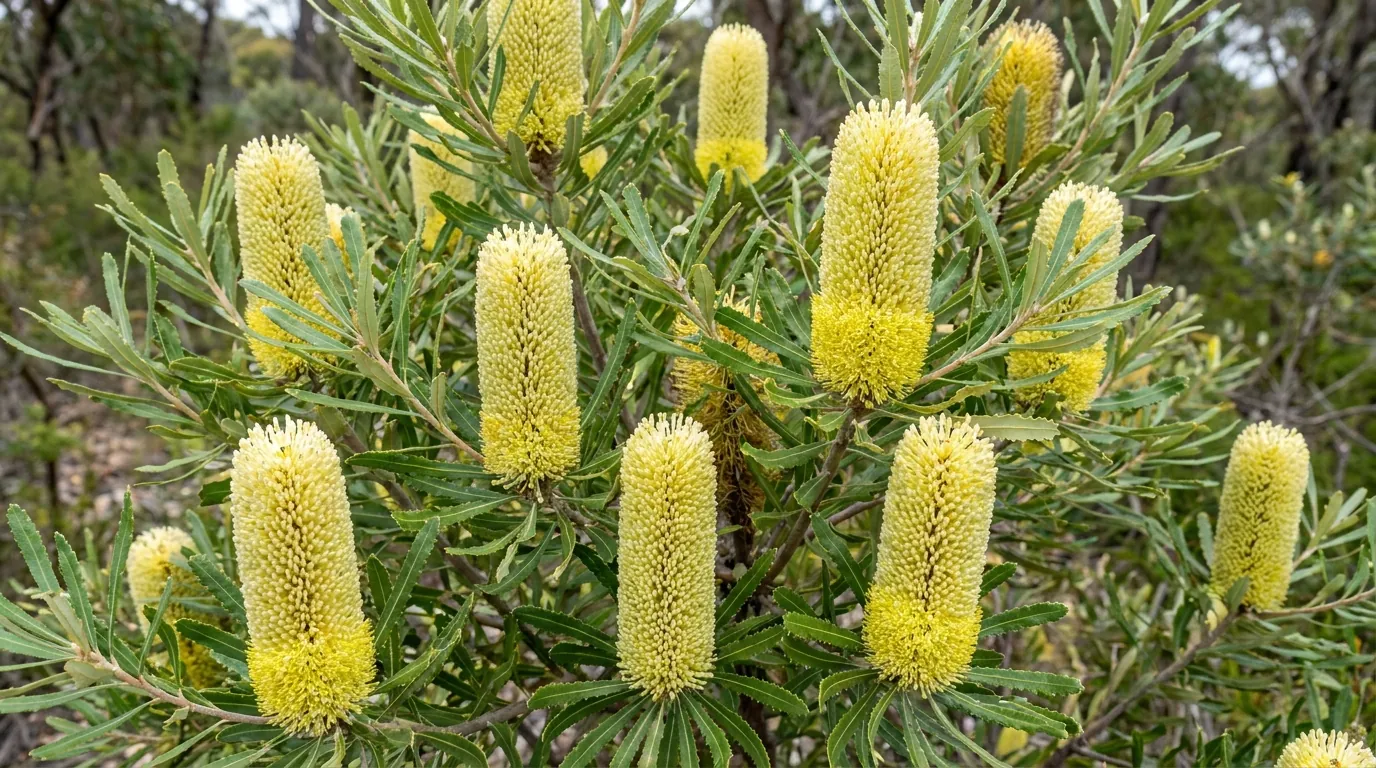
This is not one of the huge candle-flowered banksias.
VicFlora records Silver Banksia flower spikes at roughly 3–13 cm long and 4–6 cm wide, while the Australian Native Plants Society describes commonly encountered spikes around 5–10 cm long and 4–6 cm wide. They are pale to brighter yellow rather than orange or red.
Flowering is long but regionally variable. VicFlora records the main Victorian flowering period as February to July. The Australian National Botanic Gardens describes flowering from late summer to winter, while South Australian garden references extend the display into spring in some forms.
We therefore plan for a long cool-season display rather than promising one exact flowering month across Australia.
For wildlife, the smaller flowers still do serious work
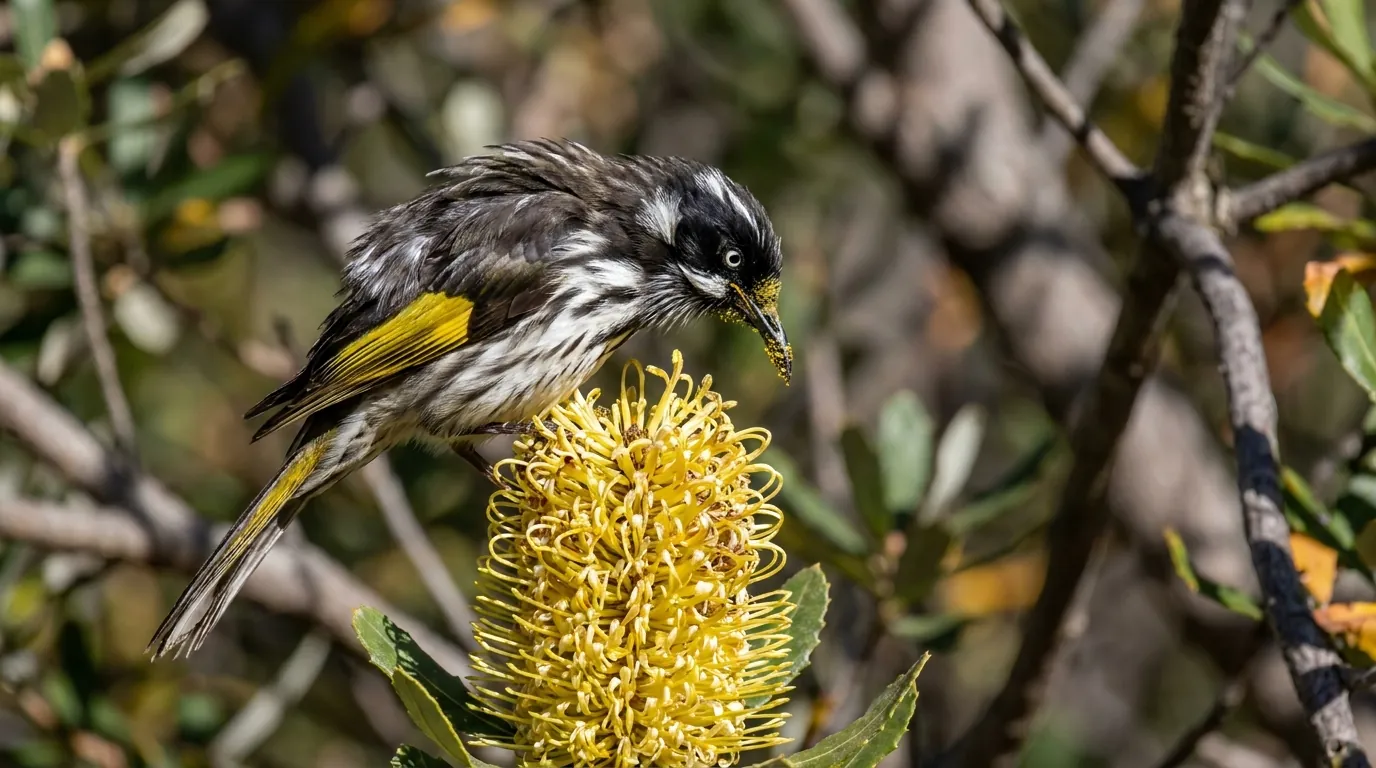
The South Australian Plant Selector+ lists Silver Banksia as providing food and habitat for native birds and insects, while the Australian Plants Society describes it as excellent for attracting honeyeaters and other birds.
That matters when we are building a garden for wildlife rather than simply choosing the largest flower spikes. A mature Silver Banksia provides nectar, foliage structure and eventually woody cones, while its dense forms can add useful shelter.
In our native plantings, we prefer to combine it with different flowering heights and seasons rather than expecting one Banksia to carry the whole habitat garden.
How fast does Silver Banksia grow?
There is no credible centimetres-per-year figure that applies across Banksia marginata, and the Australian sources do not even agree on a simple speed category.
The Australian National Botanic Gardens describes the species as fairly fast growing. The Australian Plants Society NSW describes it as slow growing but consistent when happy, noting that a garden specimen may eventually reach around 3–4 m.
Rather than choosing one adjective and pretending the disagreement does not exist, we think the species’ extraordinary variation explains much of it. A low dry-country shrub and a vigorous tree-form provenance are not useful candidates for one universal annual growth number.
On our own work, we judge a young Silver Banksia by establishment: healthy new shoots, good leaf colour, increasing branch structure and a root zone that is neither drying continuously nor staying waterlogged. Until a particular form has a documented growth rate, those observations are more useful than a made-up number.
Where Silver Banksia fits around Australia
Its natural range is unusually broad. VicFlora records the species in Victoria and also in South Australia, New South Wales, the ACT and Tasmania. The Australian Plants Society describes its NSW distribution from coastal districts through tablelands and western slopes, while Tasmanian records extend from coastal country into high-elevation habitat.
| Garden situation | What matters most |
|---|---|
| Victoria and Tasmania | Well within the species’ natural climatic range; match the form to local frost, exposure and soil conditions |
| South Australia | Native forms occur naturally; Plant Selector+ lists drought, moderate frost, lime and some salinity tolerance |
| NSW and ACT | Also within the natural range; local or nearby provenance is particularly useful |
| Coastal gardens | Coastal forms can handle exposed conditions better; provenance still matters |
| Hot humid climates outside its natural south-eastern range | Choose cautiously and prioritise drainage; local provenance guidance becomes even more important |
We would not turn that into a city-by-city survival chart. The species itself tells us why: populations have adapted to very different habitats, so the origin of the plant can matter as much as the postcode where it ends up.
Frost tolerance is real—but it varies with the form
The Australian National Botanic Gardens says most forms are frost tolerant. The South Australian Plant Selector+ lists moderate frost tolerance, and Australian Plants Society NSW also reports the species as frost tolerant.
Research on Tasmanian populations found substantial frost tolerance across populations sampled from sea level to 1,040 m elevation. That study is useful evidence for the species’ adaptability, but we would not convert it into one minimum-temperature guarantee for nursery plants of unknown provenance.
For a frost-prone property, we would still favour material propagated from a cold-climate or higher-altitude population where provenance is available. Young plants also benefit from a sensible establishment position rather than being placed immediately in the most exposed frost hollow on the site.
Silver Banksia is more soil-tolerant than many Banksias
The South Australian Plant Selector+ lists Silver Banksia for clay, loam and sand and across acidic, neutral and alkaline soil categories. ANBG cultivation notes likewise say the species tolerates sandy soils, loams and clay.
That does not make drainage irrelevant. Australian Plants Society NSW recommends a sunny position with drainage, and general Banksia cultivation guidance from the Australian National Botanic Gardens places well-drained soil among the basic requirements for reliable garden performance.
Interestingly, ANBG records some Banksia marginata forms tolerating moist and even waterlogged sites in nature. We treat that as evidence of the species’ ecological breadth, not permission to plant an unknown nursery form into permanently stagnant soil.
On jobs, we would rather give the root system a well-aerated site and let a locally suited provenance demonstrate how much seasonal moisture it can handle.
Drought tolerance comes after establishment
The South Australian Plant Selector+ lists drought tolerance and minimal supplementary watering for established plants, while ANBG describes the species as drought resistant.
A newly planted Silver Banksia still needs establishment watering. Its root system starts inside a nursery pot and has not yet explored the surrounding soil.
We water the root ball thoroughly at planting, monitor the moisture through the establishment period and then extend the interval as roots move outward. We do not keep an established Banksia permanently wet simply because the young plant once needed regular water.
Use low-phosphorus nutrition
Silver Banksia belongs to the Proteaceae family. The Australian National Botanic Gardens recommends low-phosphorus fertilisers for Banksias, and Australian Plants Society NSW specifically warns against high-phosphorus fertiliser for Banksia marginata.
In our own work, fertiliser is never the first response to a struggling Banksia. We check drainage, root-zone moisture and site suitability first. Extra nutrients do not solve a root system under stress.
If feeding is needed, use a product formulated for phosphorus-sensitive Australian natives and follow its label rather than increasing the dose to push faster growth.
Phytophthora is a bigger concern than many care guides admit
Australian Plants Society NSW lists Banksia marginata as susceptible to Phytophthora and other root-rotting fungi. Australian Plants Society Tasmania also specifically notes sensitivity to Phytophthora cinnamomi.
The classic warning sign with root rot can be a plant declining even though the soil appears wet enough. This is why we do not respond automatically to wilting or yellowing by adding more irrigation.
Good drainage and avoiding unnecessary movement of contaminated soil are much more useful preventive habits than trying to rescue badly infected roots later.
Be careful before pruning hard into old wood
This is another area where the variability of Silver Banksia matters.
Some forms develop a lignotuber—a woody swelling at the base capable of producing new shoots after damage or fire. Others do not. The Australian Native Plants Society explicitly records both fire-sensitive and fire-resistant forms.
That means advice such as “Banksias can be cut back hard” is too broad for an unidentified Silver Banksia.
The South Australian Plant Selector+ recommends light pruning and warns that cutting too hard into old wood can permanently damage a plant. Australian Plants Society NSW likewise recommends periodic pruning for shape.
Unless we know we are dealing with a lignotuberous form that responds well to hard renovation, we stay conservative: prune young growth to build density, remove damaged branches and shape after flowering rather than gambling on a severe cut into bare old wood.
Fire response is not identical across the species
Wild Silver Banksias have more than one survival strategy. The Australian Native Plants Society records forms that regenerate only from seed after fire and others that can regenerate vegetatively from a lignotuber as well as from seed.
The woody cones can retain seed until drying or fire triggers release. That ecology explains the persistent cones gardeners see on older plants, but it is not a reason to expose a garden tree to fire or heat.
From a garden perspective, the useful lesson is simply that provenance influences more than height—it can also change how the plant responds to major damage.
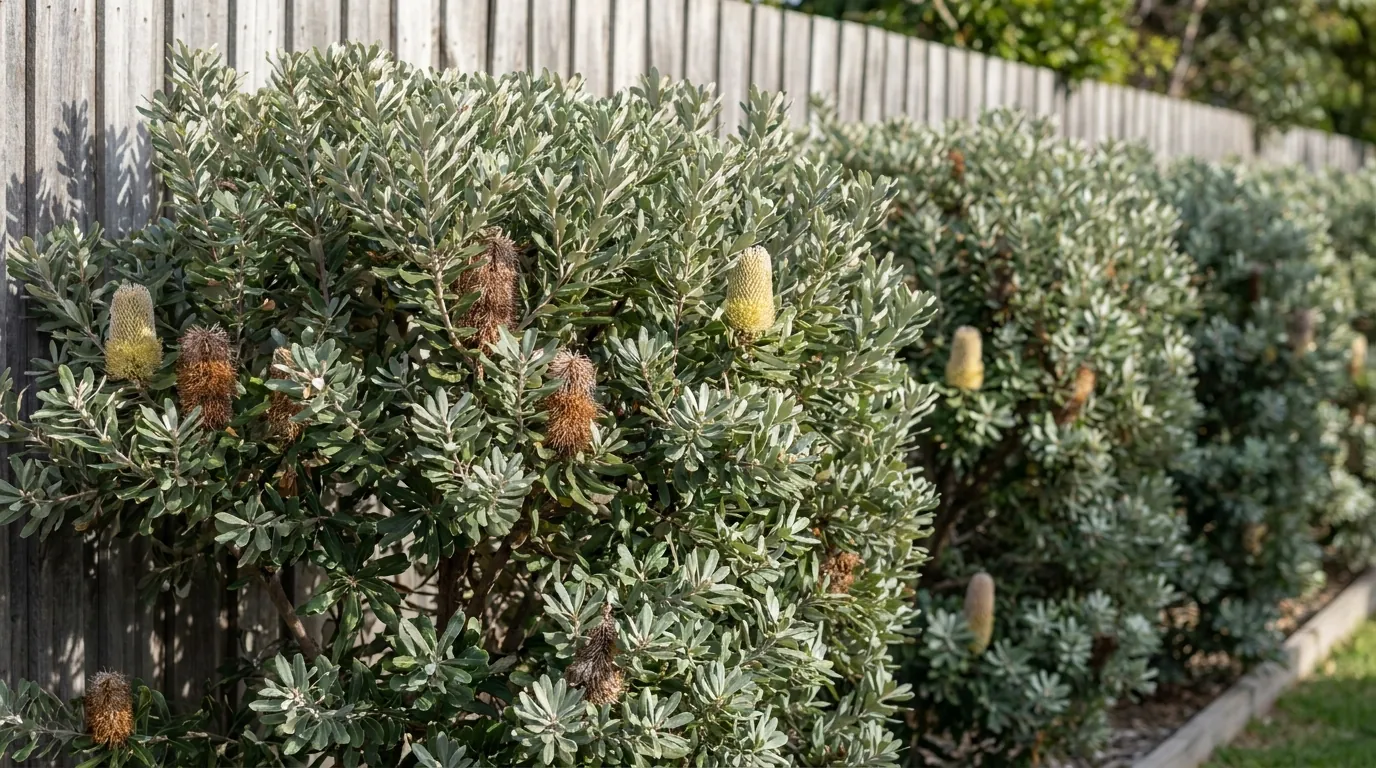
Silver Banksia can make a screen, but choose the form first
Dense forms are genuinely useful screening plants. The Australian National Botanic Gardens notes that dense forms make good screens, Faceys Nursery lists screening among its landscape uses, and Great Ocean Road Nursery sells a 4–8 m high × 3–5 m wide form as a screening plant.
That last figure is exactly why we do not recommend generic Silver Banksia spacing. A 4 m rounded form and an 8 m tree-form plant should not automatically be laid out on the same centres.
When we plan a screen, we work from the mature dimensions of the actual nursery form, the amount of pruning the client is willing to do and whether they want a solid hedge or a more open native screen.
If the provenance or expected width is unknown, leave more room rather than designing around the smallest number you found online.
Silver Banksia or another Banksia?
| If you want… | Silver Banksia makes sense when… |
|---|---|
| A south-eastern Australian native | You are gardening in or near its broad natural range and can source an appropriate form |
| A wildlife tree or shrub | You want nectar flowers plus dense native structure |
| A frost-tolerant Banksia | You can choose a suitable cold-climate provenance |
| A coastal native | You select a coastal form suited to exposure and salt |
| A tightly predictable 2 m shrub | Probably not—the species is too variable unless you buy a named compact form |
For us, that last line is the main buying lesson. Silver Banksia is adaptable precisely because it is variable. That strength becomes a problem only when a gardener assumes every plant carrying the same species name will mature to the same shape and size.
Frequently asked questions
How big does Silver Banksia grow?
Banksia marginata is extremely variable. VicFlora records trees to about 12 m, the Australian National Botanic Gardens gives roughly 1–12 m, and the South Australian Plant Selector+ describes forms ranging from below 1 m to around 8 m. Australian Plants Society NSW says suitable garden forms commonly reach about 3–4 m.
How fast does Banksia marginata grow?
There is no reliable species-wide centimetres-per-year figure. Australian sources even differ in their qualitative descriptions: ANBG calls it fairly fast growing, while Australian Plants Society NSW describes it as slow but consistent. The difference likely reflects the species’ many forms, provenances and growing conditions.
When does Silver Banksia flower?
Flowering varies with region. VicFlora records the main Victorian period as February to July, while the Australian National Botanic Gardens describes flowering broadly from late summer to winter. Other Australian references report flowers extending into spring in some forms and locations.
Is Silver Banksia frost tolerant?
Yes, many forms are. The Australian National Botanic Gardens says most forms are frost tolerant, while the South Australian Plant Selector+ lists moderate frost tolerance. Provenance matters, so a cold-climate or high-altitude form is the better choice where frost is a major concern.
What soil does Banksia marginata need?
Silver Banksia is adaptable. South Australia’s Plant Selector+ lists it for clay, loam and sand, while Australian cultivation references recommend good drainage for reliable garden performance. The species is unusually broad in its natural soil and moisture tolerance, so locally appropriate provenance remains important.
Can Silver Banksia be used as a screen?
Yes. Dense forms are recommended for screening by Australian botanical and nursery sources. Because mature forms can vary from compact shrubs to large trees, screen spacing should be based on the expected width of the actual form you buy rather than a generic species-wide number.
Can Banksia marginata tolerate drought?
Established Silver Banksia is regarded as drought tolerant by Australian horticultural references. Newly planted specimens still need establishment watering while their roots move beyond the nursery root ball.
What fertiliser should I use on Silver Banksia?
Use a low-phosphorus fertiliser formulated for phosphorus-sensitive Australian native plants if feeding is needed. Banksias belong to the Proteaceae family, and Australian botanical guidance specifically advises against high-phosphorus feeding.


