
Viburnum Hedge Problems Australia: Causes & Fixes

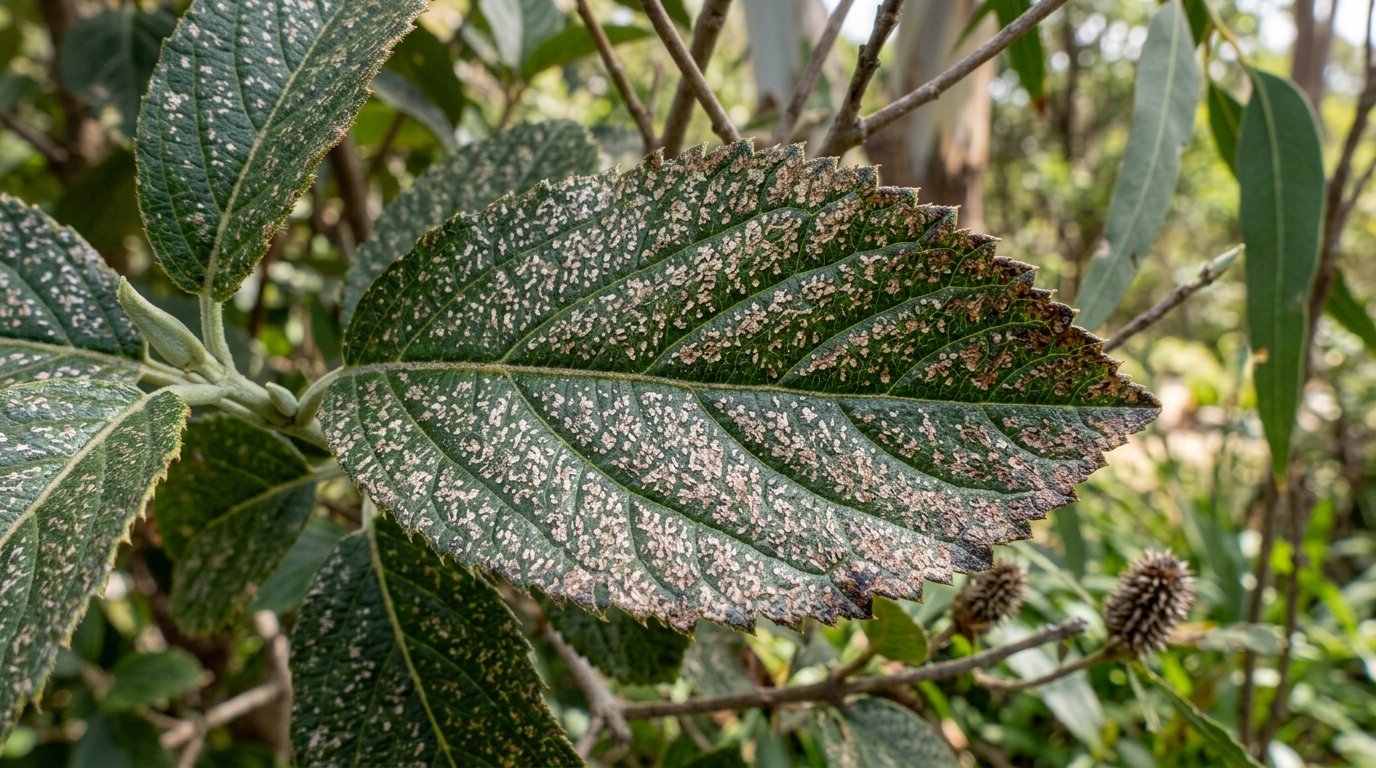
If a Sweet Viburnum hedge is turning silver, yellow, brown or sparse, diagnose the pattern before treating it. Silvery or bronzed leaves with damage underneath strongly point toward thrips or mites; yellow new leaves with greener veins suggest an iron-availability problem; crispy brown tips are more often linked to moisture, heat or wind stress; black sticky foliage points toward scale and sooty mould; and a hedge that is thick on top but bare underneath is usually suffering from self-shading and pruning geometry rather than a disease.
Viburnum odoratissimum ‘Emerald Lustre’, commonly sold as Sweet Viburnum, is not an Australian native. Kew’s Plants of the World Online accepts Viburnum odoratissimum and records its native range across parts of Asia, including China, the eastern Himalaya and South-East Asia. Australian nurseries such as Plantmark and Nurseries Online sell ‘Emerald Lustre’ as a vigorous evergreen hedge and screening plant, and Sweet Viburnum has become one of the most widely used screening shrubs in Australian landscapes.
Several Viburnum problems can look almost identical from a few metres away. A grey hedge is not automatically short of fertiliser, a brown hedge does not always need more water, and a yellow hedge can deteriorate further if a drainage problem is mistaken for hunger. The most useful first checks are the undersides of the leaves, moisture below the soil surface, whether new or old foliage is affected, and whether the damage occurs evenly or only in one section of the hedge.
Which Viburnum hedge problem is it?
| What you can see | Likely cause | What to check first |
|---|---|---|
| Silver, grey, bronzed or brown-speckled foliage | Thrips or mites | Turn leaves over and inspect the undersides for tiny insects, dark specks or feeding damage |
| Yellow new leaves with greener veins | Iron chlorosis / high soil pH | Check soil pH and whether the pattern is strongest on new foliage |
| General yellowing with persistently wet soil | Overwatering, poor drainage or root stress | Check moisture below the surface and how quickly the root zone drains |
| Dry brown tips or crispy leaf margins | Under-watering, heat, drying wind or damaged roots | Check the root-zone moisture before adding more water |
| Black coating with sticky foliage | Sooty mould caused by scale or another sap-sucking pest | Inspect stems and leaf undersides for scale rather than treating the mould alone |
| Brown, grey or black leaf spots that expand | Possible fungal or bacterial leaf spot | Check airflow, leaf wetness, density of the hedge and whether lesions are spreading |
| Healthy top but sparse or bare lower hedge | Self-shading and pruning shape | Check whether the hedge is wider at the top than the base |
| Long shoots but poor density | Insufficient formative tip pruning, low light or unsuitable spacing | Check whether young growth has been encouraged to branch |
| Scorched leaves on the hottest exposed side | Heat or sun scorch, often worsened by dry roots | Check soil moisture and reflected heat from fences or paving |
| Soft new tips browned after cold weather | Frost injury | Wait for further frost risk to pass before hard pruning |
This is a triage table, not a substitute for a positive diagnosis. A stressed hedge can have two problems at once. Thrips, for example, may be present on a hedge that is also struggling with heat and dry roots.
Silver or bronzed Viburnum leaves: check for thrips first
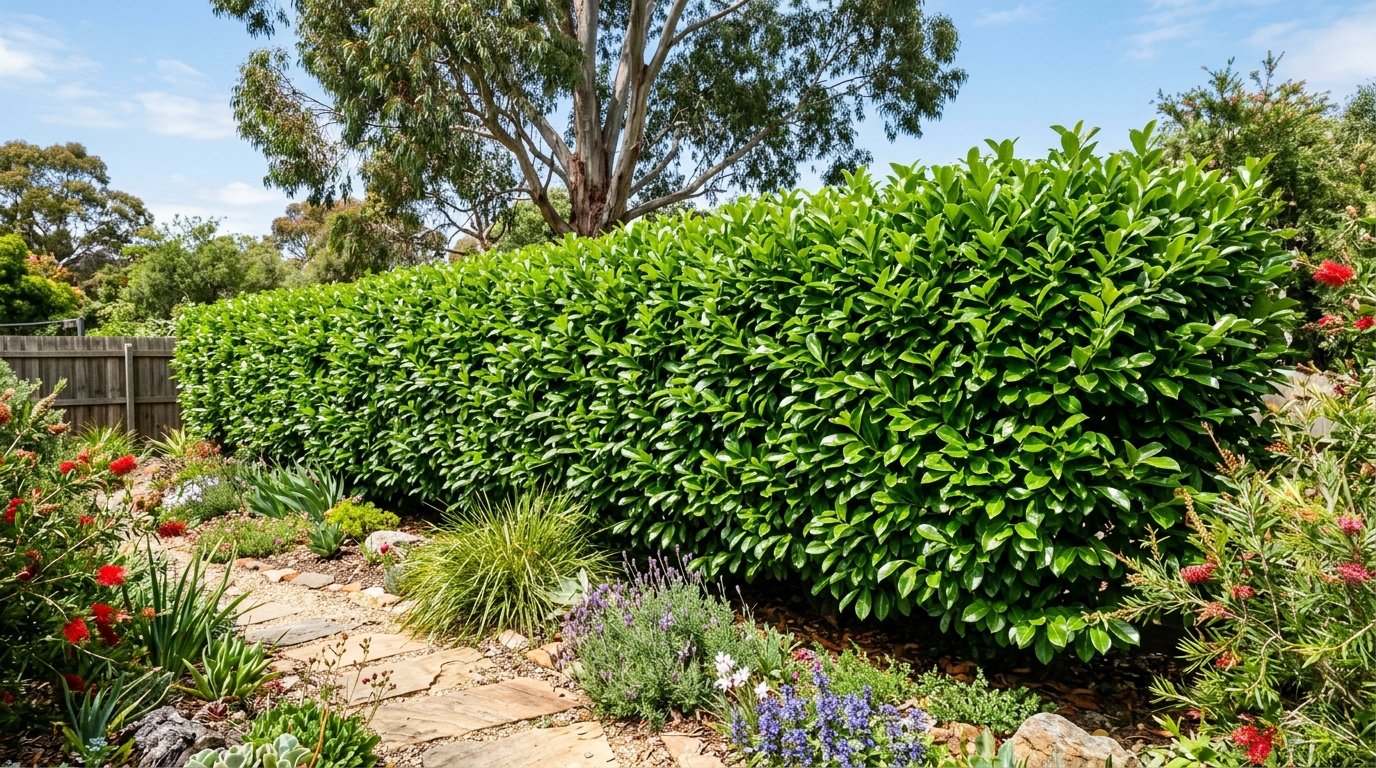
Thrips are the signature pest problem on Viburnum hedges in Australia. Yates Australia calls thrips the biggest pest of Viburnum and describes the characteristic symptom as silver and brown speckling, with the insects and dark droppings found on the undersides of affected leaves.
Bunnings Australia gives essentially the same diagnostic advice: if Viburnum foliage begins turning silver, turn the leaves over and look for thrips or spider mites underneath.
Professional Plant Supplies has documented the familiar silvery-brown upper-leaf effect on Australian Viburnum hedges and attributes it to sap-sucking pests including greenhouse thrips and, in some cases, two-spotted mite. These insects feed from the lower surface, so simply looking at the top of the hedge can miss the cause.
On our hedge work, the first step with this colour change is not fertiliser. We turn over leaves from both the damaged and apparently healthy sections and look closely at the undersides.
What does Viburnum thrips damage look like?
Typical signs include:
- foliage losing its normal rich green colour;
- silver, grey or bronze patches;
- brown speckling or scarring;
- tiny dark insects or black specks underneath the leaf;
- damage appearing worse inside dense foliage or on stressed plants.
GardensOnline’s Australian Garden Doctor describes thrips as feeding by rasping the undersurface of leaves and sucking the contents, producing a silvered or mottled appearance. New foliage may also become distorted when feeding is severe.
Before applying anything, confirm that insects are actually present. Mites can create similar bronzing, and some environmental stress can mimic pest damage.
What should you do about thrips on a Viburnum hedge?
Start by removing badly damaged growth where practical and opening overly congested foliage enough to improve inspection and airflow.
Professional Plant Supplies recommends maintaining healthy growth through appropriate feeding and light pruning, and notes that where sprays are used they need to reach the back of the leaves where the pests are feeding.
Bunnings and Yates also recommend treatment with an appropriate registered garden insecticide where infestation warrants it. Always use the product label as the authority for what plants, pests, rates and conditions are permitted.
Repeated spraying without identifying whether the problem is thrips, mites or something else is not a diagnosis.
Yellow Viburnum leaves: drainage, nutrition or iron?
Yellowing is one of the easiest Viburnum symptoms to misread.
If the hedge is yellowing and the soil remains wet for long periods, investigate root-zone conditions before adding fertiliser. Sweet Viburnum is commonly described by Australian nurseries as preferring moist but well-drained soil. Plantmark, Alpine Nurseries, Landsdale Plants and South Australian Plant Selector all emphasise drainage in their growing guidance.
If the roots remain healthy and drainage is satisfactory, nutrition becomes a more plausible cause.
Yates Australia gives a particularly useful clue: yellow leaves with distinctly greener veins can indicate iron deficiency associated with high soil pH. In alkaline conditions, iron may be present in the soil but unavailable to the plant.
The practical distinction is:
- yellowing plus wet soil: investigate drainage and irrigation;
- yellow new growth with greener veins: investigate pH and iron availability;
- general pale growth in otherwise good soil: review overall nutrition and feeding;
- yellowing plus pests or damaged roots: solve the underlying stress rather than relying on fertiliser.
Do not keep applying iron or fertiliser indefinitely without checking the cause. If high pH is preventing uptake, repeated feeding without correcting the soil condition may only treat the symptom temporarily.
Brown crispy tips: check the root zone before watering again
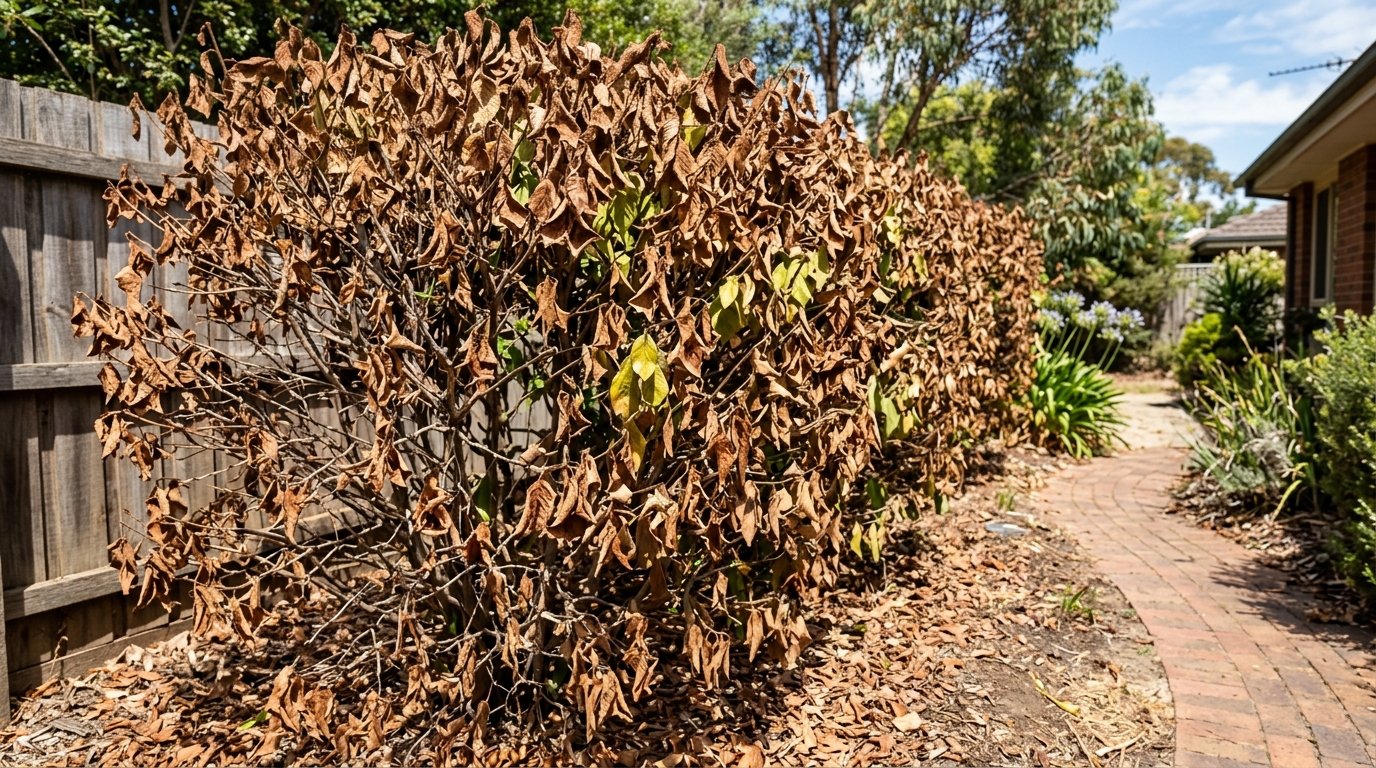
Dry brown tips or crispy leaf margins commonly suggest water stress, heat or drying wind. But a damaged root system can create a similar appearance because stressed roots cannot supply the canopy even when the soil contains plenty of water.
This is why we do not diagnose a brown hedge by colour alone.
Push past the mulch and surface layer and assess moisture where the roots actually are. If the soil is dry through the root zone, irrigation may need correcting. If it is already saturated, adding more water can make the problem worse.
Where one stretch of a hedge is affected and neighbouring plants are healthy, inspect for a local difference:
- a blocked or missing dripper;
- a low area collecting runoff;
- compacted soil;
- root disturbance;
- reflected heat;
- wind exposure;
- changes in irrigation coverage.
On long hedges, that pattern often tells us more than the leaf colour itself.
Root rot and wet feet
Sweet Viburnum can cope with a useful amount of soil moisture, but that does not mean its root zone should remain stagnant.
Australian sources repeatedly describe Viburnum odoratissimum as preferring a well-drained soil. Alpine Nurseries specifies moist, well-drained conditions; Landsdale Plants also lists well-draining soil; Plant Selector South Australia recommends well-drained soils for Sweet Viburnum screening.
Root problems should move higher on the list when:
- yellowing persists despite feeding;
- growth slows while the soil stays wet;
- branches begin dying back;
- only plants in a low section of the bed decline;
- the problem follows prolonged rain or an irrigation change;
- the roots smell sour or appear visibly unhealthy when inspected.
The fix has to address the reason for the waterlogging. Simply turning the irrigation off temporarily will not correct a compacted clay layer, poor grading or a bed that continually receives runoff.
Likewise, do not jump straight to a fungicide without evidence that a pathogen is involved. Correcting drainage is fundamental even where root disease has developed.
Scale insects and black sooty mould
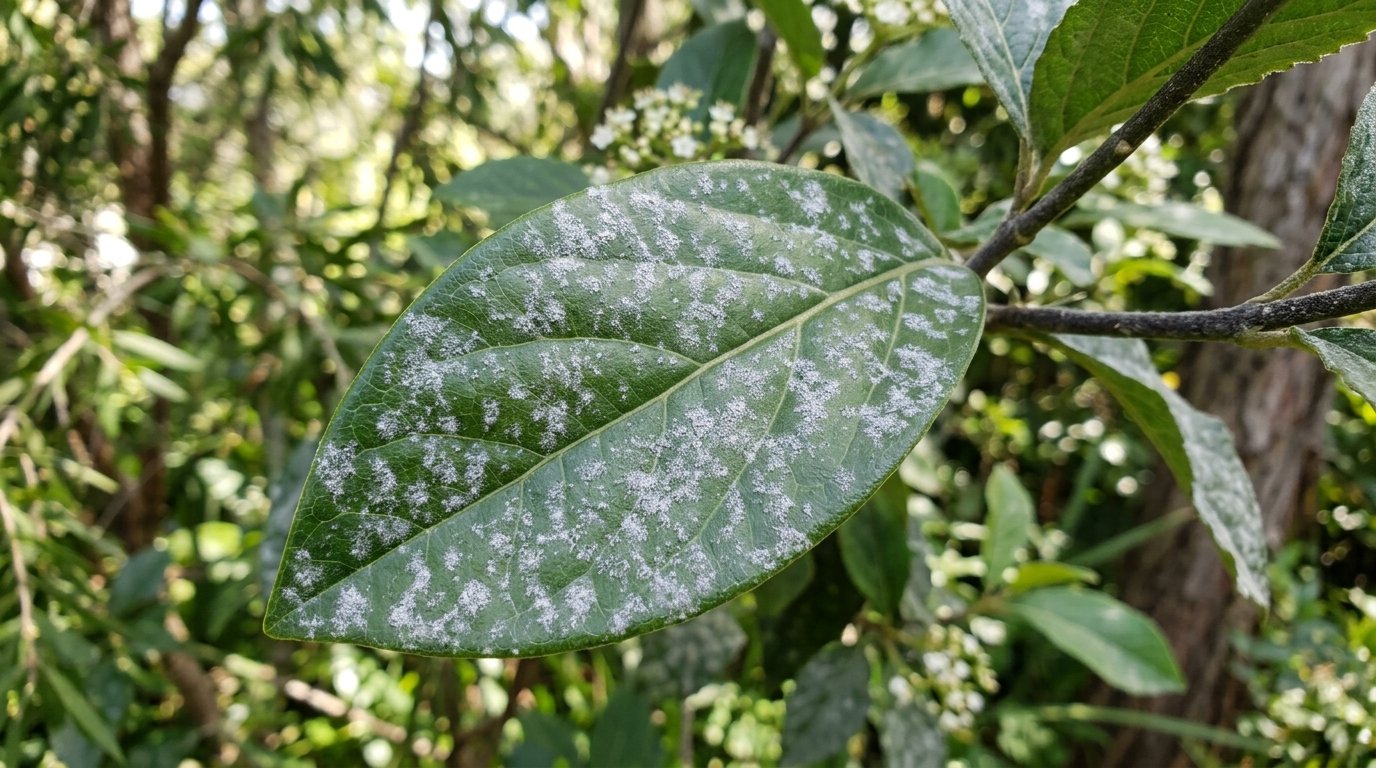
Sticky leaves, small raised insects on stems or foliage, and a black surface coating point toward a sap-sucking pest rather than a primary black-leaf disease.
Yates Australia’s general diagnostic guidance identifies removable lumps and bumps on stems and leaves as consistent with scale. The sugary honeydew produced by scale and related sap-sucking insects provides the surface on which sooty mould develops.
That means the black coating is usually the secondary symptom.
Our approach is to:
- inspect stems, petioles and leaf undersides for scale;
- confirm the pest rather than treating the colour alone;
- deal with the sap-sucker using a product registered for the pest and ornamental plant;
- improve airflow where dense hedge growth is making inspection difficult.
Once the honeydew source is controlled, the sooty mould no longer has the same food supply.
Leaf spots and fungal problems
Individual brown, grey or black spots that enlarge or merge are a different pattern from uniform thrips silvering or dry leaf margins.
Yates Australia notes that many dark spots on foliage are caused by leaf-spot diseases, although pests, spray injury and nutritional problems can sometimes create similar marks. Their leaf-spot guidance recommends reducing prolonged leaf wetness, avoiding overcrowding and removing affected foliage where practical.
For a dense Viburnum hedge, cultural management matters because foliage can stay wet for longer inside a tightly clipped canopy.
Useful first steps include:
- avoid routinely wetting the foliage late in the day;
- water the soil rather than the hedge canopy where practical;
- remove heavily affected fallen material;
- improve airflow without stripping the hedge bare;
- avoid unnecessary overhead irrigation;
- confirm the diagnosis before using fungicide.
If spots continue spreading despite reasonable cultural conditions, a closer diagnosis is more useful than cycling through broad-spectrum products.
Why a Viburnum hedge becomes bare at the bottom
A Sweet Viburnum hedge can be vigorous and still become sparse underneath.
One of the most common reasons is self-shading. If repeated clipping leaves the hedge wider and heavier at the top than at the base, the upper foliage blocks light from reaching the lower branches.
Bunnings Australia advises starting hedge shaping while Viburnum plants are young. That early formative pruning is important because it creates branching low in the plant rather than allowing a few shoots to race upward and dominate the hedge.
On our hedge work, we aim for a profile that is slightly wider at the base than the top. That lets more light reach the lower foliage.
A bare base can also be made worse by:
- deep shade from buildings or trees;
- allowing the hedge to become much taller than intended before pruning starts;
- repeatedly shearing only the outermost top growth;
- poor root conditions reducing the plant’s ability to regenerate.
For normal hedge sizing, spacing and maintenance rather than troubleshooting, see our Viburnum ‘Emerald Lustre’ hedge growing, spacing and care guide.
Why the hedge grows upward but will not thicken
A fast-growing Viburnum does not automatically become a dense screen.
The most common reasons include:
- not tip-pruning young plants;
- allowing long vertical leaders to keep extending;
- insufficient light;
- plants positioned too far apart for the intended finish;
- poor establishment watering;
- root stress or nutrient deficiency.
Bunnings recommends shaping Viburnum hedges from a young age specifically to keep them bushy. Pruning the tips encourages side branching below the cuts, which is what turns a row of upright shrubs into a hedge.
Do not try to compensate for poor spacing or deep shade by simply applying more fertiliser.
If you are still designing the hedge rather than fixing an existing problem, use the Emerald Lustre spacing and growing guide before deciding how closely to plant or how tall to maintain it.
Sunburn and heat scorch
Sweet Viburnum is widely grown in full sun and part shade, but exposed foliage can still scorch during extreme heat, particularly if the roots are dry or the hedge sits beside a heat-radiating fence or paving.
Gardening Australia has previously noted thrip and mite problems on Viburnum in hot, dry positions, which is another reason not to assume bronzed foliage is purely sunburn without checking underneath the leaves.
Heat stress is more likely where damage is strongest on the most exposed side of the hedge and appears after a severe hot spell.
Our first response is to check root-zone moisture and irrigation coverage. We do not immediately hard-prune every browned leaf during extreme weather because the remaining canopy still shades stems and soil.
Once the stress period passes, assess which tissue is genuinely dead and prune accordingly.
Frost damage on new growth
Australian nursery descriptions differ slightly in how strongly they rate Sweet Viburnum for cold tolerance, but there is broad agreement that established plants handle at least some frost better than tender new growth.
Alpine Nurseries describes Viburnum odoratissimum as frost tolerant once established, Landsdale Plants specifies tolerance of light frost once established, and Plant Selector South Australia lists moderate frost tolerance for a Sweet Viburnum cultivar.
Fresh soft shoots remain the most vulnerable part.
After a frost, you may see:
- browned or blackened shoot tips;
- soft new leaves collapsing;
- damage concentrated on the exposed upper surface;
- healthy older wood beneath damaged tips.
Avoid reacting with an immediate severe prune while more frost is likely. Dead material can be removed once the extent of damage is clear and conditions are safer for new growth.
When a Viburnum hedge becomes woody
Old Viburnum hedges can become leafy only around the outside while developing a woody interior.
This often happens after years of clipping the exact same outer surface. New foliage forms at the perimeter while progressively less light reaches the internal framework.
A second pattern occurs when plants are allowed to grow too tall, then repeatedly cut back hard to the same height without building lower branching.
Sweet Viburnum generally responds well to pruning, but a stressed hedge should not automatically receive a severe renovation cut.
Before rejuvenating an old hedge, check:
- root health and drainage;
- whether the stems are still alive;
- whether enough light reaches the lower plant;
- whether the hedge is simply being maintained far below the natural scale of the plant;
- whether extreme heat or frost makes the timing unsuitable.
If the underlying site remains unsuitable, pruning alone will not produce a permanent fix.
Could the hedge simply need more light?
Sweet Viburnum tolerates part shade, but Australian nursery guidance consistently recommends full sun to part shade rather than deep shade.
Nurseries Online specifically notes that Viburnum odoratissimum is not well suited to deep shade. Plantmark, Landsdale Plants and Plant Selector South Australia also place it in full sun to part-shade conditions.
A hedge in deep shade may produce longer shoots, larger gaps and less dense lower foliage even if irrigation and fertiliser are adequate.
Where a row crosses different light conditions, compare the sunny and shaded sections. If the sparse plants correspond closely with the darkest part of the site, light may be a bigger factor than disease.
When should you replace the hedge instead of treating it?
Most Viburnum problems are worth diagnosing before considering removal, particularly when the hedge still has healthy roots and substantial live wood.
Replacement becomes more reasonable where the underlying problem cannot realistically be corrected.
Examples include:
- permanent waterlogging that cannot be remedied;
- repeated severe decline from an unsuitable site;
- a hedge planted in deep shade where dense screening is required;
- plants kept permanently far smaller than their natural scale with constant hard cutting;
- extensive root or structural damage;
- individual plants in a row that have died while the rest of the hedge remains healthy.
If the main problem is that Sweet Viburnum is simply too large or maintenance-heavy for the available space, replacing it with a naturally smaller hedge species may be more sensible than continuing to force it into the wrong role.
For an Australian native alternative where site conditions suit, our Lilly Pilly hedge guide covers cultivar, spacing and screening considerations.
Our diagnosis order for a struggling Viburnum hedge
When we inspect a declining Sweet Viburnum hedge, we work through the evidence in this order:
- Turn the leaves over. Silvering or bronzing means thrips and mites need to be ruled out immediately.
- Check the root zone. Establish whether the soil is genuinely dry, appropriately moist or persistently wet.
- Look at which leaves are yellow. New yellow leaves with greener veins suggest a different problem from whole-plant yellowing in saturated soil.
- Compare healthy and unhealthy sections. One failing stretch often points to irrigation, drainage, heat or root differences.
- Inspect stems and leaf undersides. Sticky foliage, scale and sooty mould are easily missed from standing height.
- Separate spots from scorch. Defined lesions and expanding spots suggest a different process from uniform crispy margins.
- Check hedge shape and light. A bare base can be caused by self-shading rather than pests or disease.
- Consider recent weather. Heat, drying winds and frost can produce sudden symptoms.
- Only then decide whether the correction is irrigation, drainage, pruning, nutrition, pest control or disease treatment.
That order prevents the common cycle of applying fertiliser, insecticide and extra water to the same hedge without first knowing what is actually wrong.
If your Viburnum symptoms do not match these patterns, several causes appear to be overlapping, or the hedge continues declining after the obvious growing conditions have been corrected, Garden Green’s plant and flower disease diagnosis service can help identify the likely cause and practical next step. You can also contact Garden Green and describe what you are seeing.
Frequently asked questions
Why are my Viburnum hedge leaves turning silver or bronze?
Silver, grey or bronzed Viburnum foliage is strongly associated with sap-sucking pests, especially thrips and mites. Yates Australia identifies thrips as a major Viburnum pest, while Bunnings recommends checking underneath silvering leaves for thrips or spider mites. Turn affected leaves over before deciding on treatment.
How do I know if my Viburnum hedge has thrips?
Look for silver or brown speckling on the upper leaf surface, then inspect the underside for tiny elongated insects and dark specks. Australian Viburnum guidance consistently notes that thrips feed on the underside of the foliage, so the pest can be missed if only the top of the hedge is inspected.
Why are the leaves on my Viburnum hedge turning yellow?
Yellowing can come from several causes. Persistently wet soil points toward overwatering or root stress, while Yates Australia says yellow new leaves with greener veins can indicate iron deficiency associated with high soil pH. Check drainage, soil moisture, the age of the affected leaves and soil pH before automatically adding fertiliser.
Why does my Viburnum have brown crispy leaf tips?
Brown crispy tips commonly indicate moisture stress, extreme heat or drying wind, but damaged or waterlogged roots can produce similar symptoms because they cannot supply the foliage properly. Check moisture through the root zone before watering again, particularly if only one section of the hedge is affected.
Why is my Viburnum hedge black and sticky?
Sticky foliage with a black coating usually points toward a sap-sucking pest such as scale, with sooty mould growing on the honeydew left behind. Inspect stems and leaf undersides for the pest and address the honeydew source rather than treating the black surface coating alone.
Why is my Viburnum hedge bare at the bottom?
The lower hedge is often being shaded by dense upper growth. If the hedge is wider at the top than the base, less light reaches the lower branches and they gradually lose foliage. Start shaping Viburnum hedges while young and maintain a profile that is slightly broader at the base than the top.
Can overwatering damage a Sweet Viburnum hedge?
Yes. Australian nursery guidance consistently recommends moist but well-drained soil for Viburnum odoratissimum. Persistent wet soil can stress the roots and contribute to yellowing, weak growth and dieback. If the soil is already saturated, adding more irrigation is not the solution.
Can a sparse or woody Viburnum hedge recover?
Often it can if the roots and remaining stems are healthy. Viburnum responds well to pruning, but recovery depends on solving the underlying cause as well. A hedge affected by deep shade, waterlogging, severe root damage or an unsuitable planting position may remain sparse even after hard pruning.


