
Tristaniopsis laurina: Water Gum Size, Hedge and Growing Guide Australia

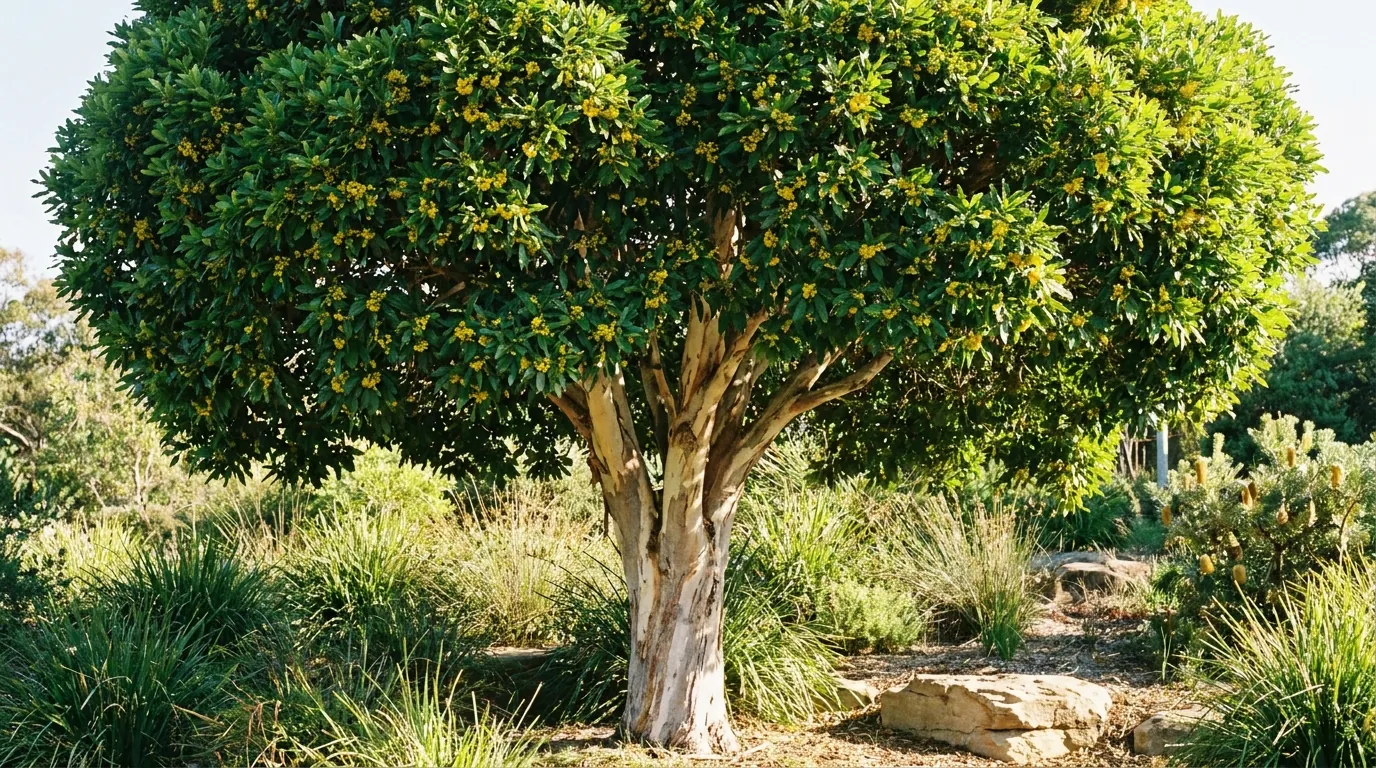
Tristaniopsis laurina, or Water Gum, is a medium-to-large evergreen Australian tree that commonly reaches about 5–15 m in botanical references, although garden-grown trees are often smaller. The Australian National Botanic Gardens gives the straight species at 5–15 m, while Australian Plants Society NSW notes that wild trees can reach 30 m in natural creekline habitat. For urban planting, Northern Beaches Council uses a much more compact planning figure of about 5 m high with a 3 m branch spread.
That spread in published size is the first thing to understand. Water Gum is not one perfectly predictable 5 m tree. Climate, pruning, provenance and growing conditions all affect the final scale, and named cultivars such as ‘Luscious’ have their own dimensions. In our own landscape work, we treat the straight species as a genuine tree first, then decide whether pruning and site conditions make it suitable for the available space.
The straight species and ‘Luscious’ are not interchangeable
One of the biggest problems in current Water Gum content is that straight Tristaniopsis laurina and the cultivar ‘Luscious’ are often blended together.
| Plant | Published size | What changes |
|---|---|---|
| Straight Tristaniopsis laurina | 5–15 m in the Australian National Botanic Gardens; 3–10 m high × 3–5 m wide in SA Plant Selector+ | Natural species; variable size and form |
| Tristaniopsis laurina ‘Luscious’ | 7–12 m high × about 5 m wide from Alpine Nurseries and Winter Hill Tree Farm | Larger, glossier foliage and copper-red new growth |
| Urban street-tree planning example | 5 m high × 3 m spread from Northern Beaches Council | Managed urban-tree expectation, not a botanical maximum |
We check the label before using any size figure. ‘Luscious’ is a selected cultivar, not another name for every Water Gum, and its larger glossy leaves and red-copper flush should not be attributed to the straight species.
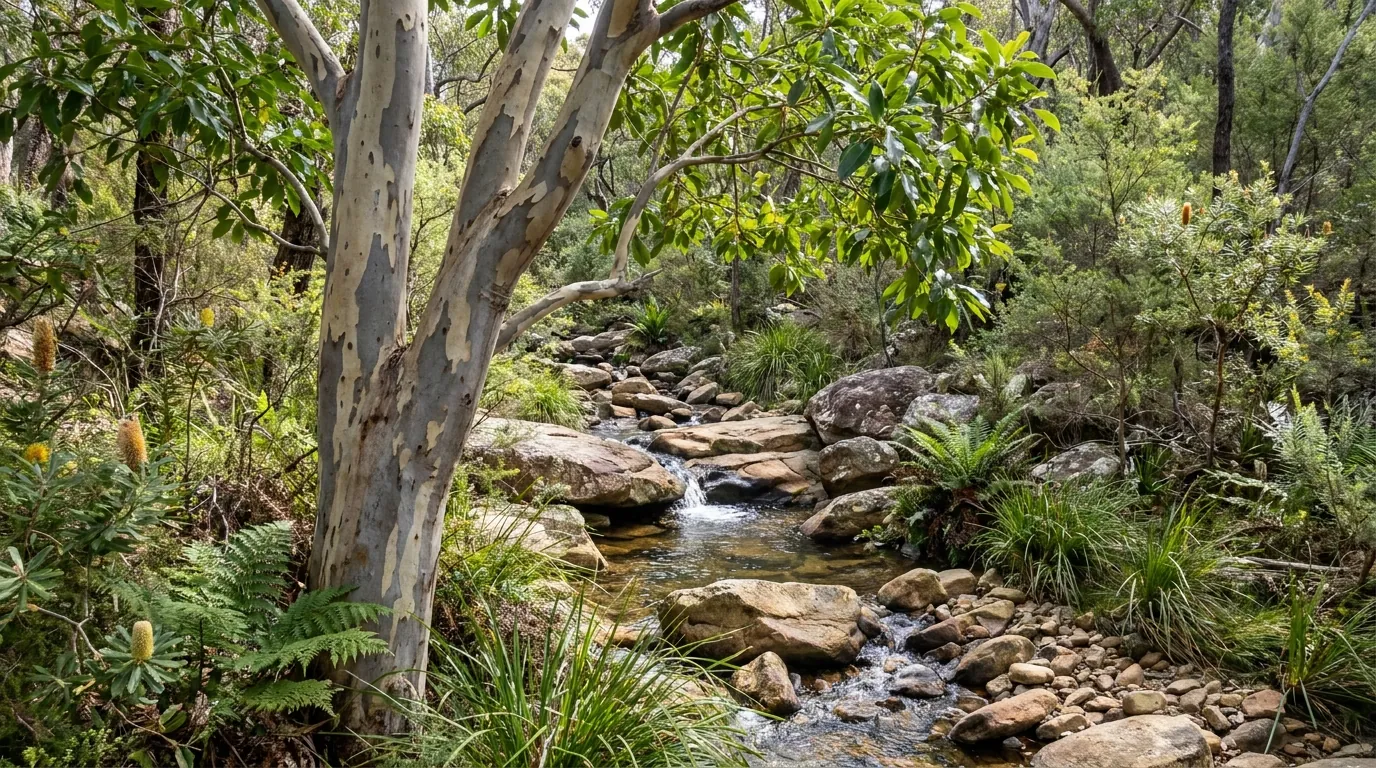
Its creekline origin explains why Water Gum behaves differently from a dryland tree
The Australian National Botanic Gardens records Water Gum naturally along moist, well-drained sites from the Brisbane River through coastal New South Wales to Gippsland in Victoria. Australian Plants Society NSW describes it growing directly along freshwater creeklines and even with roots in moving water.
That ecology explains why the species responds well to reliable moisture and why it has become such a useful urban shade tree. It is much more comfortable with moisture than many dry-country natives, yet Australian cultivation references still repeatedly favour drainage rather than stagnant soil.
On jobs, we read that habitat as “moist and aerated”, not “permanently boggy”. A tree beside a flowing creek has oxygenated water moving through the root zone; a compacted garden hole full of stagnant water is a completely different environment.
How big should you plan for?
The strongest botanical sources show a much broader range than most nursery cards.
| Australian source | Published size |
|---|---|
| Australian National Botanic Gardens | 5–15 m high |
| Australian Plants Society NSW | Up to 30 m in natural habitat; around 20 m × 10 m possible in a garden over time if uncontrolled |
| SA Plant Selector+ | 3–10 m high × 3–5 m wide |
| Waverley Council tree guide | 6–8 m high × 4–6 m spread |
| Northern Beaches Council | 5 m high × 3 m branch spread |
Those figures are not really contradictory. They describe the same species at different ages, in different climates and under different maintenance regimes.
For a suburban garden, we would not design around the smallest council figure unless we know the tree will be managed. If the site genuinely cannot accommodate a canopy several metres wide, a smaller tree species or a compact cultivar is the safer long-term choice.
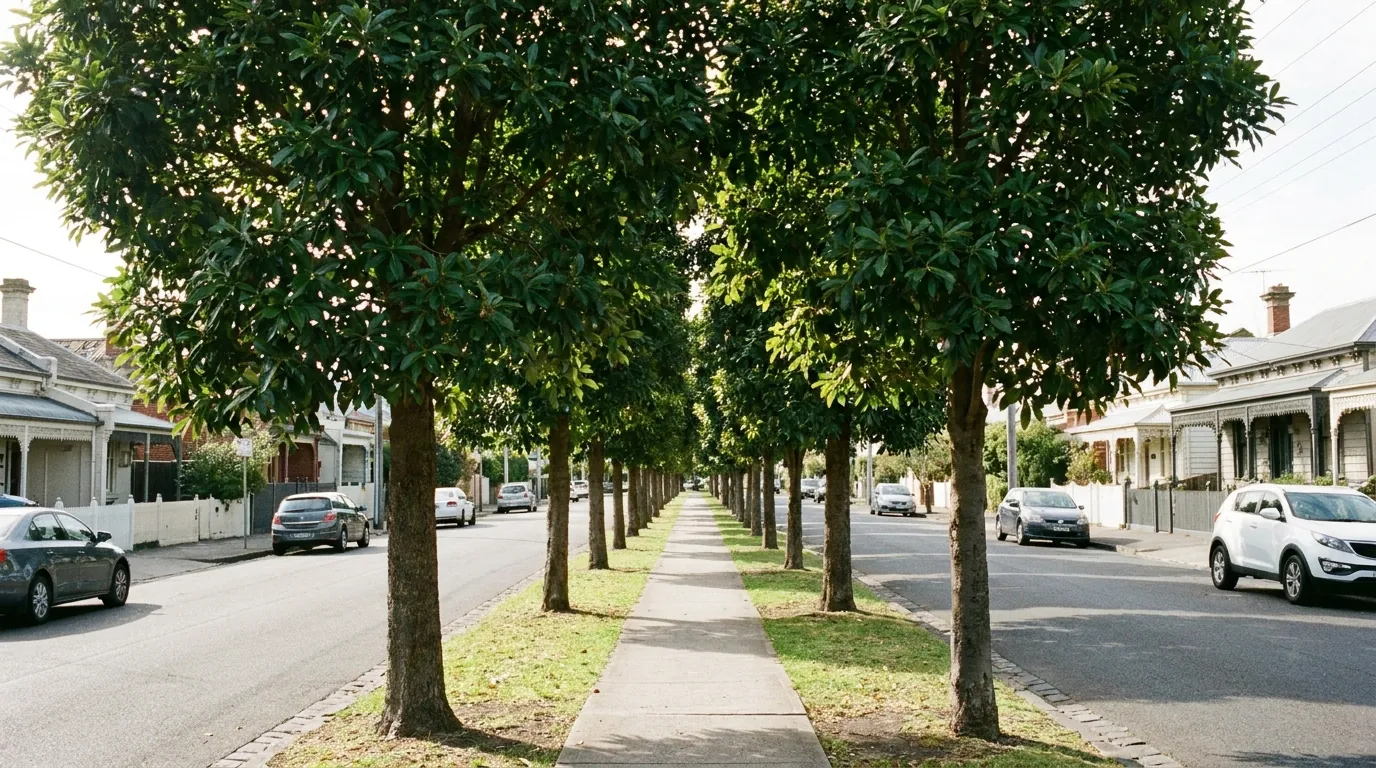
Water Gum is a street tree for good reasons
The species has been used as a street tree in Australian cities for decades. ANBG specifically notes plantings in Sydney, and Australian Plants Society NSW describes it as a long-established parks and street-tree species. Rockhampton Regional Council also includes Water Gum on its preferred street-tree list.
The appeal is easy to understand: evergreen foliage, a rounded canopy, decorative bark, yellow flowers and the ability to accept formative pruning all work well in urban landscapes.
In our own work, the street-tree pedigree is useful evidence of toughness, but it is not a licence to plant one anywhere. Councils select planting sites around underground services, road visibility, canopy clearance and long-term maintenance. A private garden should make the same kind of space calculation.
Do Water Gum roots damage pipes or paving?
There is no responsible universal answer such as “Water Gum has non-invasive roots”. Some council tree-selection material describes the root system of selected Water Gum cultivars as not overly vigorous, but that is not the same as proving that every mature straight-species tree is harmless beside every pipe or slab.
The species naturally develops substantial roots along creek banks, and mature trees can become large. SA Plant Selector+ gives a specific infrastructure warning for the ‘Luscious’ cultivar: it notes that SA Water provisionally classifies that plant under Schedule 2 and requires written approval before street or drainage planting, with a stated setback of 3.5 m from sewer mains or connections. That is a South Australian infrastructure rule for that cultivar and context, not a universal household setback for the straight species.
Our approach is simpler: treat Water Gum as a real tree. Around sewer lines, retaining walls, pools and foundations, check local utility or arboricultural guidance instead of relying on the phrase “non-invasive roots”.
Growth rate: slow, moderate or fast?
The Australian references genuinely disagree.
ANBG describes Water Gum as slow growing and notes that it rarely becomes very large in southern Australia. Northern Beaches Council lists a moderate growth rate. Hornsby Shire Council says growth is more rapid in full sun, while Australian Plants Society NSW says the species can take time to establish but can then grow relatively quickly.
That combination is more useful than inventing a centimetres-per-year figure. In our experience, young Water Gums can spend time establishing a root system before canopy growth becomes more obvious. Light, moisture, climate and whether the tree is a straight species or selected cultivar all influence the result.
We judge a young tree by new extension growth, branch development, leaf quality and canopy density rather than trying to make every Water Gum match a generic annual number.
Full sun usually gives faster growth
The species tolerates both light shade and full sun. ANBG specifically notes that growth is more rapid in full sun, while SA Plant Selector+ and Northern Beaches Council also list sunny to partly shaded positions.
That matches what we see in practice. A Water Gum can make a handsome shade-tolerant tree, but where the goal is faster canopy development and denser screening, useful direct light helps.
Deep shade under an established canopy is different from part shade. If the site gets very little direct light, we would not expect the same dense crown as a tree growing in a more open position.
Water it like a creekline tree during establishment
Water Gum appreciates moisture. The species’ natural habitat and Australian horticultural guidance are unusually consistent on that point.
ANBG says it grows across soils from rocky ground to heavy clay loams provided ample water is available. SA Plant Selector+ lists moderate supplementary watering, and Northern Beaches Council says the species prefers moisture.
For a newly planted tree, we water deeply through the original root ball and the surrounding soil rather than giving frequent shallow sprinkles. Mulch helps slow evaporation, but we keep it away from direct contact with the trunk.
Once established, Water Gum is more resilient. Australian nursery sources describe established trees as capable of handling dry periods, but extended drought can still justify supplementary water—particularly in hot inland or Mediterranean-style summers.
Most soils are workable if moisture and drainage are balanced
SA Plant Selector+ lists the straight species for clay, gravel, loam and sand and across acidic, neutral and alkaline soil categories. ANBG likewise reports success in rocky soils and heavy clay loams.
That makes Water Gum much less fussy than many gardeners assume from the word “rainforest”.
In our own plantings, soil structure matters more than chasing a perfect pH number. A compacted clay hole that never drains is still a poor planting environment, while a very sandy site may need organic matter and deeper watering to hold enough moisture through summer.
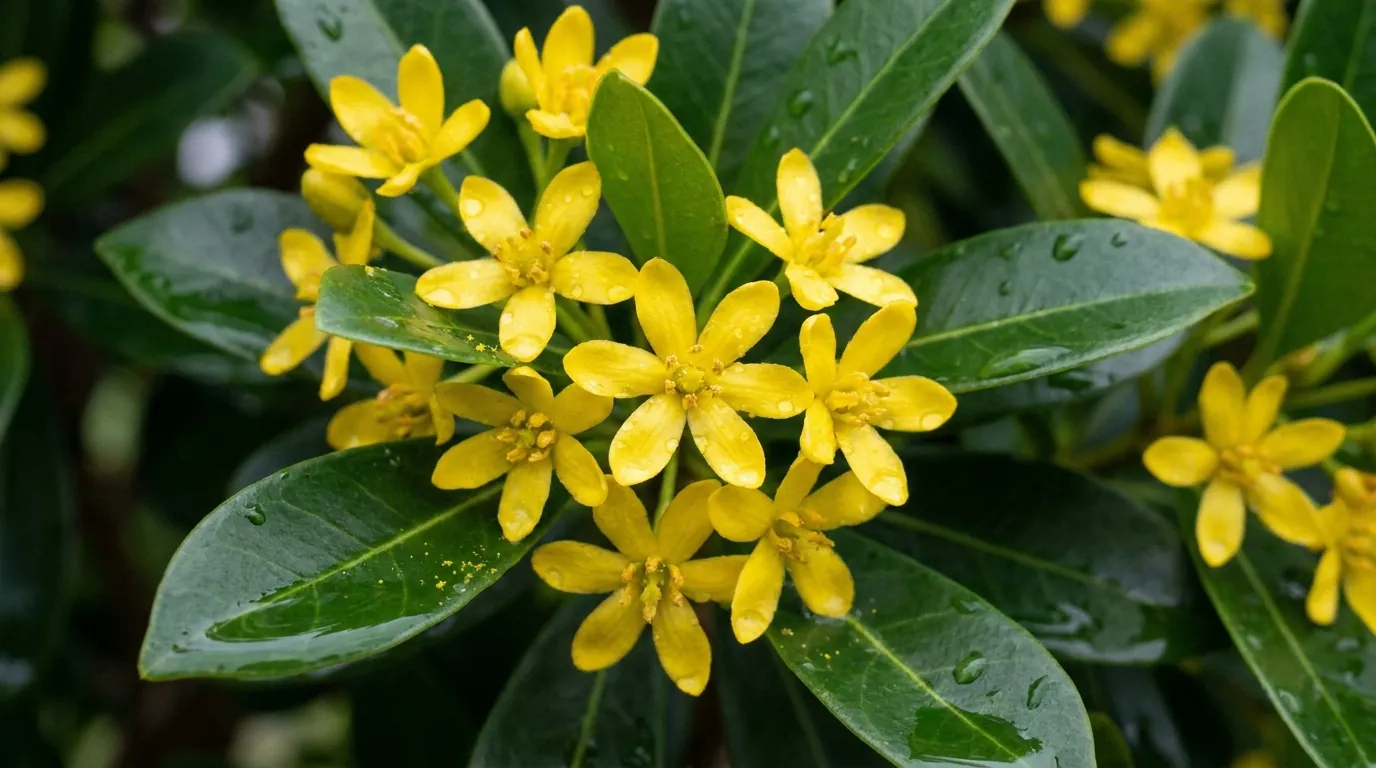
Flowering is strongest through the warmer months
ANBG records cream to orange-yellow flowers in short clusters during January and early February, with individual flowers about 10 mm in diameter. SA Plant Selector+ gives a broader cultivated flowering window across spring and summer, while Northern Beaches Council records September to November for its local tree guide.
That variation is exactly what we would expect across Australia’s climate range and from different forms of the species.
The useful garden description is a spring-to-summer flowering tree with stronger local timing depending on climate. The flowers are not enormous, but they can be produced heavily enough to brighten the canopy, and SA Plant Selector+ notes that they are attractive to bees.
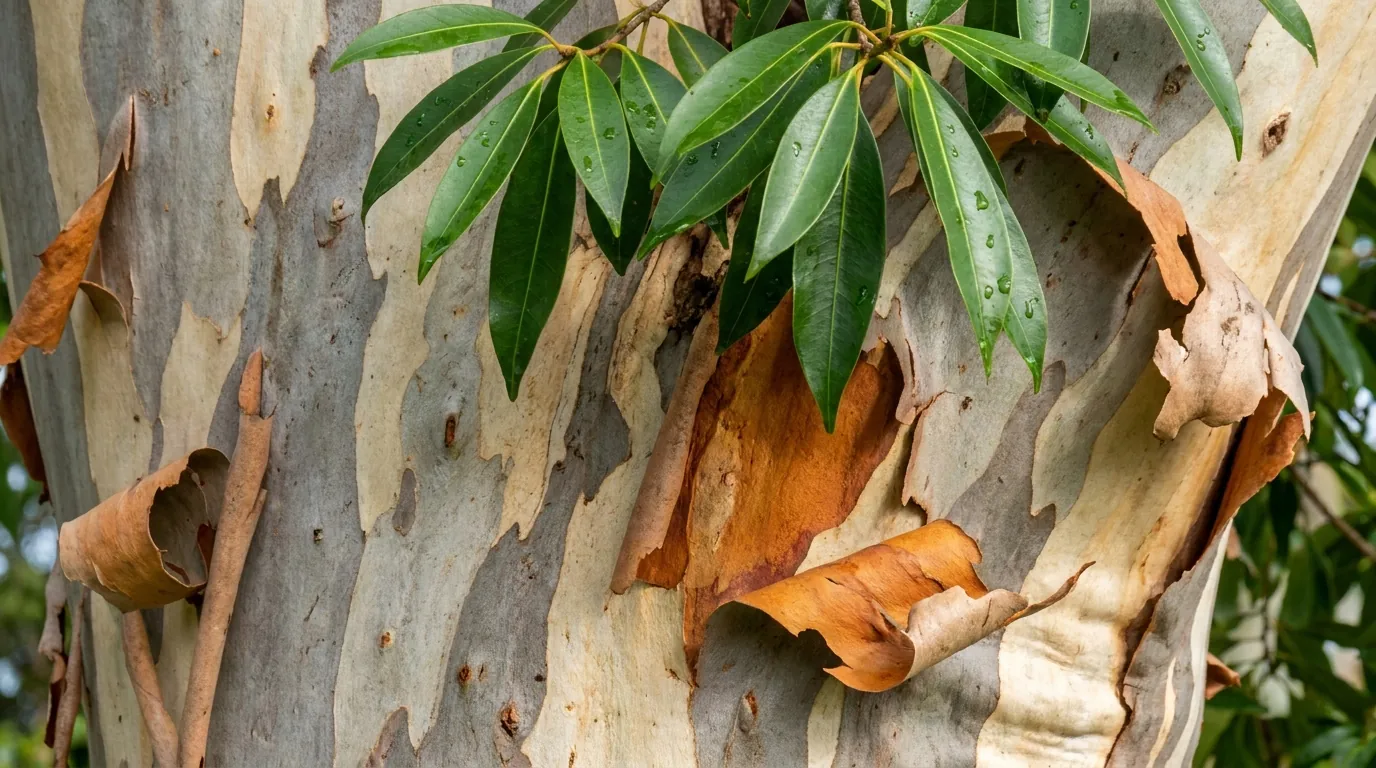
The bark gets better with age
Water Gum is worth growing for more than leaves and flowers. ANBG describes the bark as smooth when young and increasingly scaly with maturity, while many landscape references note the mottled grey, cream and brown trunk that develops as older bark sheds.
This is one reason we often prefer Water Gum as a specimen or small avenue tree rather than burying the entire trunk inside dense underplanting. With age, the bark becomes part of the visual structure of the garden.
Pruning can completely change its role
Australian Plants Society NSW says Water Gum can tolerate heavy pruning and can be turned into dense topiary or hedging. Rockhampton Regional Council likewise notes that the multi-branched tree can be pruned to maintain a compact shape.
For a normal shade or street-style tree, we do almost the opposite: formative pruning while young is used to develop a clean structure and, where desired, a stronger single trunk.
| Desired result | Pruning approach |
|---|---|
| Shade tree | Formative pruning while young; retain a balanced canopy |
| Street-style single trunk | Progressively remove competing lower leaders while the tree is young |
| Dense screen | Tip-prune to encourage lower branching and canopy density |
| Topiary / heavily controlled form | Regular structural clipping; APS NSW confirms tolerance of heavy pruning |
In our own work, early formative pruning is far easier than trying to correct a badly structured mature tree. The cut size stays smaller, the response is cleaner and you preserve more of the natural canopy.
Water Gum handles frost better than its rainforest label suggests
SA Plant Selector+ lists moderate frost tolerance. ANBG says frost tolerance varies by provenance and specifically advises southern Australian gardeners to obtain material from their local region rather than seed sourced from northern NSW or Queensland.
That is an unusually useful piece of advice. Provenance matters because populations from cooler southern areas have been exposed to colder conditions over generations.
We would not publish one minimum-temperature figure for the straight species. The source material does not justify it. In a frost-prone garden, locally sourced or southern-provenance material is the more defensible choice.
Southern Australia naturally slows the tree down
ANBG says Water Gum rarely reaches its largest size in southern Australia and describes it as slow growing there. That fits the species’ broader natural range: warmer eastern coastal conditions give it a longer active season than a cold inland or southern site.
| Australian situation | Practical expectation |
|---|---|
| South-east Queensland / warm coastal NSW | Close to the warmer part of its natural range; strong potential with moisture |
| Sydney and coastal NSW | Very well established as an urban and street tree |
| Eastern Victoria | Within its natural range; growth is usually more restrained than farther north |
| Adelaide and Mediterranean-style summers | Possible with supplementary summer water; SA Plant Selector+ supports cultivation |
| Very dry inland climates | A weaker fit; Australian Native Plants Society specifically excludes very dry inland areas from its strongest climate recommendation |
These are climate expectations rather than invented city growth rates. Soil depth, irrigation and local microclimate can still change the result dramatically.
Can Water Gum be used as a screen or hedge?
Yes, but we would not confuse that ability with natural size. SA Plant Selector+ explicitly lists the species for screening and living fences, and Australian Plants Society NSW confirms that it can be heavily pruned into dense hedging or topiary.
The straight species can ultimately become a substantial tree, so a permanently narrow suburban hedge will require regular management. Where the goal is a clipped wall several metres high, Water Gum can work well. Where the target is a permanently tiny hedge, there are easier species.
For us, the advantage is foliage density and pruning tolerance. The disadvantage is that a tree with genuine canopy potential does not stop behaving like a tree simply because it was planted on a hedge line.
‘Luscious’ is worth choosing when its traits are actually what you want
‘Luscious’ is registered as Tristaniopsis laurina ‘DOW10’. Australian Plants Society NSW says it comes from the NSW north coast and has broader leaves around 2–3 cm wide. Alpine Nurseries lists the cultivar at 7–12 m high × about 5 m wide.
Its appeal is the larger glossy foliage, copper-red new growth and darker young bark. That makes it a stronger ornamental statement than the straight species, but not necessarily a smaller one.
If the design calls for a compact tree, do not assume the cultivar name means dwarf. ‘Luscious’ is an improved ornamental selection, not a miniature Water Gum.
Pests are usually a secondary issue
ANBG records scale insects as a common pest and leafhoppers or leaf-eating beetles as occasional problems, while also noting that damage is rarely serious enough to justify spraying. Australian Plants Society NSW flags possible susceptibility to Myrtle Rust.
In our own inspections, we would first look at the health of new growth and the overall canopy before treating a few marked leaves. A vigorous established tree can tolerate minor insect activity without needing an aggressive chemical response.
Myrtle Rust is different because it affects susceptible new growth in Myrtaceae. Where symptoms are suspected, follow current state biosecurity guidance rather than relying on generic home-remedy advice.
Water Gum or a smaller garden tree?
| If you need… | Water Gum makes sense when… |
|---|---|
| A medium evergreen shade tree | You have room for a canopy several metres wide |
| A street-style Australian native | You can provide establishment water and formative pruning |
| A tree for a moist garden | The site drains but holds useful moisture |
| A screen or clipped living fence | You are prepared to prune a naturally tree-sized species |
| A permanently tiny courtyard tree | A naturally smaller species is usually the easier choice |
| Glossy foliage and copper-red new growth | Consider the named ‘Luscious’ cultivar rather than assuming the straight species has the same foliage |
For us, the buying decision is straightforward. Water Gum is at its best where you actually want a tree: shade, canopy, evergreen structure and enough room for a substantial root system. Its pruning tolerance gives you flexibility, but it should not be used to justify planting a large species into a space that was too small from the beginning.
Frequently asked questions
How big does Tristaniopsis laurina grow?
The Australian National Botanic Gardens lists the straight species at about 5–15 m high, while Australian Plants Society NSW says wild trees can reach 30 m. Urban planning guides often use smaller managed sizes, such as Northern Beaches Council’s 5 m high × 3 m spread.
How fast does Water Gum grow?
Australian sources describe Water Gum from slow to moderate and, once established, relatively quick. ANBG says it grows slowly and is smaller in southern Australia, while Northern Beaches Council lists moderate growth. There is no reliable species-wide centimetres-per-year figure.
Does Water Gum need full sun?
No. It grows in full sun to light or part shade. ANBG notes that growth is more rapid in full sun, so brighter sites are usually better where fast canopy development is the goal.
Is Tristaniopsis laurina frost tolerant?
It has useful frost tolerance, but provenance matters. SA Plant Selector+ lists moderate frost tolerance, while ANBG advises southern gardeners to favour locally sourced material rather than northern provenance where cold tolerance is important.
Can Water Gum grow in wet soil?
The species naturally occurs along creeks and can even grow with roots in moving water, but garden references still favour moist, reasonably drained soil. A flowing creek environment should not be confused with stagnant, oxygen-poor waterlogging in a compacted planting hole.
Can Tristaniopsis laurina be pruned into a hedge?
Yes. Australian Plants Society NSW says the species tolerates heavy pruning and can be turned into dense topiary or hedging, while SA Plant Selector+ lists it for screens and living fences. Regular pruning is required because the straight species is naturally a tree.
Is ‘Luscious’ the same as ordinary Water Gum?
No. ‘Luscious’ is the registered cultivar Tristaniopsis laurina ‘DOW10’. It has broader, glossier leaves and copper-red new growth. Australian nursery references commonly put it around 7–12 m high × about 5 m wide, so it is ornamental but not a dwarf form.
Are Water Gum roots safe near pipes?
Do not rely on a universal “non-invasive roots” claim. Water Gum is a genuine tree with a substantial root system. SA Plant Selector+ notes a 3.5 m sewer setback requirement for ‘Luscious’ under a specific SA Water street/drainage classification, but local infrastructure rules and site conditions should determine setbacks elsewhere.


