
Heliconia ‘Hot Rio Nights’: Size, Flowers and Growing Guide for Australian Gardens

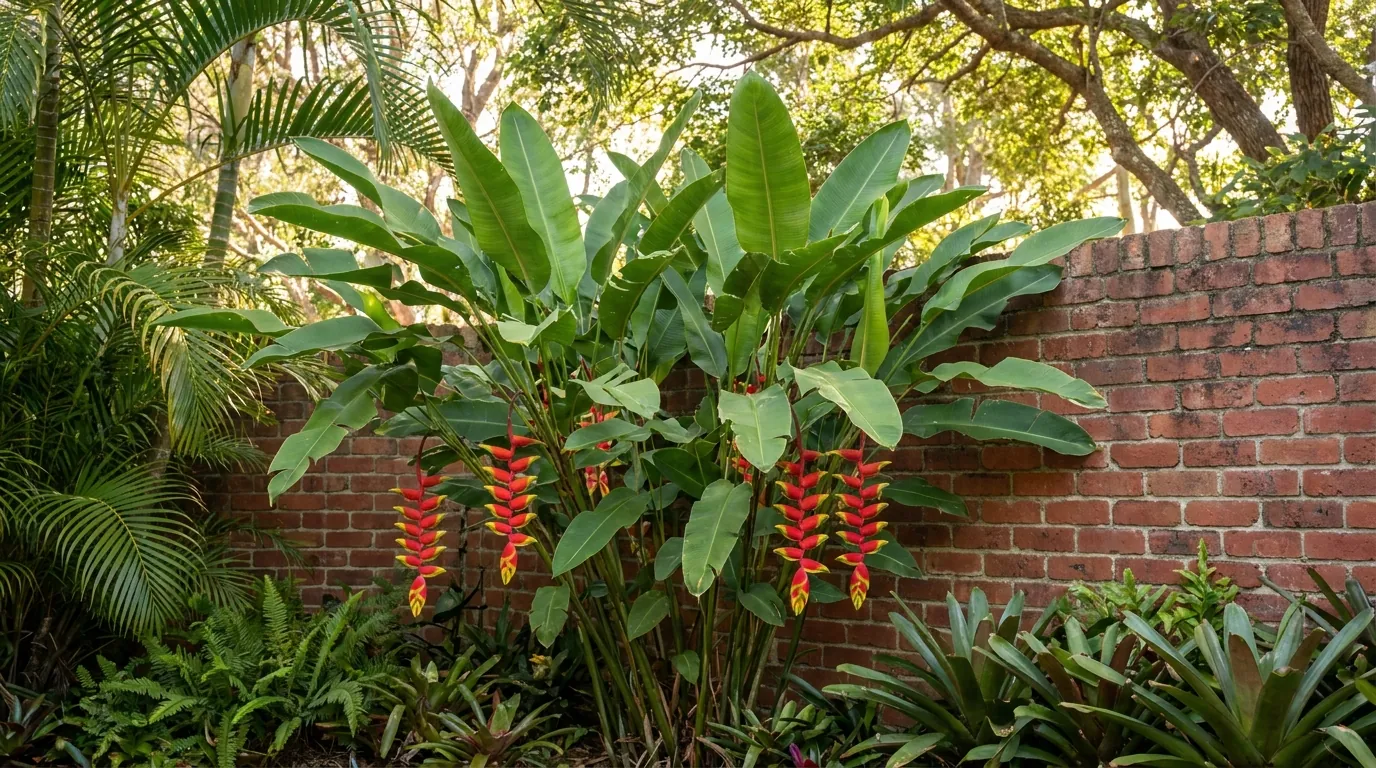
Heliconia ‘Hot Rio Nights’ is a tall, clumping tropical screening plant that typically reaches about 3–4.5 m in Australian nursery references. Bamboo Land lists it at 3–4 m, Sunshine Coast Plants at 3.5–4.5 m, and Florafolia at 3–4.5 m. This is not a small ornamental Heliconia: it is a substantial backdrop or privacy plant with upright red bracts, large leaves and a clump that widens as new shoots emerge.
For Australian gardens, the bigger question is not whether Hot Rio Nights grows quickly—it is whether your climate gives it enough warmth, moisture and protection from frost to keep growing strongly. Coastal Queensland and the humid subtropics suit it naturally; protected coastal parts of New South Wales can also grow it; cold and frost become the limiting factors further south.
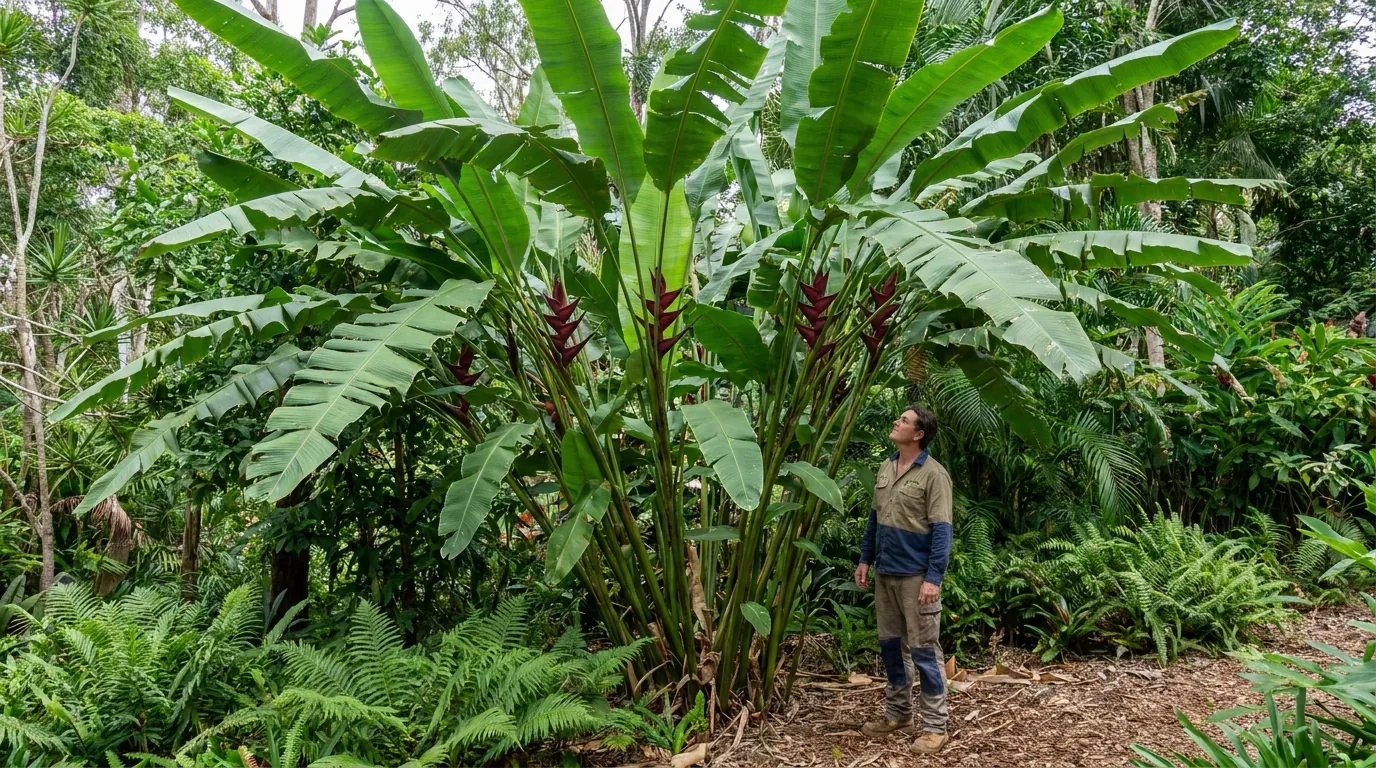
How big does Hot Rio Nights actually get?
| Australian source | Published height | Published width |
|---|---|---|
| Bamboo Land Nursery | 3–4 m | Not stated |
| Sunshine Coast Plants | 3.5–4.5 m | About 1.5 m |
| Florafolia | 3–4.5 m | 1–2 m |
| Mountain View Nursery | 3–4 m | 2–3 m |
| East Coast Palms | About 3 m | Not stated |
Those figures describe the same basic garden role: a tall clumping Heliconia for the back of a bed, beside a fence or wherever a tropical screen needs real height.
The width figures vary because a Heliconia clump is not a fixed-width woody shrub. New shoots emerge from underground rhizomes and the stand thickens with age. In our own work, that spreading habit is exactly what makes tall Heliconias useful for privacy, but it also means we do not squeeze them into narrow beds and expect them to remain pencil-thin.
Buying size changes the result on day one
Bamboo Land publishes unusually useful stock measurements for Hot Rio Nights. Its current listings give the following typical supplied heights:
| Nursery pot size | Typical listed plant height |
|---|---|
| 200 mm | About 60 cm |
| 300 mm | About 1.5 m |
| 400 mm | About 2 m |
| 500 mm | About 2.5 m |
Those are Bamboo Land’s current stock measurements, not an Australian pot-size standard, but they show why two Hot Rio Nights installations can look completely different on planting day.
We see the same trade-off on tropical landscaping jobs: larger stock buys immediate height and visual mass; smaller plants cost less but need time to establish, produce more shoots and close the gaps. If privacy is urgent, starting stock size often matters as much as the cultivar’s eventual height.
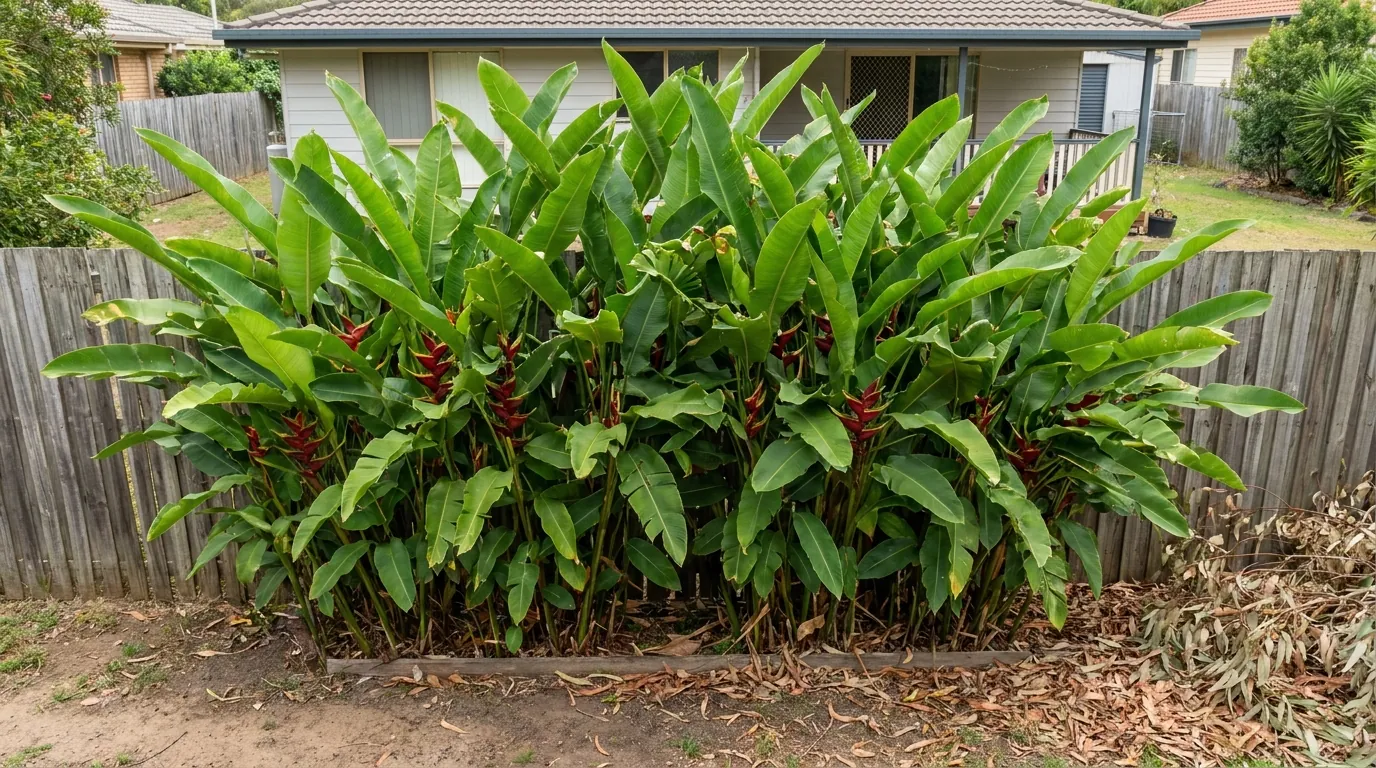
For screening, allow for the clump—not just the stems
Sunshine Coast Plants recommends about 1.5 m spacing for Hot Rio Nights, while The Nurso gives 1–1.5 m for screening in Brisbane conditions.
We treat those figures as useful landscape starting points rather than a compulsory spacing rule. A screen planted toward the closer end fills visually sooner but also becomes a denser rhizomatous mass. Wider spacing leaves more room for each clump and takes longer to close.
Before setting out a row, look at three things: the width of the bed, how quickly you need privacy and whether you will still be able to reach the back of the clump for cleanup later. A tall Heliconia screen can look excellent from the front and become awkward to maintain if it is planted hard against a fence with no working room.
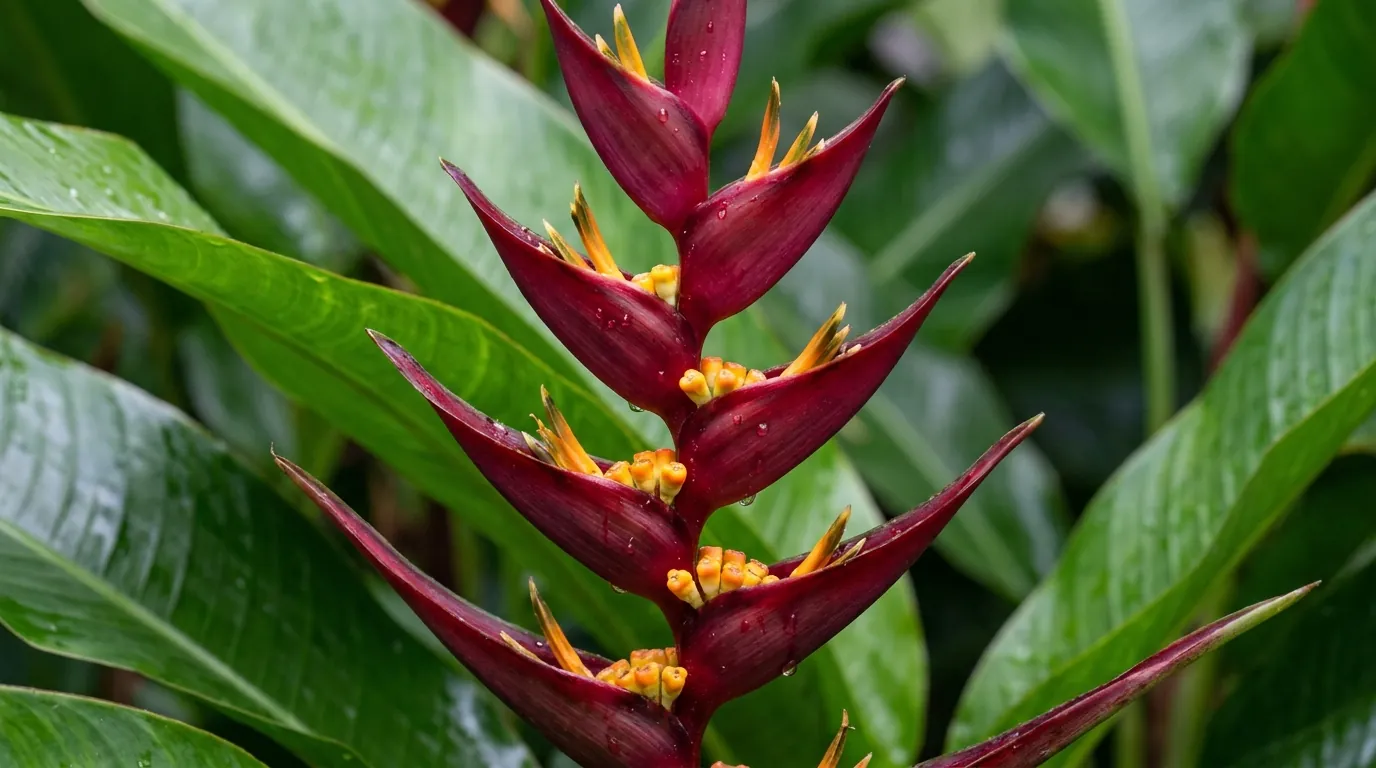
The red display can be enormous
Bamboo Land describes Hot Rio Nights as producing bright red inflorescences that can reach around half a metre long. The flowers sit above tall upright stems, which is why the cultivar reads so strongly from across a garden rather than disappearing into the foliage.
Australian flowering descriptions vary slightly with climate. Bamboo Land lists summer to autumn; Sunshine Coast Plants says the display can begin from mid-spring and continue into autumn; The Nurso reports late spring to autumn in Brisbane.
That variation makes horticultural sense. In a warm subtropical garden the plant gets a longer active season than it does in a marginal temperate position, so we would not promise one exact flowering month nationwide.
Queensland is the easy end of the climate range
Bamboo Land’s 2026 regional guide is one of the better Australian sources for this cultivar because it deals with climate directly. It describes coastal South East Queensland and Far North Queensland as particularly suitable, with the warmth and rainfall pattern closer to the conditions Hot Rio Nights prefers.
That matches what we expect from the plant on real jobs. In tropical and humid subtropical conditions, the question is usually how to give the clump enough moisture, nutrition and physical space—not how to coax it through winter.
| Australian region | Practical expectation |
|---|---|
| Far North Queensland and tropical coastal gardens | Very well suited where soil stays fertile and moist but drains |
| South East Queensland / Brisbane / Sunshine Coast | Strong fit; current local nurseries report vigorous spring and summer growth |
| Northern NSW and warm coastal NSW | Good prospects in warm, sheltered positions |
| Coastal Sydney | Possible in a protected warm microclimate; several Australian growers specifically mention coastal Sydney |
| Cool southern or frost-prone inland districts | Increasingly marginal outdoors; winter cold and frost become the main constraints |
Those are climate-use interpretations, not invented city-by-city growth rates. A warm courtyard near the coast and an exposed inland frost hollow can behave like different climates even within the same state.
Cold stops the show
Mountain View Nursery labels Hot Rio Nights frost tender, The Nurso says it is not frost tolerant, Sunshine Coast Plants describes it as sensitive to frost, and East Coast Palms also lists the cultivar as frost-sensitive.
Bamboo Land’s regional guidance is particularly direct: winter frost can halt growth and can kill Heliconias. For colder areas it recommends using heat-retaining, protected positions near structures such as walls or fences rather than exposed sites.
In our own planting work, we think about winter protection before we think about summer growth when a tropical plant is being pushed toward the edge of its climate range. A vigorous Heliconia in January tells you very little about how suitable the site will be after a hard winter.
Cold damage usually shows as battered, browned or collapsed foliage, and stems can deteriorate after severe exposure. In frost-prone districts, containers have one advantage: they can be shifted into a protected position when cold weather arrives.
Hot Rio Nights grows when the weather is warm
The Nurso describes its strongest growth in Brisbane through spring and summer and reports flowering from late spring into autumn. Mountain View Nursery likewise recommends applying organic fertiliser when new growth emerges in spring.
That seasonal rhythm is useful when judging the plant. In warm weather we expect new shoots, increasing height and a thickening clump. In a marginal southern garden, winter can bring a pronounced slowdown rather than steady month-by-month growth.
We would therefore judge establishment over the active season. A newly planted Hot Rio Nights that spends its first cool winter doing very little has not necessarily failed; the more telling period is what it does when soil and air temperatures rise again.
Sun, shade and wind: the trade-off is foliage quality
Most Australian sellers place Hot Rio Nights somewhere between full sun and part shade. Bamboo Land lists full sun to part shade, Sunshine Coast Plants does the same, while Mountain View Nursery favours morning sun with protection from harsh midday exposure.
The other part of the site choice is wind. Mountain View and The Nurso both recommend shelter because the large banana-like leaves can tear in strong wind.
We see this with tropical foliage plants generally: a plant can be perfectly healthy yet look rough because its leaves are constantly being shredded. Where the leaves are part of the design, a bright but sheltered position often gives a cleaner result than the most exposed sunny corner.
Rich soil, steady moisture and drainage belong together
There is unusually good agreement among the Australian growers on soil. Bamboo Land recommends moist, well-drained soil rich in organic matter; Mountain View says moist well-drained soil with mulch; Florafolia specifies moist, well-drained loam rich in organic matter.
That combination matters. Hot Rio Nights is not a dryland plant, but “likes moisture” does not mean “likes stagnant soil”.
On planting jobs, we aim for soil that can hold useful moisture through hot weather while still allowing excess water to leave the root zone. Organic matter and mulch help with moisture retention; drainage prevents the same bed from turning anaerobic after heavy rain.
A normal feeding and watering routine
The Nurso recommends keeping the soil consistently moist and feeding through spring and summer. Mountain View recommends organic fertiliser as new spring growth appears, while Sunshine Coast Plants recommends a balanced slow-release fertiliser during the growing season.
A practical routine is therefore seasonal rather than calendar-heavy:
- Spring: Refresh mulch, add organic matter where needed and feed as strong new growth begins.
- Summer: Keep the root zone evenly moist during hot or dry spells and continue feeding according to the product label if the plant is actively growing.
- Autumn: Remove spent flowering stems and damaged foliage; in warm climates the display may continue well into the season.
- Winter: In cooler districts, ease back as growth slows and concentrate on cold protection rather than trying to force new growth.
We prefer deep, useful watering over frequent surface splashing. The goal is a moist root zone with oxygen still in it, not permanently saturated soil.
Cut an old flowering stem out rather than trimming the flower
Heliconias flower on individual pseudostems. Once a stem has flowered and finished, that particular stem will not produce another flower spike.
That is why Australian nursery care instructions commonly tell gardeners to remove spent flower stems and old or yellowing foliage. In practice, we cut a finished stem down near the base when it has completed its display, which opens the clump for fresh shoots rather than leaving a forest of old stems.
Do not confuse that with shearing the whole plant like a hedge. Hot Rio Nights looks best when the individual upright stems and large leaves are allowed to keep their natural form.
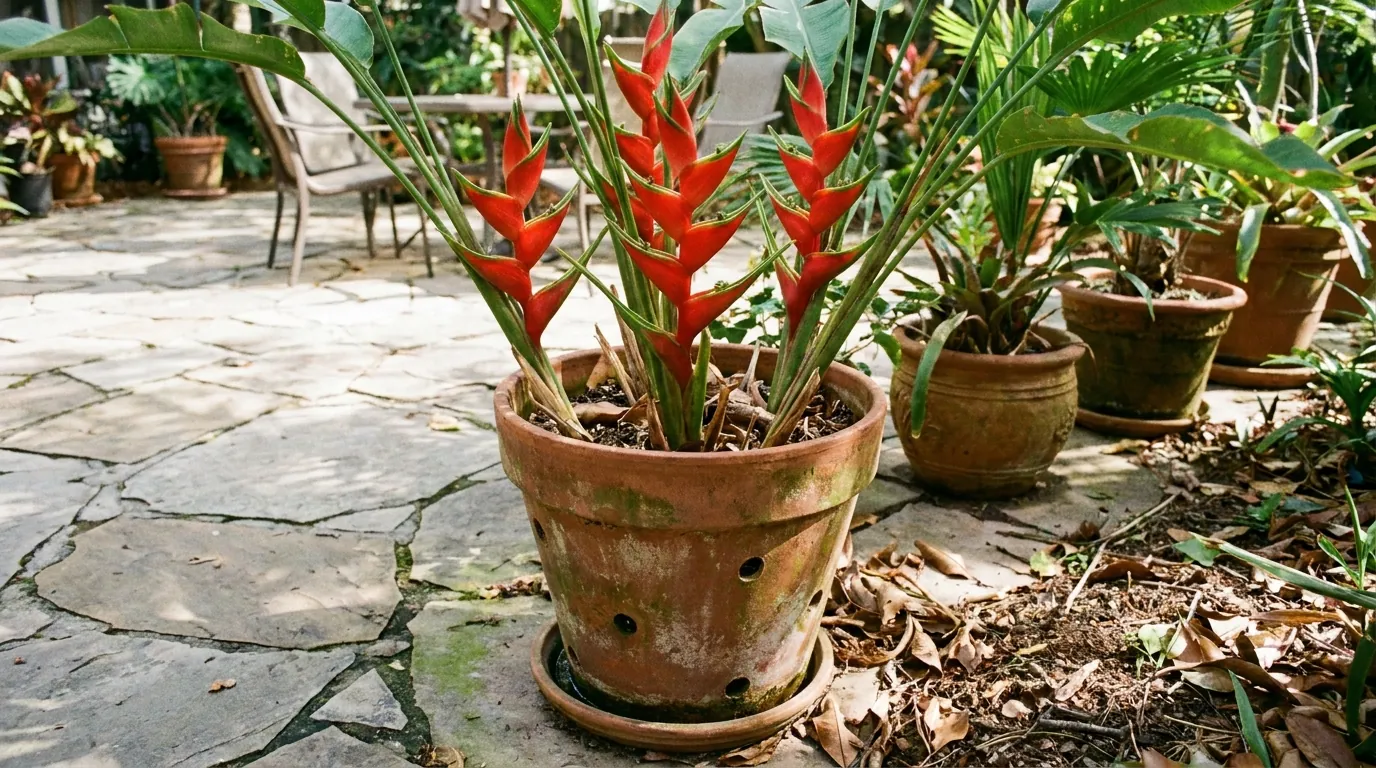
Can Hot Rio Nights grow in a pot?
Yes, but use a genuinely large container. Sunshine Coast Plants explicitly recommends large-container planting, and The Nurso also lists large pots among the cultivar’s landscape uses.
The issue is scale: this is a plant that Australian sources put around 3–4.5 m in favourable ground conditions. A container restricts that root system and needs much closer attention to moisture and feeding.
For us, pots make the most sense where you want a bold tropical feature or where winter mobility matters. They make less sense if the goal is a long, low-maintenance privacy screen.
Hot Rio Nights versus smaller Heliconias
ePlants’ trade list gives a useful sense of scale: it lists Hot Rio Nights / Tropicana around 3 m, ‘Nicky’ around 2 m, and cultivars such as ‘Lady Di’ and ‘Petranova’ around 1.5 m.
| What you need | Better choice | Why |
|---|---|---|
| Tall fence or neighbour screening | Hot Rio Nights | Australian sources commonly put it around 3–4.5 m |
| Back-of-border tropical height | Hot Rio Nights | Upright clumping habit and large red display |
| Mid-height tropical planting | A smaller Heliconia cultivar | 2 m-class plants are easier to scale into medium beds |
| Low tropical layer | A compact Heliconia | 1.5 m-class cultivars better match restricted height |
| Large movable feature pot | Hot Rio Nights | Possible with enough container volume and maintenance |
We would not buy Hot Rio Nights simply because its flowers are impressive and then try to keep it permanently at 1.5 m. If the garden only has room for a low tropical layer, choosing a naturally smaller cultivar is the easier long-term design.
Frequently asked questions
How tall does Heliconia ‘Hot Rio Nights’ grow?
Current Australian nursery references generally put Hot Rio Nights at about 3–4.5 m tall. Bamboo Land lists 3–4 m, while Sunshine Coast Plants and Florafolia extend the upper figure to about 4.5 m.
How wide does Hot Rio Nights grow?
Published Australian widths vary because it is a spreading clumping plant. Sunshine Coast Plants lists about 1.5 m, Florafolia gives 1–2 m, and Mountain View Nursery lists 2–3 m. Allow space for the rhizomatous clump to broaden over time.
How far apart should Hot Rio Nights be planted for screening?
The Nurso recommends about 1–1.5 m spacing for screening in Brisbane, while Sunshine Coast Plants lists about 1.5 m. Closer planting gives quicker visual closure but creates a denser mature clump.
When does Hot Rio Nights flower?
Australian nursery references place flowering broadly from spring or early summer through autumn. Bamboo Land lists summer–autumn, while Brisbane and Sunshine Coast sources report flowering beginning from late or mid-spring in warm conditions.
Is Heliconia Hot Rio Nights frost tolerant?
No. Multiple Australian nurseries describe Hot Rio Nights as frost-tender or frost-sensitive. Bamboo Land warns that frost can stop growth and can kill Heliconias, so colder gardens need a protected warm position.
Can Hot Rio Nights grow in Sydney?
Yes, in the right microclimate. Bamboo Land specifically mentions sheltered coastal parts of New South Wales and coastal Sydney as possible growing areas. Choose a warm protected position with good light, moisture and shelter from frost and cold wind.
Does Hot Rio Nights need full sun?
Australian sources generally recommend full sun to part shade. In very exposed sites, protection from harsh afternoon sun and strong wind can help keep the large leaves looking cleaner.
Can Hot Rio Nights be grown in a pot?
Yes. Australian nurseries list Hot Rio Nights for large containers, but its eventual 3–4.5 m garden scale means the pot needs substantial root volume, reliable moisture and regular feeding during active growth.


