
Lemon Myrtle Problems Australia: Causes & Fixes

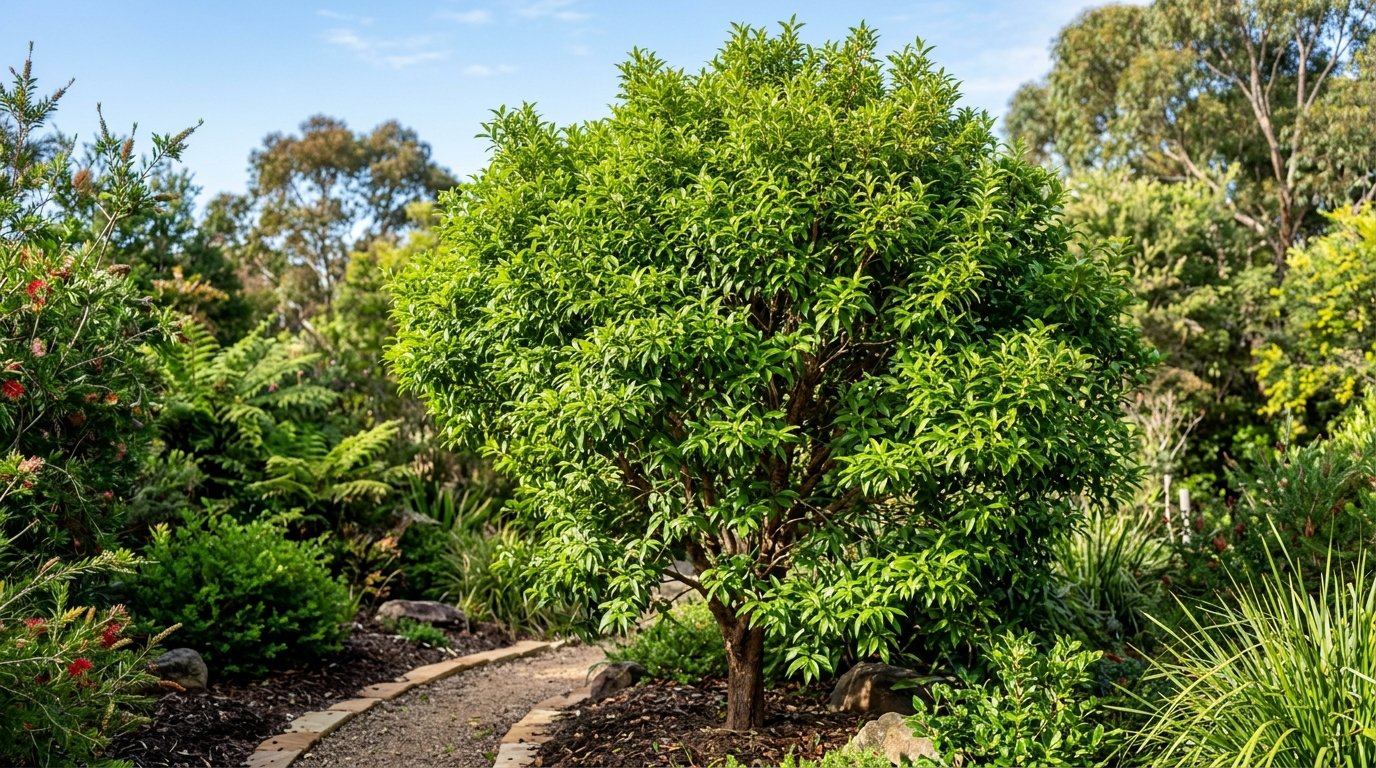
If a Lemon Myrtle is developing yellow-orange powder on fresh leaves, distorted new shoots or rapidly dying tips, rule out Myrtle rust before treating it as a nutrition or watering problem. Backhousia citriodora is highly susceptible to Austropuccinia psidii, and current Australian research shows that widely used commercial Lemon Myrtle clones can suffer severe infection. Ordinary yellowing, dry brown margins, root stress and scale occur too, but the combination of bright yellow spores on soft new growth with purple-brown lesions and shoot dieback is the pattern that deserves immediate attention.
Lemon Myrtle is an Australian native rainforest tree in the Myrtaceae family. Kew’s Plants of the World Online accepts Backhousia citriodora as a native Queensland species, while Australian Native Plants Society and Gardening Australia place its natural range in Queensland’s coastal rainforests. Its intensely lemon-scented leaves are harvested for cooking, herbal infusions and essential oil, which makes healthy foliage especially important.
The useful first distinction is between disease on the new flush and whole-plant stress coming from the roots or environment. Myrtle rust targets young leaves, shoots, buds and flowers. Waterlogging usually affects the plant more broadly. Frost often burns the newest exposed tips. Scale leaves sticky honeydew and black mould. Those patterns tell us far more than simply saying the tree “looks yellow”.
Which Lemon Myrtle problem is it?
| What you can see | Likely cause | What to check first |
|---|---|---|
| Bright yellow or orange powder on soft new leaves or shoots | Myrtle rust | Stop handling the plant and inspect young growth for lesions and distorted shoots |
| Purple-red spots progressing to brown lesions and tip dieback | Possible Myrtle rust | Look closely for yellow spores, especially on fresh growth |
| General yellowing with persistently wet soil | Waterlogging / root stress | Check drainage before fertilising or watering again |
| Yellow new leaves with greener veins | Possible iron chlorosis / nutrient-availability problem | Check soil pH and whether roots are healthy |
| Dry brown leaf margins or crispy shoot tips | Dry roots, hot wind, frost, scorch or damaged roots | Check root-zone moisture and recent weather before adding water |
| Sticky leaves with black coating | Scale or another sap-sucker with sooty mould | Inspect stems and leaf undersides for insects |
| Leaves dropping without obvious yellow rust spores | Water stress, root stress, frost, heat or pest damage | Check roots, weather history and foliage closely |
| Young plant scorched on an exposed hot side | Sun and heat stress | Check exposure, moisture and whether the plant was recently moved or planted |
| Potted plant declining despite regular watering | Root-bound roots, exhausted potting mix or poor drainage | Slide the plant from the pot and assess roots and drainage holes |
| Irregular chewed leaves | Caterpillars or other leaf-chewing insects | Inspect foliage, especially at night or inside dense growth |
This table is for triage. A Lemon Myrtle can be water-stressed and infected with Myrtle rust at the same time, so do not assume every symptom has only one cause.
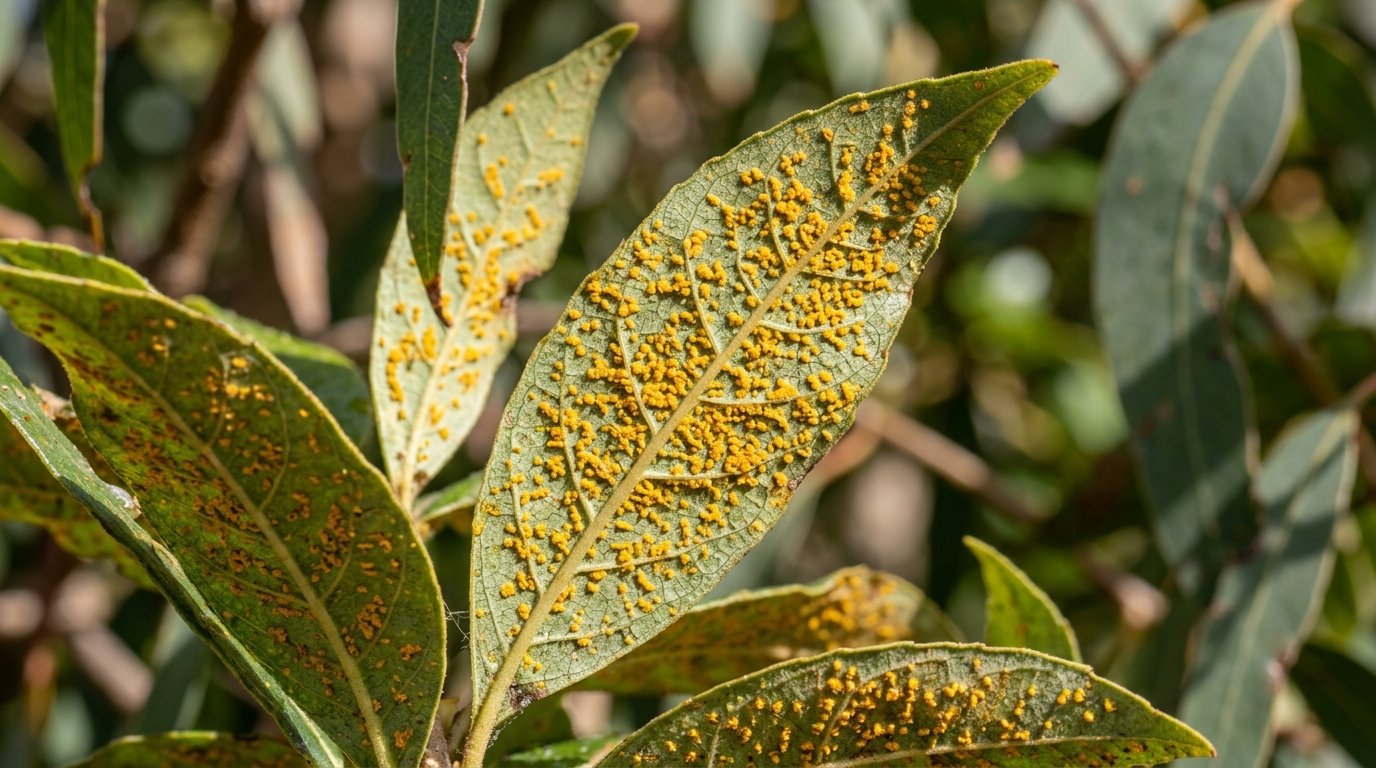
Myrtle rust is the first serious disease to rule out
Myrtle rust is caused by the exotic fungal pathogen Austropuccinia psidii. The Australian Government says the disease attacks plants in the Myrtaceae family and can cause distorted foliage, heavy defoliation, branch dieback and plant death.
Lemon Myrtle is not just a theoretical host. Agriculture Victoria lists Backhousia citriodora among plants confirmed with Myrtle rust, and a 2026 Queensland Department of Primary Industries-led study found the main commercial Lemon Myrtle clones to be highly susceptible. That research reported serious losses in commercial plantings and found no fully resistant material among the germplasm tested, although some provenances showed better resistance than others.
That makes Myrtle rust the headline diagnosis whenever fresh Lemon Myrtle growth develops the characteristic yellow-spore symptoms.
What Myrtle rust looks like on Lemon Myrtle
Agriculture Victoria and the Australian Government describe Myrtle rust as attacking young, soft and actively growing tissue, including:
- new leaves;
- shoot tips;
- young stems;
- flower buds and flowers;
- young fruit.
Early symptoms can begin as pale chlorotic or purple-red spots. These can progress to the disease’s best-known sign: masses of bright yellow, egg-yolk-coloured powdery spores.
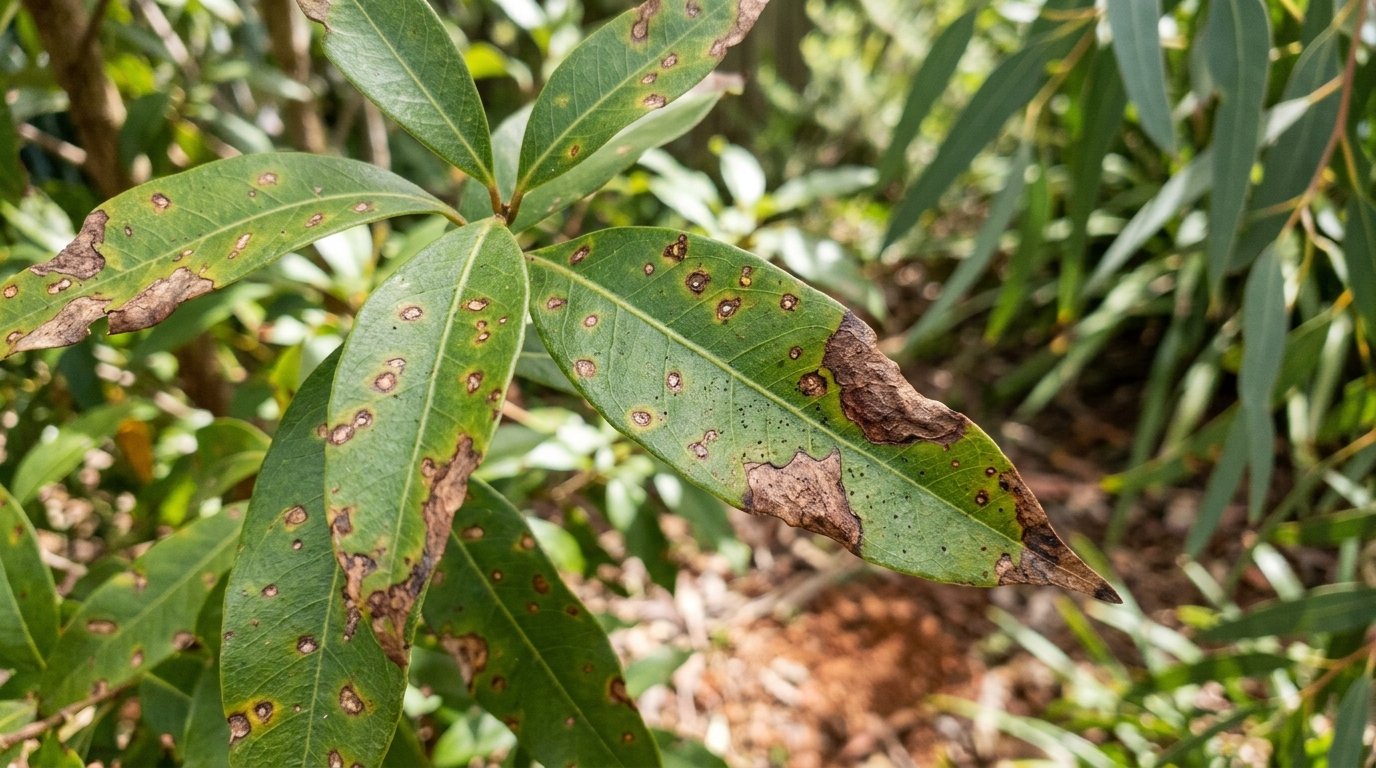
As lesions age they can become red-purple, brown or grey. Young leaves may twist or distort. Shoot tips can die. Repeated infection of fresh flushes can leave the plant sparse, weak and unable to replace foliage normally.
The recent Australian Lemon Myrtle resistance study documented infection ranging from restricted pustules on a small portion of foliage through to extensive leaf infection, distorted shoots and severe stem dieback.
Myrtle rust versus ordinary yellow leaves
The word “yellow” causes a lot of confusion here.
| Pattern | More consistent with |
|---|---|
| Bright yellow powder that rubs or sits on young leaves/shoots | Myrtle rust spores |
| Purple-brown lesions plus distorted new growth | Myrtle rust |
| Entire older leaves becoming pale without powdery pustules | Root or nutrition stress more likely |
| New leaves yellow between greener veins | Possible iron availability problem |
| Yellowing combined with saturated soil | Drainage/root stress |
If the yellow colour is a powdery surface growth on fresh foliage, treat it as a possible plant-disease and biosecurity issue rather than a fertiliser deficiency.
What to do if you suspect Myrtle rust
Do not carry suspect leaves around the garden to compare them with other plants.
Agriculture Victoria advises people with suspect Myrtle rust to avoid touching, moving or collecting infected material because the spores are abundant, airborne and sticky. Spores can spread on tools, clothing, hair, skin, vehicles, animals, wind and splashing water.
Practical hygiene includes:
- avoid handling suspect foliage unnecessarily;
- do not move infected plant material to other parts of the property;
- do not take suspect cuttings to another garden or nursery;
- clean and disinfect secateurs and other equipment after contact;
- avoid pruning while foliage is wet;
- bag infected material where local disposal guidance recommends removal;
- do not casually compost heavily infected material;
- change or clean contaminated gloves, clothing and footwear before moving among susceptible Myrtaceae;
- avoid overhead irrigation that repeatedly keeps vulnerable new flushes wet.
Where disposal, treatment or reporting requirements apply, follow the current instructions from your state or territory biosecurity authority rather than relying on generic internet advice.
Is Myrtle rust reportable in Australia?
The answer depends on where you are.
Myrtle rust is already established across much of eastern Australia. The Australian Government records it in New South Wales, Queensland, Victoria, Tasmania and the Northern Territory, with detections also recorded in the ACT and northern Western Australia.
In Victoria, Agriculture Victoria describes Myrtle rust as an established disease and focuses on management and limiting spread rather than eradication.
Western Australia is different. WA’s Department of Primary Industries and Regional Development currently lists Myrtle rust as a declared pest that must be reported if found or suspected.
Because biosecurity status and movement restrictions can change, check your current state or territory guidance if you suspect Myrtle rust—particularly before transporting an infected Lemon Myrtle or any other Myrtaceae plant.
Warm, humid new growth is the vulnerable stage
The Australian Government says Myrtle rust develops best in damp conditions and primarily attacks tender young tissue.
This explains why a Lemon Myrtle may look healthy for a period and then develop severe symptoms during a flush of soft growth.
Dense foliage, humid weather and repeated wetting can increase disease pressure. We therefore avoid keeping new foliage unnecessarily wet through routine overhead watering when Myrtle rust is a concern.
Water the root zone, not the canopy, where practical.
That does not guarantee prevention because spores can arrive on the wind, but it avoids creating additional prolonged surface moisture on the tissue most vulnerable to infection.
Can badly affected Lemon Myrtle recover?
That depends on disease pressure and how much healthy growing tissue remains.
One infection may damage a flush without killing an established tree. Repeated severe infection is more serious because Myrtle rust keeps attacking the new shoots a plant needs to replace lost foliage.
The 2026 Australian resistance research is particularly important here: commonly used commercial Lemon Myrtle clones were highly susceptible, and repeated disease pressure has caused major production losses in plantations.
For a home gardener in a humid, high-pressure area, that means there is a point where continually forcing a highly susceptible plant through recurrent infection may stop being sensible.
If every new flush becomes badly infected despite good hygiene and appropriate management, replacement or growing a less susceptible plant may be more realistic than permanent treatment.
Yellow leaves without Myrtle rust
If there are no yellow spores, distorted tips or characteristic lesions, return to the root zone.
Plantmark lists Lemon Myrtle for well-drained loam or sandy soils, while Daleys Fruit Tree Nursery describes its preferred soil as moist but well drained. Australian National Botanic Gardens cultivation guidance likewise reflects the species’ rainforest origins by recommending rich, moist conditions.
The combination matters:
moist does not mean waterlogged.
A Lemon Myrtle with persistently wet roots may yellow because stressed roots cannot absorb water and nutrients normally.
Yellowing from poor drainage
Root-zone stress becomes more likely where:
- the soil remains saturated after rain;
- the plant is sitting in a low point;
- heavy clay lies beneath the planting hole;
- yellowing worsens after an irrigation increase;
- growth slows despite plentiful water;
- branches begin dying without obvious Myrtle rust symptoms.
On our plant-care work, we check those conditions before recommending fertiliser because feeding waterlogged roots rarely solves the underlying problem.
Yellow new leaves with greener veins
If the newest leaves are pale while the veins remain noticeably greener, reduced iron availability becomes one possible explanation.
This chlorosis pattern can occur where soil chemistry makes iron difficult for roots to absorb.
Check drainage and pH before repeatedly applying iron. Root disease can also interfere with nutrient uptake, so a nutrient-looking symptom does not automatically mean the soil lacks fertiliser.
Root rot and wet feet
Lemon Myrtle is a rainforest species, but even rainforest plants need oxygen around their roots.
Chronically saturated garden soil or potting mix can injure roots directly and also create conditions favourable to root-rot organisms, including Phytophthora and other water moulds.
Possible warning signs include:
- yellowing followed by wilting;
- a plant looking thirsty although the soil is wet;
- progressive branch dieback;
- dark, soft or decaying roots;
- decline concentrated after prolonged wet weather;
- a sour or stagnant smell in persistently wet potting mix.
Do not diagnose Phytophthora from leaf colour alone. Several root problems produce similar symptoms.
The immediate question is why the roots are remaining wet. A fungicide cannot permanently correct blocked drainage, an undrained decorative pot or heavy soil that repeatedly fills with water.
Brown crispy tips and leaf burn
Brown leaf tips are less specific than Myrtle rust.
They can result from:
- genuinely dry roots;
- hot drying wind;
- frost;
- sun scorch on young or newly exposed foliage;
- root damage from waterlogging;
- container stress.
The important trap is assuming brown equals dry.
Damaged roots cannot supply water properly, so a plant sitting in saturated soil may still develop wilted or scorched-looking foliage.
Check moisture deeper in the root zone before watering again.
Frost damage is especially important on young Lemon Myrtle
Australian Native Plants Society describes Lemon Myrtle as successfully grown in cooler districts when protected from frost while young. Australian National Botanic Gardens likewise calls it slightly frost-tender when young and recommends shelter in colder climates.
Daleys also recommends protecting Lemon Myrtle from frost and strong winds.
Frost injury usually affects:
- fresh soft shoots;
- exposed upper foliage;
- young plants more than established trees;
- plants pushed into tender growth immediately before cold weather.
Tips may brown, blacken or collapse after a cold night.
Do not confuse frost-burned tips with Myrtle rust. Frost does not create bright yellow powdery spores.
Wait until the full extent of cold injury is clear before making a hard prune, especially if further frost is likely.
Sunburn and heat scorch on young plants
Established Lemon Myrtle can grow in strong light, but its rainforest background is relevant when young.
Gardening Australia recommends a sunny but wind-protected position, while Daleys describes semi-shade as suitable and notes that full sun is better tolerated in cooler areas. Gardening Australia’s bush-food container guidance also notes that rainforest myrtles can benefit from protection from harsh afternoon sun.
A young plant moved abruptly from sheltered nursery conditions into intense reflected western heat may scorch before it acclimatises.
Typical scorch is concentrated on the exposed side rather than appearing as powdery disease pustules across soft new shoots.
Where a young tree is struggling, check:
- afternoon exposure;
- hot reflected surfaces;
- wind;
- root moisture;
- whether the plant was recently transplanted.
Scale and black sooty mould
Scale insects occasionally colonise Lemon Myrtle, especially where a plant is stressed or dense growth makes inspection difficult.
Look for:
- small raised scale-like insects on stems or leaves;
- sticky honeydew;
- ants moving through the plant;
- black sooty coating developing over the sticky foliage.
Sooty mould is usually secondary. It grows on honeydew produced by sap-sucking insects.
The useful response is to identify and control the pest producing the honeydew rather than treating the black mould as the primary disease.
If using horticultural oils or pesticides on a tree whose leaves you harvest for food or tea, check the Australian product label carefully for the permitted crop/use and withholding requirements. Do not assume a product labelled for ornamental shrubs is automatically appropriate for edible leaves.
Psyllids, caterpillars and other occasional pests
Lemon Myrtle can also host occasional sap-sucking or leaf-chewing insects.
Psyllid-type damage tends to distort or mark new foliage, while caterpillars and other chewing insects usually leave missing sections, holes or ragged edges rather than powdery yellow spores.
Inspect both sides of the leaves before treating.
On our work, pest damage moves down the diagnosis list when an entire plant is yellowing or collapsing from saturated soil. A few chewed leaves rarely explain whole-tree decline.
Leaf drop is a symptom, not a diagnosis
A Lemon Myrtle can shed leaves after several different stresses:
- Myrtle rust damaging repeated new flushes;
- waterlogging;
- severe drying;
- frost;
- heat and transplant stress;
- root-bound container conditions;
- major pest pressure.
Look at what happened immediately before the leaf drop.
If the leaves had yellow pustules and distorted shoots, disease is more likely. If the entire pot dried out during hot weather, water stress is more likely. If the soil stayed saturated for weeks, inspect the roots.
Potted Lemon Myrtle problems
Lemon Myrtle is often grown in containers because it keeps its culinary leaves close to the kitchen and pruning can maintain a compact plant.
Gardening Australia specifically recommends Lemon Myrtle as a good native pot plant and has demonstrated repotting one that had outgrown its container.
The most common container issues are not mysterious diseases. They are:
- poor drainage;
- an outer decorative pot holding water around the inner pot;
- old compacted potting mix;
- roots circling tightly around the container;
- irregular watering;
- nutrients becoming depleted over time;
- a large canopy trying to live on a very small root volume.
How to recognise a root-bound Lemon Myrtle
Gardening Australia’s pot-health guidance uses Lemon Myrtle as an example of a plant that can simply outgrow its pot.
Clues include:
- roots circling densely around the outside of the root ball;
- water running through immediately without properly wetting the mix;
- the plant drying much faster than it used to;
- growth slowing despite otherwise suitable conditions;
- the canopy becoming obviously oversized for the container.
Repot into fresh quality potting mix with reliable drainage rather than compensating indefinitely with extra watering and fertiliser.
Feeding Lemon Myrtle in pots and garden beds
Lemon Myrtle is not a Proteaceae plant, so it should not automatically be treated under the very low-phosphorus rules used for Banksia, Grevillea and Hakea.
It naturally occurs in comparatively fertile rainforest environments and responds to reasonable nutrition.
That said, yellow leaves are not permission to fertilise blindly.
Feed when roots are healthy and the plant is actively growing. If the potting mix is sour and saturated or garden soil is waterlogged, correct that problem first.
Pruning helps keep Lemon Myrtle bushy
Gardening Australia recommends regular tip pruning for Lemon Myrtle because an unpruned plant naturally develops into a tree rather than remaining a compact kitchen shrub or hedge.
Tip pruning encourages branching and provides fresh aromatic foliage.
It is particularly useful for:
- container plants;
- hedged Lemon Myrtle;
- plants being maintained for leaf harvest;
- young plants where a bushier framework is wanted.
For routine establishment, position, pruning and growing guidance rather than troubleshooting, see our guide to growing Lemon Myrtle in Australia.
If you are choosing material for different regions or trying to understand how Lemon Myrtle forms perform outside their natural range, our Lemon Myrtle types and regional suitability guide provides the broader context.
Myrtle rust hygiene matters even after pruning
Pruning an infected shoot does not automatically remove the disease risk.
Agriculture Victoria explains that spores can contaminate secateurs, clothing and other equipment. Wind can also move spores naturally.
If you prune suspect infected material:
- work in dry conditions where possible;
- bag the material as you remove it;
- avoid dragging it through healthy Myrtaceae;
- clean tools afterwards;
- clean contaminated gloves and footwear;
- follow your local disposal and biosecurity advice.
Do not take infected material to a nursery for identification without first checking how the relevant authority wants samples handled. A clear photograph is often safer than carrying potentially infected foliage.
When should you replace Lemon Myrtle instead of keep treating it?
Replacement is not the first response to ordinary yellowing or a few damaged leaves.
It becomes more reasonable where:
- Myrtle rust repeatedly destroys every new flush in a high-disease-pressure location;
- the plant has suffered extensive repeated shoot dieback;
- most of the root system has been lost to chronic waterlogging or root rot;
- the garden position is permanently too wet;
- a young plant repeatedly suffers severe frost in an unsheltered site;
- a pot-grown plant has deteriorated beyond useful recovery from neglected roots.
The 2026 Australian Lemon Myrtle research provides an important reality check: susceptibility varies among genetic material, but the principal commercial clones have been highly susceptible and no completely resistant germplasm was found in the material tested.
In a humid area with heavy Myrtle rust pressure, repeatedly replacing a severely affected plant with equally susceptible stock may simply restart the same problem.
Our diagnosis order for a struggling Lemon Myrtle
When a Lemon Myrtle looks sick, we work through the evidence in this order:
- Inspect the newest growth first. Yellow powder, purple lesions or distorted soft shoots make Myrtle rust the priority.
- Avoid handling suspect rust unnecessarily. Confirm local biosecurity guidance before moving material.
- Check the root zone. Establish whether the soil is dry, appropriately moist or waterlogged.
- Separate powdery yellow spores from ordinary yellow foliage. They are completely different diagnostic patterns.
- Review recent weather. Frost, hot wind and sudden sun exposure can burn new growth.
- Inspect stems and leaf undersides. Scale, psyllids and other pests leave different evidence from Myrtle rust.
- For potted plants, inspect the container. Check drainage holes, standing water, root binding and potting-mix condition.
- Review nutrition only after root health is sound. A waterlogged plant cannot be rescued by fertiliser alone.
- Only then decide whether the answer is disease hygiene, drainage correction, watering, repotting, pruning, pest control or replacement.
If the symptoms do not clearly match these patterns, you are unsure whether yellow growth is Myrtle rust or a nutrition/root problem, or the tree continues declining after obvious growing conditions have been corrected, Garden Green’s plant and flower disease diagnosis service can help identify the likely cause and practical next step. You can also contact Garden Green with the details of what you are seeing.
Frequently asked questions
What does Myrtle rust look like on Lemon Myrtle?
Myrtle rust usually attacks soft new growth. Look for pale or purple-red spots followed by bright yellow or orange powdery spores on young leaves, shoots or buds. Leaves can distort, lesions later turn brown or grey, and repeated infection can cause tip dieback and defoliation.
Is Lemon Myrtle highly susceptible to Myrtle rust?
Yes. Australian research published in 2026 found the main commercial Backhousia citriodora clones to be highly susceptible to Austropuccinia psidii. Disease severity varied between provenances and clones, but no fully resistant material was found among the germplasm tested.
Do I need to report Myrtle rust on Lemon Myrtle?
Reporting requirements depend on jurisdiction. Myrtle rust is established in much of eastern Australia, while Western Australia currently lists it as a declared pest that must be reported if found or suspected. Check the current biosecurity guidance for your state or territory before moving suspect infected material.
Why are my Lemon Myrtle leaves turning yellow without yellow spores?
Ordinary yellowing can result from root stress, waterlogging, poor nutrition or reduced nutrient availability. If the soil remains wet, investigate drainage first. Yellow new leaves with greener veins can suggest an iron-availability problem, but root health and soil pH should be checked before repeatedly applying fertiliser.
Why does my Lemon Myrtle have brown crispy leaves?
Brown crispy tips can result from dry roots, frost, hot wind, sun scorch or damaged roots in waterlogged soil. Check moisture below the surface before watering again. Young Lemon Myrtle is particularly frost-sensitive, and newly exposed plants can also scorch in harsh conditions.
Can Lemon Myrtle get root rot?
Yes. Lemon Myrtle prefers moist but well-drained soil. Chronically saturated soil or potting mix can damage roots and favour root-rot organisms. Warning signs include yellowing, wilting despite wet soil, branch dieback and dark or decaying roots. Correct the drainage problem rather than simply adding more water.
Why is my potted Lemon Myrtle struggling?
Check drainage and root space first. Gardening Australia has shown Lemon Myrtle becoming root-bound in containers. Old compacted potting mix, blocked drainage, standing water inside decorative pots, depleted nutrients and an undersized container can all cause decline even when the plant is watered regularly.
Should I replace a Lemon Myrtle that keeps getting Myrtle rust?
Replacement may be reasonable where severe Myrtle rust repeatedly destroys each new flush and the plant is declining despite appropriate hygiene and management. Current Australian research confirms that commonly used Lemon Myrtle material can be highly susceptible, so repeated severe infection in a high-pressure humid area may make long-term cultivation impractical.


