
Japanese Box Hedge Problems Australia: Causes & Fixes

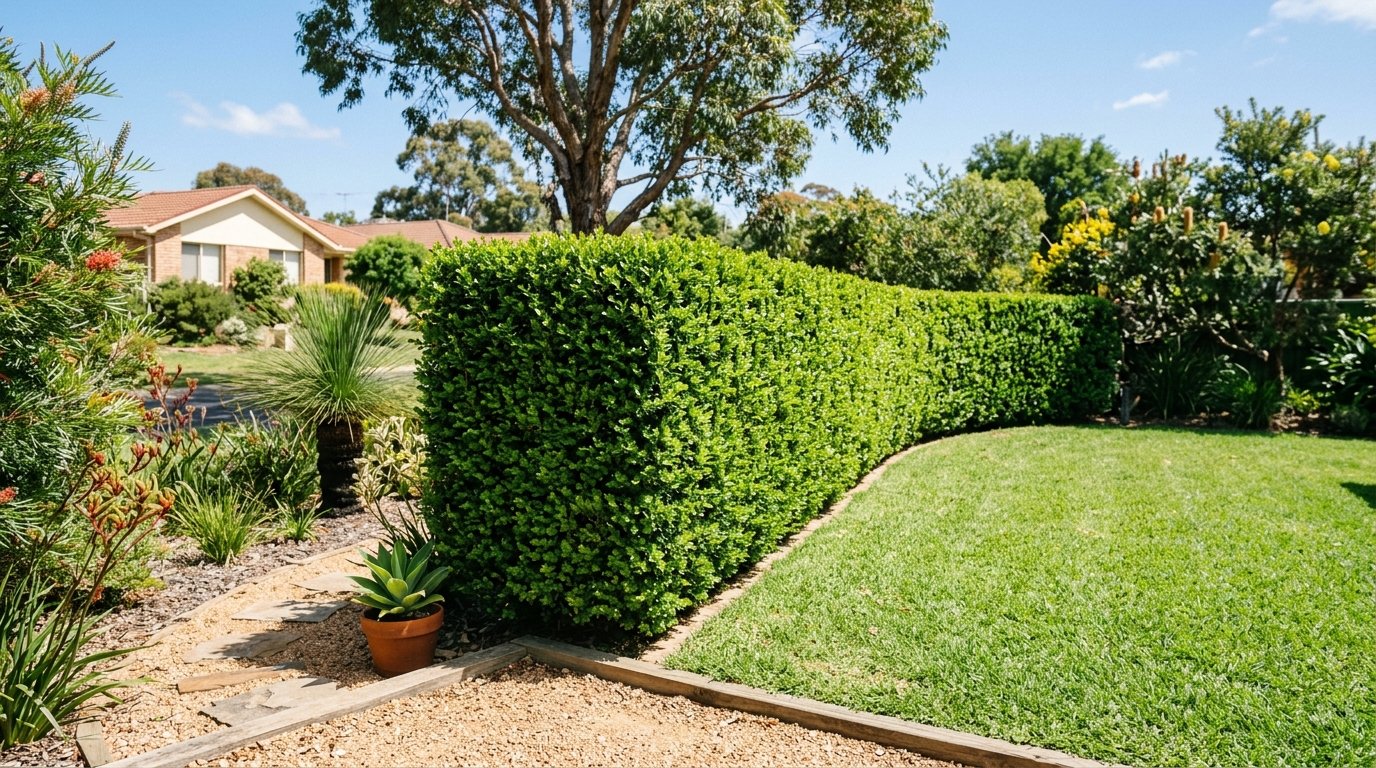
If a Japanese Box hedge is yellowing, bronzing, browning or developing bare patches, do not assume it is dying. Winter bronzing can be a normal cold-weather response; fine stippling points more toward mites; cupped new leaves with white waxy material suggest box psyllid; black stem streaks with rapid defoliation raise concern for box blight; and yellowing in wet soil points toward root stress rather than a simple fertiliser deficiency.
Japanese Box is commonly sold in Australia as Buxus microphylla var. japonica, Buxus japonica or simply Japanese Buxus. Kew’s Plants of the World Online currently treats Buxus microphylla var. japonica as a synonym within Buxus microphylla var. microphylla, a Japanese taxon in the Buxaceae family. It is not an Australian native, but Australian nurseries such as Bunnings, Spring Colours Nursery, Winter Hill and others sell it extensively as a formal low hedge, edging and topiary plant.
The important diagnostic point is that several box problems produce similar brown or bronze foliage. Box blight, Volutella dieback, mites, waterlogged roots, frost and normal winter bronzing can all look like “brown box” from a distance. The fastest way to narrow the cause is to check whether leaves are falling, whether stems carry black lesions, whether foliage remains attached, what the undersides look like, and whether the root zone is wet or dry.
Which Japanese Box hedge problem is it?
| What you can see | Likely cause | What to check first |
|---|---|---|
| Orange, copper or bronze foliage in winter but leaves remain attached | Normal winter bronzing or cold stress | Check season, exposure and whether stems remain healthy |
| Rapid brown leaf spots, leaf drop and bare patches | Possible box blight | Inspect young stems for distinctive black streaks or lesions |
| Tan or straw-coloured leaves that remain attached, with twig dieback | Possible Volutella blight | Check undersides of affected leaves in damp conditions for pinkish spore masses |
| Cupped, curled or distorted new leaves with white waxy material | Box psyllid | Inspect soft new growth and leaf folds |
| Fine pale stippling or bronzing without major leaf drop | Box mite / spider mite | Inspect leaf undersides closely for mites or fine webbing |
| General yellowing with wet soil | Waterlogging, root stress or root rot | Check drainage before fertilising |
| Yellow new leaves with greener veins | Possible iron chlorosis / nutrient-availability issue | Check soil pH and whether the pattern is limited to new growth |
| Dry brown tips or scorched margins | Heat, wind, dry soil or damaged roots | Check moisture through the root zone before adding more water |
| Healthy top but thinning lower hedge | Self-shading | Check whether the hedge is wider at the top than at the base |
| Slow, open growth that will not thicken | Insufficient formative pruning, light or poor establishment | Check whether young shoots are being lightly tip-pruned |
This table is a triage tool. Japanese Box can have more than one problem at the same time, and environmental stress can make disease or mite damage more obvious.
Box blight is the serious disease to rule out
Box blight is caused by Calonectria pseudonaviculata and the closely related Calonectria henricotiae; the older name Cylindrocladium buxicola is still widely used in horticultural references.
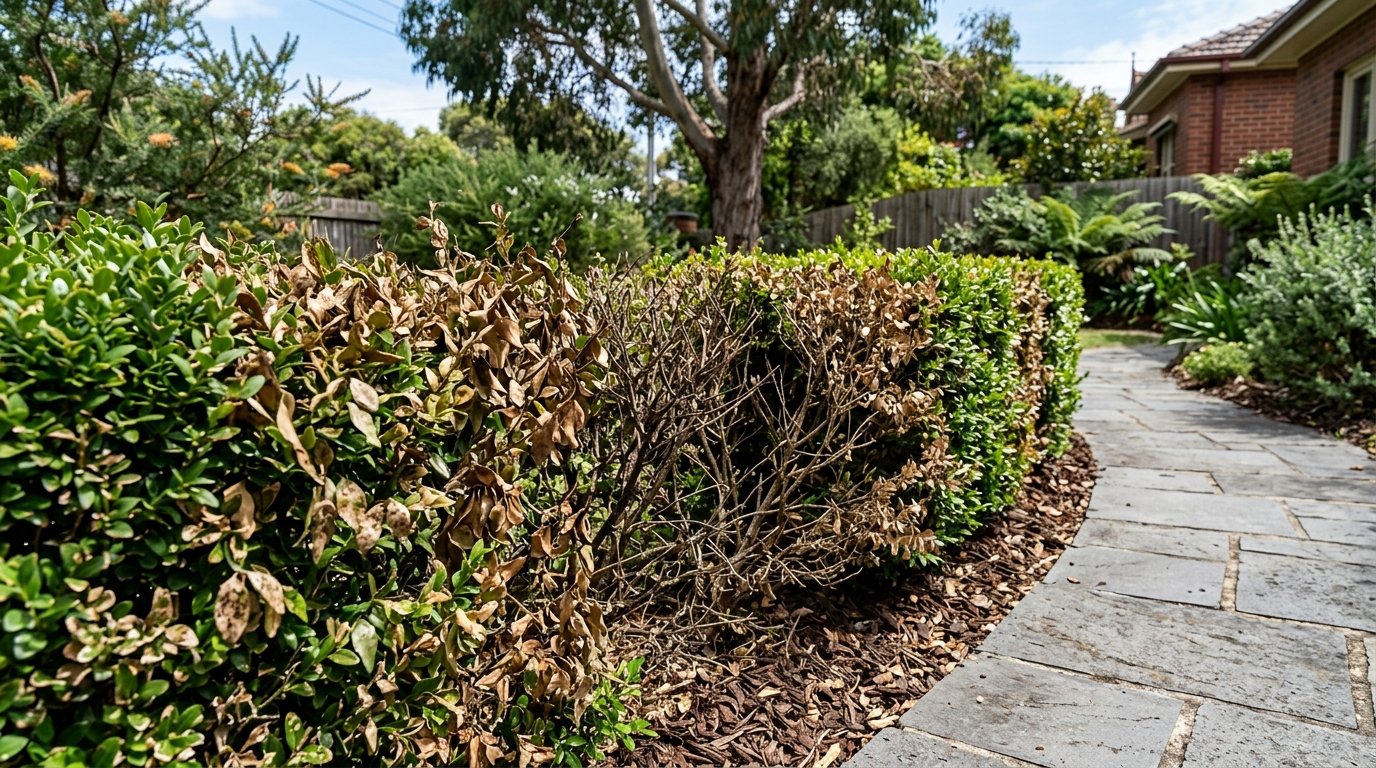
The Royal Horticultural Society describes the key symptoms as brown leaf lesions, rapid leaf fall, bare patches, black streaks on young stems and dieback. In wet conditions, white spore masses may develop on the undersides of infected leaves.
Those black stem streaks and rapid defoliation are especially useful because simple winter bronzing does not normally produce them.
Box blight spreads most readily when foliage is wet and conditions are mild to warm and humid. Dense clipped hedges provide exactly the sheltered, slow-drying environment in which the disease can move from plant to plant.
How Japanese Box compares with English Box for blight
Susceptibility varies among Buxus species and cultivars. Current RHS guidance says no box is highly resistant, but common English Box, Buxus sempervirens, and especially dwarf forms such as ‘Suffruticosa’ are among the more susceptible types.
Small-leaved Asian box types, including Buxus microphylla, are often regarded in nursery and horticultural literature as relatively more tolerant than traditional English Box. That does not make Japanese Box immune.
If symptoms match box blight, do not dismiss them because the hedge is Japanese Box.
Box blight hygiene matters as much as treatment
The box-blight fungi survive in infected leaves, stems and fallen debris. The RHS notes that infected residues can remain a source of spores for years, so hygiene is a major part of control.
If box blight is suspected or confirmed:
- do not prune or handle infected plants while the foliage is wet;
- remove badly infected leaves and stems carefully;
- bag infected material rather than carrying it uncovered through the garden;
- do not put infected box material into ordinary home compost;
- remove fallen infected leaves from inside and beneath the hedge;
- clean and disinfect pruning tools before moving to healthy box plants;
- avoid walking contaminated clippings or soil from an affected area into healthy plantings;
- improve airflow where the hedge is excessively dense.
Where infection is severe, removing a badly affected section may be more sensible than repeatedly clipping it and spreading spores along the whole hedge.
Accurate diagnosis matters before making that decision because less-serious Volutella dieback and normal winter bronzing can both be mistaken for box blight.
Volutella blight looks similar but behaves differently
Volutella blight of box is associated with Pseudonectria buxi, historically referred to as Volutella buxi.
The RHS distinguishes it from box blight in several useful ways. Volutella commonly causes twig and leaf death, tan or straw-coloured foliage that tends to remain attached, and pinkish spore masses on the undersides of affected leaves in damp conditions.
By contrast, box blight more characteristically causes rapid leaf drop and black stem streaks.
| Feature | Box blight | Volutella blight |
|---|---|---|
| Leaf colour | Brown lesions progressing to dead foliage | Yellowing to tan/straw foliage |
| Leaf drop | Often pronounced, creating bare patches | Dead leaves commonly remain attached |
| Stem symptom | Distinctive black streaks/lesions on young stems | Dieback without the characteristic black streaking |
| Spore colour in wet conditions | White | Pinkish |
| Typical seriousness | Potentially severe and difficult to manage | Often associated with stress or wounds and usually less destructive |
Volutella is commonly associated with stressed plants or pruning wounds, particularly where clipping is done in wet conditions. Improving cultural conditions, pruning diseased branches in dry weather and removing dead leaves from inside the hedge are important parts of management.
Winter bronzing is often normal
One of the easiest Japanese Box symptoms to overdiagnose is winter bronzing.
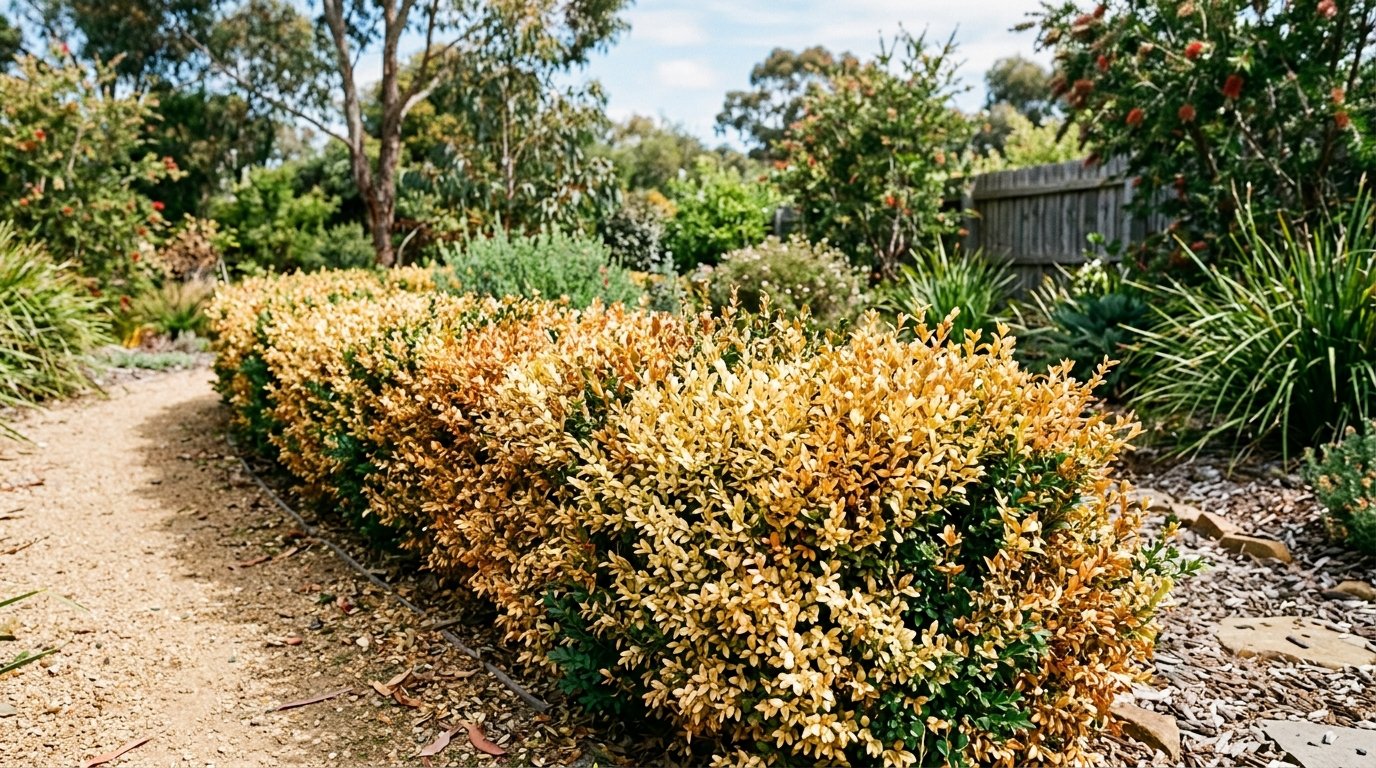
Winter Hill Tree Farm specifically notes that Japanese Box foliage can turn bronze in winter. South Australian Plant Selector also records winter bronzing for Buxus microphylla var. japonica, while Australian nursery observations from colder regions describe copper-orange winter colour.
This is often a stress response to cold, bright sun and exposed conditions rather than evidence of fungal disease.
Normal bronzing usually has several clues:
- it appears during colder weather;
- the leaves remain attached;
- there are no spreading black lesions on stems;
- there is no rapid patchy defoliation;
- the foliage can regain greener colour as active growth resumes.
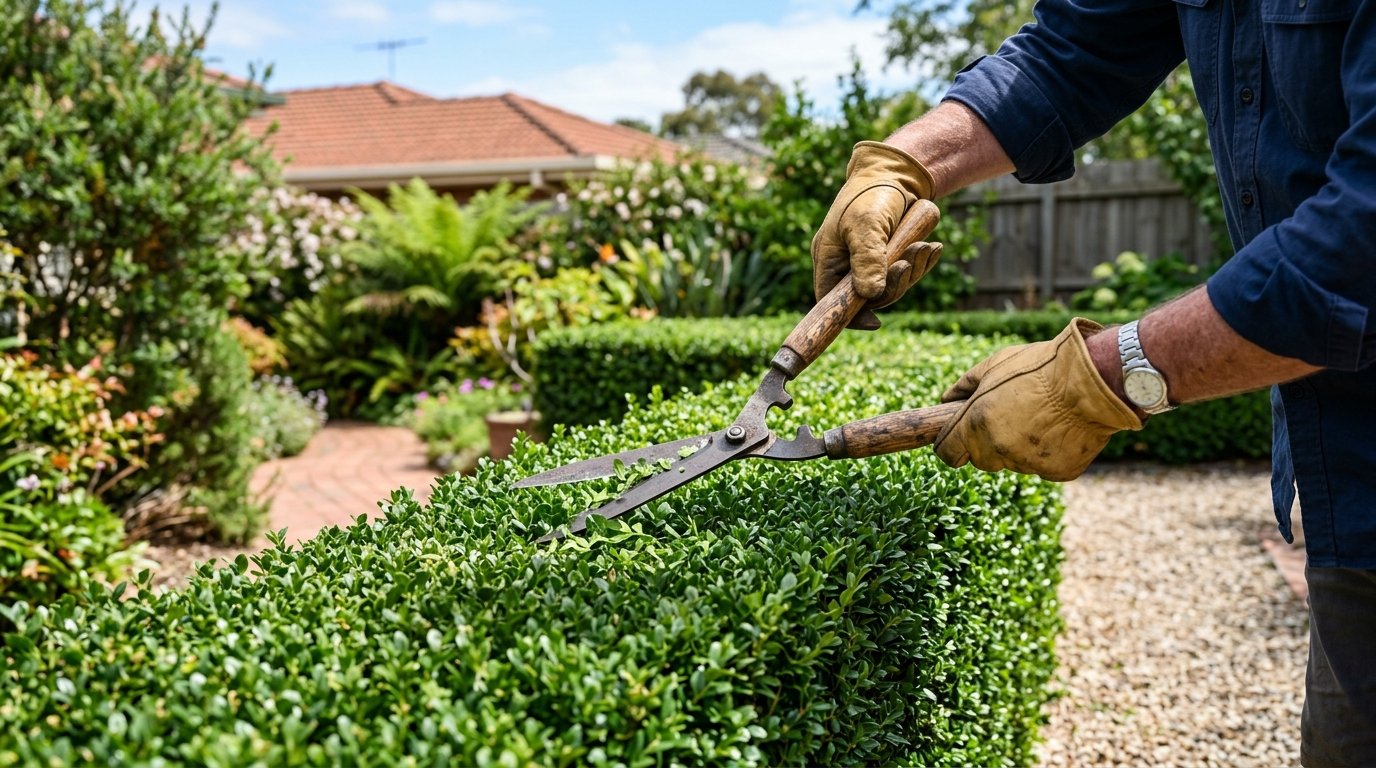
On our hedge work, we do not treat uniform winter bronze foliage as box blight unless there are additional disease signs.
When bronzing is not normal
Investigate further if bronze or brown foliage is accompanied by:
- fine pale stippling;
- webbing;
- leaf drop;
- black stem streaks;
- defined fungal lesions;
- dead shoot tips;
- persistent decline after cold weather has passed.
Those patterns suggest mites, disease, root stress or another problem rather than seasonal colour alone.
Box psyllid: curled new growth and white wax
Box psyllid is a sap-sucking pest associated with box foliage. The characteristic damage is quite different from box blight.
Look for:
- cupped or spoon-shaped new leaves;
- curled and distorted soft growth;
- small insects hidden within the folded leaves;
- white waxy or fluffy secretions around feeding sites.
The distortion is usually strongest on fresh growth because that is where the pest feeds.
A lightly affected formal hedge may be managed by pruning out the worst distorted tips after confirming the pest, while heavier infestations may require a product registered for sap-sucking pests on ornamentals. Always follow the Australian product label rather than applying an insecticide simply because leaves are curling.
Fine bronzing and stippling: check for box mites
Box and spider mites can make foliage look dull, grey-green or bronzed without producing the major leaf drop associated with box blight.
RHS diagnostic guidance lists box red spider mite among common box problems. Typical mite feeding creates numerous tiny pale marks or stipples across the leaf surface.
Inspect the undersides carefully, especially during warm dry conditions.
A mite problem is more likely where:
- individual leaves show fine, evenly distributed speckling;
- bronzing develops gradually;
- there are no black stem lesions;
- leaf drop is limited;
- tiny mites or fine webbing are visible under close inspection.
Do not confuse that pattern with uniform winter bronzing.
Yellow leaves: check drainage before adding fertiliser
Japanese Box prefers a moist but well-drained root zone. Winter Hill Tree Farm describes Japanese Box as preferring moist, well-drained soil, and Australian nurseries including Spring Colours and Rockbank Nursery give the same basic drainage requirement.
If yellow foliage appears while the ground remains wet, root stress should move higher on the diagnosis list.
Waterlogged roots lose oxygen and become less effective at taking up water and nutrients. A hedge can therefore look both yellow and thirsty even though the soil is already saturated.
Before feeding, check:
- whether water drains away after irrigation;
- whether one section sits lower than the rest;
- whether heavy clay lies below an improved surface layer;
- whether mulch or soil is piled against stems;
- whether the problem worsened after prolonged rain.
Yellow new leaves with greener veins
Where new leaves are pale yellow but the veins remain comparatively green, an iron-availability problem becomes more plausible.
High soil pH can make iron less available even when iron is physically present in the soil.
That pattern is different from whole-plant yellowing in saturated soil, so check pH and drainage before repeatedly adding iron or general fertiliser.
Phytophthora and root rot in wet soil
Box can suffer from Phytophthora root rot. RHS box-disease guidance notes that established plants may suddenly fail with no obvious foliar cause when a soil-borne Phytophthora problem has damaged the roots.
Possible warning signs include:
- decline beginning after prolonged wet conditions;
- yellowing followed by wilting or dieback;
- one section of hedge failing in a low or poorly drained area;
- roots becoming dark, soft or decayed;
- plants failing even though irrigation appears plentiful.
Phytophthora is not the only possible root-rot organism, so do not diagnose it from brown leaves alone.
The practical first action is the same regardless: identify why the root zone is staying wet. A fungicide will not permanently rescue box planted into chronically waterlogged soil.
Brown crispy tips: do not assume more water is the answer
Crispy brown margins can result from genuine drought, hot reflected conditions, drying wind or sun scorch.
Damaged roots can produce a similar symptom because they cannot supply the foliage efficiently.
Before watering a browned hedge again:
- move mulch aside;
- check moisture below the surface;
- compare the affected section with a healthy section;
- look for standing water or compacted soil;
- review recent heat and wind conditions.
If the soil is dry, correct the watering problem. If it is already saturated, adding more water may worsen the root stress.
Leaf spot in dense or humid hedges
Box foliage can develop fungal spotting other than box blight.
RHS diagnostic material lists Macrophoma leaf spot as one of the less serious fungal problems of box. It tends to occur on stressed or dying leaves and produces small dark fruiting bodies on straw-coloured foliage.
Dense formal hedges are particularly prone to staying damp inside because air movement is limited.
Useful cultural measures include:
- avoid routine late-day overhead irrigation;
- water the root zone rather than repeatedly wetting the foliage;
- remove dead leaves trapped inside the hedge;
- avoid clipping when the foliage is wet;
- keep tools clean when moving between plants;
- maintain enough internal airflow without cutting deeply into bare wood.
Defined leaf spotting with continuing spread deserves closer diagnosis rather than being treated as generic “brown box”.
Why Japanese Box becomes bare at the bottom
A formal box hedge can be green and dense across the top but increasingly woody underneath.
The usual reason is light.
If repeated clipping leaves the hedge wider at the top than the base, the upper foliage shades the lower branches. Over time those branches lose leaves.
We prefer a slight taper: broader at the bottom and narrower at the top. This lets sunlight reach more of the hedge face.
Another cause is waiting too long before formative pruning. A young Japanese Box allowed to grow upward without regular light shaping develops fewer low side branches, and it takes much longer to build the dense formal line people expect.
For normal sizing, spacing, pruning and establishment rather than troubleshooting, see our Japanese Box hedge growing and care guide.
Why a Japanese Box hedge will not thicken
Box rewards patience and repeated light shaping more than aggressive correction.
Common reasons a hedge stays open include:
- insufficient light;
- too little formative tip pruning;
- plants spaced too widely for the intended low hedge;
- root stress;
- excessive cutting into old bare wood;
- expecting rapid screening from a naturally compact formal hedge plant.
Australian nurseries consistently recommend regular clipping for Japanese Box. The aim is to encourage many short lateral shoots rather than a few long stems.
Do not try to accelerate density by feeding heavily if the hedge has a drainage or light problem.
Sun scorch and freshly clipped box
Japanese Box handles Australian heat better than traditional English Box and is widely recommended by Australian nurseries for warmer conditions, but freshly exposed foliage can still scorch.
This is most likely where:
- a dense hedge is cut hard during hot sunny weather;
- previously shaded inner leaves are suddenly exposed;
- the root zone is dry;
- reflected heat comes from paving, masonry or fencing.
Scorch usually appears as dry brown patches concentrated on the exposed face rather than black stem lesions running through the hedge.
On our work, we avoid combining severe clipping with extreme weather stress wherever possible.
Frost and winter colour
Japanese Box tolerates cold reasonably well in many Australian climates, and South Australian Plant Selector records moderate frost tolerance.
Cold can still damage very soft growth, particularly after a warm flush.
Fresh tips may brown while older wood survives. At the same time, otherwise healthy plants can take on bronze or copper winter colour.
That combination makes late-winter diagnosis tricky.
Before pruning hard, check whether:
- the stems are still green beneath the bark;
- leaves are merely bronze or actually necrotic;
- black stem streaks are present;
- leaf drop is accelerating;
- more frost is still likely.
Where the issue is simple winter bronzing, patience may be more appropriate than treatment.
When should you replace Japanese Box rather than keep treating it?
Most Japanese Box problems are worth diagnosing before removal. Replacement becomes more sensible when the structural or disease problem is severe enough that the hedge no longer has a realistic recovery path.
We would consider replacement where:
- box blight is confirmed and infection is widespread through a low-value hedge;
- repeated outbreaks continue despite strict hygiene and cultural management;
- root rot has destroyed most of the root system;
- the site remains permanently waterlogged;
- large areas have become bare old wood with little ability to refill;
- the garden requires a hedge that is fundamentally better suited to the site.
If confirmed box blight has repeatedly damaged the planting, replanting immediately with another susceptible box into the same contaminated environment can repeat the problem.
Where the formal look matters more than using Buxus specifically, a small-leaved Lilly Pilly cultivar or another compact hedge species may be a better long-term choice for some Australian sites. Japanese Box itself is already among the box types generally regarded as less susceptible than traditional English Box, but no box should be treated as immune.
Our diagnosis order for a struggling Japanese Box hedge
When a Japanese Box hedge turns yellow, bronze or brown, we work through the evidence in this order:
- Check whether the colour is seasonal. Uniform bronze foliage in winter can be normal.
- Look for leaf drop. Rapid defoliation and bare patches move box blight much higher on the list.
- Inspect young stems. Black streaks or lesions are an important box-blight warning sign.
- Check whether dead leaves stay attached. Straw-coloured leaves remaining on dead twigs are more consistent with Volutella than classic box blight.
- Inspect new leaves. Cupping and white wax suggest psyllid.
- Check leaf undersides. Fine stippling or bronzing can indicate mites.
- Check the root zone. Yellowing or wilting in wet soil means drainage and root health need attention before feeding or watering.
- Review hedge shape and light. Bare lower growth is often self-shading.
- Consider recent weather and pruning. Heat, frost or hard clipping can create temporary browning.
- Only then decide whether the answer is pruning, drainage correction, pest management, disease hygiene or replacement.
Correct identification matters more with box than with many hedges because the response to each problem is very different. Normal winter bronzing may need no treatment at all, while confirmed box blight requires strict hygiene and careful management.
If your symptoms do not clearly match these patterns, the hedge is deteriorating despite correcting obvious drainage and pruning problems, or you need help distinguishing box blight from Volutella, mites or root stress, Garden Green’s plant and flower disease diagnosis service can help identify the likely cause and practical next step. You can also contact Garden Green with the details of what you are seeing.
Frequently asked questions
Why is my Japanese Box hedge turning bronze in winter?
Winter bronzing can be a normal cold-weather response. Winter Hill Tree Farm and South Australian Plant Selector both note that Japanese Box foliage can turn bronze in winter. If leaves remain attached, stems are healthy and there are no black lesions or rapid bare patches, seasonal bronzing is more likely than box blight.
What does box blight look like on Japanese Box?
Box blight typically causes brown leaf lesions, rapid leaf drop, bare patches and distinctive black streaks on young stems. In wet conditions, white fungal spore masses may appear on the undersides of infected leaves. Japanese Box can be less susceptible than some English Box types, but it is not immune.
How can I tell box blight from Volutella blight?
Box blight commonly causes rapid defoliation and black stem streaks, while Volutella more often causes tan or straw-coloured dead leaves that remain attached to dying twigs. In damp conditions, Volutella can produce pinkish spore masses, whereas box blight produces white spores.
Why are my Japanese Box leaves curled or cupped?
Cupped or distorted new leaves with white waxy material are characteristic of box psyllid feeding. Inspect the soft new growth and inside the curled leaves for the pest before treating. This symptom pattern is different from the stem lesions and rapid leaf loss associated with box blight.
Why are Japanese Box leaves turning yellow?
Yellow leaves can result from waterlogging, root stress, nutrition problems or poor nutrient availability. If the soil stays wet, investigate drainage first. Yellow new leaves with greener veins can suggest an iron-availability problem, so soil pH may also be worth checking before repeatedly applying fertiliser.
Can overwatering kill Japanese Box?
Yes. Australian nursery guidance consistently recommends moist but well-drained soil for Japanese Box. Persistently saturated soil can damage roots and increase the risk of root rot, including Phytophthora-related decline. A wilting hedge in wet soil should not automatically be given more water.
Why is my Japanese Box hedge bare at the bottom?
The lower hedge is often being shaded by dense upper growth or was not tip-pruned enough while young. Maintain the hedge slightly wider at the base than the top so light reaches lower branches, and use regular light formative pruning to encourage dense branching.
Should I remove a Japanese Box hedge with confirmed box blight?
Not every infection requires immediate removal, but a badly affected or repeatedly infected low-value hedge may be better removed than continually treated. Box blight survives in infected leaves and stems, so strict hygiene is essential. If replacing the hedge, consider whether another box or a different compact hedge species is better suited to the site.


