
Acacia podalyriifolia: Queensland Silver Wattle Size, Flowers and Growing Guide Australia

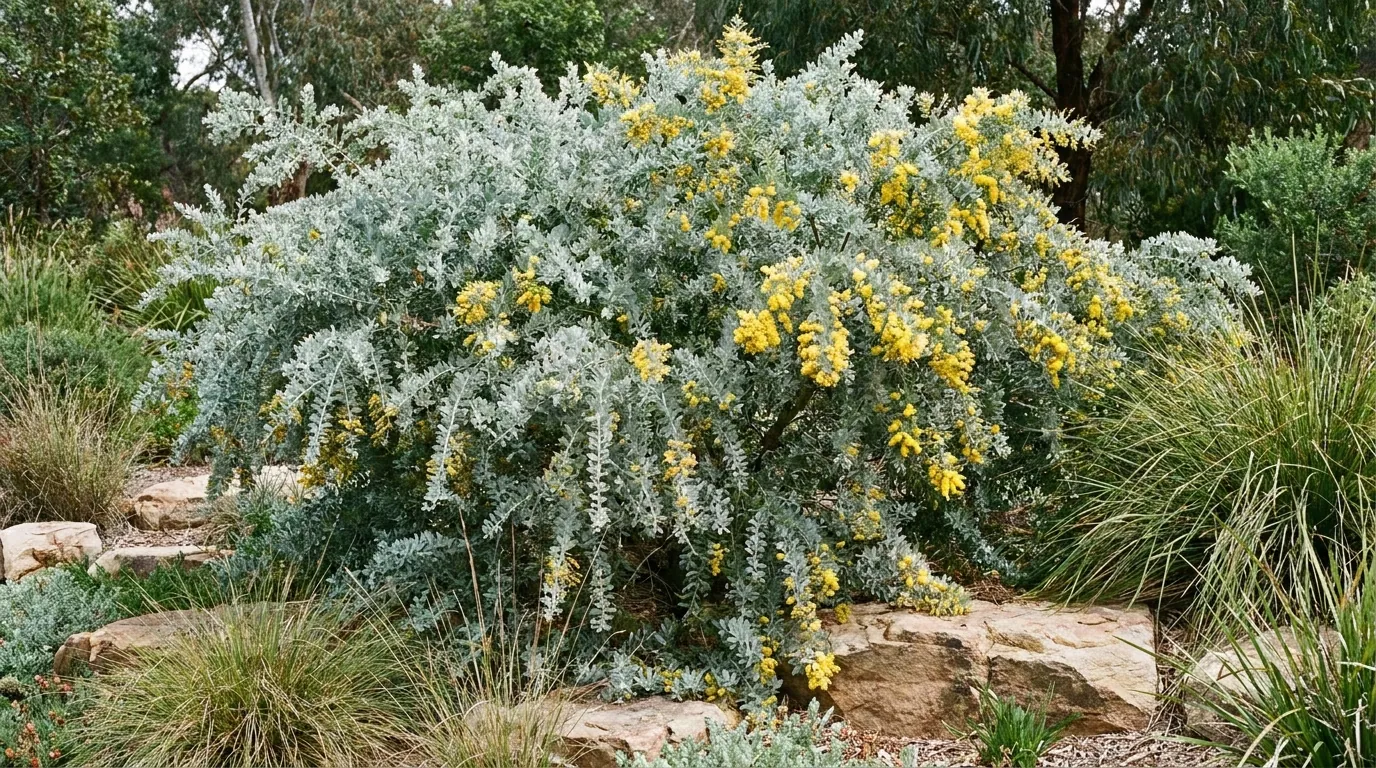
Acacia podalyriifolia, or Queensland Silver Wattle, is a fast-growing silver-foliaged shrub or small tree that commonly reaches about 4–7 m in Australian cultivation. South Australia’s Plant Selector+ gives 4–7 m high × 4–5 m wide, the Australian National Botanic Gardens gives up to 8 m high × 5 m across, and Which Plant Where lists a cultivated range of about 2–7 m high × 3–5 m wide.
It is one of the quickest ways to get silver-grey foliage, winter colour and a broad native screen—but it is also relatively short-lived and can self-seed aggressively outside its natural range. That second point changes where we are comfortable using it. In the right Queensland or northern NSW setting it can be an excellent ornamental wattle; beside sensitive bushland in parts of southern and western Australia, the weed risk deserves equal weight.
Its size is fairly consistent across the stronger Australian sources
| Australian source | Published size |
|---|---|
| SA Plant Selector+ | 4–7 m high × 4–5 m wide |
| Australian National Botanic Gardens | To 8 m high × 5 m across |
| Which Plant Where | 2–7 m high × 3–5 m wide in cultivation |
| Plantmark | About 5 m × 5 m in description; broader profile 4–10 m |
| Mountain View Nursery | About 6 m high × 6 m wide |
For an ordinary garden layout, we would treat Queensland Silver Wattle as a 4–7 m-class plant with a broad crown. It is not a narrow screening pole, and it is not naturally a compact hedge.
On jobs, the width is what catches people out. A young 140 mm pot looks easy to fit between other plants, but a mature silver wattle can spread several metres. We prefer to give it a proper feature position or enough room in an informal screen rather than designing around constant corrective pruning.
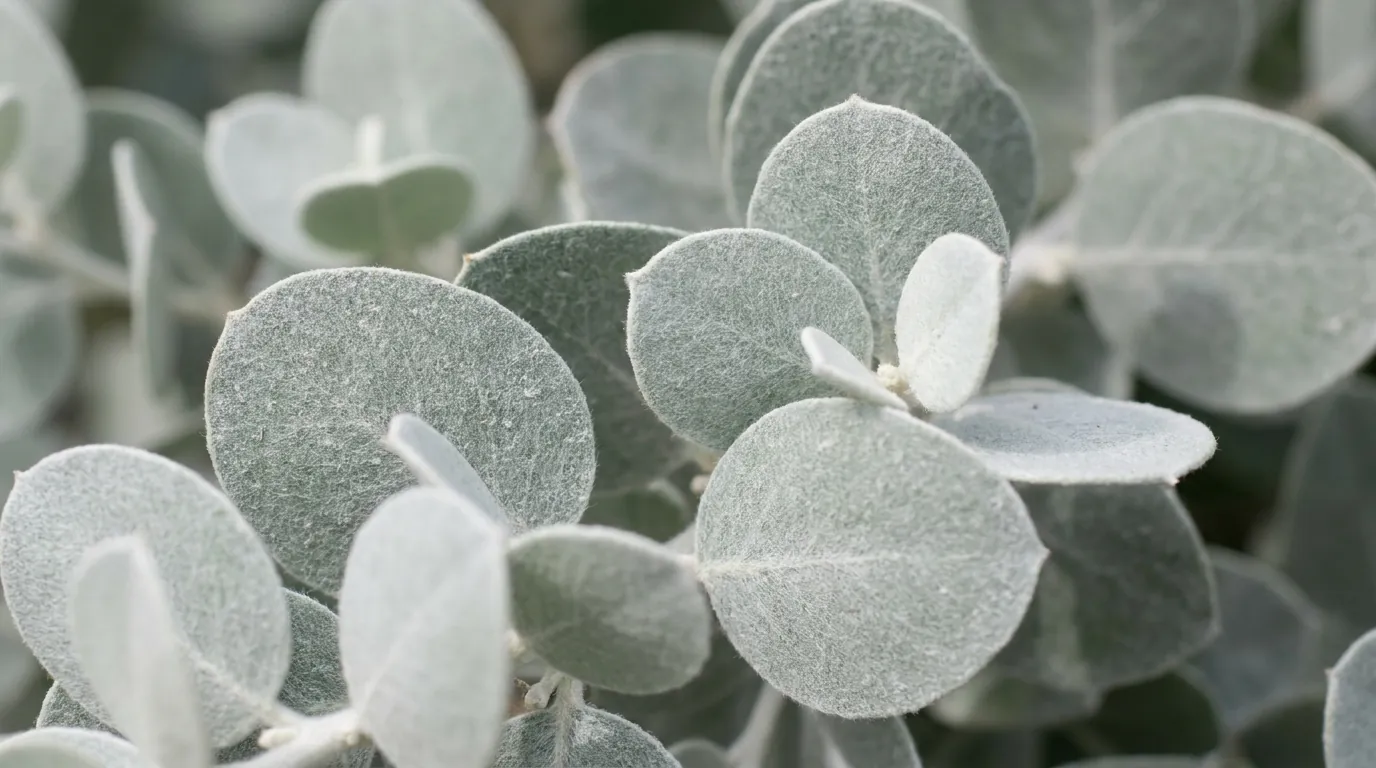
The silver foliage is the reason many people buy it
The foliage is actually made up of phyllodes rather than ordinary compound Acacia leaves. ANBG describes the silver-grey phyllodes as obliquely elliptical and up to about 4 cm long. VicFlora gives a broader botanical range of about 2–5 cm long and 10–25 mm wide.
Young growth carries a waxy bloom and soft hairs that create the distinctive grey-silver effect. That colour is useful even outside flowering season, especially against darker green Lilly Pillies, Westringias or rainforest foliage.
In our planting work, we use that contrast deliberately. One silver-foliaged tree can break up a wall of dark evergreen foliage without relying on flowers to carry the design all year.
The main flower show is winter
The Wattle identification database records flowering mainly in June and July. VicFlora gives June to August for naturalised Victorian plants, while the South Australian Plant Selector+ lists winter and spring. Nindethana gives an indicative nursery window of July to October.
That spread is best read as a winter-centred flowering period that can extend into spring depending on climate.
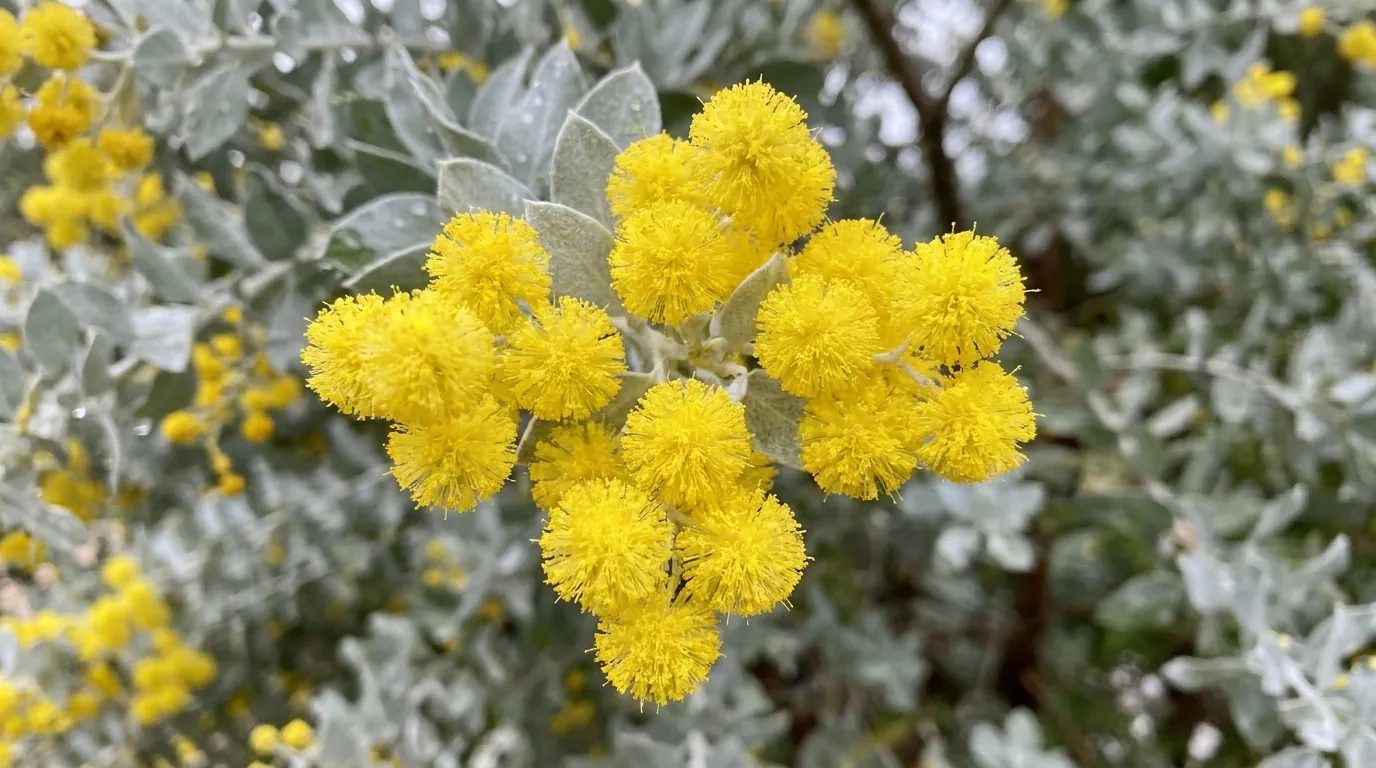
The flowers are bright golden-yellow globular heads arranged in racemes. The Wattle fact sheet records individual heads with around 15–30 flowers, while the old Queensland Agricultural Journal describes fully open heads at just under 1 cm across.
The contrast between the silver foliage and deep yellow flowers is stronger than the flower size suggests. From across a garden, the whole crown can read as gold rather than as a collection of small individual flower heads.
It really is fast-growing—but don’t turn that into a fake cm/year claim
The South Australian Plant Selector+ calls Queensland Silver Wattle a popular fast-growing wattle. Which Plant Where also classifies its growth rate as fast, Plantmark calls it fast-growing, and Wallum Nurseries describes it as quick-growing.
What the stronger sources do not provide is a reliable species-wide centimetres-per-year rate. We are not going to invent one.
Wallum adds one genuinely useful observation: the plant may flower in its second year. Nursery Near Me makes a similar commercial claim for first flowering around the second winter. We treat that as nursery guidance rather than a guarantee, but it fits the species’ reputation for early maturity.
In our own gardens, the better way to judge a young wattle is by canopy extension, branching and whether it is thickening into the space you planted it to fill. A fast top shoot without useful side branching is not the same thing as a finished screen.
It is also relatively short-lived
This is the trade-off that deserves to sit beside the words “fast-growing”.
The Weeds of Australia fact sheet describes Queensland Silver Wattle as relatively short-lived, usually around 10–15 years. That is a useful expectation for landscape planning: this is not a tree we would install as the one irreplaceable structural specimen expected to anchor a garden for generations.
We use fast wattles for what they are good at—quick canopy, early flowers, pioneer structure and visual impact—while planning the surrounding garden so slower, longer-lived plants are developing alongside them.
That way, if an older wattle declines after a decade or more, removing it does not suddenly leave the entire screen empty.
Native in Queensland and northern NSW does not mean harmless everywhere in Australia
The Australian Native Plants Society records the species naturally in open forest and woodland in south-eastern Queensland, while current Plants of South Eastern NSW records confirm it is also native in northern NSW.
Outside that natural range, the story changes. VicFlora lists Queensland Silver Wattle as introduced and adventive in Victoria. The Urban Bushland Council WA treats it as a serious urban-bushland weed in Western Australia, where it has escaped gardens and can alter native vegetation.
The WA weed profile records mature plants to about 7 m high and says the soil seed bank can persist for more than 5 years. Seeds can be spread by water, birds, ants, soil movement and dumped garden material.
| Australian situation | Our approach |
|---|---|
| South-east Queensland / northern NSW within or near natural range | Strong ornamental candidate where the site suits it |
| Urban garden well away from sensitive bushland | Possible, with seedling monitoring and responsible pruning |
| Victoria where it can naturalise | Use more cautiously and monitor self-seeding |
| Perth / south-west WA near remnant bushland | Avoid planting where escape could contribute to an existing weed problem |
| Property adjoining conservation bushland | Prefer a locally native alternative with lower invasion risk |
That is not a blanket “never plant it outside Queensland” rule. It is a reminder that a species can be Australian native nationally and still behave as an environmental weed when moved outside its own ecological range.
Pruning after flowering has two jobs
Mountain View Nursery recommends pruning after flowering both to control size and to reduce self-seeding. That is practical advice for this species.
On jobs, we use post-flowering pruning to encourage a denser frame while also removing developing seed pods where unwanted spread is a concern. Light structural pruning while the tree is young is much easier than allowing long, open branches to develop and trying to reshape the plant later.
We do not shear Queensland Silver Wattle like a box hedge. It looks better as a naturally rounded shrub or small tree, with pruning used to build branching and manage width rather than force a rigid wall.
Full sun gives the best silver-and-gold display
ANBG recommends sunny, well-drained situations. SA Plant Selector+ lists full sun and part shade, as do Plantmark and several current nurseries.
For the strongest flowering and compact crown, we favour full sun. In part shade the plant can still grow, but the structure may become more open and the flower display less impressive.
On exposed sites, this species is tougher than its soft-looking silver foliage suggests. Mountain View lists coastal and pollution tolerance, while SA Plant Selector+ includes coastal-footslopes and plains among suitable landscape zones.
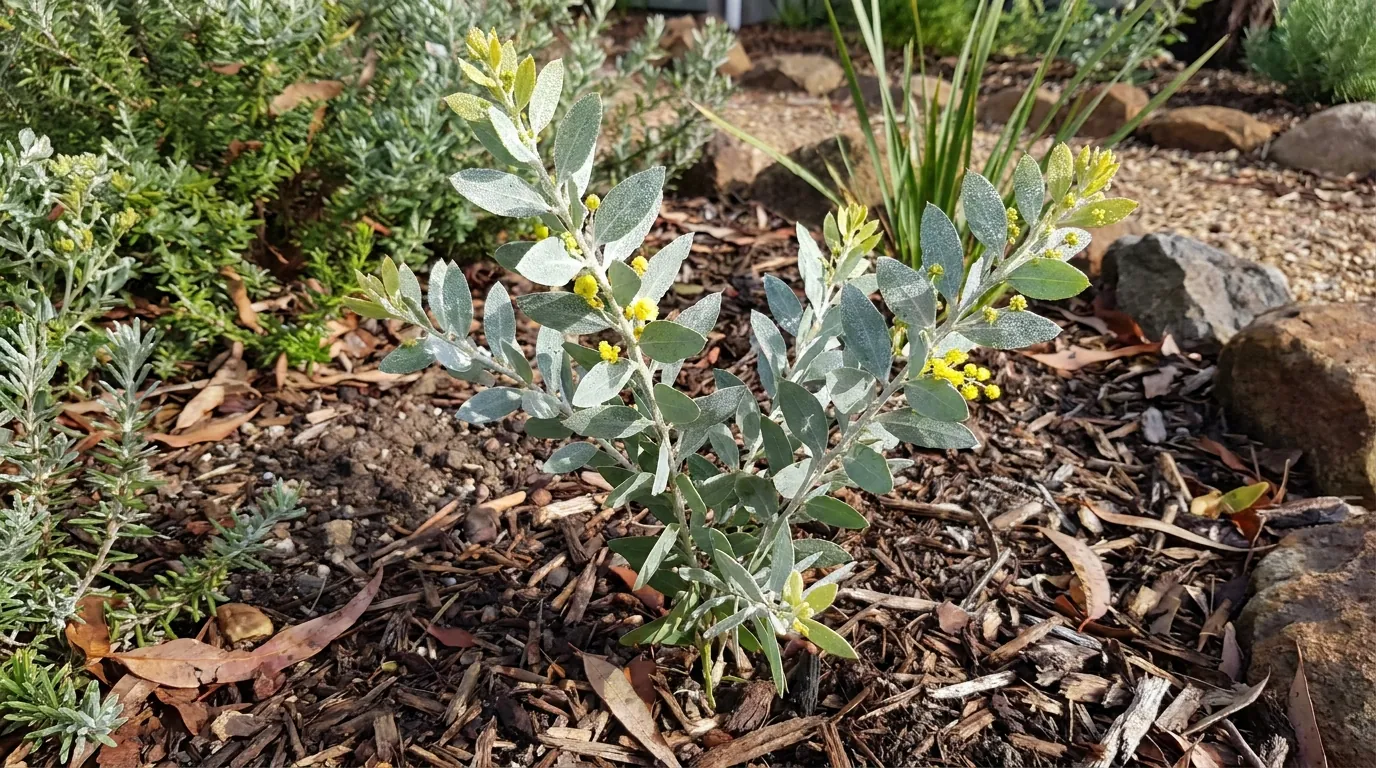
The species comes from rocky, free-draining country
The Wattle database says northern populations are mainly associated with sandstone hills in open eucalypt forest, while southern populations occur on several rock types. The Queensland Agricultural Journal similarly records it on stony sandstone hillsides, ridges and granite country.
That natural history fits the cultivation guidance. ANBG calls it hardy in most well-drained sunny positions, while SA Plant Selector+ lists successful cultivation in clay, loam and sand across acidic, neutral and alkaline soils.
Soil texture is not the main limitation. Drainage is.
On our planting work, we do not heavily enrich the hole or keep the root zone wet. We prepare enough surrounding soil for roots to move outward, water well during establishment, then allow the plant to behave like the drought-tolerant wattle it becomes.
Drought tolerance is one of its strengths
SA Plant Selector+ lists the species as drought tolerant with minimal supplementary watering. Which Plant Where gives it high drought tolerance, and current Queensland nursery sources also recommend it for drier conditions.
A young tube or pot still needs establishment water. We wet the original root ball thoroughly and keep an eye on soil moisture until new growth shows that the roots are moving into the surrounding ground.
Once established, we stretch watering intervals rather than keeping it on a lush high-frequency irrigation schedule. Overwatering a dry-country Acacia is not a shortcut to faster healthy growth.
Frost tolerance is better than many Queensland natives
The Australian National Botanic Gardens gives one unusually specific figure: Queensland Silver Wattle is listed as frost hardy to about -7°C. SA Plant Selector+ lists light, moderate and heavy frost tolerance, while Which Plant Where also scores frost tolerance highly.
That does not mean every newly planted nursery specimen can be dropped into an exposed -7°C frost hollow without damage. The ANBG figure is best understood as evidence that established plants can be remarkably cold tolerant for a species associated with Queensland.
In cold gardens, we still protect small young plants during establishment and avoid forcing soft late-season growth immediately before winter.
Humidity can be more troublesome than cold
Wallum Nurseries says the species performs across a wide range of climates, particularly drier ones, but can be affected by sooty mould in humid climates. ANBG also records a striking regional pest difference: the plant was very susceptible to leaf miner in Sydney but not in Canberra.
That is a useful reminder that “hardy” does not mean equally problem-free everywhere.
In humid gardens, we give Queensland Silver Wattle good airflow and full light rather than burying it inside a dense irrigated planting. If black sooty coating develops, we inspect for the sap-sucking insects producing honeydew rather than treating the black surface as the primary problem.
Leaf miner can be very location-dependent
ANBG’s cultivation notes specifically say Queensland Silver Wattle was very subject to leaf miner in Sydney but not in Canberra.
That is unusually useful first-hand botanical-garden evidence because it shows how different the same species can behave between climates.
Leaf miner damage is usually most obvious as pale or winding tracks in the foliage. On a vigorous ornamental tree, mild damage may be mainly cosmetic. If repeated attacks are badly affecting new growth, first confirm the pest rather than spraying every damaged leaf on sight.
The seed crop is both a propagation advantage and a weed risk
The Wattle database records pods up to about 12 cm long and 1.5–2 cm wide, with dull black seeds around 6–7.5 mm long. The species is readily propagated from seed after scarification or hot-water treatment.
That ease of germination is useful in native propagation—and it is exactly why escaped plants can become weeds.
The Urban Bushland Council WA notes that fire can stimulate mass germination from soil-stored seed. Adults may be killed by fire while a large pulse of seedlings follows.
For gardens beside bushland, seed management is therefore not an abstract environmental concern. Removing developing pods after flowering can materially reduce the amount of seed leaving the garden.
Wildlife value is real, but it does not cancel weed risk
SA Plant Selector+ records the flowers and foliage as food for caterpillars, while Which Plant Where lists bird, insect and pollinator value. Burringbar Rainforest Nursery also categorises the species as bird-attracting.
We like the plant for exactly that reason in suitable areas: winter flowers arrive when nectar and pollen can be particularly useful, and the canopy adds structure quickly.
But wildlife value does not make an invasive planting automatically responsible. Near bushland outside the natural range, a locally indigenous Acacia can provide similar ecological value without adding a persistent exotic-to-that-region seed bank.
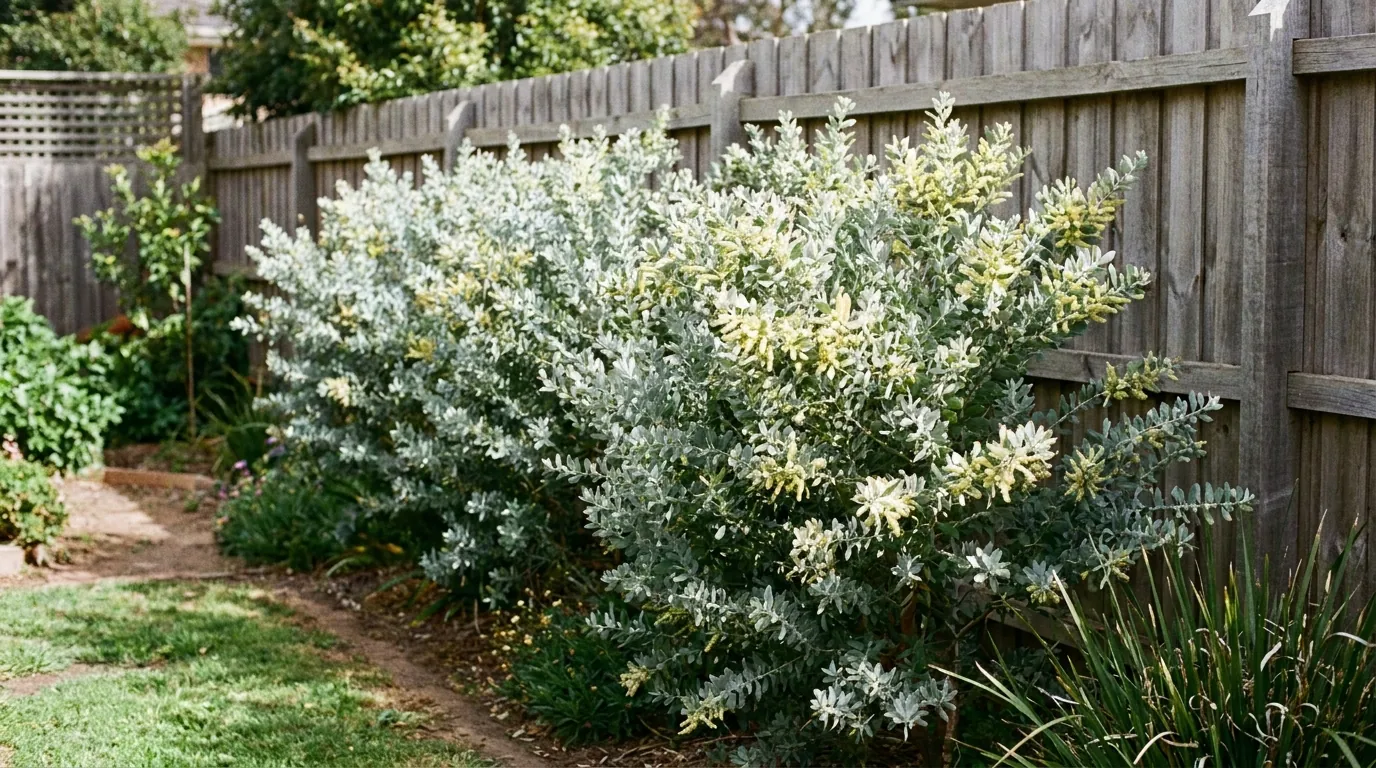
Queensland Silver Wattle as a screen
Wallum Nurseries specifically recommends the species as a fast-growing screen because it naturally retains a bushy form. Nindethana also describes it as useful for fast screening, while Plantmark lists a dense habit.
The catch is mature width. Most reliable references put the crown at around 4–5 m wide, with some nursery sources going broader. This is therefore an informal screening tree, not a narrow hedge for a 600 mm side passage.
In our own layouts, we place it where the crown can expand and where future replacement is possible. Its relatively short lifespan makes it better as part of a mixed screen than as the only species protecting an important sightline.
Where it makes sense—and where we would choose something else
| Garden requirement | Queensland Silver Wattle fit |
|---|---|
| Fast silver-foliaged feature tree | Excellent |
| Winter yellow flowers | Excellent |
| Dry, sunny, well-drained site | Very good |
| Broad informal screen | Good if there is room for a 4–5 m-class crown |
| Narrow formal hedge | Poor fit |
| Very long-lived structural tree | Poor fit; documented lifespan is relatively short |
| Garden beside sensitive WA or southern bushland | Choose cautiously or use a locally indigenous alternative |
For us, this is the honest buying decision. Queensland Silver Wattle is spectacular when you want quick silver foliage and winter gold, especially in sunny, relatively dry conditions. Its compromises are equally clear: several metres of mature width, a relatively short lifespan and a real capacity to naturalise outside its home range.
Frequently asked questions
How big does Acacia podalyriifolia grow?
Australian horticultural sources commonly put Queensland Silver Wattle around 4–7 m high and 4–5 m wide. The Australian National Botanic Gardens records plants to about 8 m high × 5 m across, while individual nursery forms may be somewhat smaller or broader.
How fast does Queensland Silver Wattle grow?
Australian botanical and nursery sources consistently describe the species as fast growing, but there is no strong species-wide centimetres-per-year figure. Wallum Nurseries says plants may flower in their second year, which supports its reputation for rapid establishment and early maturity.
How long does Queensland Silver Wattle live?
The Weeds of Australia fact sheet describes Acacia podalyriifolia as relatively short-lived, usually around 10–15 years. That makes it useful for quick structure and screening, but less suitable as the only long-term framework tree in a garden.
When does Queensland Silver Wattle flower?
The main flowering season is winter. The Wattle database records flowering mainly in June and July, VicFlora gives June to August, and some cultivated plants continue into spring.
Is Acacia podalyriifolia frost tolerant?
Yes. The Australian National Botanic Gardens lists established plants as frost hardy to about -7°C, while other Australian references rate the species highly for frost tolerance. Young newly planted trees still benefit from protection during severe cold while establishing.
Is Queensland Silver Wattle drought tolerant?
Yes, once established. SA Plant Selector+ lists drought tolerance and minimal supplementary watering. Newly planted trees still need establishment moisture while their roots move beyond the nursery root ball.
Can Queensland Silver Wattle become invasive?
Yes, outside parts of its natural range. VicFlora records it as adventive in Victoria, and Urban Bushland Council WA treats it as a serious bushland weed. Its seed bank can persist for more than 5 years, so avoid planting it near sensitive bushland where local guidance identifies an invasion risk.
Can Acacia podalyriifolia be used as a screen?
Yes. Australian nurseries use it as a fast informal screening plant, but its crown commonly reaches around 4–5 m wide. It suits broad mixed screens much better than narrow formal hedges.


