
Best Soil Moisture Meters Australia: Buyer’s Guide

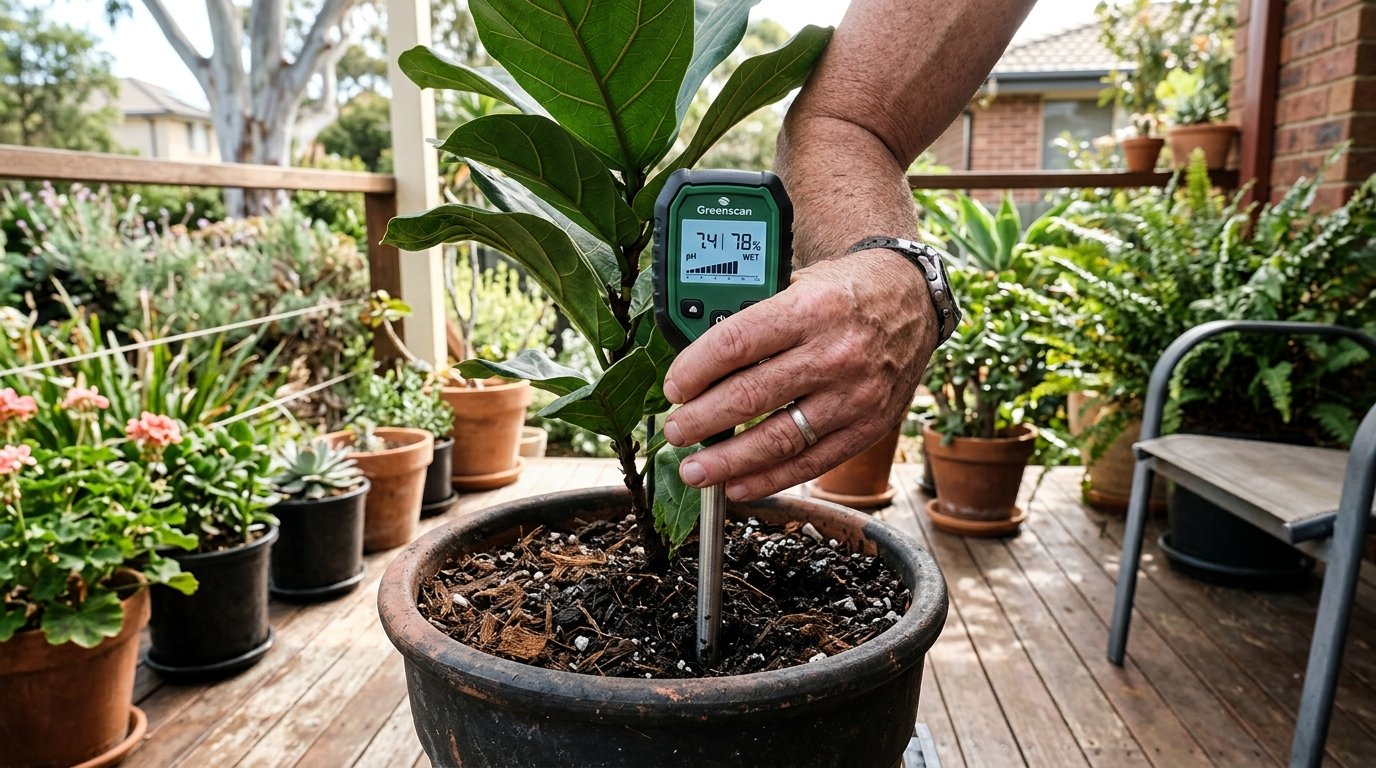
A soil moisture meter is one of the cheapest ways to stop guessing about watering — but only if you understand what it actually measures and where it can mislead you. For most Australian gardeners, a basic analogue probe meter is enough to answer the single most useful question: is the root zone dry, damp or waterlogged? More expensive digital and capacitance meters add precision, but the technique of how and where you probe matters more than the price of the device.
Overwatering and underwatering produce surprisingly similar symptoms — yellowing leaves, wilting, dropping foliage — so a meter that tells you what is happening below the surface can prevent the most common mistake in home gardening: watering a plant that is already too wet.
Brands widely available in Australia include generic analogue probe meters sold under many labels, plus digital options from names such as Gardena and various hardware-store house brands. Garden Green has not yet joined an affiliate program or completed controlled side-by-side testing of current moisture meters, so this guide does not publish live retailer links, prices, invented accuracy tests or fake “best meter” rankings. Its purpose is to help you choose the right type and, more importantly, use it correctly.
Quick pick: which moisture meter suits you?
| Situation | Best starting meter type | Why |
|---|---|---|
| General home garden and pots | Basic analogue probe meter | Cheap, no batteries, answers dry/damp/wet quickly |
| Indoor plants and precise care | Digital moisture meter | Clearer readout, often adds light or pH |
| Serious or repeated accuracy needs | Capacitance-style meter | Less prone to some errors of simple probe designs |
| Large garden or automation | In-ground sensor / smart system | Continuous monitoring rather than spot checks |
What a soil moisture meter actually does
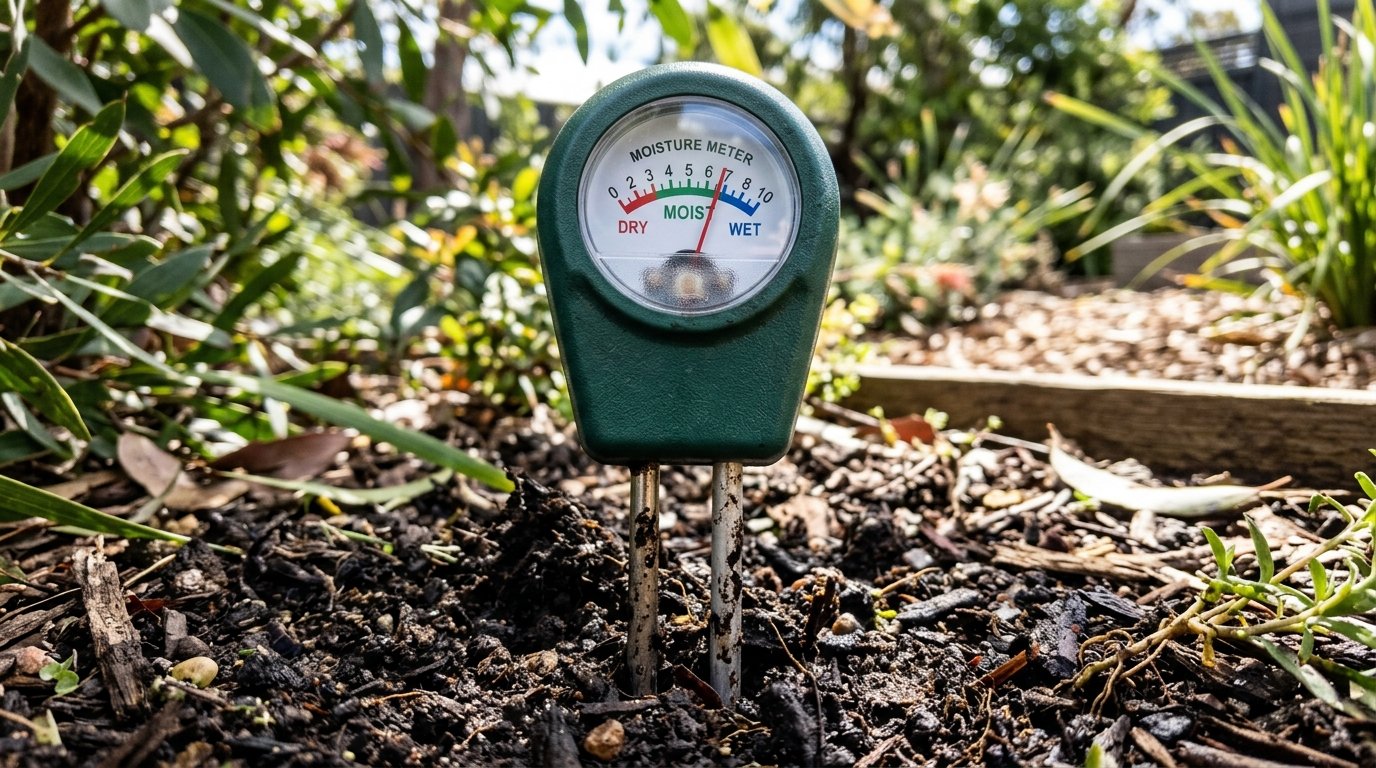
A moisture meter estimates how much water is in the soil around the probe.
The most common inexpensive meters do not measure water directly. They respond to the soil’s electrical conductivity, which is influenced by moisture — but also by salts and fertiliser.
This is the single most important thing to understand: a cheap probe meter is an indicator, not a laboratory instrument.
Why this still matters
Even an approximate reading is useful because most watering mistakes are large, not subtle.
The meter’s job is to answer a simple, decisive question:
- Is the root zone bone dry?
- Is it comfortably damp?
- Is it saturated and staying that way?
You do not need three-decimal accuracy to answer that.
Analogue probe meters
The classic garden moisture meter is a metal probe attached to a dial marked something like “dry”, “moist” and “wet”.
They are popular because they are:
- inexpensive;
- battery-free;
- simple to use;
- good enough for the dry/damp/wet decision.
Their weakness is that they can misread in certain conditions, which we cover below.
Digital moisture meters
Digital meters use a screen instead of a needle dial.
They often:
- display a clearer numeric or graphic reading;
- combine moisture with light and pH functions;
- suit indoor-plant owners who want a tidy readout.
A digital display does not automatically mean greater accuracy. A cheap digital meter can share the same underlying limitations as a cheap analogue one.
Capacitance meters
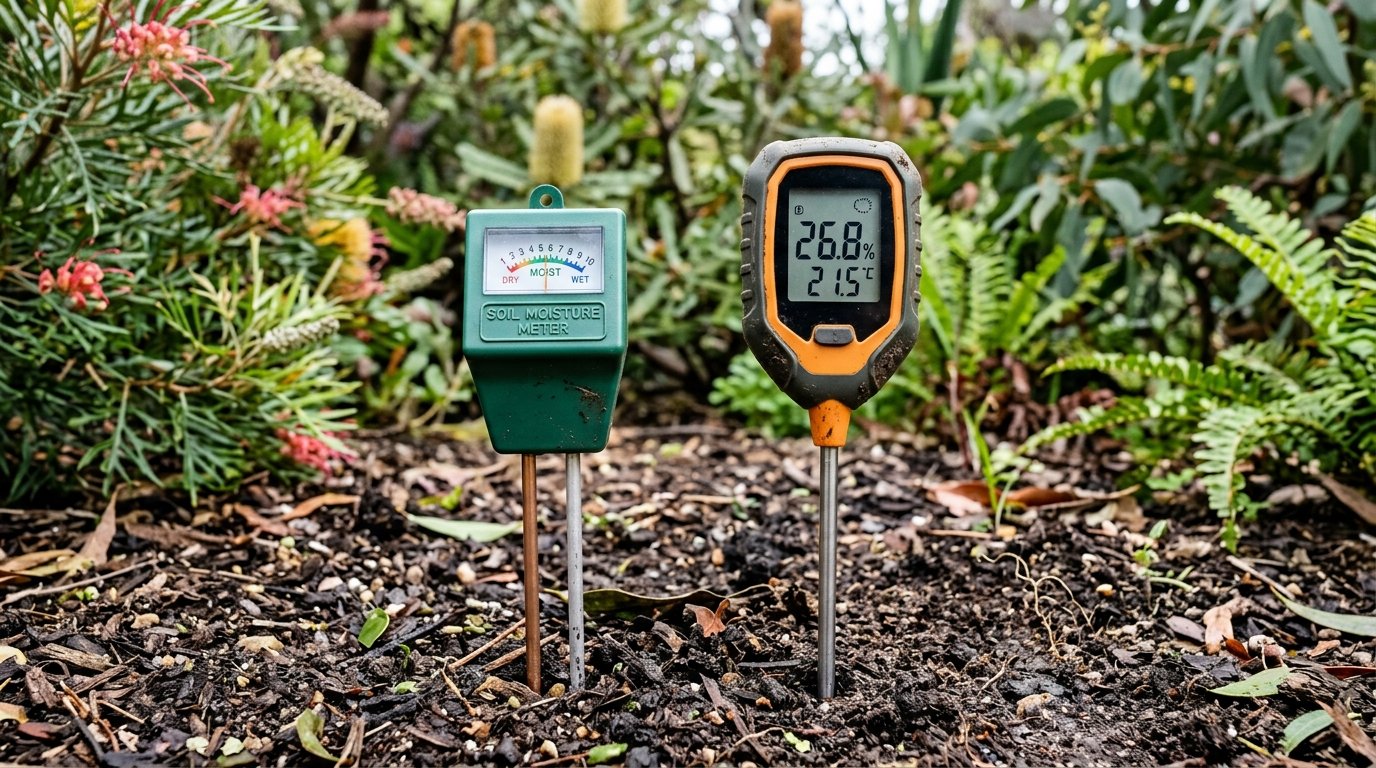
Capacitance-style meters measure moisture using a different electrical principle than simple conductivity probes.
They are generally:
- less affected by some conductivity errors;
- more expensive;
- aimed at users who want more reliable readings.
For most home gardeners a basic meter is enough. Capacitance meters make more sense where repeatable accuracy genuinely matters.
In-ground sensors and smart systems
At the top end, permanent soil sensors feed data to an irrigation controller or app.
These suit:
- larger gardens;
- automated irrigation;
- people who want continuous monitoring rather than manual spot checks.
They are a different category from a hand-held probe and are usually part of a wider irrigation setup.
Why cheap meters misread in very dry soil
Simple conductivity probes rely on some moisture to carry a small current.
In extremely dry soil there is little moisture to conduct, and some meters can give an inconsistent or oddly “moist” reading rather than a clear “bone dry”.
If a meter reads strangely in soil you know is bone dry, this limitation is a likely explanation.
Why fertiliser and salt can fool a probe meter
Because many probe meters respond to conductivity, dissolved salts and fertiliser can increase the reading.
Freshly fertilised soil can therefore read wetter than it really is.
This matters in Australian gardens where salty soils, recycled water or heavy feeding can all raise conductivity independently of actual moisture.
Do not water based on a single suspicious reading
If a reading contradicts what your eyes and fingers tell you, trust your judgement and re-check.
A meter is a helper, not an override.
The classic mistake is watering a wilting plant that is already waterlogged, because the visible symptom of overwatering can look like drought stress.
Probe depth: measure where the roots are
A reading at the surface tells you little about the root zone.
For most shrubs and hedges, the useful measurement is deeper — where the working roots actually sit.
Insert the probe:
- gently and fully enough to reach the root zone;
- without forcing it against rocks or roots;
- at a depth appropriate to the plant’s size.
Take several readings, not one
Soil moisture varies across a bed.
One probe hole can hit an unusually wet or dry pocket.
Take readings at several points around the plant and form a picture rather than trusting a single spot.
Clean the probe after use
Metal probes can corrode and can carry residue between pots.
Wipe the probe clean and dry after use, especially between indoor plants, to keep readings consistent and avoid transferring problems between containers.
Do not leave a probe meter permanently in the soil
Inexpensive garden probe meters are designed for spot checks, not permanent burial.
Leaving a cheap probe in the soil can corrode it and degrade both the probe and the reading.
For continuous monitoring, use a sensor actually designed to stay in the ground.
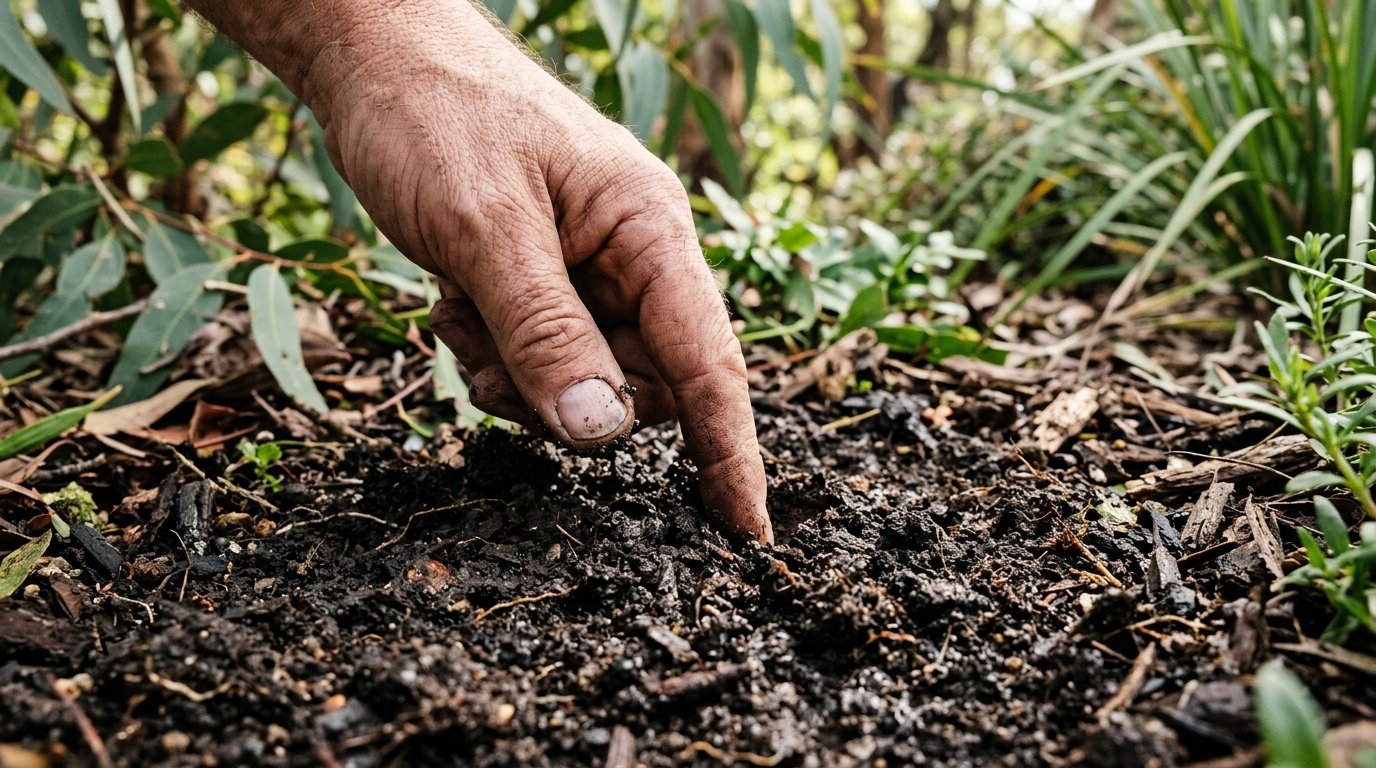
The finger test still works
A moisture meter does not replace basic observation.
For pots and smaller plants, pushing a finger into the soil to the second knuckle remains a reliable cross-check.
Use the meter and your senses together, particularly while you learn how your specific soil behaves.
Match watering to the plant, not just the meter
Different plants tolerate very different moisture levels.
Drought-tolerant natives such as Westringia dislike constantly wet feet, while some screening plants prefer more consistent moisture.
A “moist” reading that suits one plant may be too wet for another. Interpret the reading in the context of what you are growing.
Overwatering is the more common killer
In many home gardens, more plants are harmed by chronic overwatering and poor drainage than by underwatering.
A moisture meter is most valuable precisely because it can reveal soil that is staying wet — the condition behind much root rot.
If your meter repeatedly shows saturated soil days after watering, the problem is usually drainage, not a need for more water.
Meters and hedge watering
Establishing a new hedge such as Lilly Pilly or Ficus Hillii is one of the situations where a meter genuinely helps, because young plants are vulnerable to both drying out and drowning.
Check the root zone rather than the surface, take several readings along the row, and adjust rather than watering the whole hedge on a fixed schedule regardless of conditions.
Common moisture-meter buying and use mistakes
Trusting one reading
Take several readings around the plant, at root depth.
Measuring only at the surface
Surface soil dries first; the root zone is what matters.
Watering straight after fertilising based on the meter
Fertiliser can raise the reading without adding water.
Assuming digital means accurate
A screen does not fix a cheap sensor’s limitations.
Leaving the probe in the ground
Spot-check meters corrode if left buried.
Ignoring drainage
Persistently wet readings usually mean a drainage problem, not a watering need.
Where our recommended moisture-meter picks will go
Garden Green has not yet joined an affiliate program and has not completed controlled hands-on comparisons of current moisture meters. We therefore are not publishing a fake “best moisture meters” list assembled from product pages.
When recommendations are added, they should be grouped by genuine use case: a cheap analogue meter for general spot checks, a digital meter for indoor-plant owners, and a capacitance or sensor option for those who need repeatable accuracy.
The best moisture meter is the one you use correctly
For most gardeners our buying order would be:
- start with an inexpensive analogue probe meter;
- upgrade to digital or capacitance only if you need clearer or more repeatable readings;
- always probe at root depth, in several spots;
- cross-check against the finger test and the plant’s own signals;
- treat persistently wet readings as a drainage issue;
- consider a proper in-ground sensor only for continuous monitoring.
A moisture meter will not make watering decisions for you. What it does well is remove the guesswork about what is happening below the surface — and that alone can prevent the most common and most fatal watering mistakes.
Frequently asked questions
Are cheap soil moisture meters accurate?
Inexpensive probe meters are indicators rather than precise instruments. They are usually good enough to tell you whether the root zone is dry, damp or saturated, which is the decision most gardeners actually need. They can misread in very dry or very salty soil, so use them alongside observation rather than as an absolute measurement.
Why does my moisture meter read wet when the soil feels dry?
Many cheap meters respond to electrical conductivity, so dissolved salts and fertiliser can raise the reading independently of moisture. Very dry soil can also give inconsistent readings because there is little moisture to conduct. If a reading contradicts your eyes and fingers, re-check rather than watering.
How deep should I push a moisture meter probe?
Measure at the depth where the working roots sit, not at the surface. Surface soil dries first and can mislead you. Insert the probe gently to reach the root zone, and take several readings around the plant because soil moisture varies across a bed.
Can I leave a moisture meter in the soil permanently?
No. Inexpensive garden probe meters are designed for spot checks and can corrode if left buried, which degrades both the probe and the reading. For continuous monitoring, use an in-ground sensor specifically designed to stay in the soil, usually as part of an irrigation system.
Do digital moisture meters work better than analogue ones?
Not automatically. A digital screen can be easier to read and sometimes adds light or pH functions, but a cheap digital meter can share the same sensing limitations as a cheap analogue one. Accuracy depends more on the sensing method and correct technique than on whether the display is a dial or a screen.
Should I water my plant if the meter says dry?
Usually check the reading against the plant’s needs first. Drought-tolerant plants dislike constantly wet soil, while others prefer steady moisture. Take several readings at root depth, consider the species, and remember that a wilting plant can be overwatered rather than dry, so a single “dry” reading is not an automatic instruction to water.
Why is overwatering worse than underwatering?
In many gardens, chronically wet soil and poor drainage cause more damage than occasional dryness, because saturated soil starves roots of oxygen and encourages rot. A moisture meter is valuable partly because it can reveal soil that stays wet long after watering, pointing to a drainage problem rather than a need for more water.
Do I still need to check soil by hand if I have a meter?
Yes. For pots and smaller plants, pushing a finger into the soil remains a reliable cross-check, and your eyes tell you a great deal about plant health. Use the meter and your own observation together, especially while you learn how your particular soil behaves.


