
Waterhousea Hedge Problems Australia: Causes & Fixes

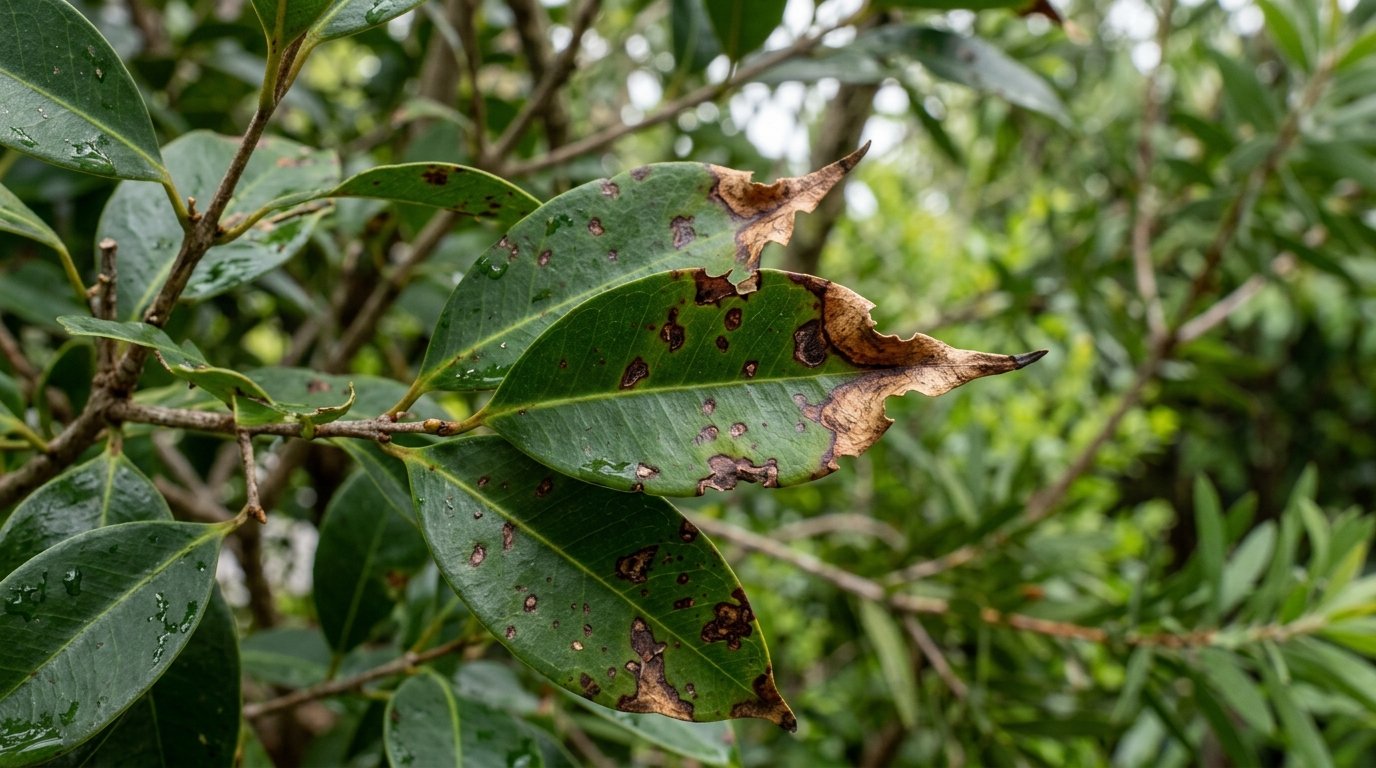
If a Waterhousea hedge is yellowing, browning, thinning or repeatedly needing severe pruning, check whether the problem is actually the site—or simply that a large rainforest tree has been forced into the wrong-sized hedge. Weeping Lilly Pilly naturally grows into a substantial tree, likes reliable moisture but still needs oxygen around its roots, and can lose density when repeatedly cut hard or shaded by its own canopy. Psyllid, scale, Myrtle rust and fungal problems can occur too, but they should be diagnosed from their specific symptoms rather than blamed for every struggling screen.
Waterhousea floribunda, commonly called Weeping Lilly Pilly or Weeping Myrtle, is an Australian native Myrtaceae tree from eastern rainforest and riverine habitats. PlantNET records it lining stream banks in riverine rainforest from northern New South Wales into Queensland. Australian Plants Society notes that it can reach around 30 m in natural habitat, while current Australian landscape nurseries generally place cultivated selections in a smaller but still substantial range: Plantmark gives roughly 4–10 m high for selected landscape forms, while Alpine Nurseries gives about 10–15 m for the species.
There is also a current botanical-name wrinkle worth knowing. PlantNET still recognises Waterhousea floribunda, while Kew’s Plants of the World Online currently treats that name as a synonym of Syzygium floribundum. Australian nurseries continue to sell it overwhelmingly as Waterhousea floribunda, so that is the name used throughout this garden guide.
Which Waterhousea hedge problem is it?
| What you can see | Likely cause | What to check first |
|---|---|---|
| Hedge constantly outgrowing the required height | Wrong plant scale for the space | Compare the maintained height with Waterhousea’s natural mature size |
| Pimples, dimples or distorted soft new leaves | Psyllid | Inspect the undersides of fresh growth for sap-sucking insects |
| General yellowing with persistently wet soil | Waterlogging, compacted soil or root stress | Check drainage despite the plant’s natural liking for moist sites |
| Yellow new leaves with greener veins | Possible iron chlorosis / nutrient-availability problem | Check soil pH and root health before repeated feeding |
| Dry brown tips or crispy margins | Dry root zone, heat, wind or damaged roots | Check moisture deeper in the root zone before watering again |
| Sticky leaves with black surface coating | Scale or another sap-sucker with sooty mould | Inspect stems and leaf undersides for the pest |
| Yellow powdery pustules on soft new growth | Possible Myrtle rust | Avoid moving suspect material and check current local biosecurity guidance |
| Bare lower screen under a dense upper canopy | Self-shading | Check hedge profile, height and light reaching the base |
| Long upright growth but poor density | Insufficient formative pruning, excess spacing or low light | Review early tip-pruning and planting layout |
| Brown spots in dense humid foliage | Possible fungal leaf disease | Check airflow, prolonged leaf wetness and overhead irrigation |
| Soft new growth damaged after cold weather | Frost injury | Wait until further frost risk passes before hard pruning |
This table is a starting point. A tall Waterhousea hedge can be suffering from poor pruning geometry and root stress at the same time, and several pest or disease symptoms can overlap.
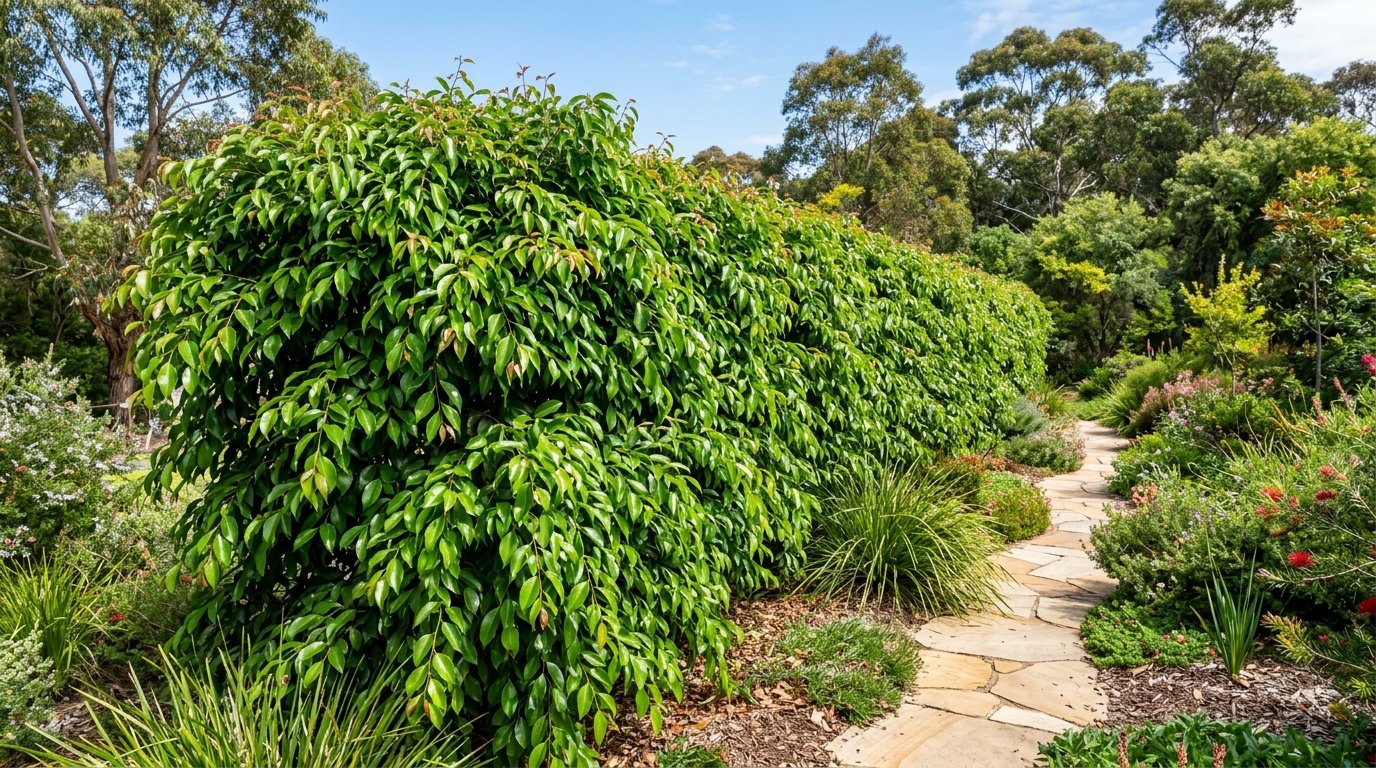
The most common “problem” may be that Waterhousea is too large
Waterhousea is often sold as a hedge plant, but botanically it is first and foremost a substantial tree.
Australian Plants Society describes Waterhousea floribunda as potentially reaching around 30 m in its natural habitat. Alpine Nurseries gives roughly 10–15 m high for landscape-grown plants, while Plantmark’s selected hedge forms are commonly listed around 4–10 m. Speciality Trees lists ‘Green Avenue’ at about 10–11 m high × 7 m wide.
Those figures explain why a Waterhousea planted for a permanent 1.5 m or 2 m formal hedge can become a maintenance battle.
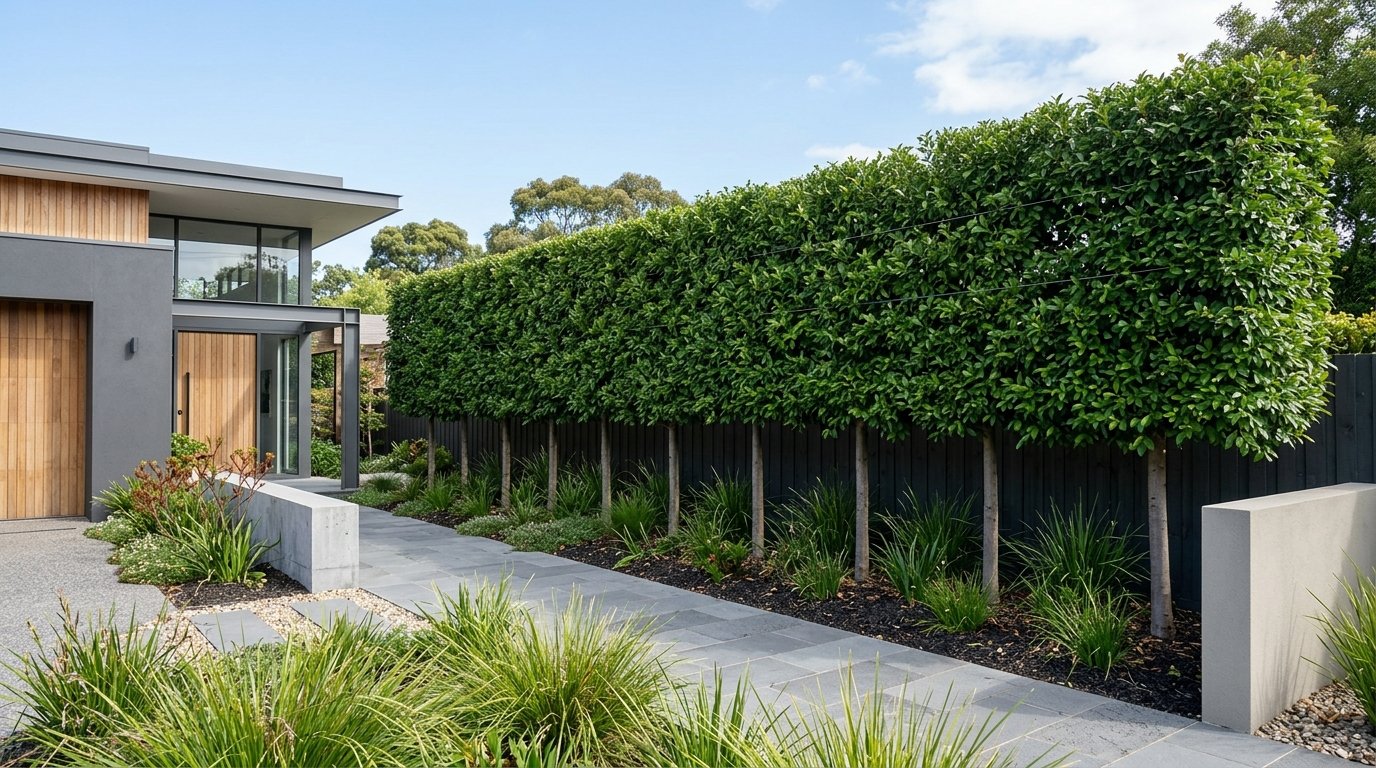
It can certainly be clipped as a tall screen. Plantmark specifically markets selected forms for formal hedging and privacy screening. But there is a big difference between maintaining a vigorous tree at 4–5 m and forcing it indefinitely into the dimensions of Japanese Box.
On our hedge work, if repeated heavy pruning is the only thing stopping the plant overwhelming the space, we treat plant selection—not the pruning technique—as the first problem.
Hard pruning can create bare patches and repeated stress
Waterhousea responds to pruning, and Australian Plants Society recommends pruning to encourage denser foliage and a desired shape. Speciality Trees likewise says Green Avenue responds well to pruning.
The issue is frequency and severity.
A tall vigorous tree repeatedly allowed to surge outward and then cut deeply back can develop:
- open interior branches;
- heavy shading of lower growth;
- large bare sections after hard cuts;
- an uneven canopy where recovery is stronger in some areas than others;
- a constant cycle of strong regrowth followed by another severe reduction.
Formative tip pruning while plants are young generally produces a better screen than allowing them to become small trees first and trying to convert them into a dense hedge later.
For normal size, spacing and hedge maintenance rather than troubleshooting, see our Waterhousea floribunda growing and hedge guide.
Psyllid: Waterhousea is not reliably resistant
There is a persistent claim in parts of the Australian nursery market that Weeping Lilly Pilly is psyllid resistant. Current authoritative and mainstream Australian sources do not support treating the species as reliably immune.
Gardening Australia specifically says the pimple psyllid that affects Lilly Pillies can also attack Waterhousia / Weeping Lilly Pilly. Yates Australia says Waterhousea floribunda can be affected by psyllids. Australian Plants Society likewise says the species can be attacked by psyllid, while Alpine Nurseries lists it as susceptible to psyllid.
Some individual nursery selections may be marketed as more resistant, but that does not justify describing the species as psyllid-proof.
So if your Waterhousea develops:
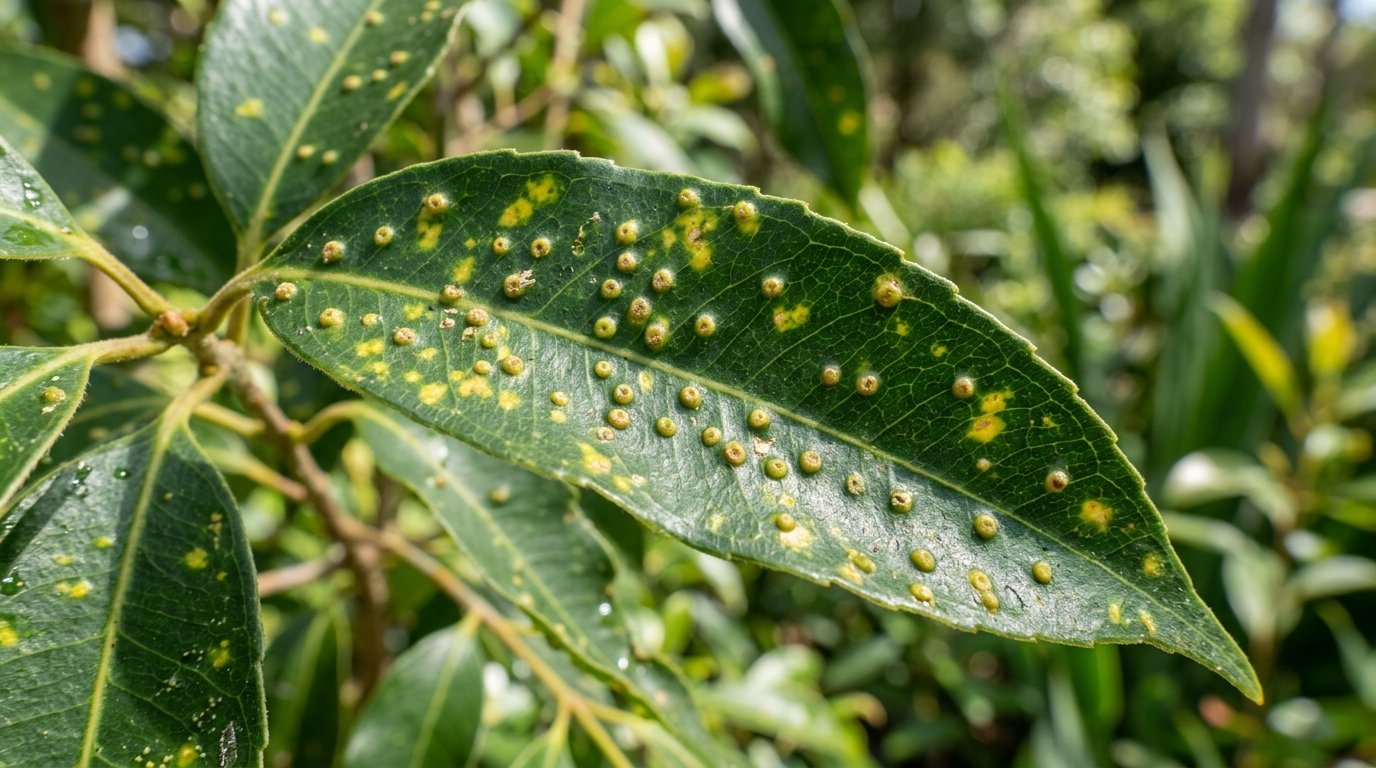
- pimple-like bumps;
- cupped or distorted new leaves;
- lumpy young growth;
- damage concentrated on the soft flush;
psyllid remains a credible diagnosis.
If avoiding pimple psyllid is a priority for a new planting, compare proven resistant cultivars in our Lilly Pilly hedge guide rather than assuming every plant sold as a Weeping Lilly Pilly has the same resistance.
What psyllid damage looks like on Waterhousea
Gardening Australia describes psyllid feeding as occurring around soft developing leaves. The insect feeds from beneath the foliage, causing surrounding tissue to grow abnormally and form the familiar pimples or dimples.
Once a leaf is badly deformed, it will not become perfectly flat again.
Gardening Australia recommends trimming off affected soft growth as a simple response where the damage is limited. Australian Plants Society also recommends oil treatment where infestations become serious.
If using any horticultural oil or pesticide, follow the current Australian product label and confirm that the pest and ornamental plant use are covered.
Yellow Waterhousea leaves: moist is not the same as waterlogged
Waterhousea naturally grows beside streams, so a yellow plant is sometimes given even more water on the assumption that “it is a creek tree”.
PlantNET does indeed record it lining stream banks in riverine rainforest, and Australian Plants Society says it likes supplementary water in hot dry conditions.
But those same horticultural sources still recommend good drainage.
Plantmark lists well-drained soil for the species. Australian Plants Society says it likes enriched soil but specifically tells growers to ensure good drainage. Speciality Trees notes that selected forms can tolerate occasional wet conditions, which is not the same as permanent stagnant saturation.
A healthy stream bank has moving water, porous soils and oxygen exchange. A compacted suburban clay hole filled with stagnant water is a different environment.
Yellowing from root stress
Root-zone problems move higher on the list where:
- yellowing follows prolonged rain;
- the affected plant sits lower than the rest of the row;
- soil remains wet long after nearby ground drains;
- growth has slowed despite plenty of irrigation;
- branches begin dying without obvious psyllid damage;
- the hedge is in compacted heavy soil.
Do not add more water simply because yellow leaves look limp.
Yellow new leaves with greener veins
If the newest foliage is pale while the veins remain noticeably greener, reduced iron availability becomes one possible explanation.
High soil pH, damaged roots or poor soil conditions can all interfere with iron uptake.
Check pH and root health before repeatedly applying iron or general fertiliser. A waterlogged root system can produce apparent nutrient deficiency even when nutrients are present in the soil.
Root rot can still happen to a moisture-loving tree
Waterhousea’s natural association with waterways does not make its roots immune to oxygen deprivation.
In stagnant, compacted soil, roots can decline and opportunistic root-rotting organisms can become involved.
Possible symptoms include:
- yellowing progressing to wilting;
- a plant appearing thirsty in wet soil;
- progressive branch dieback;
- decline after an unusually wet period;
- dark or unhealthy roots;
- one plant failing where water consistently collects.
Do not diagnose Phytophthora or another specific pathogen from leaf symptoms alone.
The first practical question is why drainage is failing. Reducing irrigation helps only if irrigation is the cause; it will not fix an impermeable clay basin or runoff flowing into the bed.
Brown crispy tips: Waterhousea genuinely dislikes drying out
Unlike Westringia, Waterhousea is not a shrub we treat as strongly drought-oriented.
Australian Plants Society recommends supplementary water during hot dry periods. Alpine Nurseries says it prefers moist soils and grows quickly when adequate water is available. Advanced Plants similarly recommends consistent moisture, especially during establishment and dry periods.
That makes genuine water deficit a credible cause of crispy tips and shoot dieback.
But damaged roots can cause similar symptoms.
Before reaching for the hose:
- move mulch aside;
- check moisture deeper in the root zone;
- compare with a healthy plant nearby;
- check whether irrigation reaches the entire row;
- look for standing water as well as dry soil.
If the root zone is dry, correct the watering problem. If it is saturated, investigate drainage instead.
Young Waterhousea needs reliable establishment water
The species’ rainforest and riparian background matters most while the root system is establishing.
Young plants with a limited nursery root ball can dry much faster than an established tree with roots extending through a larger soil volume.
Common establishment mistakes include:
- watering the surrounding garden but not the original root ball;
- allowing fresh planting mix to dry completely between irrigations;
- assuming rainfall has penetrated dense mulch;
- using a single dripper that wets only one side of the root system.
A young tree that repeatedly dries can brown at the tips, shed leaves and stall even though mature Waterhousea nearby looks effortless.
Scale and black sooty mould
Scale insects can occur on Waterhousea and related Myrtaceae.
Look for:
- small raised bumps on stems and leaf surfaces;
- sticky honeydew;
- ants moving through the foliage;
- a black surface coating developing over leaves.
The black layer is usually sooty mould growing on honeydew produced by the sap-sucking pest.
The useful diagnosis is therefore scale—or another honeydew-producing insect—not “black fungus” in isolation.
Control the sap-sucker and the food source for the mould disappears.
Myrtle rust: possible, but keep the risk in proportion
Waterhousea belongs to the Myrtaceae family and is a documented host of Myrtle rust, Austropuccinia psidii.
The Australian Myrtle-rust host list records natural infection of Waterhousea floribunda. However, Waterhousea is not generally highlighted as one of the catastrophic garden hosts in the way highly susceptible Lemon Myrtle can be.
The symptom to recognise is yellow powdery pustules on soft new growth, often accompanied by purple-brown lesions, distorted leaves or dying shoot tips.
This looks different from:
- general nutritional yellowing;
- dry crispy margins;
- psyllid pimples;
- scale and sooty mould.
If Myrtle rust is suspected, avoid moving infected material unnecessarily and check current state or territory biosecurity advice before transporting plants or samples.
There is also cultivar variation. Ozbreed markets Sweeper® Waterhousea floribunda ‘DOW20’ as highly Myrtle-rust resistant, so cultivar identity can matter where disease pressure is high.
Leaf spots and fungal problems in dense screens
Tall Waterhousea screens can become extremely dense, particularly where they are frequently clipped.
Dense foliage traps humidity and can stay wet long after exposed leaves dry. That creates conditions in which fungal leaf spotting becomes more likely.
Look for:
- defined brown, grey or black spots rather than general scorching;
- spots increasing in number after wet weather;
- damage concentrated deep inside a dense canopy;
- leaf drop following prolonged periods of wet foliage.
Useful cultural steps include:
- water the root zone instead of routinely wetting the canopy;
- avoid late-day overhead irrigation;
- remove heavily affected dead material;
- maintain airflow without stripping the screen;
- clean pruning tools when disease is suspected.
Do not apply fungicide simply because a leaf is brown. Confirm that the symptom pattern is consistent with disease first.
Why a tall Waterhousea screen becomes bare at the bottom
Waterhousea has a naturally dense, pendulous canopy. That beautiful weeping habit can also shade the lower portion of a hedge when the upper canopy becomes too wide.
A tall screen that is broader at the top than the base progressively reduces the light reaching its lowest branches.
Over time you may see:
- dense foliage high up;
- long bare lower stems;
- gaps at eye level;
- vigorous growth outside the desired screen but little regrowth deep inside.
Maintain the hedge slightly broader at the base than at the top where practical, and begin formative pruning while plants are young.
Trying to rebuild a completely bare base years later is much harder than preserving low branching from the start.
Why the screen grows tall but will not thicken
A Waterhousea can gain height rapidly while remaining open between individual plants.
Common causes include:
- insufficient tip pruning during establishment;
- spacing too wide for the desired timeframe and screen density;
- too much shade;
- dry establishment conditions;
- root stress;
- allowing dominant vertical shoots to run instead of encouraging side branches.
Australian Plants Society recommends pruning to encourage denser foliage, while Plantmark specifically uses selected Waterhousea forms for dense screening and formal hedges.
For appropriate spacing and expected mature scale, use our Waterhousea floribunda hedge and growing guide rather than copying spacing from a compact Syzygium cultivar.
Too much shade can thin the screen
Waterhousea tolerates part shade, and its rainforest origins make it more shade-adaptable than many dryland trees.
Plantmark lists full sun to semi-shade, while Australian Plants Society gives full sun to part shade.
Deep shade is different.
Where light becomes too low, you may see:
- longer spaces between leaves;
- branches reaching toward brighter areas;
- reduced density;
- more foliage concentrated at the canopy edge;
- a screen that never fills evenly despite feeding.
If one shaded portion of a hedge is consistently thinner than the sunny section, light may be more important than fertiliser.
Frost can damage young Waterhousea
Cold tolerance varies with age, provenance and site.
Australian Plants Society reports that the species can tolerate light frost, while some commercial nursery guidance is more cautious and recommends protection from frost, particularly for young stock.
Young soft growth is generally the most vulnerable.
Frost damage may appear as:
- browned fresh tips;
- blackened or collapsed soft leaves;
- damage strongest on exposed upper foliage;
- older internal wood remaining alive.
Do not prune deeply immediately after a frost if more cold weather is likely. Wait until the full extent of dead tissue is clear.
Sun scorch and heat stress on young or newly exposed growth
Established Waterhousea handles full sun well when the roots have reliable moisture, but young plants can scorch if they are suddenly exposed to intense heat, reflected sun or drying wind.
Hard pruning can also expose inner foliage that developed in shade.
Scorch is more likely where:
- browning occurs mainly on one hot exposed face;
- the soil has dried significantly;
- the plant was recently transplanted;
- hard pruning exposed previously shaded leaves.
Correct moisture stress and allow the plant to recover before repeatedly cutting away every browned leaf.
When should you replace or re-site Waterhousea?
Waterhousea is a long-lived tree when the site suits it, so replacement should not be the first answer to cosmetic damage.
But sometimes the honest diagnosis is that the planting decision was wrong.
We would consider replacement or re-siting where:
- a naturally large tree has been planted where a permanently low hedge is required;
- the hedge needs constant severe cutting simply to fit the space;
- the root zone remains stagnant and waterlogged despite practical drainage corrections;
- large sections have lost lower foliage because the screen has become structurally oversized;
- severe root damage has killed most of an individual plant;
- another more compact Lilly Pilly could achieve the same privacy with substantially less pruning.
If the job really needs a compact suburban hedge rather than a tall weeping screen, our Australian Lilly Pilly hedge guide compares smaller screening options.
Our diagnosis order for a struggling Waterhousea hedge
When a Weeping Lilly Pilly screen starts looking thin, yellow or brown, we work through the evidence in this order:
- Ask whether the plant fits the space. If a large tree is being kept permanently tiny, pruning stress may be part of the problem.
- Inspect the newest leaves. Pimples or distortion can still indicate psyllid; Waterhousea should not be assumed immune.
- Check the root zone. Establish whether the soil is dry, comfortably moist or stagnant and saturated.
- Compare affected and healthy plants. A single failing section often reveals a drainage or irrigation difference.
- Inspect stems and leaf undersides. Scale and other sap-suckers can explain sticky foliage and sooty mould.
- Look for yellow powder on soft new growth. That raises the possibility of Myrtle rust.
- Review the hedge shape and light. A broad weeping canopy can shade out its own base.
- Consider recent weather. Frost, heat, dry wind and prolonged rain can change the symptom pattern quickly.
- Only then decide whether the answer is irrigation, drainage, formative pruning, pest control, disease diagnosis or replacing the plant with something better sized for the site.
If the symptoms do not clearly match these patterns, several causes appear to be overlapping, or your Waterhousea continues declining after obvious irrigation, drainage and pruning problems have been corrected, Garden Green’s plant and flower disease diagnosis service can help identify the likely cause and practical next step. You can also contact Garden Green with the details of what you are seeing.
Frequently asked questions
Why is my Waterhousea hedge turning yellow?
Yellowing can result from waterlogged roots, compacted soil, genuine water shortage or a nutrient-availability problem. Waterhousea naturally grows near streams and likes reliable moisture, but Australian Plants Society and Plantmark still recommend good drainage. If the soil remains saturated, investigate root-zone conditions before fertilising or watering again.
Is Waterhousea floribunda resistant to Lilly Pilly psyllid?
Do not assume it is. Gardening Australia, Yates Australia, Australian Plants Society and Alpine Nurseries all state that Waterhousea floribunda can be affected by or is susceptible to psyllid. Some nursery selections may be promoted as having better resistance, but pimpled and distorted new growth on ordinary Waterhousea can still be psyllid damage.
How big does Waterhousea floribunda get?
It is a large tree rather than a naturally small hedge shrub. Australian Plants Society says it can reach around 30 m in natural habitat. Australian landscape sources commonly list selected or cultivated Waterhousea in roughly the 4–15 m range, depending on form and growing conditions, so it is best suited to tall screening or larger gardens.
Why does my Waterhousea hedge have brown crispy tips?
Brown crispy tips can result from dry roots, hot wind or heat stress, particularly while the hedge is establishing. Damaged roots in saturated soil can produce similar symptoms, so check moisture below the surface before watering. Waterhousea generally performs best with reliable moisture and reasonable drainage.
Can Waterhousea get root rot even though it likes wet conditions?
Yes. Waterhousea naturally grows in moist riverine environments, but permanently stagnant, oxygen-poor soil is different from a healthy stream-bank root zone. Compacted heavy soil and chronic waterlogging can damage roots and allow root-rot organisms to become involved. Good drainage still matters.
Can Waterhousea get Myrtle rust?
Yes. Waterhousea floribunda is a documented Australian host of Myrtle rust. Check soft new growth for yellow powdery pustules, purple-brown lesions and distorted shoots. The disease is not usually highlighted as severely on Waterhousea as on highly susceptible Lemon Myrtle, but suspect material should still be handled carefully and current local biosecurity guidance checked.
Why is my Waterhousea hedge bare at the bottom?
A tall weeping canopy can shade its own lower branches, particularly if the hedge becomes wider at the top than at the base. Early formative pruning and preserving light to the lower foliage help maintain a fuller screen. Once the base is heavily shaded and woody, rebuilding density becomes more difficult.
Should I replace a Waterhousea hedge that is too large?
Sometimes that is the most practical solution. Waterhousea is naturally a substantial tree, so a hedge that requires constant severe pruning to remain very low may simply be the wrong plant for the space. Where permanent low screening is required, a smaller Lilly Pilly cultivar can often deliver privacy with less structural stress and maintenance.


