Japanese Box Hedge Australia: Buxus japonica Size, Spacing, Pruning and Care

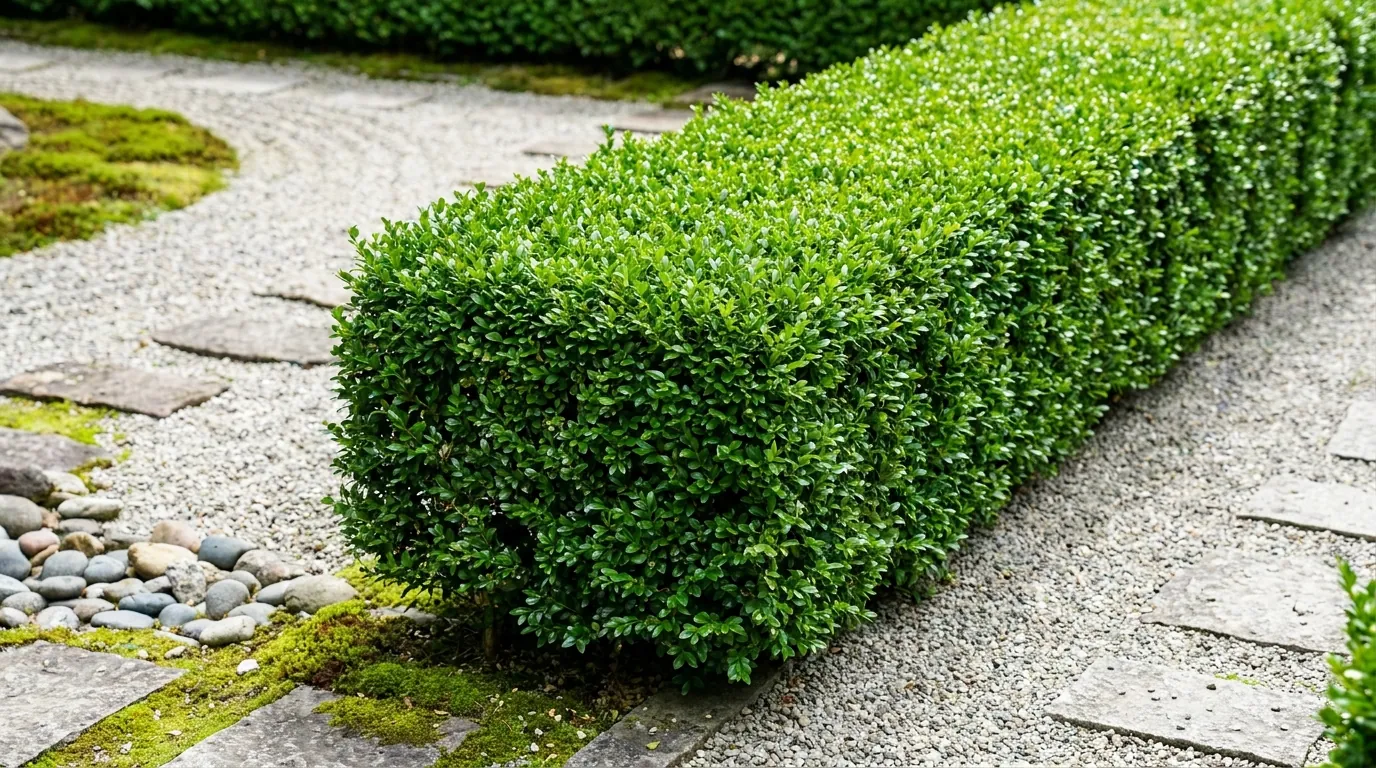
Japanese Box is one of the easiest plants to recognise in a formal Australian garden.
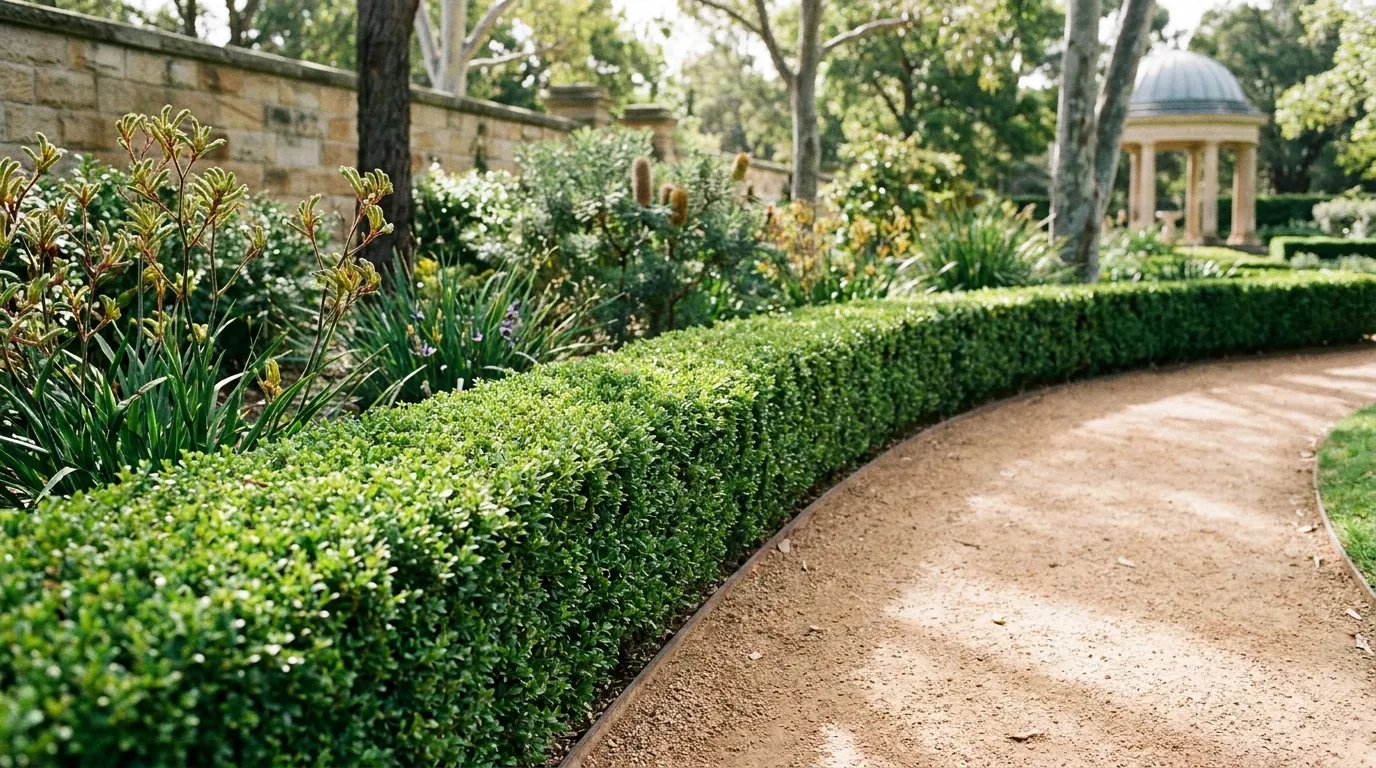
A neatly clipped row beside a path, driveway or front garden creates the dense green line people usually mean when they say “box hedge”.
But the plant itself is often misunderstood.
Japanese Box is commonly sold as a 15–30 cm nursery plant and maintained as a 30–80 cm hedge. That does not mean its natural mature size stops there.
The Botanic Gardens of South Australia lists Buxus microphylla var. japonica at around 1–2 metres high and 1–1.5 metres wide, while Royal Botanic Gardens Victoria describes the variety as a broad, relatively fast-growing shrub compared with other small-leaved boxwoods.
That is why Japanese Box works so well as a hedge:
it tolerates repeated clipping and can be held far below its unrestricted shrub size.
If you are choosing between Japanese Box and a taller privacy hedge, compare it with our Lilly Pilly hedge guide before buying purely on appearance.
Quick Answer: What Is Japanese Box?
Japanese Box is the horticultural name commonly used in Australia for:
- Buxus microphylla var. japonica
It belongs to the Buxaceae family and is grown primarily for its dense evergreen foliage rather than its flowers.
Royal Botanic Gardens Victoria describes var. japonica as having:
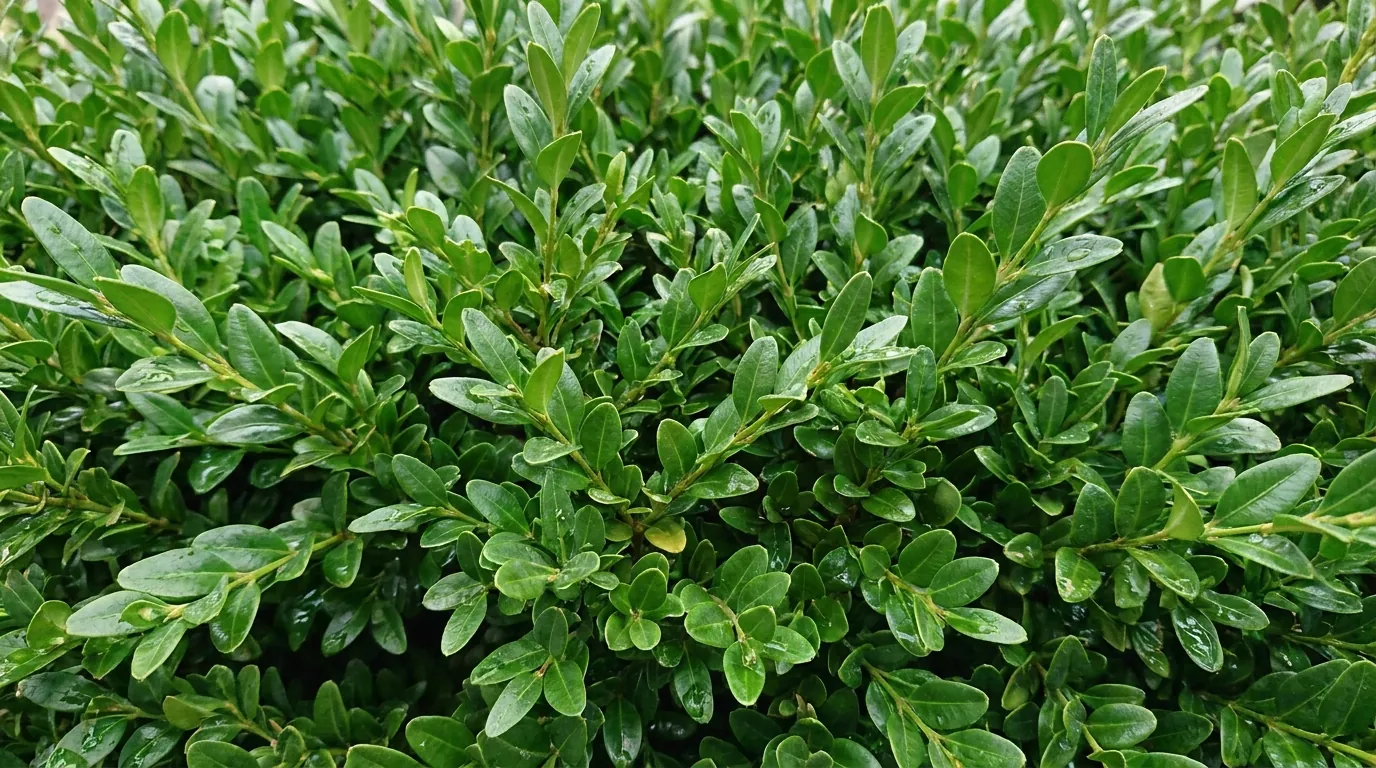
- glossy rounded leaves
- small foliage around 1–1.5 cm long
- a broad, open natural shrub form
- faster growth than many traditional box forms.
In Australian gardens it is mainly used for:
- formal hedges
- low borders
- parterre gardens
- path edging
- topiary
- clipped balls
- pots and courtyards
Japanese Box at a Glance
| Feature | Japanese Box |
|---|---|
| Botanical name | Buxus microphylla var. japonica |
| Common name | Japanese Box |
| Plant type | Evergreen shrub |
| Unpruned landscape height | Commonly around 1–2 m |
| Unpruned spread | Around 1–1.5 m in Australian landscape references |
| Typical hedge height | Often maintained from about 30 cm to 1 m+ |
| Foliage | Small, glossy, bright to mid-green |
| Flowers | Small and inconspicuous |
| Light | Full sun to part shade |
| Soil | Adaptable, but drainage matters |
| Drought | Some tolerance once established |
| Frost | Moderate tolerance |
| Main use | Formal hedge, border and topiary |
| Maintenance | Regular trimming for a crisp hedge |
The important distinction is natural shrub size versus maintained hedge size.
Is Japanese Box the Same as Buxus japonica?
Usually, yes in Australian nursery language.
You will commonly see labels such as:
- Buxus japonica
- Japanese Box
- Buxus microphylla japonica
- Buxus microphylla var. japonica
The more complete botanical treatment used by Australian horticultural references is Buxus microphylla var. japonica. Royal Botanic Gardens Victoria recognises it under Buxus microphylla and distinguishes var. japonica from var. microphylla, var. koreana and other forms.
For garden shopping, “Buxus japonica” usually means Japanese Box rather than a completely different plant.
How Big Does Japanese Box Grow?
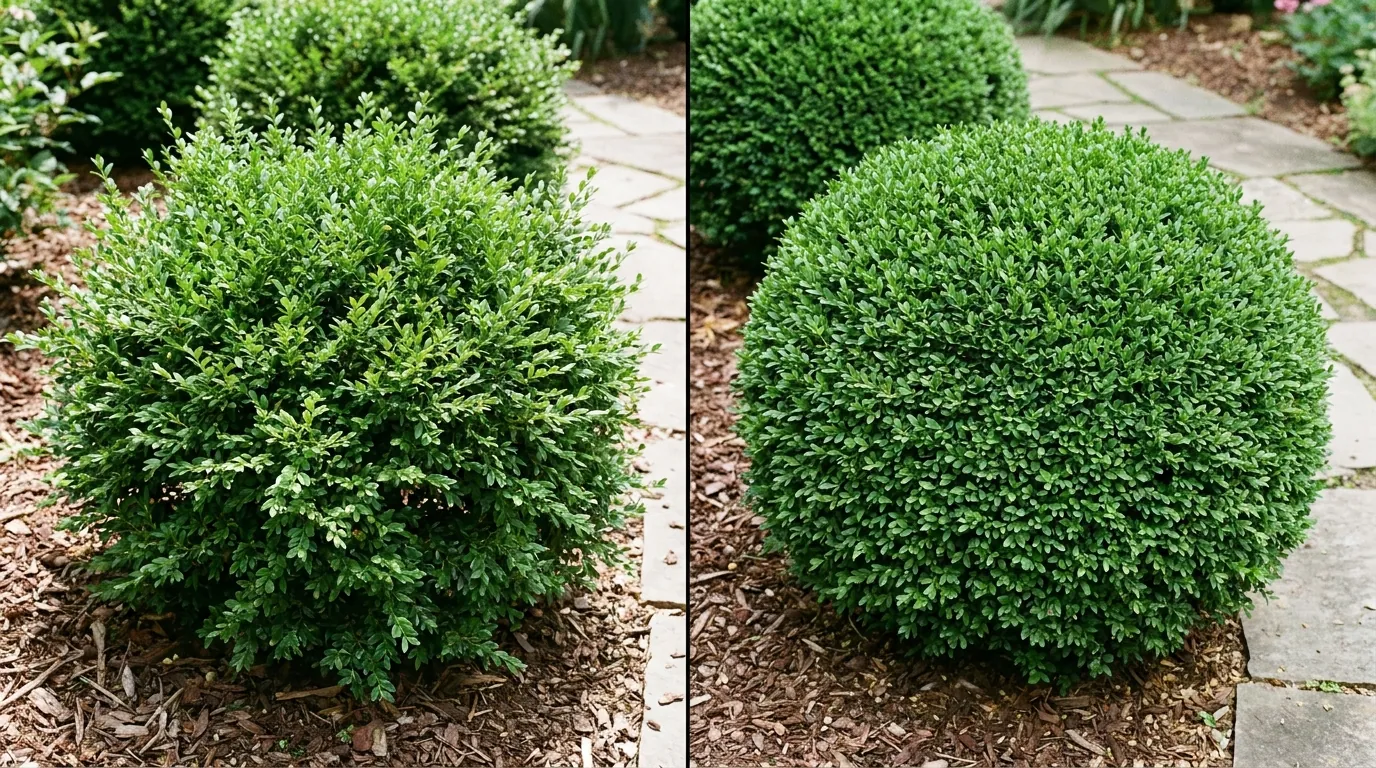
If left unpruned, Japanese Box can become much larger than the low edging seen around formal gardens.
The Botanic Gardens of South Australia gives:
- 1–2 m height
- 1–1.5 m spread.
Some Australian nursery references allow for even larger mature shrubs under favourable conditions, while many garden guides quote closer to 1 m because the plant is usually kept clipped.
Why do size figures vary?
Because Japanese Box is almost always pruned.
A plant clipped to 50 cm for ten years does not demonstrate its unrestricted mature size.
Final size depends on:
- pruning
- climate
- soil
- irrigation
- age
- available root space
So plan the plant by the hedge size you intend to maintain, not by nursery-pot height.
Is Japanese Box Good for a Low Hedge?
Yes. This is its strongest use.
Japanese Box responds well to repeated clipping and naturally produces small foliage, which allows a crisp surface that larger-leaved hedge plants cannot create as easily.
The Botanic Gardens of South Australia recommends it for:
- formal hedging
- informal hedging
- low borders
- barriers
- screens.
Australian retailers also commonly recommend it for topiary and structured garden borders, with Bunnings listing it for hedging, topiary and containers.
Good uses
Japanese Box works particularly well for:
- front paths
- garden-bed edging
- driveways
- rose gardens
- formal courtyards
- knot gardens
- parterre layouts
- low boundaries
It is much less suitable when the real goal is a fast 2–3 m privacy screen.
How Far Apart Should Japanese Box Be Planted?
There is no single perfect spacing because starting plant size and target hedge height matter.
For low formal hedges, Australian nursery guidance commonly falls around 20–30 cm between plants.
Nurseries Online recommends roughly 25 cm spacing, while established Australian hedge growers commonly use around 30 cm.
About 20–25 cm apart
Useful when:
- plants are small
- you want faster visual closure
- the target hedge is low and dense
Around 30 cm apart
A practical general starting point for many low-to-medium Japanese Box hedges.
Wider spacing
Can work where:
- plants are already large
- the intended hedge is taller
- you are prepared to wait longer for gaps to close
Do not plant extremely tightly just to make the hedge look finished on day one.
Close spacing means:
- more plants
- higher initial cost
- greater root competition later
The future Garden Green hedge-spacing calculator should ultimately account for plant width, target height and desired closure rather than returning one spacing for every hedge.
How Many Japanese Box Plants Do I Need per Metre?
At 25 cm centres, you need approximately:
- 4 plants per metre
At 30 cm centres, the practical requirement is roughly:
- 3–4 plants per metre
The exact number across a long hedge depends on whether you place a plant at both ends of the measured run.
For example, calculating a 10 m hedge is not just “10 × 4” in every layout because the endpoint positions affect the final plant count.
This is exactly why spacing calculations are better handled by a dedicated calculator rather than a memorised plants-per-metre rule.
How Fast Does Japanese Box Grow?
Japanese Box is faster than many traditional boxwoods, but it should not be confused with a fast privacy hedge.
Royal Botanic Gardens Victoria describes var. japonica as relatively fast growing within the box group. Garden Express similarly calls it the fastest-growing of the commonly used Buxus varieties.
Nurseries Online gives an indicative figure of around 30 cm in a good year under favourable conditions.
Treat that figure as an indication, not a guaranteed annual rate.
Growth varies with:
- climate
- watering
- soil
- pruning
- root establishment
- sun
- plant age
Faster than English Box does not mean fast like Lilly Pilly
This distinction matters.
Japanese Box may establish a formal border relatively quickly compared with slower Buxus types, but it will not normally provide tall privacy as quickly as Lilly Pilly, Ficus or Murraya.
If the main goal is rapid privacy rather than a formal low hedge, use our Lilly Pilly hedge guide instead.
Does Japanese Box Need Full Sun?
It performs well in full sun but also tolerates part shade.
Garden Express recommends an open sunny position while noting shade tolerance, and Australian commercial growers commonly list full sun to semi-shade.
Full sun
Can support:
- denser growth
- faster drying after rain
- compact foliage
But exposed plants in very hot inland or western-facing positions may need more careful establishment watering.
Part shade
Can work well, especially in hotter climates.
Deep shade
Can lead to more open growth and less dense hedge structure.
The goal is enough usable light for foliage throughout the hedge, particularly at the base.
Why Does Japanese Box Turn Bronze in Winter?
Winter bronzing can be a normal seasonal response.
The Botanic Gardens of South Australia specifically notes that Japanese Box foliage can turn bronze in winter.
That does not automatically mean the hedge is:
- dying
- nutrient deficient
- diseased
Colour changes can become stronger with:
- cold
- frost
- exposed winter sun
- dry winter conditions
Healthy growth should return greener when active growth resumes.
If the foliage is also dropping, blackening or dying back, investigate further rather than assuming normal bronzing.
What Soil Does Japanese Box Prefer?
Japanese Box is reasonably adaptable.
The Botanic Gardens of South Australia lists suitability across:
- clay
- loam
- sand
- acidic soils
- neutral soils
- alkaline soils.
That broad tolerance does not make drainage irrelevant.
A clipped hedge planted into a permanently waterlogged strip can still develop root stress.
The practical soil target
Aim for soil that:
- drains
- holds some useful moisture
- is not severely compacted
- allows roots to expand along the hedge line
Do not automatically add gypsum to every clay soil. Soil structure and sodicity should be assessed rather than assuming all clay requires the same amendment.
How Often Should Japanese Box Be Watered?
Do not use one national watering schedule.
Water need depends on:
- establishment
- soil texture
- rainfall
- heat
- wind
- hedge density
- sun exposure
Newly planted hedge
Keep the original root balls from repeatedly drying hard while roots establish into the surrounding soil.
A continuous planting strip can dry unevenly, particularly next to:
- paving
- retaining walls
- driveways
Check several points along the hedge rather than assuming one irrigation emitter represents the entire row.
Established hedge
Japanese Box has some drought tolerance, but a formal clipped hedge generally looks better with consistent moisture during prolonged dry weather.
The Botanic Gardens of South Australia lists drought tolerance and minimal supplementary watering once established.
How Often Should Japanese Box Be Pruned?
There is no compulsory number of trims per year.
Pruning frequency depends on:
- how formal you want the hedge
- growth rate
- climate
- target height
- season
Bunnings notes that Japanese Box grows faster than several other Buxus types and therefore needs more regular pruning to maintain a crisp shape.
For a very formal hedge
Light trimming whenever new growth begins to blur the outline is better than waiting until the shrub is badly oversized.
For an informal hedge
Allow more natural growth between trims.
Start shaping early
Do not let plants become tall and open before trying to create density at the base.
Early light pruning encourages branching and makes it easier to create a solid hedge face.
Should a Box Hedge Be Wider at the Bottom?
Yes, slightly.
A hedge with a very broad top can shade its own lower foliage.
A subtle taper — slightly wider at the base than at the top — helps light reach lower leaves.
This is the same basic hedge-light principle that applies to many clipped evergreen species.
Do not exaggerate it into a dramatic triangle.
The finished hedge can still look rectangular to the eye while being a little wider at ground level.
Can Japanese Box Be Hard-Pruned?
Healthy Buxus generally tolerates pruning well, but there is little reason to make severe cuts part of routine care.
A better maintenance strategy is:
- shape early
- trim regularly
- avoid repeated cycles of neglect and drastic renovation
- retain enough healthy foliage for recovery
If an old hedge has become badly oversized or bare inside, renovate it gradually rather than assuming one severe cut will create an instant dense hedge again.
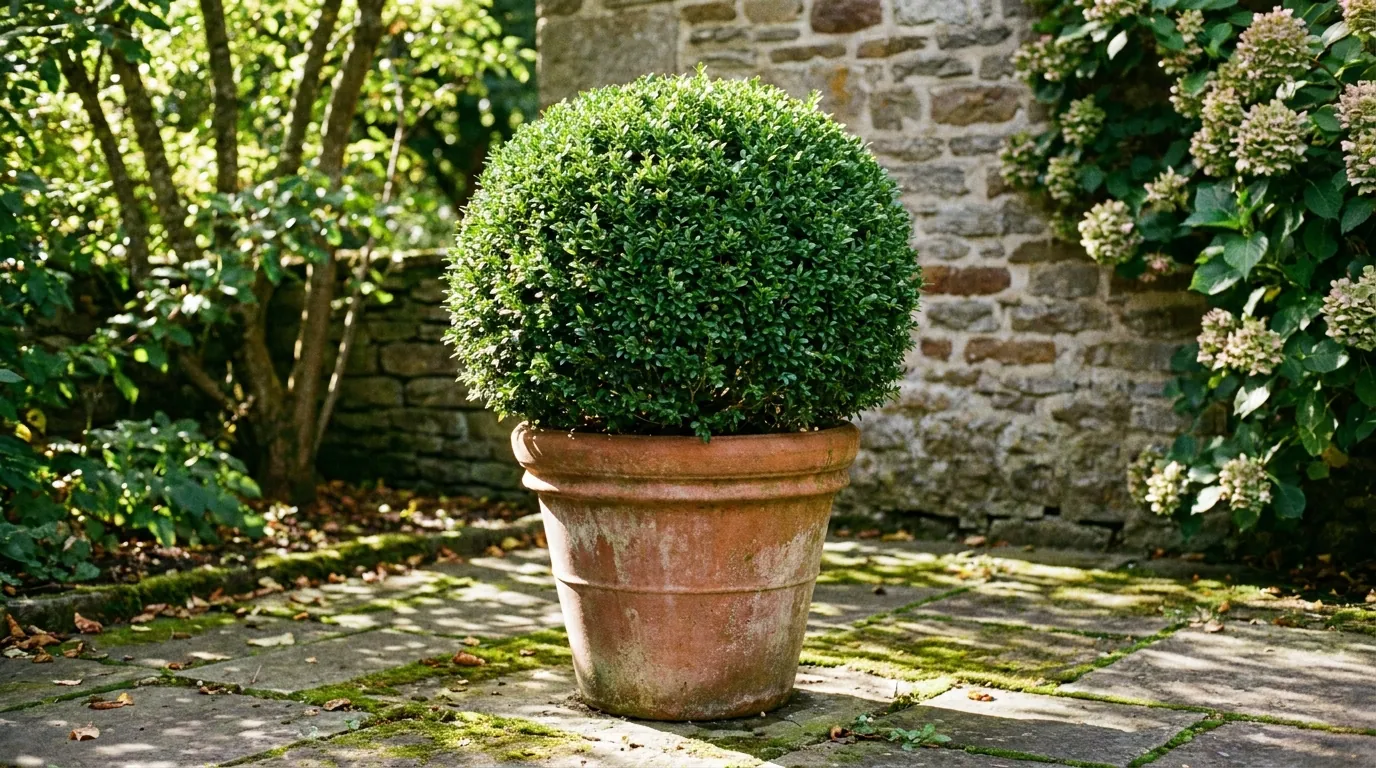
Can Japanese Box Grow in Pots?
Yes.
Japanese Box is widely used for:
- clipped balls
- entrance pots
- courtyard containers
- topiary
- paired formal specimens
Bunnings specifically lists container and topiary use.
A pot-grown plant needs more careful water management because the root volume is limited.
Use:
- reliable drainage holes
- enough pot volume for the intended plant size
- a stable container if the plant is shaped into taller topiary
Do not leave the container permanently standing in water.
Does Japanese Box Tolerate Heat?
It is generally considered more suitable for warmer Australian conditions than traditional English Box.
Garden Express notes that Japanese Box handles more heat than other Buxus types and grows from cool through warmer climates.
Bunnings likewise markets it as preferring warmer conditions.
That does not mean newly planted Box should be allowed to dry out beside hot paving.
Heat tolerance and drought during establishment are different issues.
Does Japanese Box Tolerate Frost?
Yes, to a useful degree.
The Botanic Gardens of South Australia lists moderate frost tolerance.
Cold may cause bronzing without killing the plant.
Young plants and hedges in exposed frost pockets may show more winter stress than established plants in sheltered gardens.
Japanese Box or Lilly Pilly: Which Is Better?
They solve different hedge problems.
Choose Japanese Box when you want:
- a low formal hedge
- neat garden-bed edging
- small foliage
- topiary
- geometric garden structure
- a hedge maintained around 30 cm to roughly 1 m
Choose Lilly Pilly when you want:
- taller privacy
- faster screen development
- native foliage
- 1.5–4 m hedge options
- colourful new growth
For tall privacy, Japanese Box usually requires too much time and pruning relative to a purpose-selected Lilly Pilly.
Use our Lilly Pilly hedge guide for those taller screening options.
Japanese Box or Murraya?
Choose Japanese Box when the priority is:
- tight formal structure
- low edging
- crisp topiary
- small foliage
Choose Murraya when you want:
- a taller screen
- fragrant white flowers
- looser evergreen foliage
- faster privacy development
Our Murraya hedge guide covers the larger flowering-screen option.
Japanese Box or Ficus Hillii?
These plants operate at completely different scales.
Japanese Box is suited to:
- low formal hedges
- borders
- small topiary
Ficus Hillii is used for:
- tall privacy screens
- large dense hedges
- substantial vertical coverage
If your goal is neighbour screening rather than garden edging, compare the requirements in our Ficus Hillii hedge guide.
Japanese Box or Nandina?
Japanese Box gives a more formal evergreen line.
Nandina gives:
- looser form
- seasonal foliage colour
- softer structure
- less “clipped architecture”
Our Nandina hedging guide is more useful if colour and informal structure matter more than a crisp formal edge.
What Problems Affect Japanese Box?
Japanese Box is hardy but not immune to stress.
Common causes of poor appearance include:
- waterlogging
- severe drying
- deep shade
- irregular irrigation along long hedges
- old woody growth
- frost bronzing
- excessive or poorly timed pruning
Do not diagnose a pest or disease simply because a section of hedge turns brown.
First check:
- soil moisture
- drainage
- whether the damage follows one irrigation zone
- recent pruning
- heat or frost exposure
- whether affected stems are alive beneath the bark
If insects, spotting or widespread dieback are present, diagnose the actual symptom before treating.
Is Japanese Box Toxic?
Buxus species should be treated as ornamental plants rather than edible plants.
Do not use Japanese Box as a substitute for culinary herbs despite its compact leaf size.
If ingestion by children, pets or livestock is a concern, use current Australian poison-information or veterinary guidance rather than relying on a landscaping article for medical risk assessment.
Frequently Asked Questions
How tall does Japanese Box grow?
Australian landscape references commonly list Japanese Box around 1–2 m high if left relatively unrestricted. Most garden hedges are maintained much lower through regular clipping.
How far apart should Japanese Box be planted?
Around 20–30 cm is common for low formal hedges. Roughly 25–30 cm is a practical starting range for many small nursery plants, while larger plants can sometimes be spaced farther apart.
How many Japanese Box plants do I need per metre?
At 25 cm centres, allow about four plants per metre. At 30 cm centres, the requirement is roughly three to four plants per metre, with exact totals depending on hedge length and endpoint layout.
How fast does Japanese Box grow?
It is one of the faster-growing boxwoods, but still slower than many privacy-hedge plants. Australian horticultural sources sometimes quote around 30 cm growth in a favourable year.
Does Japanese Box grow in shade?
It tolerates part shade, although enough light is important for dense foliage. Deep shade can lead to more open growth.
Why has my Japanese Box turned bronze?
Cold weather can cause seasonal bronzing. The Botanic Gardens of South Australia specifically notes that Japanese Box leaves may bronze in winter.
How often should Japanese Box be trimmed?
There is no fixed schedule. Trim when new growth begins to soften the hedge outline. Faster growth in warm active periods may require more frequent light shaping than during winter.
Can Japanese Box grow in pots?
Yes. It is widely used for container topiary, clipped balls and formal courtyard planting. Good drainage and consistent container watering are important.
Does Japanese Box tolerate frost?
Yes, to a moderate degree. Cold may temporarily bronze the foliage, especially in exposed positions.
Is Japanese Box better than Lilly Pilly for a hedge?
For a low formal hedge, Japanese Box is usually more naturally suited. For taller, faster privacy screening, Lilly Pilly is generally the more practical plant. The right choice depends on target height rather than which plant is universally “better”.
Final Thoughts
Japanese Box remains popular because it does one job extremely well:
it creates a dense, precise evergreen hedge at a manageable garden scale.
Its strengths include:
- small glossy foliage
- strong response to clipping
- full sun to part-shade tolerance
- useful frost tolerance
- heat tolerance
- container and topiary use
- predictable formal appearance
But it is not a zero-maintenance dwarf.
Left alone, Japanese Box can become a shrub around 1–2 m or more, and maintaining a crisp low hedge requires regular shaping.
The key planning decisions are:
- choose the final hedge height first
- space plants according to starting size and desired closure
- establish them evenly
- shape early
- keep light reaching the lower foliage
If your real goal is tall privacy rather than low formal structure, compare the alternatives in our Lilly Pilly hedge guide.

