
Acacia podalyriifolia: Queensland Silver Wattle Size, Flowers and Growing Guide Australia

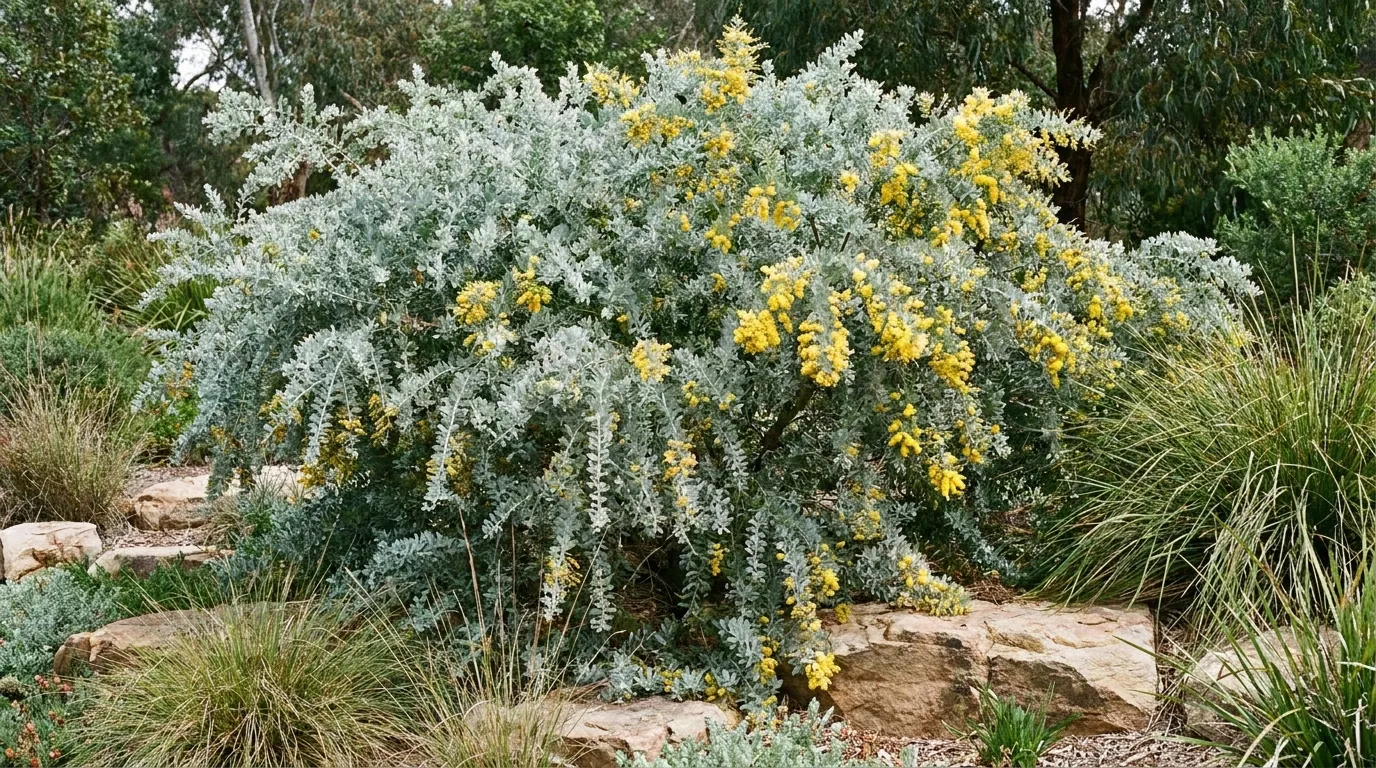
Few Australian shrubs create as much contrast as Acacia podalyriifolia.
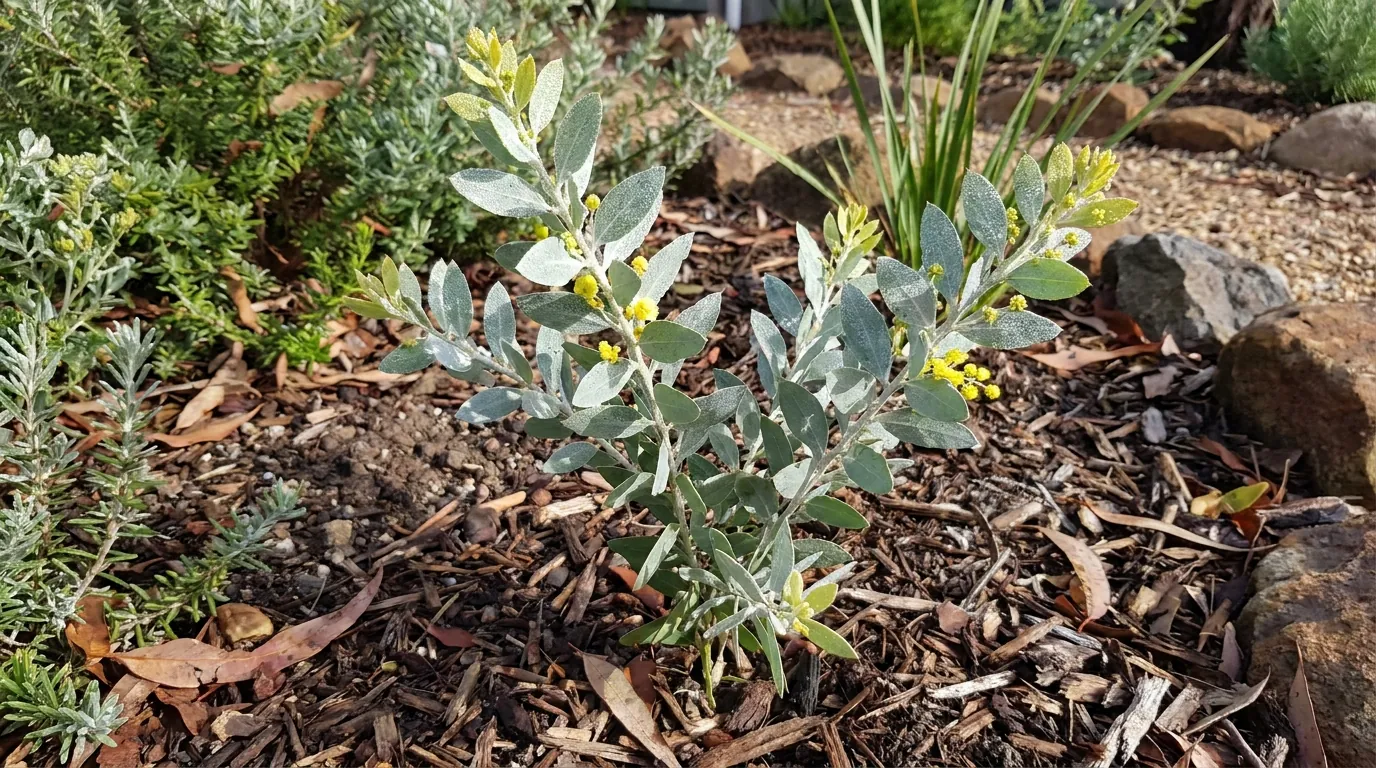
The foliage is soft silver-grey rather than typical bright green, and in late winter the plant can carry masses of rounded golden flower heads against that pale background.
That combination explains why Queensland Silver Wattle has been planted widely in Australian gardens.
It also explains why this species needs more careful advice than “plant it anywhere because it is native”.
Acacia podalyriifolia is naturally native to Queensland and northern New South Wales. Outside its natural range it has escaped cultivation and become naturalised in several parts of Australia. NSW PlantNET specifically warns that it should not be planted close to natural bushland because of its capacity to spread by seed.
So the first question is not only:
“Will Queensland Silver Wattle grow here?”
It is also:
“Is it an appropriate species for this location?”
For broader native-plant selection, use our Australian Native Plants guide.
Quick Answer: What Is Acacia podalyriifolia?
Acacia podalyriifolia is an evergreen Australian wattle commonly called:
- Queensland Silver Wattle
- Mount Morgan Wattle
- Silver Wattle in some nursery contexts
It is a tall shrub or small tree with:
- silvery-grey phyllodes
- rounded bright-yellow flower heads
- fast growth
- dense bushy habit
- strong winter colour
NSW PlantNET records it as a shrub or tree around 2–6 metres high, while the Australian National Botanic Gardens gives a broader horticultural maximum around 8 metres high by about 5 metres wide.
Australian Plants Society describes it as one of the more widely cultivated wattles and commonly around 5 metres high by a similar spread.
Queensland Silver Wattle at a Glance
| Feature | Acacia podalyriifolia |
|---|---|
| Common names | Queensland Silver Wattle, Mount Morgan Wattle |
| Plant type | Evergreen tall shrub to small tree |
| Typical height | About 3–6 m in many gardens |
| Potential height | Up to around 8 m in favourable conditions |
| Width | Often around 3–5 m, sometimes broader |
| Foliage | Silver-grey to glaucous phyllodes |
| Flowers | Bright yellow globular flower heads |
| Main flowering | Late winter to early spring |
| Growth rate | Fast |
| Light | Full sun best; some part shade tolerated |
| Soil | Best in free-draining soil |
| Frost | Moderate to good tolerance |
| Drought | Good once established |
| Main uses | Feature plant, informal screen, native garden |
| Important caution | Can naturalise outside native range |
This is not a dwarf Acacia.
Plan it as a large shrub or small tree.
Why Is It Called Queensland Silver Wattle?
The silver part comes from the foliage.
NSW PlantNET describes the phyllodes as silvery-grey to glaucous, while Australian Plants Society describes the mature foliage as silver-grey and oval.
The overall effect is especially striking when the yellow flowers open.
Instead of the usual green-and-gold Wattle combination, this species creates:
- silver-grey foliage
- bright yellow flower balls
- pale stems and young growth
That makes it useful as a foliage plant even outside flowering season.
What Are the “Leaves” on Queensland Silver Wattle?
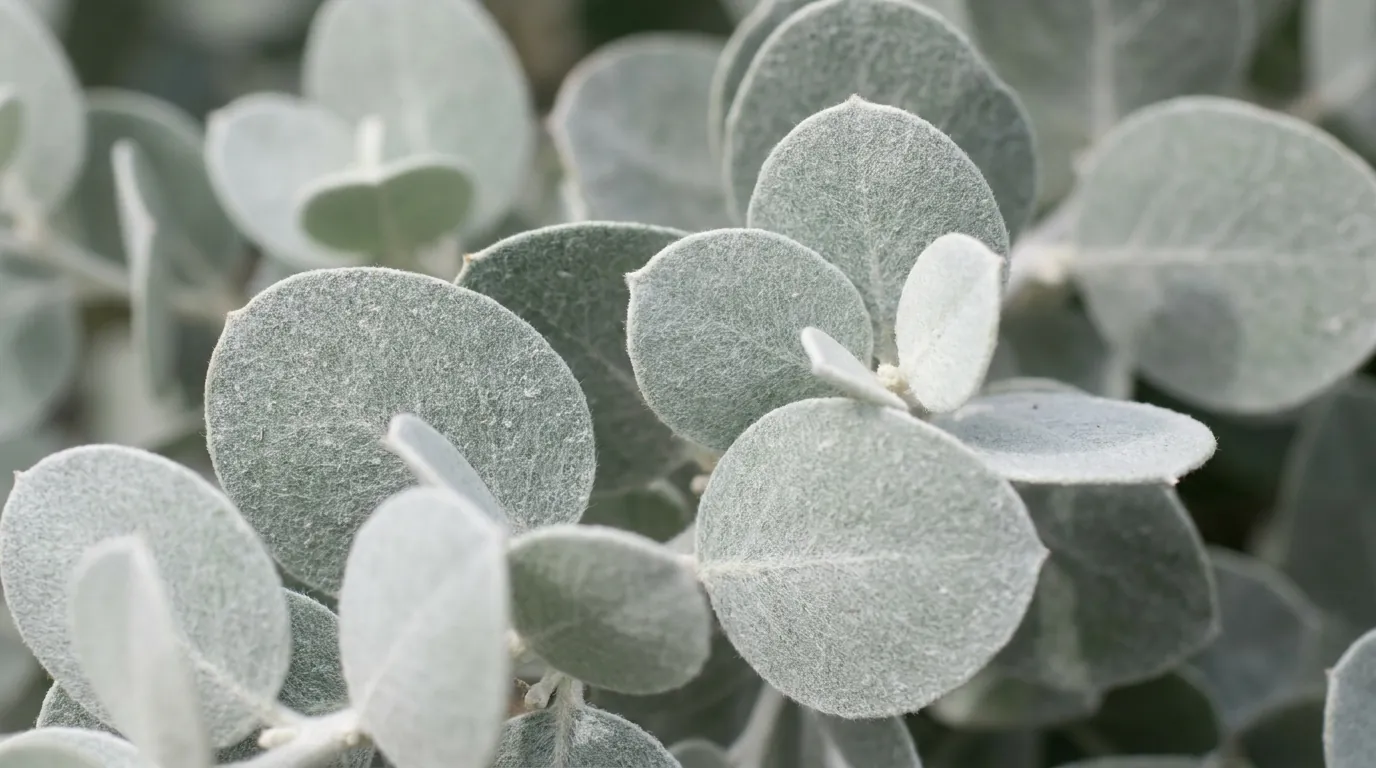
Like many adult Acacias, the mature plant mainly carries phyllodes, not conventional leaves.
A phyllode is a flattened leaf-like structure.
In A. podalyriifolia, NSW PlantNET records phyllodes around:
- 2–5 cm long
- 10–25 mm wide
- elliptic to broadly elliptic or ovate
- silver-grey to glaucous.
This broad, soft-looking foliage is one of the easiest ways to distinguish the species from many narrow-leaved wattles.
How Big Does Acacia podalyriifolia Grow?
Expect a substantial shrub or small tree.
NSW PlantNET gives around:
- 2–6 metres high
while ANBG lists plants to about:
- 8 m high × 5 m wide.
Australian Plants Society gives approximately:
- 5 m high × 5 m wide.
Why do size figures vary?
Because garden size depends on:
- rainfall
- soil depth
- climate
- pruning
- age
- available root space
- provenance
- competition
A regularly pruned screening shrub will not look like an unrestricted tree-form plant.
Is Queensland Silver Wattle Fast Growing?
Yes.
Australian Plants Society describes it as quick growing, while ANBG has also characterised it as a fast-growing small tree.
That makes it appealing when gardeners want:
- fast visual impact
- a quick informal screen
- early flowering
- rapid establishment of a feature shrub
Australian Plants Society notes that it may flower by its second year under suitable conditions.
Fast growth comes with trade-offs
Fast-growing Acacias can also:
- become larger than expected quickly
- need structural pruning
- seed freely
- be relatively short-lived compared with some slower-growing trees
PlantNET specifically describes A. podalyriifolia as rather short-lived.
Do not choose it only because you want immediate height.
What Do Queensland Silver Wattle Flowers Look Like?
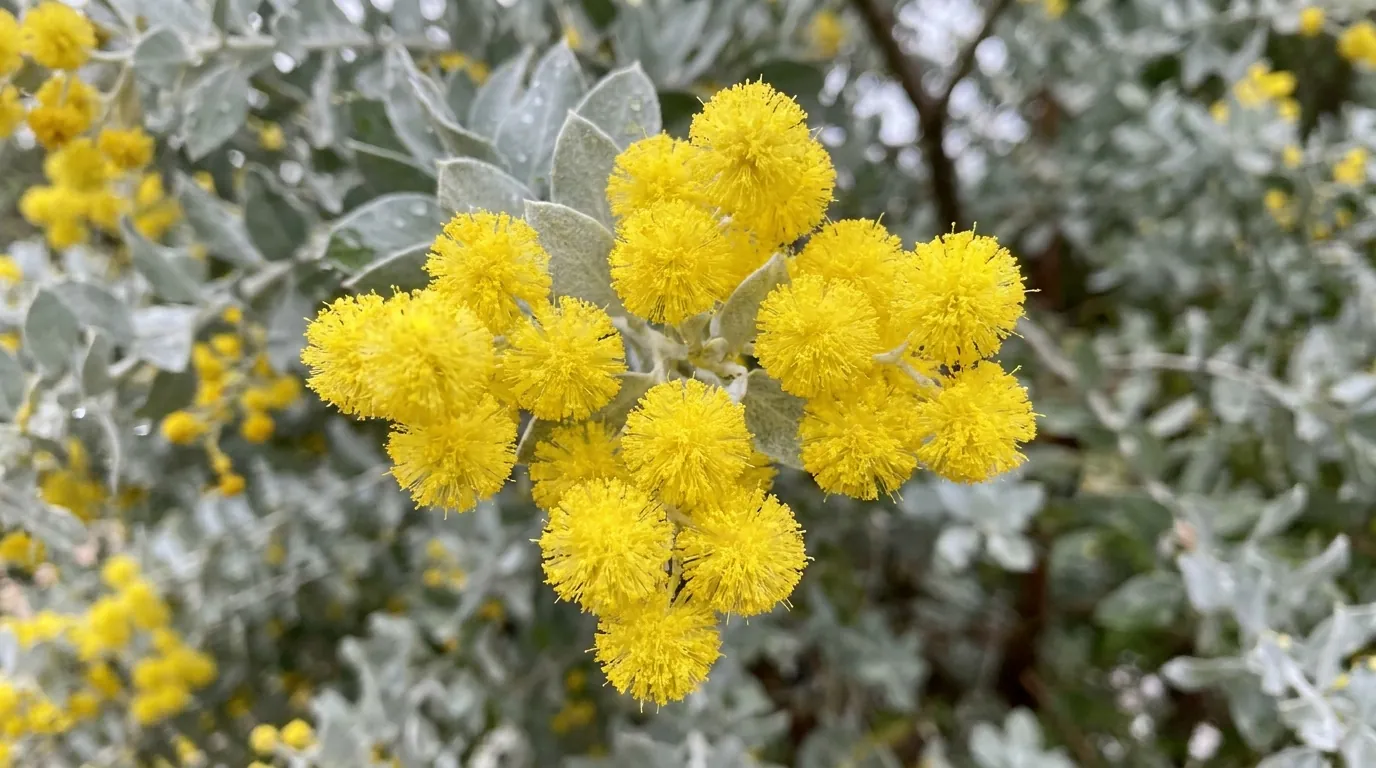
The flowers are classic Acacia-style round heads.
NSW PlantNET describes:
- bright-yellow globular heads
- around 15–30 individual flowers per head
- flower heads around 5–8 mm across
- multiple heads carried along racemes.
When a mature plant flowers heavily, the yellow flower heads can cover large portions of the canopy.
When Does Acacia podalyriifolia Flower?
The strongest display is usually in late winter to early spring.
Australian Plants Society gives late winter and early spring as the main flowering period, while ANBG similarly notes golden ball-shaped flowers in late winter.
NSW PlantNET records flowering throughout the year in its broader naturalised range, but the conspicuous garden flush is generally associated with the cooler-to-spring transition.
Do not promise one exact month across all of Australia.
Is Queensland Silver Wattle Good for Screening?
It can be.
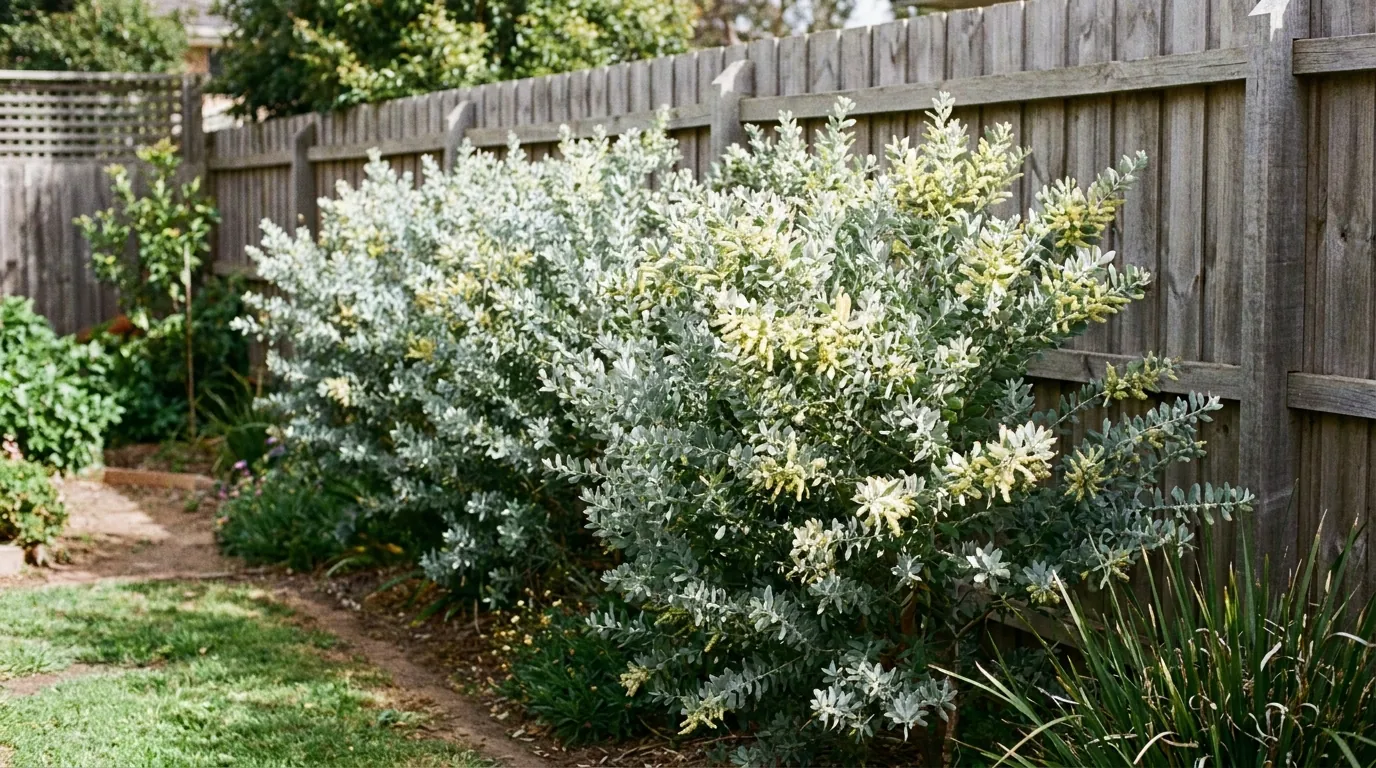
Australian Plants Society specifically describes it as useful for quick-growing screening because it generally retains a bushy habit.
It works best as:
- an informal screen
- a broad native boundary
- a feature shrub with privacy value
- background planting
It is less suited to being treated as a narrow formal hedge.
Why it is not a box-style hedge
The species naturally wants to become a several-metre shrub or small tree.
Repeatedly forcing it into a narrow 1 m hedge means fighting its natural architecture.
If your site is genuinely narrow, choose a naturally compact hedge plant instead.
Can Acacia podalyriifolia Be Pruned?
Yes.
Pruning can help:
- maintain density
- control overall size
- remove crossing or damaged growth
- reduce seed production
- shape the plant after flowering
Mountain View Nursery recommends pruning after flowering and specifically notes that this can also reduce seed spread.
Better timing for shaping
Light shaping after the main flowering period has an advantage:
- you enjoy the winter flower display first
- you can reduce developing seed pods
- fresh growth can rebuild the canopy afterward
Avoid repeated severe pruning into old bare wood unless there is a specific structural reason.
Is Queensland Silver Wattle Invasive?
This needs a careful answer.
It is native to Australia, but that does not mean it is native to every Australian region.
NSW PlantNET states that the species is endemic naturally farther north but has become naturalised in Sydney and other areas and can be troublesome in disturbed bushland. It explicitly says the plant should not be grown near natural bushland because of its invasive nature.
Australian Plants Society similarly warns that it seeds freely and may become invasive in natural bushland outside its appropriate range.
Native somewhere does not mean appropriate everywhere
That distinction is important.
A Queensland-native plant introduced into southern bushland can still behave as an environmental weed.
Before planting near:
- reserves
- remnant bushland
- creek corridors
- conservation areas
check local council and state weed guidance.
How can gardeners reduce seed spread?
If you already have the plant in a suitable garden:
- prune after flowering before large numbers of mature pods develop
- remove obvious seedlings
- avoid dumping seed-bearing branches into bushland
- do not deliberately establish it along bushland boundaries
Where Is Acacia podalyriifolia Native?
Its natural range is centred in Queensland.
Australian Plants Society describes it as occurring in open forest and woodland in south-eastern Queensland.
VicFlora records it as native to Queensland and northern New South Wales, while introduced and adventive in Victoria.
NSW PlantNET also records its cultivated and naturalised spread beyond its natural range.
This is why planting advice should distinguish:
- natural range
- cultivated range
- naturalised range
What Climate Suits Queensland Silver Wattle?
It is surprisingly adaptable.
ANBG describes it as hardy in most well-drained sunny situations and suitable for tropical areas.
Australian Plants Society says it suits a broad range of climates, particularly drier areas, and tolerates at least moderate frost.
Warm subtropical climates
This is close to the species’ natural environmental fit.
Expect strong growth where drainage is good.
Temperate climates
Cultivation is possible and widely practised, but weed risk outside the natural range becomes more important.
Humid climates
Australian Plants Society notes that the species can be affected by sooty mould in humid conditions.
Good airflow helps.
Does Queensland Silver Wattle Need Full Sun?
Full sun is the safest choice for dense growth and flowering.
ANBG recommends well-drained, sunny situations, while Mountain View Nursery lists full sun to partial shade.
Part shade can work, but heavier shade may reduce:
- flowering
- density
- overall vigour
For maximum silver foliage and flower display, use strong light.
What Soil Does Acacia podalyriifolia Prefer?
Good drainage is more important than creating a rich garden bed.
ANBG describes it as hardy in well-drained sunny situations.
Mountain View Nursery likewise recommends free-draining native soil but notes that the species is adaptable.
For broader site preparation, use our Australian native soil-preparation guide.
Avoid over-improving the soil
Do not assume an Australian wattle needs heavily enriched soil.
The aim is:
- functional drainage
- enough root volume
- appropriate establishment moisture
- no permanent saturation
How Often Should Queensland Silver Wattle Be Watered?
Do not follow a fixed national schedule.
Newly planted trees
Keep the root ball from repeatedly drying hard while roots establish.
Established plants
Australian nurseries commonly describe the species as drought tolerant once established. Mountain View Nursery lists drought tolerance among its landscape strengths.
That does not mean established plants never need water.
Long droughts, shallow soil and extreme heat can still cause stress.
Water according to:
- rainfall
- soil
- heat
- plant age
- root establishment
Is Acacia podalyriifolia Frost Tolerant?
Yes, to a useful degree.
ANBG records frost hardiness to approximately −7°C under its horticultural observations.
Australian Plants Society also describes it as tolerating moderate frosts.
Do not treat that figure as a guaranteed damage threshold for every seedling or microclimate.
Young plants can still be more vulnerable than established specimens.
Does Queensland Silver Wattle Grow in Melbourne?
Yes.
The species is cultivated in Victoria and has also naturalised there.
VicFlora records Acacia podalyriifolia as:
- present in Victoria
- introduced
- adventive.
That means the question in Victoria is not whether it can grow.
It clearly can.
The more important question is whether planting it is environmentally appropriate for the site, particularly close to native vegetation.
Does It Grow in Coastal Gardens?
Yes, provided drainage and exposure are suitable.
Mountain View Nursery lists it as coastal tolerant.
Its silvery foliage can also visually suit coastal planting.
But do not assume every exposed salt-laden site is identical.
Young plants still need establishment water and protection from extreme desiccation.
Does Queensland Silver Wattle Need Fertiliser?
Usually, heavy feeding is unnecessary.
Acacias are legumes and have relationships with nitrogen-fixing bacteria in the root zone.
That does not mean every plant needs zero nutrition, but it does mean you should not treat fast growth as something that must be forced with high rates of fertiliser.
Before feeding a weak plant, check:
- drainage
- light
- establishment
- root stress
- moisture
For Australian natives, avoid unnecessary high-phosphorus fertiliser unless the product is appropriate for the species and label use.
What Problems Affect Acacia podalyriifolia?
The species is generally hardy, but it is not problem-free.
ANBG notes that it can be very susceptible to leaf miner in Sydney, while Australian Plants Society notes sooty mould can occur in humid climates.
Other decline can relate to:
- poor drainage
- prolonged saturation
- physical damage
- severe drought
- ageing
- over-pruning
Do not spray first and identify later
If foliage is damaged:
- inspect the symptom
- determine whether insects are actually present
- check root-zone and environmental stress
- only then consider treatment
Any pesticide use in Australia should still follow the current APVMA label for the relevant pest and situation.
Is Queensland Silver Wattle Good for Wildlife?
Yes.
Like many wattles, the flowers support insects, while the plant provides structure and cover.
The flower heads also create a strong seasonal resource pulse during late winter when many other shrubs are not flowering heavily.
However, wildlife value does not override local weed risk.
A species that provides nectar can still be inappropriate next to bushland if it spreads aggressively outside its natural range.
Is Queensland Silver Wattle Short Lived?
Relatively speaking, it can be.
NSW PlantNET describes the species as rather short-lived.
That is not unusual among some fast-growing wattles.
A fast-establishing screening or feature tree may reach useful size quickly but not have the lifespan of a slower-growing long-lived canopy tree.
Do not design a permanent landscape assuming every Acacia will remain for many decades.
Queensland Silver Wattle or Another Native Screen?
Choose Acacia podalyriifolia when you want:
- silver-grey foliage
- golden winter flowers
- fast growth
- a broad informal screen
- a feature shrub or small tree
- a plant suited to drier conditions once established
Choose another native when you need:
- a long-lived permanent screen
- a narrow formal hedge
- a species locally indigenous to your bushland edge
- a plant with lower self-seeding risk
- a reliably compact mature size
For broader choices, use our Australian Native Plants guide.
Frequently Asked Questions
How tall does Acacia podalyriifolia grow?
NSW PlantNET records it around 2–6 m high, while ANBG gives a horticultural maximum around 8 m. Australian Plants Society commonly describes plants around 5 m high and wide.
Why is it called Queensland Silver Wattle?
It is native mainly to Queensland and has distinctive silvery-grey phyllodes, giving the whole canopy a pale silver appearance even when it is not flowering.
Is Acacia podalyriifolia fast growing?
Yes. Australian horticultural references describe it as fast or quick growing, and it can flower while still relatively young.
When does Queensland Silver Wattle flower?
The main garden display is typically in late winter to early spring, with masses of bright-yellow ball-shaped flower heads.
Can Queensland Silver Wattle be used as a screen?
Yes. Its bushy habit and fast growth make it useful as a broad informal screen, but it is better suited to a large native boundary than a narrow clipped hedge.
Is Acacia podalyriifolia invasive?
It can be outside its natural range. NSW PlantNET and Australian Plants Society both warn that it can self-seed and naturalise, particularly around disturbed bushland. Avoid planting it near natural bushland where local weed risk is a concern.
Can Queensland Silver Wattle grow in Melbourne?
Yes. VicFlora records the species as introduced and adventive in Victoria, showing that it grows readily there. Environmental suitability matters more than simple climatic survival.
Is Queensland Silver Wattle drought tolerant?
Established plants tolerate dry periods well, but newly planted trees still need establishment moisture.
Does Queensland Silver Wattle tolerate frost?
Yes. ANBG records useful frost tolerance, with horticultural observations down to about −7°C. Young plants and exposed sites may be less resilient.
Should Acacia podalyriifolia be pruned?
Light pruning after flowering can help maintain shape and reduce seed production. Avoid relying on severe renovation pruning after the plant has become old and woody.
Final Thoughts
Acacia podalyriifolia is one of Australia’s most visually distinctive wattles.
Its combination of:
- silver-grey foliage
- golden winter flowers
- fast growth
- broad bushy form
- drought tolerance after establishment
- useful frost tolerance
makes it a strong feature or screening plant in the right garden.
But the phrase “Australian native” should not end the decision.
Queensland Silver Wattle can self-seed outside its natural range and has naturalised in parts of southern Australia. NSW PlantNET and Australian Plants Society both caution against planting it near natural bushland where spread could become a problem.
So the best place for it is a managed garden where:
- its mature size fits
- seedlings can be monitored
- natural bushland is not immediately adjacent
- drainage is good
- strong light is available
For broader native-plant selection, continue to our Australian Native Plants guide.
For soil preparation before planting, use our Australian native soil-preparation guide.


