
Firewheel Tree Australia: Stenocarpus sinuatus Size, Flowers & Care

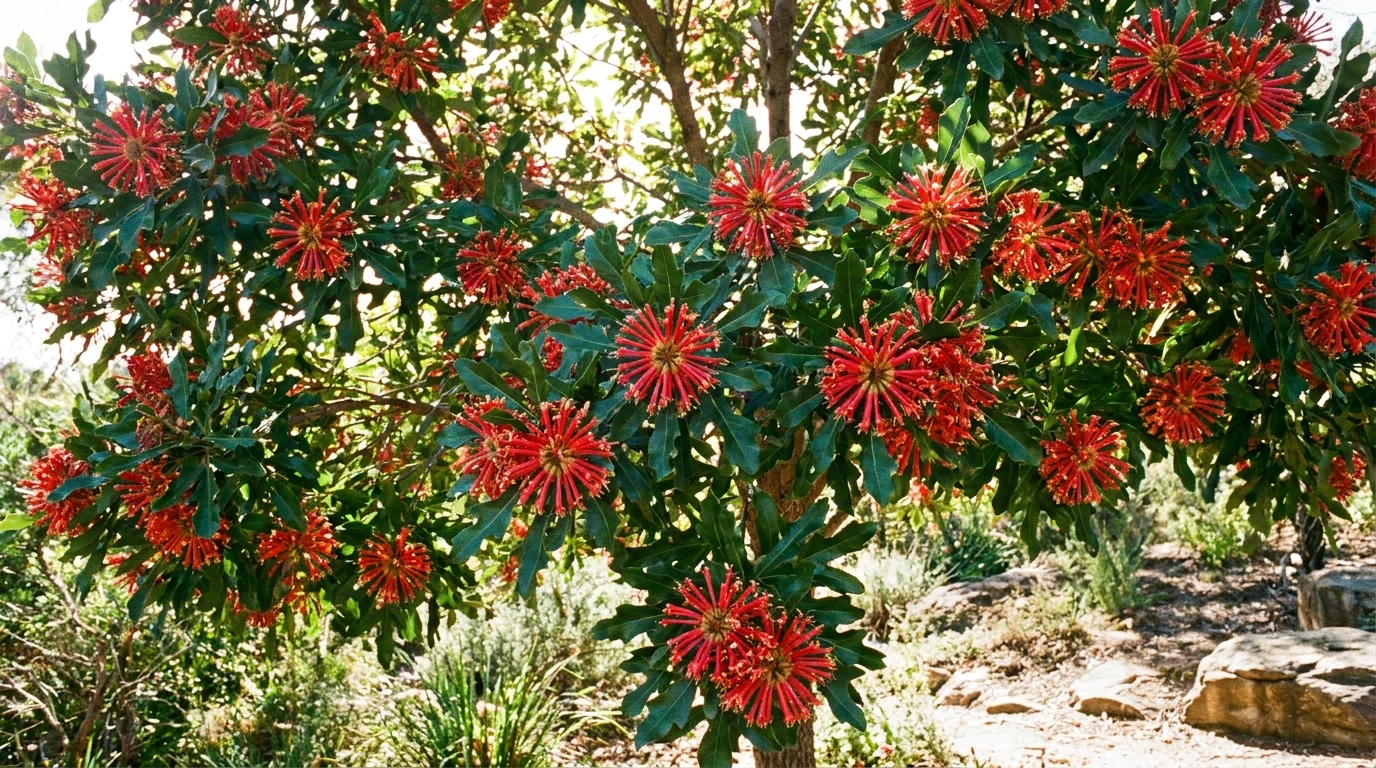
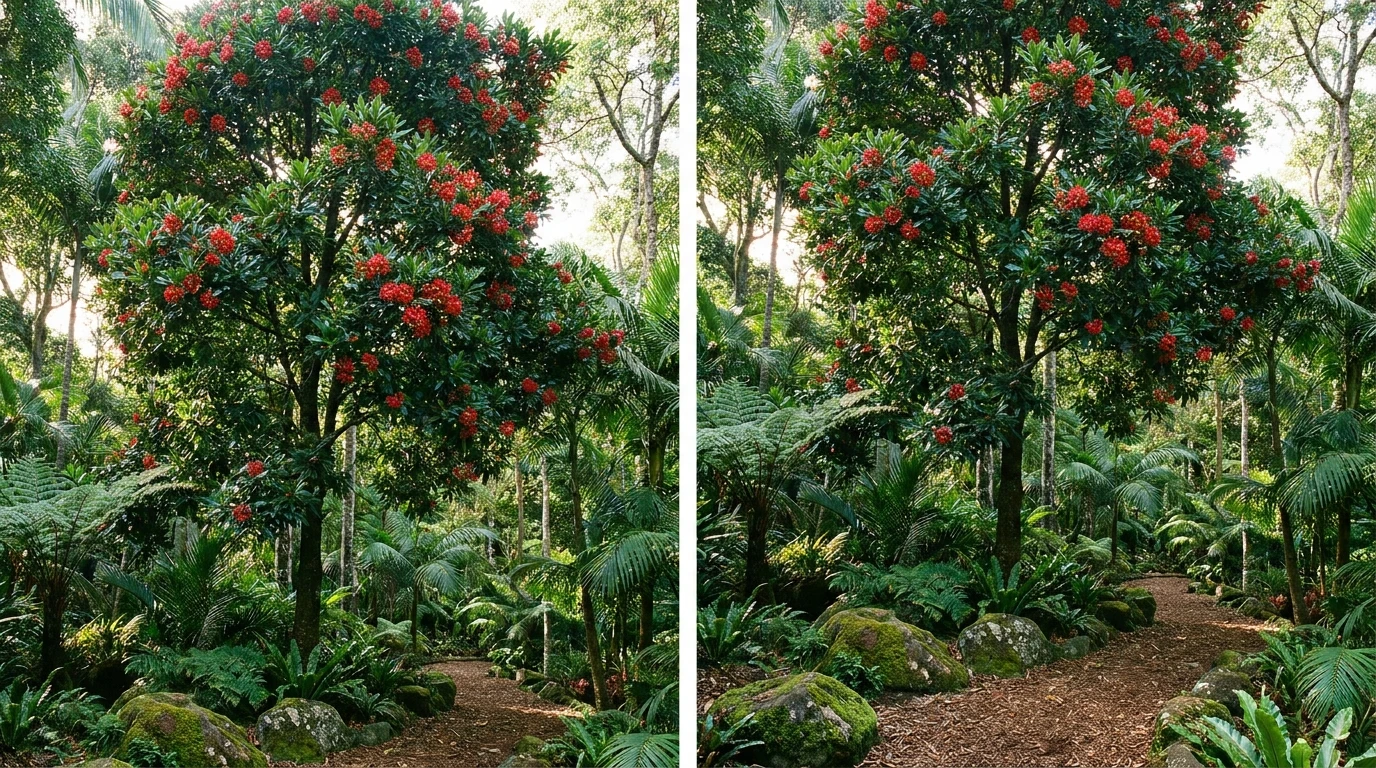
Stenocarpus sinuatus, the Firewheel Tree, is a spectacular Australian rainforest tree that is usually much smaller in cultivation than it is in the wild. NSW PlantNET records rainforest trees to about 35 m high, while Australian garden and street-tree references more commonly plan for roughly 5–15 m under cultivation, depending on climate, soil and available root space.
That makes it a genuine feature or shade tree rather than a hedge plant. In a suburban garden with enough room, its glossy evergreen canopy and extraordinary red wheel-shaped flowers can be a centrepiece. In rainforest habitat, however, it can become a large canopy tree, so we would never choose it from a small nursery pot without first checking the long-term space above and below ground.
The other important expectation is patience. Australian Native Plants Society describes Firewheel Tree as capable of taking 7 years or more to flower from seed, while plants propagated from mature flowering material may flower in about 3–4 years. Those are propagation observations, not a guaranteed countdown for every garden tree. Site, climate and propagation method can shift the first flowering considerably.
Firewheel Tree is a Proteaceae rainforest tree
Kew’s Plants of the World Online accepts the botanical name Stenocarpus sinuatus (Lindl.) Endl. and places it in the family Proteaceae, alongside familiar Australian genera such as Grevillea, Banksia and Hakea.
Kew records the native range from eastern Australia into south-eastern New Guinea. Within Australia, NSW PlantNET records the species in warmer rainforest north from the Nambucca River, with Queensland also part of its natural range.
Australian Native Plants Society describes it as the best-known member of the genus Stenocarpus and one of Australia’s most spectacular rainforest trees.
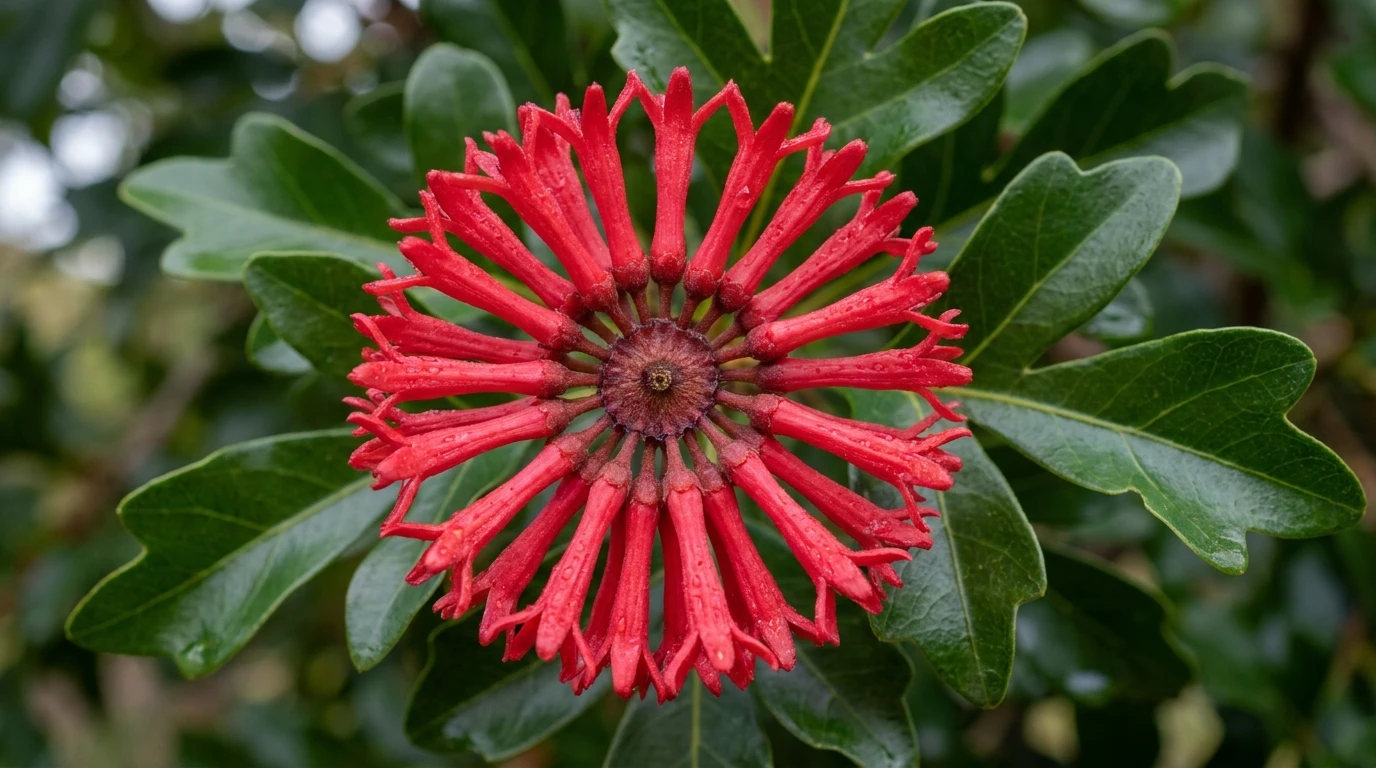
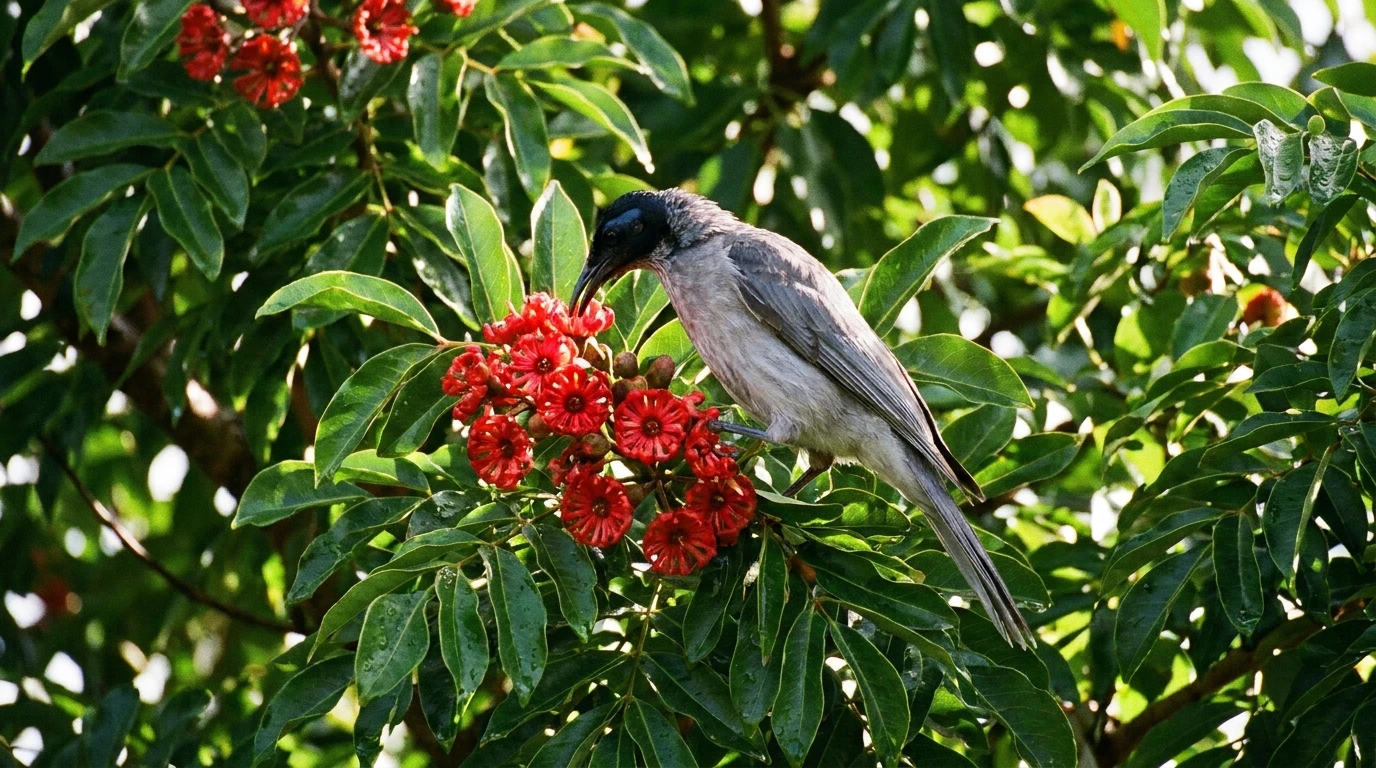
The common name comes directly from the flower structure: narrow red flowers radiate around a central point and create a flattened wheel-like display.
The wild tree and the garden tree can be very different sizes
NSW PlantNET records Stenocarpus sinuatus as a medium-sized rainforest tree to approximately 35 m high. Australian Native Plants Society gives about 30 m in nature but explicitly says cultivated trees are usually smaller, particularly in cooler areas.
Australian landscape references show just how much the cultivated figure can change.
| Australian source | Published size | What the figure represents |
|---|---|---|
| NSW PlantNET | To about 35 m high | Wild rainforest maximum |
| Australian Native Plants Society | About 30 m in nature; usually smaller in cultivation | Species-wide botanical and horticultural context |
| Brisbane City Council planning material | About 5–10 m high × 4–10 m wide | Municipal landscape/street-tree planning size |
| Daleys Fruit Tree Nursery | About 6–10 m high × 2–3 m wide in gardens | Practical nursery garden estimate |
| SA Plant Selector+ | About 8–20 m high × 2–5 m wide | Broader cultivated range for southern Australian conditions |
| Plantmark | About 10–30 m high × 4–10 m wide | Large landscape-tree range |
Those numbers are not neatly interchangeable because they describe different climates, ages and landscape situations. For a normal suburban design, we would think of Firewheel Tree as a medium-to-large evergreen tree with genuine canopy potential, not as a permanently compact 5 m ornamental.
On Garden Green jobs, the practical decision is whether the site can cope if the tree exceeds the smaller nursery estimate. If the answer is no, we would choose a naturally smaller feature tree rather than rely on lifelong size control.
Growth is slow early, and first flowering can take patience
South Australia’s Plant Selector+ specifically describes Firewheel Tree as slow growing during the first few years. Australian Native Plants Society does not publish a trustworthy centimetres-per-year figure, and neither do the stronger botanical sources.
We therefore would not invent an annual growth rate.
The flowering timeline is better documented, but it still depends heavily on propagation method. Australian Native Plants Society reports that seed-grown plants may take 7 years or more to flower, while cuttings taken from mature flowering material will usually flower in about 3–4 years.
| Propagation type | Australian Native Plants Society flowering guidance | How to interpret it |
|---|---|---|
| Seed-grown plant | May take 7 years or more | A real horticultural observation, not a guaranteed first-flower date |
| Cutting from mature flowering material | Often about 3–4 years | Juvenile phase may be shorter because the source material is physiologically mature |
This is one of the few trees where asking the nursery how the plant was propagated can genuinely change your expectation of the first flower display.
In our own work, we would judge a young Firewheel Tree by establishment, branch extension and canopy development before worrying about flowers. A healthy tree taking its time is not necessarily a poorly performing tree.
The wheel-shaped flowers are the reason people wait
NSW PlantNET records individual red flowers around 25 mm long, arranged in umbels containing approximately 12–20 flowers. The flower stalks radiate around a disc-like centre, producing the unmistakable wheel shape.
Australian Native Plants Society describes the main flowering display from summer through autumn. South Australia’s Plant Selector+ likewise lists summer and autumn, while Plantmark emphasises summer flowering.
NSW PlantNET records autumn to winter in wild northern NSW populations. That difference is useful rather than problematic: flowering timing clearly shifts with location and climate.
For an Australian garden guide, the honest expectation is a warm-season to cool-season display centred broadly from summer into autumn, with regional trees capable of flowering later.
We would not promise Christmas flowers or one fixed month nationwide.
The foliage can look different on the same tree
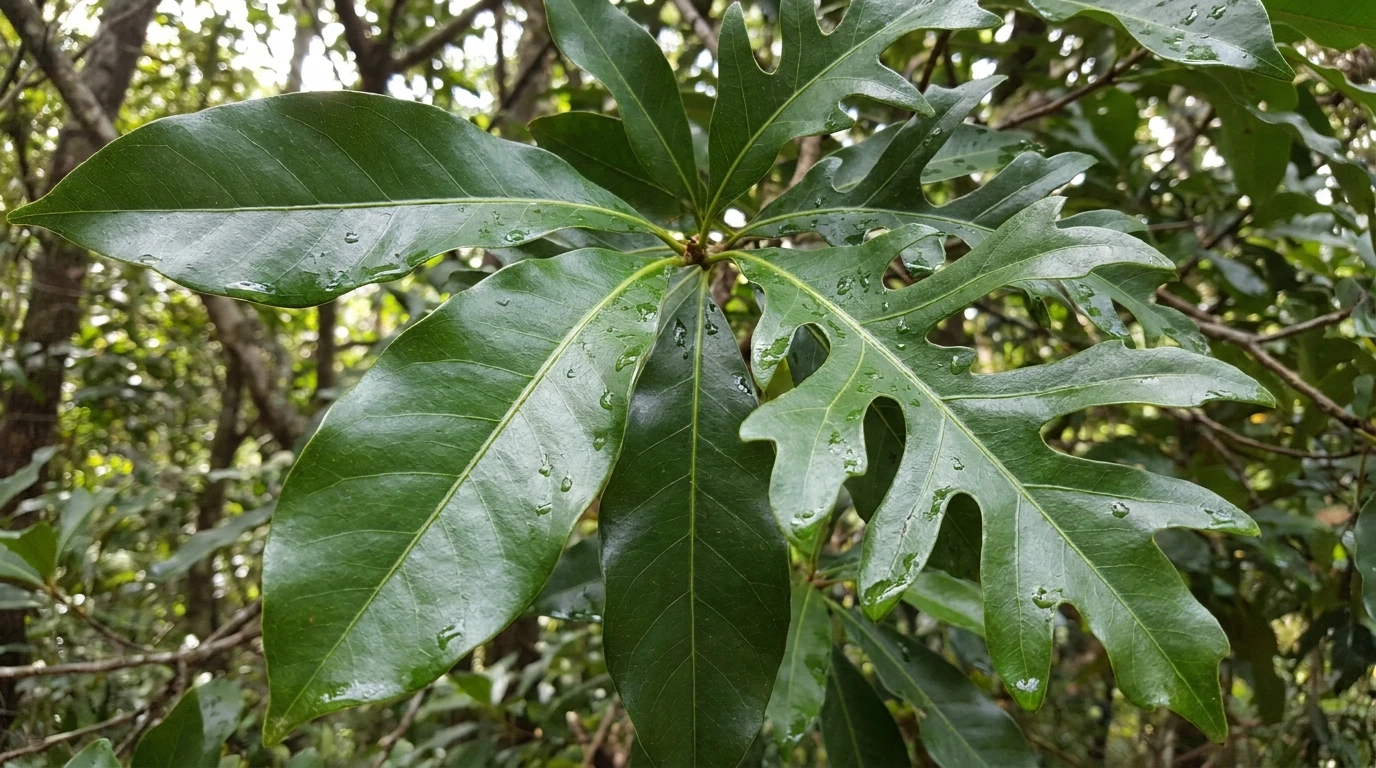
NSW PlantNET records leaves usually around 15–25 cm long and notes that they may be entire or irregularly lobed. Australian Native Plants Society records leaves up to approximately 45 cm long.
This variability is part of the tree’s character. Juvenile and vigorous shoots can carry dramatically lobed leaves, while other branches can produce much simpler, narrower foliage.
That can confuse gardeners who assume two different leaf shapes must mean two different plants. On a Firewheel Tree, leaf variation is normal.
The glossy dark-green canopy gives the tree ornamental value even during the long juvenile period before the first spectacular flower display.
Full sun to part shade both work
Australian Native Plants Society recommends a sunny or partly shaded position. Plantmark also lists full sun to semi-shade, while Gardening With Angus gives sunny to light-shade conditions.
For a dense feature-tree canopy and stronger flowering potential, we prefer good light. Part shade is particularly natural for a rainforest-origin tree when young, especially where protection from harsh heat and wind helps establishment.
We would not bury it under a permanently dark established canopy and expect the same form as an open-grown street tree.
Moist, fertile soil suits it best—but drainage still matters
Australian Native Plants Society says Firewheel Tree prefers fairly rich loamy soil but tolerates most well-drained soils. South Australia’s Plant Selector+ says it performs best in moist fertile soil and lists loam and sand across acidic, neutral and alkaline pH categories.
Plantmark likewise recommends loamy or sandy, well-drained soil.
That combination tells us how to plant it: this is a rainforest tree that appreciates moisture and organic matter, but the root zone should still contain air.
On jobs, we would improve poor soil across a broad area, mulch the surface and water deeply through establishment rather than create a small rich planting pocket surrounded by compacted ground.
Young Firewheel Trees need more protection than established ones
Daleys Fruit Tree Nursery specifically advises protecting Firewheel Tree from wind and frost when young. Gardening With Angus describes the species as tolerant of light frost, and South Australia’s Plant Selector+ also lists light frost tolerance.
Those claims fit together: established trees can handle some cold, but young rainforest-grown material is the vulnerable stage.
We would not publish an exact minimum frost temperature because the Australian sources reviewed do not support one reliable threshold. A sheltered site, mulch and protection from the coldest wind are more defensible recommendations than an invented “safe to -X°C” number.
In cooler gardens, growth is also slower. Australian Native Plants Society specifically notes that trees remain smaller in cooler areas, which partly explains why southern cultivated specimens can look very different from rainforest trees in Queensland.
Tropical and subtropical climates give it the easiest start
Firewheel Tree naturally comes from warm rainforest in Queensland and north-eastern New South Wales. Gardening With Angus classifies it for subtropical and warm-temperate climates, while Brisbane City Council includes the species among its recommended tall native trees for local gardens.
| Australian climate situation | Practical expectation |
|---|---|
| South-east Queensland and warmer coastal districts | Excellent climate fit with sufficient soil moisture |
| Northern NSW | Within the natural Australian range |
| Sydney and warm-temperate coast | Established horticultural use is possible with a favourable site |
| Southern temperate gardens | Growth is generally slower and final garden size may be smaller |
| Regular hard-frost districts | A more cautious choice, particularly while the tree is young |
Those are climate expectations rather than city-specific growth promises. An irrigated sheltered courtyard and an exposed inland property can produce very different results in the same broad region.
Water through establishment, then let the tree become tougher
Daleys says established Firewheel Trees can tolerate dry periods but recommends regular moisture and mulch for maximum growth. South Australia’s Plant Selector+ lists drought tolerance and minimal supplementary watering once plants are established.
The distinction is establishment.
A newly planted Firewheel Tree has roots confined to its nursery root ball. We water deeply enough to wet that root ball and the surrounding soil, then gradually widen the wetted area as the root system expands.
Once the tree is established, it can handle more variation in moisture. During prolonged dry weather, deep watering still makes sense if healthy canopy development and flowering are priorities.
Feed conservatively rather than trying to force speed
Daleys recommends a slow-release fertiliser in spring to support maximum growth. Because Firewheel Tree belongs to the Proteaceae family, we would stay conservative with phosphorus and favour fertilisers suitable for Australian native plants where feeding is required.
We would not use heavy feeding to compensate for a tree that is naturally slow during its juvenile stage. Soil moisture, drainage, root space and climate are more important than trying to push a young Firewheel Tree into an artificial growth rate.
This is a feature and shade tree, not a hedge
South Australia’s Plant Selector+ lists Firewheel Tree for ornamental and shade use. Plantmark recommends it as a feature plant or street tree, and Brisbane City Council lists it among tall trees that contribute shade and habitat.
Plantmark does classify the species broadly under screening as well, but its own dimensions make the limitation obvious: a tree capable of several metres of canopy spread is not a sensible substitute for a clipped suburban hedge.
We would use it as:
| Landscape role | Firewheel Tree fit |
|---|---|
| Feature tree | Excellent |
| Shade tree | Excellent where there is enough space |
| Street or avenue tree | Proven Australian landscape use |
| Rainforest-style garden | Excellent |
| Large habitat garden | Very good |
| Formal hedge | Poor fit |
| Narrow side passage | Poor fit |
For us, the Firewheel Tree earns its space when the design can celebrate it as a tree rather than constantly trying to suppress its natural form.
Street-tree use proves adaptability, but not small size
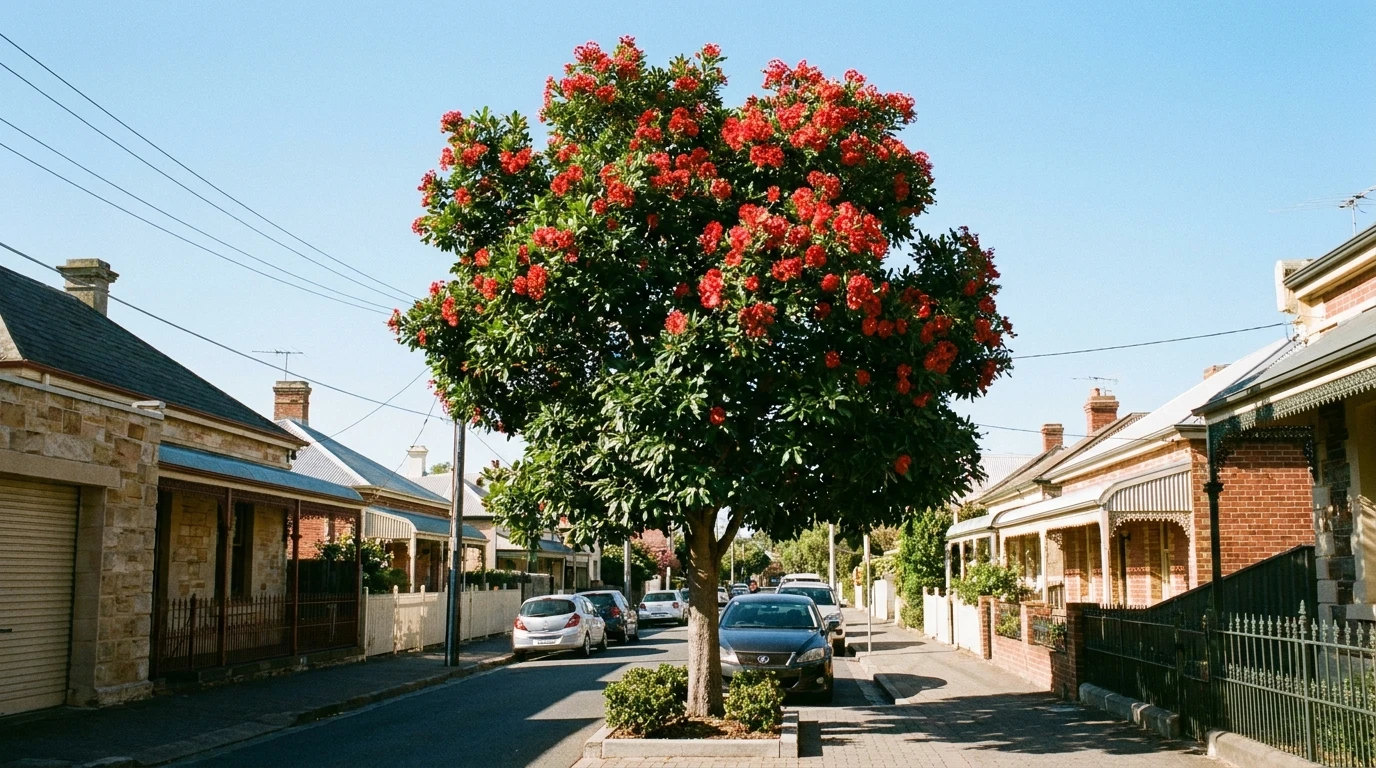
South Australia’s Plant Selector+ notes successful street-tree use in Sydney. Brisbane City Council planning material lists Firewheel Tree around 5–10 m high × 4–10 m wide for landscape planning and identifies its functions as aesthetics, landscape character, screening and shade.
That municipal use is useful evidence that the species can adapt outside intact rainforest. It does not mean every private garden has street-tree space.
Council plantings are chosen with road reserves, underground services, sightlines and canopy clearance in mind. We apply the same discipline in a home garden before planting a tree that may eventually occupy several metres of both horizontal and underground space.
Do not rely on “non-invasive roots” claims
There is no strong authoritative basis for giving Firewheel Tree a universal “non-invasive root” label or a single safe planting distance from every structure.
A mature rainforest tree needs a substantial root system to support its canopy. Root behaviour will also change with soil depth, moisture, drainage and obstacles.
We therefore plan from mature tree scale rather than from nursery reassurance. Near foundations, retaining walls, pools, sewer infrastructure or confined paved areas, local arboricultural and utility guidance is more useful than a generic setback number.
Where space is limited, choosing a naturally smaller tree is safer than depending on roots and canopy to remain artificially compact.
Pruning is mainly structural while the tree is young
Firewheel Tree is most attractive with its natural upright-to-rounded canopy, so we do not treat it as a plant that needs frequent formal clipping.
Our pruning focus is formative: remove damaged growth, correct badly placed competing branches while cuts are still small and establish the trunk or canopy clearance required for the site.
For a street-style tree, early structure matters more than heavy pruning later. Once a substantial rainforest tree has developed large limbs, corrective cuts become a much bigger intervention.
We avoid unnecessary removal of flowering wood from mature trees simply to make the canopy look artificially symmetrical.
Flowers also add wildlife value
Gardening With Angus lists Firewheel Tree as attracting bees, butterflies, nectar-feeding birds and other insects. The conspicuous red Proteaceae flowers are well positioned for animal visitors around the outer canopy.
The evergreen tree also adds vertical structure and potential shelter to a larger habitat garden.
In our wildlife-focused layouts, we would still combine it with lower shrubs, groundcovers and plants flowering at other times. A large feature tree provides one layer of habitat, not the entire ecosystem.
Where Firewheel Tree fits—and where we would choose something else
| Garden requirement | Firewheel Tree fit | Why |
|---|---|---|
| Spectacular Australian feature tree | Excellent | Distinctive red wheel-shaped flowers and glossy evergreen canopy |
| Large shade tree | Very good | Cultivated trees can develop a substantial canopy |
| Rainforest-style planting | Excellent | Native rainforest species from Queensland and northern NSW |
| Street or avenue planting | Proven fit | Australian council and landscape references document street-tree use |
| Small suburban courtyard | Poor fit | Even cultivated dimensions can exceed the available space |
| Quick-flowering feature tree | Poor fit | Seed-grown plants may take 7 years or more to flower |
| Formal privacy hedge | Poor fit | Natural architecture is that of a real tree, not a clipping shrub |
| Exposed hard-frost garden | Cautious choice | Young trees are specifically advised to be protected from frost |
The main buying lesson is patience and scale. Firewheel Tree can become one of the most memorable trees in an Australian garden, but it is not an instant-flowering small ornamental. Give it enough room, establish it carefully and accept that the extraordinary flowers may arrive on the tree’s own timetable rather than yours.
Frequently asked questions
How big does a Firewheel Tree grow?
NSW PlantNET records wild Stenocarpus sinuatus to about 35 m high, while Australian cultivated references are commonly much smaller. Brisbane City Council uses about 5–10 m high × 4–10 m wide for landscape planning, Daleys gives about 6–10 m high × 2–3 m wide in gardens, and SA Plant Selector+ gives 8–20 m high × 2–5 m wide.
How long does a Firewheel Tree take to flower?
Australian Native Plants Society says seed-grown plants may take 7 years or more to flower, while cuttings propagated from mature flowering material commonly flower in about 3–4 years. These are propagation observations rather than guaranteed first-flower dates for every garden tree.
When does Stenocarpus sinuatus flower?
Australian Native Plants Society and SA Plant Selector+ describe the main display from summer into autumn, while NSW PlantNET records autumn to winter flowering in wild northern NSW populations. Flower timing therefore varies with region and climate.
Does Firewheel Tree need full sun?
No. Australian Native Plants Society recommends sun to part shade, and Plantmark similarly lists full sun to semi-shade. Good light supports a strong canopy and flowering, while some shelter can help young rainforest-grown plants establish.
Is Firewheel Tree frost tolerant?
Established trees can tolerate light frost according to Gardening With Angus and SA Plant Selector+, but Daleys specifically recommends protecting young Firewheel Trees from frost and wind. Strong Australian sources do not provide a reliable universal minimum-temperature figure.
Can Firewheel Tree be used as a street tree?
Yes. SA Plant Selector+ notes successful street-tree use in Sydney, while Brisbane City Council includes Firewheel Tree in its landscape planning material. It needs enough long-term canopy and root space and is better suited to substantial verges, parks and large gardens than very confined planting strips.
Does Stenocarpus sinuatus have invasive roots?
There is not enough authoritative evidence to give Firewheel Tree a universal “non-invasive roots” label. It is a genuine rainforest tree capable of developing a substantial canopy, so root and infrastructure planning should be based on mature tree size, soil conditions and local arboricultural or utility guidance.
Is Firewheel Tree suitable for a small garden?
Usually not if space is genuinely limited. Although cultivated trees may remain far smaller than the 30–35 m specimens possible in rainforest habitat, Australian landscape sources still commonly plan for a medium-to-large tree. It is best where there is room for a several-metre-wide canopy and long-term root development.


