
Australian Native Jasmine: Jasminum suavissimum Growing & Care Guide

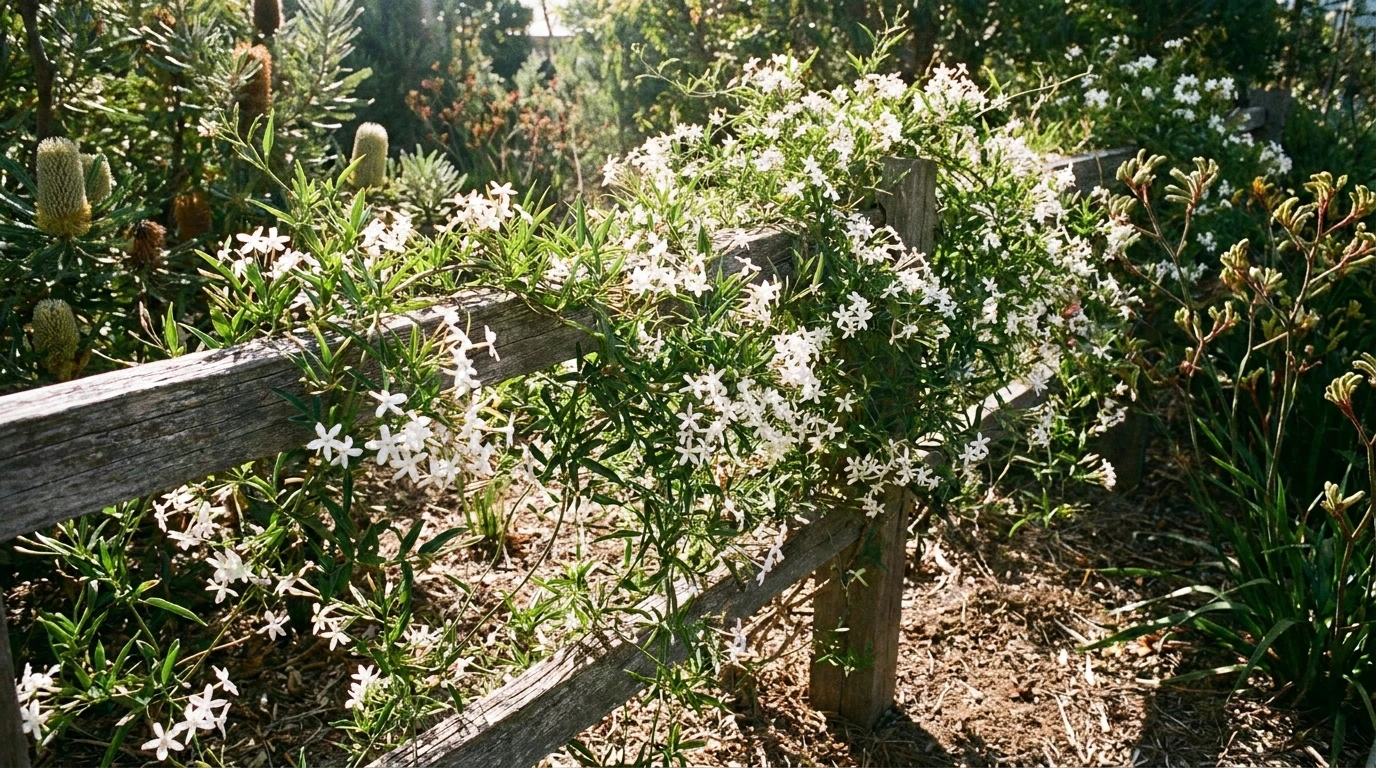
Jasminum suavissimum is a genuine Australian native jasmine: a fragrant twining climber or scrambling shrub from Queensland and New South Wales that can stay around 0.5–1 m high without support or climb roughly 2–4 m when given a fence, trellis or other structure. PlantNET describes wild plants as subshrubs to about 0.5 m high or as trailing scramblers and twiners, while Kuranga Native Nursery lists cultivated plants around 2–4 m high × 2–4 m wide when allowed to climb and spread.
The plant is especially useful when you want the perfume of jasmine without planting the invasive exotic Jasminum polyanthum. NSW WeedWise records J. polyanthum as a vigorous environmental weed with stems to about 10 m long. Australian Native Plants Society specifically recommends J. suavissimum as a native alternative with an equally attractive perfume.
There is another common source of confusion: star jasmine, Trachelospermum jasminoides, is not a true jasmine at all. Royal Botanic Gardens Victoria places it in the Apocynaceae family and records its native range in eastern Asia, while Australian nursery sources classify it as exotic. It is a useful ornamental climber in its own right, but it is botanically and ecologically different from Australian native jasmine.
The accepted botanical name depends on the taxonomic source
NSW PlantNET treats the plant as Jasminum suavissimum Lindl. and lists Jasminum simplicifolium subsp. suavissimum as a synonym.
Kew’s Plants of the World Online currently takes the opposite taxonomic position: it accepts Jasminum simplicifolium subsp. suavissimum and treats Jasminum suavissimum as a synonym.
Both names therefore appear in credible botanical and horticultural material. We use Jasminum suavissimum throughout this guide because it remains the familiar Australian flora and nursery name, while acknowledging Kew’s current accepted treatment.
| Source | Name used | Status |
|---|---|---|
| NSW PlantNET | Jasminum suavissimum | Accepted in the NSW flora treatment |
| Kew Plants of the World Online | Jasminum simplicifolium subsp. suavissimum | Currently accepted by Kew |
| Australian Native Plants Society | Jasminum suavissimum | Common horticultural/native-plant usage |
Its size depends on what you give it to climb
Native Jasmine does not have one useful mature-height number because it changes its architecture according to support.
PlantNET describes it as a subshrub to 0.5 m high or as a trailing scrambler or twiner. Australian Native Plants Society says it can be grown as a shrub when positioned away from other plants. Princess Fancy Plants gives about 1 m high unsupported and 2–3 m high when supported. Kuranga Native Nursery gives a broader cultivated climbing size of about 2–4 m high × 2–4 m wide.
| Growing situation | Published Australian size | What that means in a garden |
|---|---|---|
| Wild subshrub / unsupported form | To about 0.5 m high in PlantNET | Can remain low and scrambling without a support |
| Garden shrub without support | About 1 m high in Princess Fancy Plants and Australian Native Plants Society guidance | Useful as a loose mounded or scrambling shrub |
| Supported climber | About 2–3 m high in Princess Fancy Plants | Suitable for trellis, fence or light screening |
| Fully developed nursery climber | About 2–4 m high × 2–4 m wide at Kuranga Native Nursery | Allow real lateral spread as well as height |
The honest caveat is that there is no strong species-wide annual growth-rate figure for native jasmine. Australian sources call it vigorous or hardy, but do not provide a reliable centimetres-per-year rate. We would rather plan from the supported mature size and watch establishment growth than invent a number.
It needs something to twine around if you want height
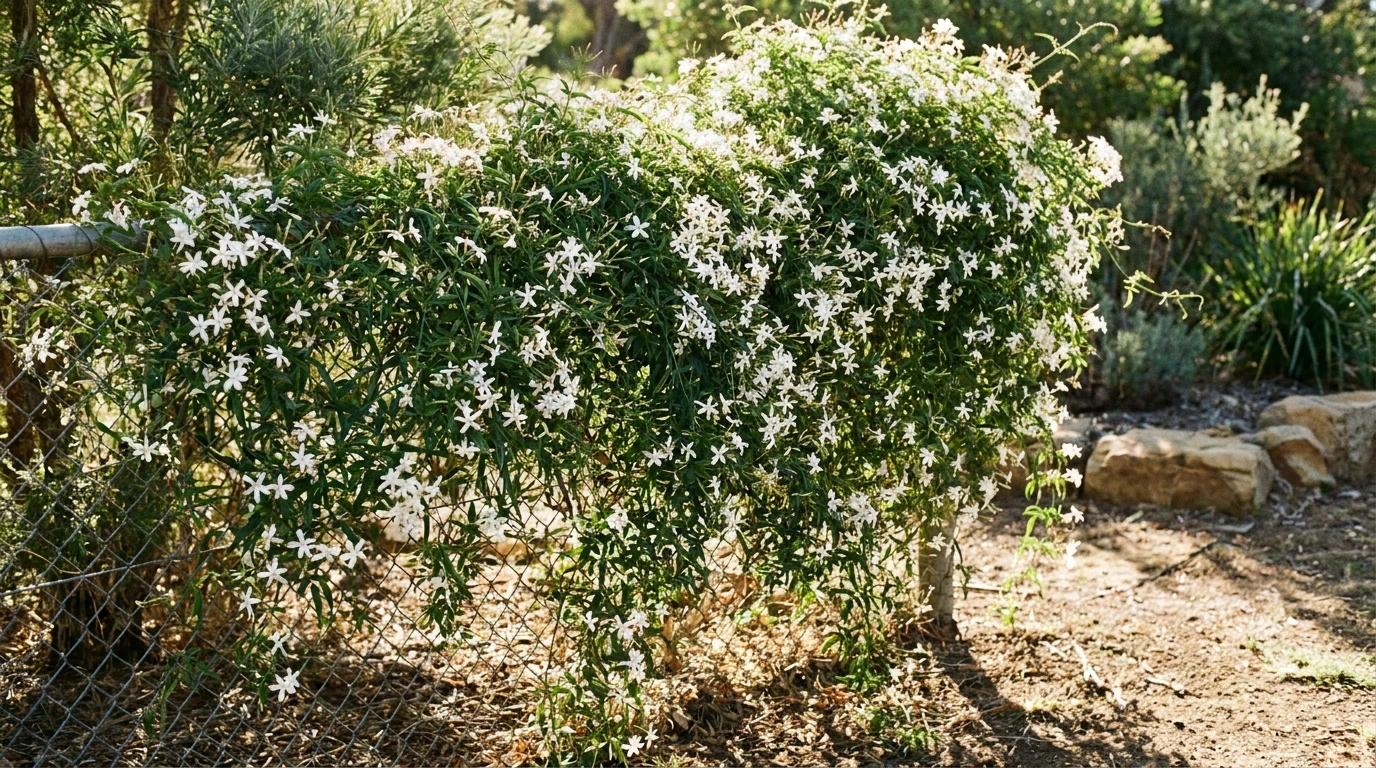
Jasminum suavissimum climbs by twining slender stems around nearby structures and vegetation. It does not adhere to a bare wall with pads or aerial roots.
For a vertical garden, we give it wires, lattice, mesh, a pergola post or another open structure it can wrap around. Australian Native Plants Society warns that it will readily twine through neighbouring plants if positioned too close and left untrimmed.
That is something we pay attention to on jobs. Native Jasmine looks beautifully natural when allowed to weave through a loose support, but it can become frustrating if every new stem disappears into a prized shrub beside it.
If we want the jasmine itself to remain the feature, we give it an independent frame and enough access to prune both sides.
The perfume is a real strength, not just a common-name promise
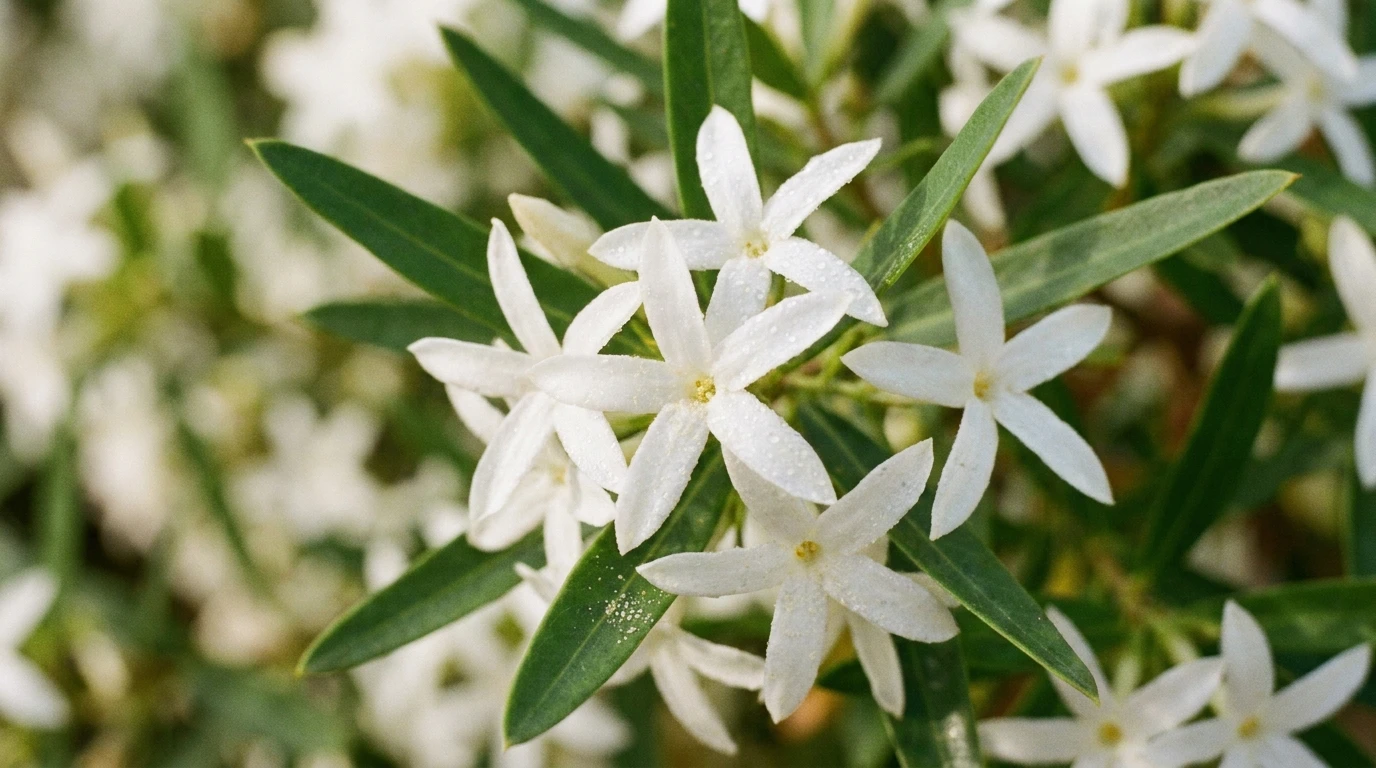
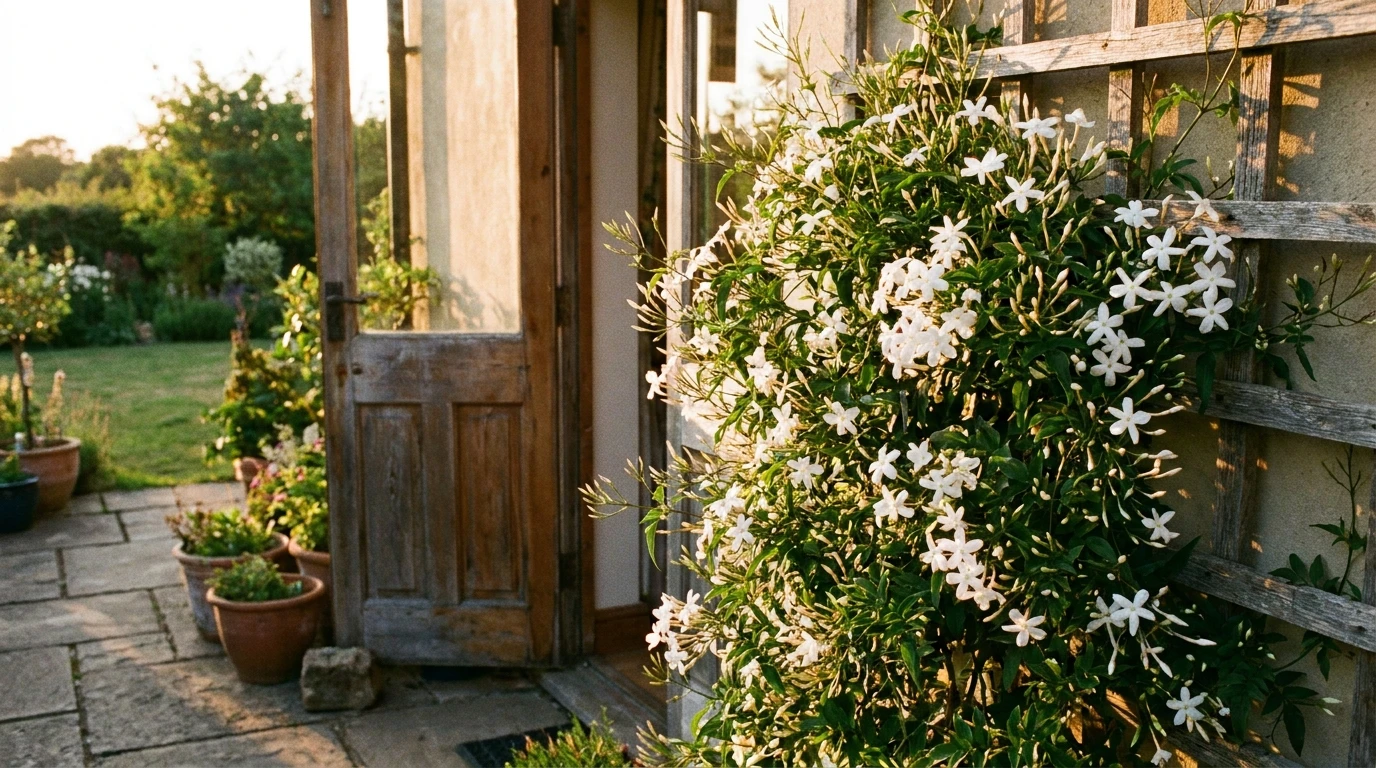
Australian Native Plants Society describes the white flowers as highly perfumed and about 15 mm across. PlantNET records terminal clusters generally carrying 1–7 flowers, with white corollas and usually seven or eight lobes.
The scent is strongest enough for Australian Native Plants Society to recommend the species specifically as a substitute for exotic jasmines. Its perfumed-garden guidance says the aroma can be detected through the garden, especially on still evenings.
Princess Fancy Plants similarly recommends positioning it near doorways and windows where the scent can be appreciated.
That is where we would use it too. A fragrant climber hidden at the far end of a large block wastes one of its strongest characteristics.
Spring and summer are the core flowering season
PlantNET records flowering in spring and summer. Australian Native Plants Society narrows the main display to late spring and early summer, while Princess Fancy Plants’ nursery tag gives a longer cultivated window from about August to January.
Those records are compatible rather than contradictory. Local climate and individual plants can stretch the display, but the reliable expectation is a strong warm-season flowering period centred on spring and early summer.
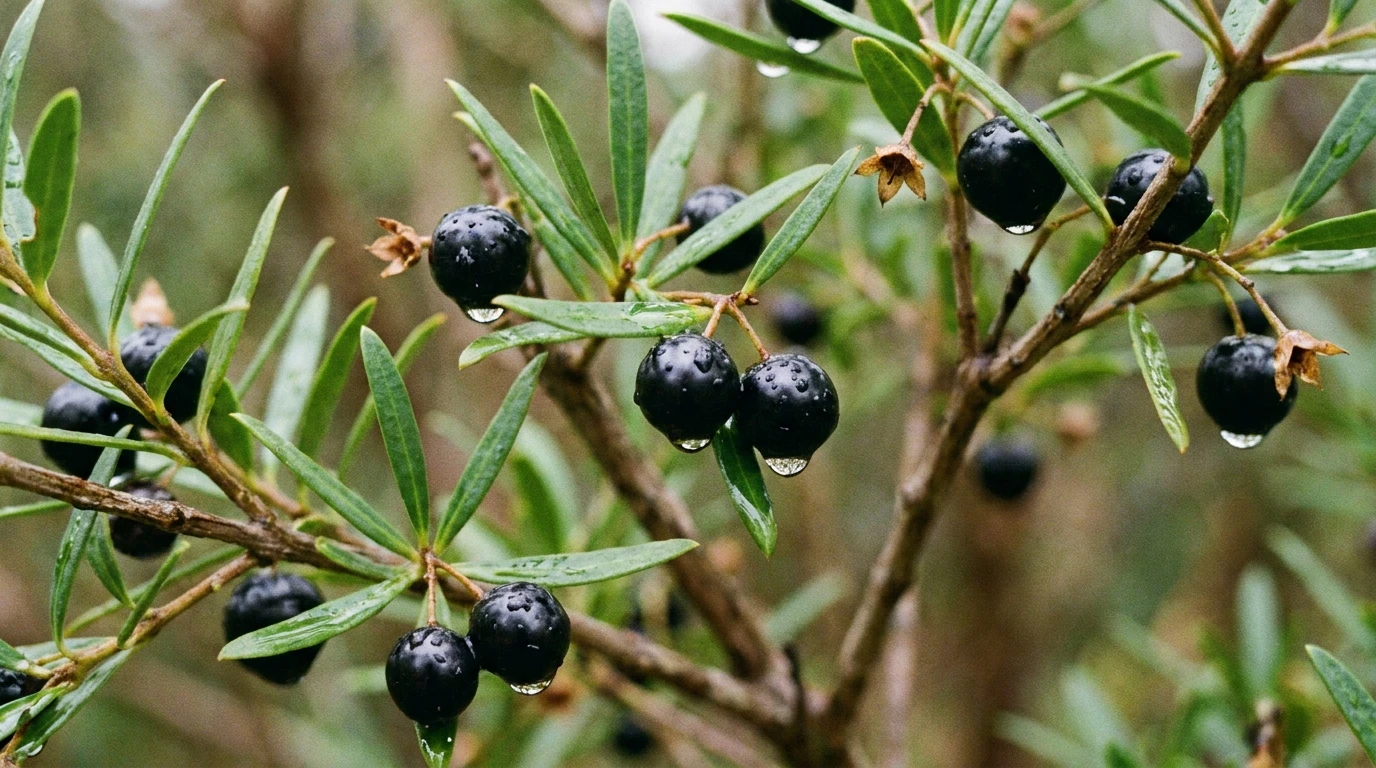
After flowering, PlantNET records shiny black berries approximately 6–7 mm in diameter. Australian Native Plants Society also describes the fruit as black, fleshy berries.
Native Jasmine, star jasmine and Jasminum polyanthum are three different plants
This is the most useful identification section in the guide because the common names are genuinely confusing.
| Plant | Botanical identity | Native status in Australia | Key distinction |
|---|---|---|---|
| Australian Native Jasmine | Jasminum suavissimum | Native to Queensland and New South Wales | Narrow simple leaves, white fragrant flowers, native twining/scrambling habit |
| Star Jasmine | Trachelospermum jasminoides | Exotic; Royal Botanic Gardens Victoria records an East Asian origin | Not a true Jasminum; glossy broader leaves and pinwheel-like flowers |
| Pink/White Jasmine | Jasminum polyanthum | Exotic and invasive in parts of Australia | Compound leaves with 5–9 leaflets; vigorous climber with pink-backed buds/flowers |
NSW WeedWise records Jasminum polyanthum as a vigorous evergreen climber with stems to about 10 m long. Its leaves are divided into 5–9 leaflets, and its white flowers have pink or red colouring on the underside. It can climb into native tree canopies, block light and suppress regeneration.
Native Jasmine is much easier to distinguish once you look at the leaf. PlantNET describes J. suavissimum leaves as single, narrow blades around 1.5–5 cm long and 2–9 mm wide, not divided into multiple leaflets.
Star jasmine is exotic, but it is not the same weed problem as Jasminum polyanthum
This distinction is worth making carefully. Star jasmine, Trachelospermum jasminoides, is exotic. Royal Botanic Gardens Victoria records its natural range in China, Japan and Korea, and Australian nursery sources list it as non-native.
It is also not a true jasmine: Trachelospermum belongs to the Apocynaceae family, whereas Jasminum belongs to Oleaceae.
However, it should not automatically be described as equivalent to invasive Jasminum polyanthum. NSW WeedWise specifically profiles J. polyanthum as an environmental weed, whereas star jasmine is widely used as an ornamental climber and groundcover without the same NSW weed listing.
If the goal is to replace an invasive exotic jasmine with an Australian native, Jasminum suavissimum is the clearer ecological swap.
Full sun to part shade both work
Australian Native Plants Society recommends full sun or partial shade. Kuranga Native Nursery gives the same range, and Princess Fancy Plants lists full sun to part shade.
For the heaviest flowering and a denser screen, we favour a position with useful direct light. In hot inland or western-exposure gardens, some afternoon protection can help reduce stress while the plant establishes.
Native Jasmine naturally grows through open forest and woodland, so it is well adapted to receiving filtered light rather than requiring an exposed full-sun position all day.
The soil requirement is simple: reasonable drainage
Australian Native Plants Society says Jasminum suavissimum is hardy in most reasonably drained soils. Kuranga Native Nursery also recommends well-drained sites, while Princess Fancy Plants specifies well-drained soil for nursery cultivation.
That makes this an easier native climber than species requiring a narrow soil chemistry range.
On jobs, we are more interested in whether the root zone drains and receives reliable establishment moisture than in chasing a particular pH number. In heavy clay, we improve the broader planting area rather than creating one isolated pocket that fills with water.
Once established, Australian nursery guidance describes the plant as hardy through dry conditions, but a young climber still needs watering while its roots move beyond the original pot.
Moderate frost tolerance makes it more adaptable than its subtropical origin suggests
Australian Native Plants Society describes Jasminum suavissimum as moderately frost resistant and says that plants damaged by frost usually recover quickly.
Princess Fancy Plants similarly lists tolerance of light to moderate frost. Neither source gives a defensible minimum-temperature figure, so we would not invent one.
For cold inland gardens, we give young plants a sheltered start and avoid an exposed frost hollow. An established root system has a better chance of reshooting after foliage damage than a recently planted specimen.
It can work as a climber, loose screen or scrambling groundcover
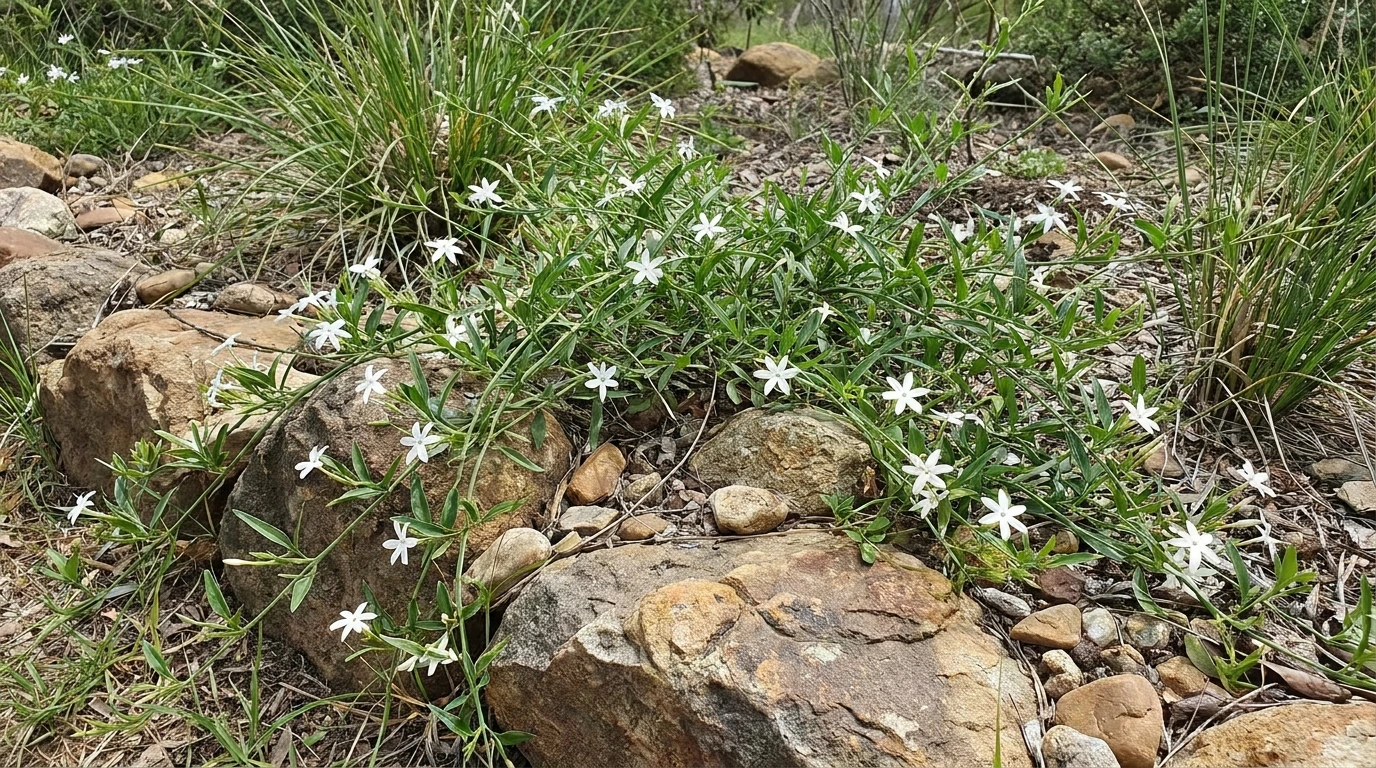
The species is more versatile than a standard trellis vine. PlantNET explicitly describes it as a trailing scrambler or twiner as well as a subshrub. Kuranga Native Nursery recommends fences and trellises, while Mallee Design uses the plant spilling over retaining edges and through naturalistic planting.
| Garden use | How Native Jasmine behaves | What it needs |
|---|---|---|
| Trellis climber | Twines upward into a 2–4 m-class plant | Wire, lattice, mesh or similar support |
| Fence screen | Creates a loose fragrant green layer rather than a rigid hedge | Support plus occasional directional pruning |
| Scrambling shrub | Can remain around 0.5–1 m when unsupported | Open space away from shrubs it could climb into |
| Groundcover / spillover | Trails across banks, rocks or retaining edges | Room for stems to spread naturally |
| Container climber | Can be trained upward or allowed to trail | Large pot, drainage and more regular watering |
For a privacy screen, we would describe it as a light to medium living screen rather than promise the dense wall produced by a vigorous exotic vine. If total visual blockage is the priority, a denser native climber or an evergreen shrub may be a better structural choice.
Pruning is mainly about directing the twining stems
Australian Native Plants Society says the plant should be trimmed where necessary to stop it twining through nearby plants. That is the most practical pruning guidance for this species.
We prune after the main flowering flush when possible, shorten stems that have moved beyond their support and remove growth heading into neighbouring shrubs or gutters. Light regular control is easier than untangling several seasons of stems from another plant.
If grown as a free-standing scrambling shrub, selective pruning can keep the mound denser. For a trellis plant, tying or redirecting young stems is often more useful than cutting them off.
Wildlife value adds another reason to use the native species
Gardening Australia includes Jasminum suavissimum among native flower forms useful for supporting wildlife in Australian gardens. Princess Fancy Plants also notes butterfly attraction, while the fragrant white flowers provide a nectar and pollen resource for visiting insects.
The scrambling structure itself can add low cover when allowed to grow through a mixed native planting.
In our habitat-focused gardens, we would use Native Jasmine as one layer rather than the whole wildlife strategy—pairing it with flowering shrubs, groundcovers and plants that provide resources at different times of year.
Where Native Jasmine fits—and where we would choose something else
| Garden job | Native Jasmine fit | Why |
|---|---|---|
| Fragrant native climber | Excellent | Strongly scented white flowers with genuine Australian native status |
| 2–4 m trellis or fence | Very good | Kuranga Native Nursery gives a supported size around 2–4 m |
| Native alternative to Jasminum polyanthum | Excellent | Australian Native Plants Society specifically recommends it as an exotic-jasmine alternative |
| Loose naturalistic groundcover | Very good | PlantNET documents trailing and scrambling growth |
| Perfumed planting near a window or patio | Excellent | Evening fragrance is one of the plant’s strongest ornamental features |
| Dense instant privacy wall | Moderate fit | Native Jasmine is less rampant and less dense than invasive J. polyanthum |
| Bare masonry wall with no wires | Poor fit | A twiner needs something to wrap around |
| Garden where stems cannot be monitored around other shrubs | Cautious choice | Australian Native Plants Society warns it will twine through neighbouring plants if left unmanaged |
For us, the strongest reason to grow Jasminum suavissimum is that it gives an Australian garden the fragrance and softness people often seek from exotic jasmine without importing the same weed risk as Jasminum polyanthum. It is less aggressive, more naturalistic and genuinely belongs to eastern Australian flora.
Frequently asked questions
How big does Australian Native Jasmine grow?
PlantNET describes Jasminum suavissimum as a subshrub to about 0.5 m high or a trailing twiner. Princess Fancy Plants gives about 1 m unsupported and 2–3 m with support, while Kuranga Native Nursery lists supported plants around 2–4 m high × 2–4 m wide.
Does Jasminum suavissimum need a trellis?
It needs a support if you want it to climb vertically. Native Jasmine is a twiner, so it can wrap around wire, lattice, mesh, posts or other vegetation. Without support it can remain a low scrambling shrub or trail across the ground.
When does Australian Native Jasmine flower?
PlantNET records flowering in spring and summer, while Australian Native Plants Society says the main display is in late spring and early summer. Some cultivated nursery stock is reported flowering from about August into January depending on climate.
Is Australian Native Jasmine fragrant?
Yes. Australian Native Plants Society describes the white flowers as highly perfumed and about 15 mm across, with fragrance strong enough to carry through the garden, particularly on still spring and early-summer evenings.
Is star jasmine the same as Australian Native Jasmine?
No. Star jasmine is Trachelospermum jasminoides, an exotic East Asian climber in the Apocynaceae family. Australian Native Jasmine is Jasminum suavissimum, an Australian member of the Oleaceae family native to Queensland and New South Wales.
Is Jasminum polyanthum invasive in Australia?
Yes, in parts of Australia. NSW WeedWise records Jasminum polyanthum as an environmental weed that can produce stems up to 10 m long, climb into tree canopies and suppress native vegetation. Native Jasminum suavissimum is a useful Australian alternative.
Is Jasminum suavissimum frost tolerant?
Australian Native Plants Society describes the species as moderately frost resistant and says frost-damaged plants usually recover quickly. Current Australian nursery guidance also reports tolerance of light to moderate frost, but there is no reliable universal minimum-temperature figure.
Can Australian Native Jasmine be used as a groundcover?
Yes. PlantNET describes it as a trailing scrambler as well as a twiner, so it can spread over banks, rocks and retaining edges when no vertical support is provided. It forms a loose naturalistic groundcover rather than a flat, carpet-like mat.


