
How Much Mulch Do I Need? Calculator & Depth Guide

To work out how much mulch you need, multiply the area you are mulching (length × width in metres) by the depth in metres, which gives you the volume in cubic metres — for example, a 10 m² bed at 75 mm (0.075 m) deep needs about 0.75 m³ of mulch. Most garden beds want a mulch depth of around 50–75 mm; too little does not suppress weeds or hold moisture, and too much can suffocate roots. The easiest way is to measure your beds and let a calculator do the maths.
Mulch is one of the best-value things you can add to a garden — it holds moisture, suppresses weeds, moderates soil temperature and feeds the soil as it breaks down. But buying too little means a return trip, and buying too much wastes money, so a quick calculation before you shop pays off.
👉 Use our free Mulch Coverage Calculator to get your exact quantity in a few seconds — just enter your area and desired depth.
The simple formula
Mulch quantity is just area multiplied by depth:
Volume (m³) = Area (m²) × Depth (m)
So for a bed:
- measure the length and width in metres and multiply them for the area;
- choose your depth and convert it to metres (75 mm = 0.075 m);
- multiply area × depth to get cubic metres of mulch.
Mulch is usually sold by the cubic metre (bulk) or in bags of a stated volume in litres (1 m³ = 1,000 litres), so once you know your cubic metres you can work out how many bags or what bulk load to order.
Worked example
Say you have a garden bed 5 m long and 2 m wide, and you want 75 mm of mulch:
- Area = 5 × 2 = 10 m²;
- Depth = 75 mm = 0.075 m;
- Volume = 10 × 0.075 = 0.75 m³.
That is 750 litres — so about fifteen 50-litre bags, or three-quarters of a cubic metre delivered in bulk.
Rather than doing this by hand for every bed, our Mulch Coverage Calculator adds it all up for you.

How deep should mulch be?
| Situation | Suggested depth |
|---|---|
| General garden beds | ~50–75 mm |
| Weed suppression | Towards ~75 mm |
| Around established trees/shrubs | ~75 mm, kept off the trunk |
| Delicate/shallow-rooted plants | Lighter, ~40–50 mm |
| Fine mulches (e.g. compost-like) | Thinner, they compact more |
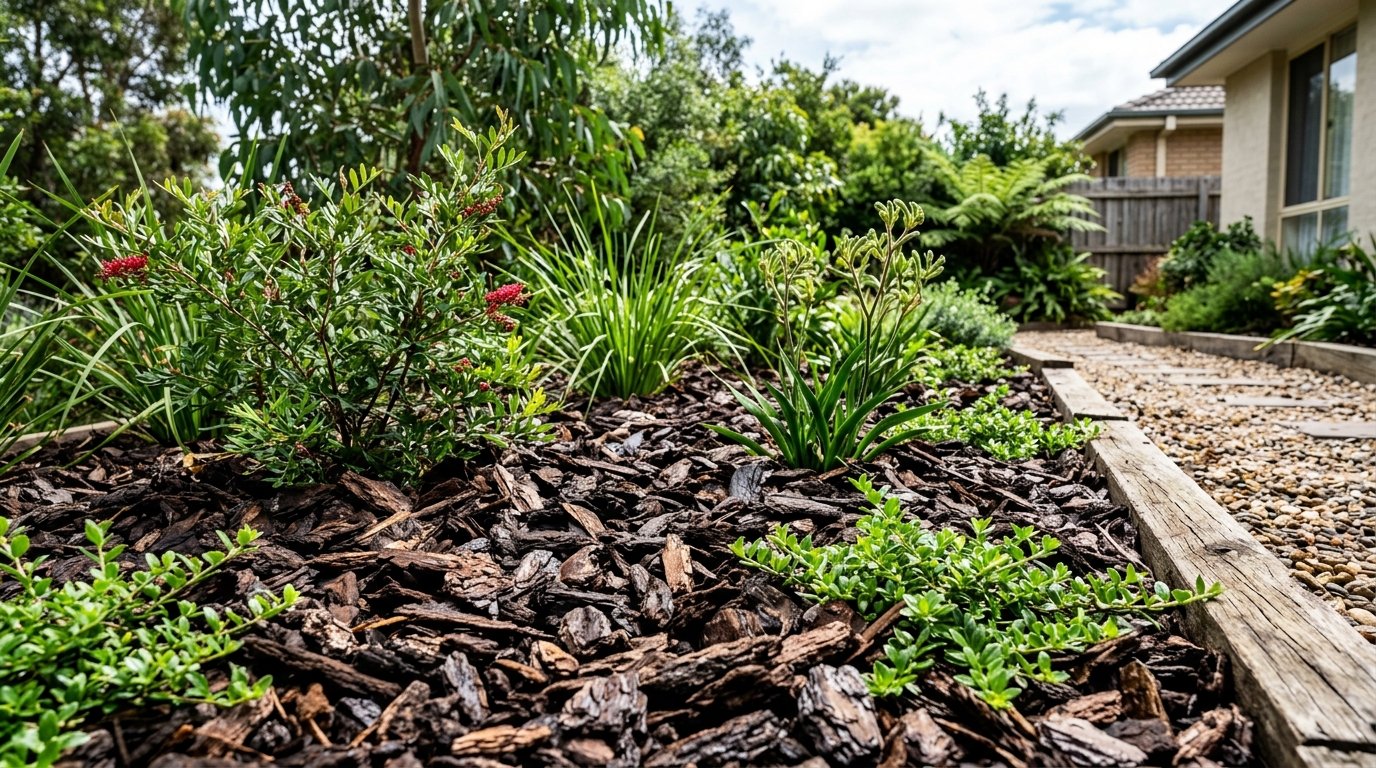
As a rule, aim for around 50–75 mm. That is enough to suppress weeds and hold moisture without smothering plants.
Why depth matters
Too little mulch (a thin scatter) does not block light from weed seeds or slow evaporation much, so you lose most of the benefit.
Too much mulch can stop water and air reaching the soil, keep the crown of plants too wet, and cause problems — especially if piled against trunks and stems.
The sweet spot of around 50–75 mm gives you weed suppression and moisture retention without suffocating the soil.
Keep mulch off trunks and stems
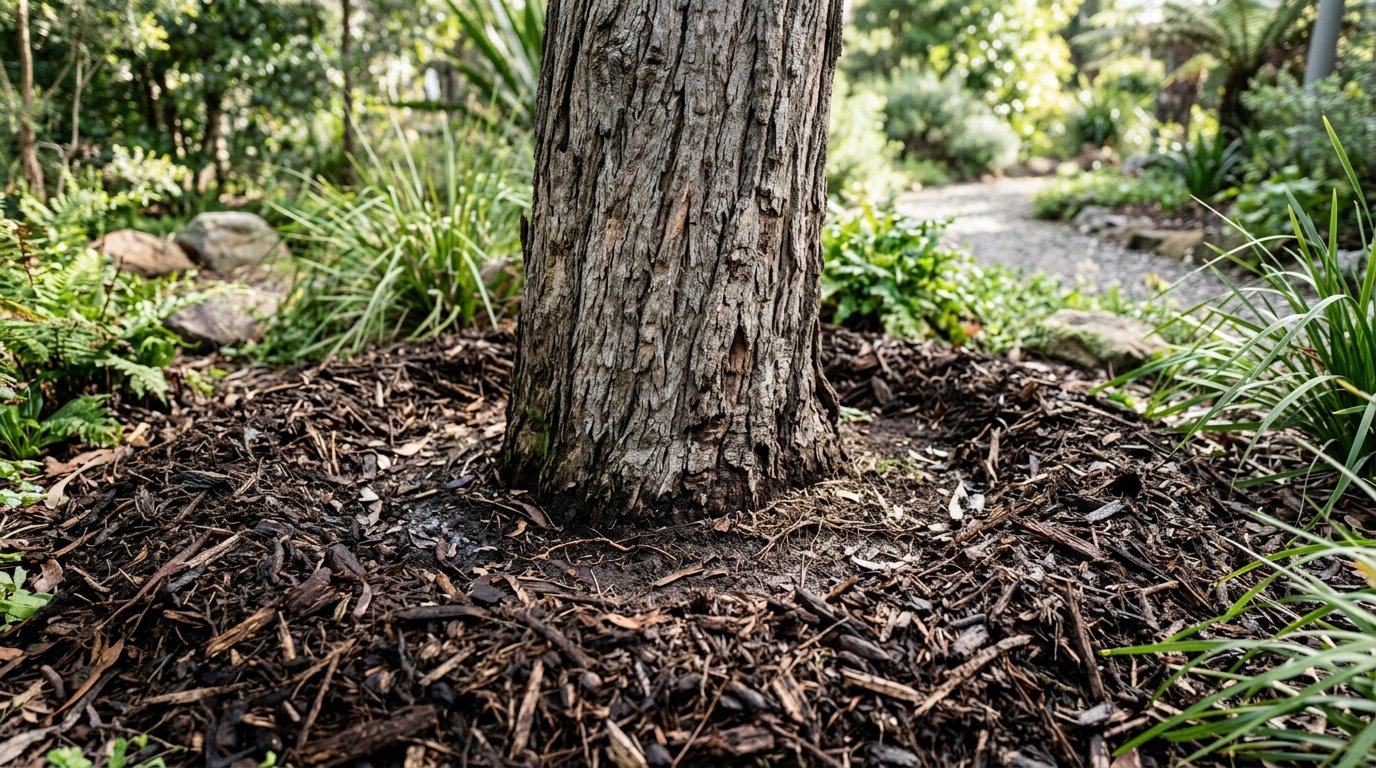
A common mistake is piling mulch up against tree trunks and plant stems (the “mulch volcano”). This traps moisture against the bark and can cause rot.
Always leave a small gap around the base of trunks and stems, and spread mulch evenly out to the drip line instead.
Coarse vs fine mulch
Coarser mulches (bark, wood chip) break down slowly, let water through easily and last longer. Finer mulches (fine composted materials) break down faster, feed the soil more quickly, but can compact and repel water if applied too thickly.
For most beds, a coarser mulch at around 75 mm is a reliable choice; apply fine mulches a little thinner.
Mulch and watering go together
Mulch dramatically cuts how often you need to water by slowing evaporation and keeping roots cool. It is one of the most effective water-saving steps in an Australian garden.
For the full picture on watering a mulched garden efficiently, see our guide to how often to water in an Australian summer.
Ordering: bags vs bulk
- Bags suit small jobs and are easy to handle — check the litre volume per bag and divide your total litres by it;
- Bulk (by the cubic metre) is usually cheaper per volume for larger areas, but you need somewhere to tip it and a way to barrow it in;
- always order a little extra for settling and uneven ground.
Get your exact quantity
To mulch efficiently:
- measure each bed’s length and width;
- choose a depth around 50–75 mm;
- multiply area × depth for cubic metres — or use the calculator;
- convert to bags or a bulk load, adding a little extra;
- keep mulch off trunks and spread it evenly.
👉 Work out exactly how much mulch you need with our Mulch Coverage Calculator — enter your area and depth and it does the rest.
Frequently asked questions
How do I calculate how much mulch I need?
Multiply the area you are mulching (length × width in metres) by the depth in metres. For example, a 10 m² bed at 75 mm (0.075 m) deep needs 10 × 0.075 = 0.75 m³ of mulch, which is 750 litres. Mulch is sold by the cubic metre or in litre-rated bags, so convert your cubic metres accordingly. Our Mulch Coverage Calculator does the maths for you.
How deep should mulch be?
For most garden beds, aim for around 50–75 mm. That is deep enough to suppress weeds and hold moisture without smothering plants. Use the deeper end for weed suppression and around established trees and shrubs, and apply fine mulches and mulch around delicate, shallow-rooted plants a little thinner to avoid compaction and suffocation.
Can you put too much mulch down?
Yes. Too much mulch can stop water and air reaching the soil, keep plant crowns too wet and cause rot, especially when piled against trunks and stems. The sweet spot of around 50–75 mm gives weed suppression and moisture retention without suffocating the soil. Avoid the “mulch volcano” of material heaped against trunks.
How many bags of mulch are in a cubic metre?
One cubic metre equals 1,000 litres, so the number of bags depends on each bag’s litre volume. For 50-litre bags, a cubic metre is about twenty bags; for 75-litre bags, about thirteen. Work out your total volume in cubic metres first, convert to litres, then divide by your bag size. Bulk delivery is usually cheaper per volume for larger areas.
Why should I keep mulch away from tree trunks?
Piling mulch against trunks and stems traps moisture against the bark, which can cause rot and invite pests and disease. Always leave a small gap around the base of trunks and stems, and spread mulch evenly outwards to the drip line instead. This gives all the benefits of mulch without the risks of the common “mulch volcano” mistake.
What is the best depth of mulch for weed control?
For weed suppression, aim towards the deeper end of the range, around 75 mm, using a coarser mulch. This blocks light from reaching weed seeds while still letting water through. Too thin a layer lets weeds germinate, while excessive depth can suffocate desirable plants, so around 75 mm is a good balance for most beds.
Should I order extra mulch?
Yes, order a little extra to allow for settling, uneven ground and slightly deeper application in places. Running a bit short means an inconvenient second trip, while a small surplus is easily used elsewhere in the garden. Calculating your area × depth first, then adding a modest margin, avoids both under- and over-ordering.
Does mulch really reduce watering?
Yes, significantly. Mulch slows evaporation, shades and cools the soil, and helps it hold moisture, so a well-mulched garden needs watering far less often than bare soil. It is one of the most effective water-saving steps in an Australian garden, especially through summer, and works best combined with deep, infrequent watering.


