
Carissa ‘Desert Star’ Australia: Natal Plum Hedge, Fruit & Care Guide

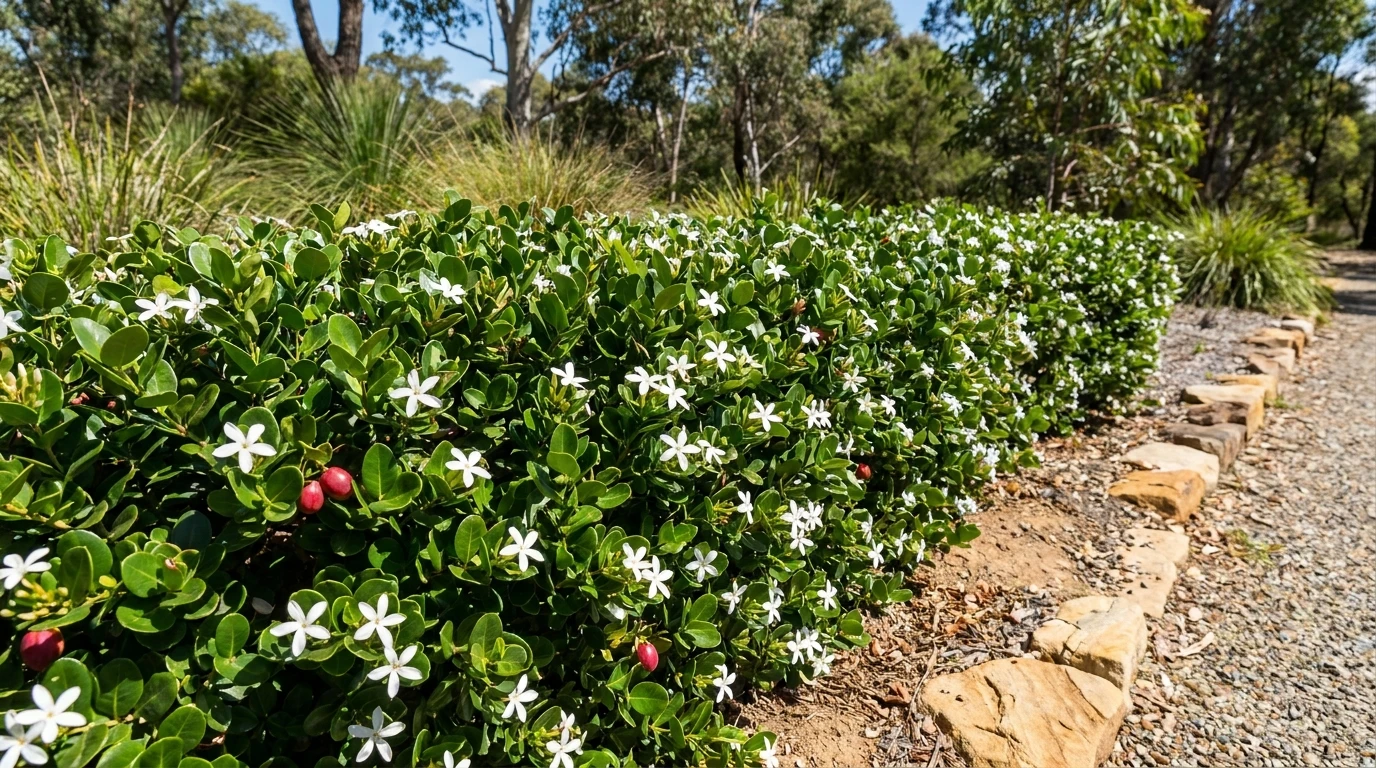
Carissa macrocarpa ‘Desert Star’ is a compact Natal Plum grown in Australia as a low evergreen hedge, border, groundcover-style shrub or container plant, usually around 0.6–1 m high and about 1 m wide in the more compact nursery descriptions. Nursery Near Me lists ‘Desert Star’ at about 60 cm high × 1 m wide, Kingdom Horticulture gives approximately 1 m × 1 m, while Plantmark and Nurseries Online allow a broader mature range around 1–2 m high × 1–2 m wide.
It is not an Australian native. Kew’s Plants of the World Online accepts Carissa macrocarpa in the Apocynaceae family and records its native range from eastern Africa into southern Africa, including KwaZulu-Natal and the Cape provinces. The older name Carissa grandiflora is treated by Kew as a synonym. Australian nurseries commonly use the name Natal Plum.
‘Desert Star’ is popular because it combines glossy evergreen foliage, fragrant white star-shaped flowers, red edible fruit when fully ripe, and unusually strong tolerance of coastal wind, salt and dry conditions. There is one safety point worth knowing before planting it around children or pets: Australian fruit-growing sources warn that unripe fruit should not be eaten, and the plant produces a white milky latex when damaged. Only fully ripe fruit should be treated as edible.
Desert Star is a compact selection of Natal Plum
Plantmark, Alpine Nurseries, Kingdom Horticulture, Nursery Near Me and Nurseries Online all currently sell the plant as Carissa macrocarpa ‘Desert Star’. The accepted species name is Carissa macrocarpa; Kew lists Carissa grandiflora among its synonyms.
The species itself can become much larger. Kew-linked botanical descriptions record Carissa macrocarpa as a many-stemmed shrub broadly in the 1–3.7 m class, while South African botanical references allow mature plants to become small trees around 4–5 m.
Desert Star is selected and sold for a much lower landscape role.
| Australian source | Published Desert Star size | How we use the figure |
|---|---|---|
| Nursery Near Me | About 0.6 m high × 1 m wide | Strong compact-groundcover/border estimate |
| Kingdom Horticulture | About 1 m high × 1 m wide | Useful Queensland landscape figure |
| Plantmark | About 1–2 m high × 1–2 m wide | Broader commercial landscape allowance |
| Nurseries Online | About 1–2 m high × 1–2 m wide | Useful upper range for lightly pruned plants |
For most suburban designs, we would plan Desert Star in roughly the 0.6–1 m height class but still allow room for lateral spread. If the planting needs to stay very low, regular light pruning becomes part of the design.
Spacing depends on whether you want groundcover or a hedge
Nursery Near Me recommends approximately 60 cm spacing for borders and mass planting and says that spacing can produce full cover over roughly two growing seasons in suitable conditions. Nurseries Online recommends around 80 cm to 1 m spacing for a dense hedge.
| Design goal | Source-backed spacing | What to expect |
|---|---|---|
| Dense low mass planting | About 45–60 cm centres | More plants, faster visual closure and stronger weed suppression |
| Border / edging | About 60 cm centres | Nursery Near Me’s practical Desert Star recommendation |
| Low hedge | About 80 cm centres | Allows shrubs to develop individual width while closing into a line |
| Broader informal hedge | About 1 m centres | Within Nurseries Online guidance and easier to maintain as individual shrubs mature |
The 45 cm end of that table is a close landscape layout for faster massing, not a universally published Desert Star rule. The stronger cultivar-specific Australian figures cluster around 60 cm for low mass planting and 80 cm–1 m for hedging.
On Garden Green jobs, we choose the spacing after deciding whether we want individual rounded plants, a continuous low band or a clipped hedge. The same cultivar should not automatically be planted at the same centres for all three finishes.
There is no reliable centimetres-per-year growth rate
Current Australian nurseries describe Desert Star as resilient, hardy and relatively easy to establish, but the stronger sources do not provide a verified cultivar-specific annual growth rate in centimetres.
We would not invent one.
Nursery Near Me describes the cultivar as capable of forming groundcover-style coverage from plants at about 60 cm spacing within two seasons in suitable conditions. That is more useful as a landscape expectation than pretending every shrub extends by the same number of centimetres each year.
For us, good establishment means the plant begins adding side shoots, filling its centre and developing enough lateral growth to perform the border or hedge job it was planted for.
The flowers are genuinely fragrant
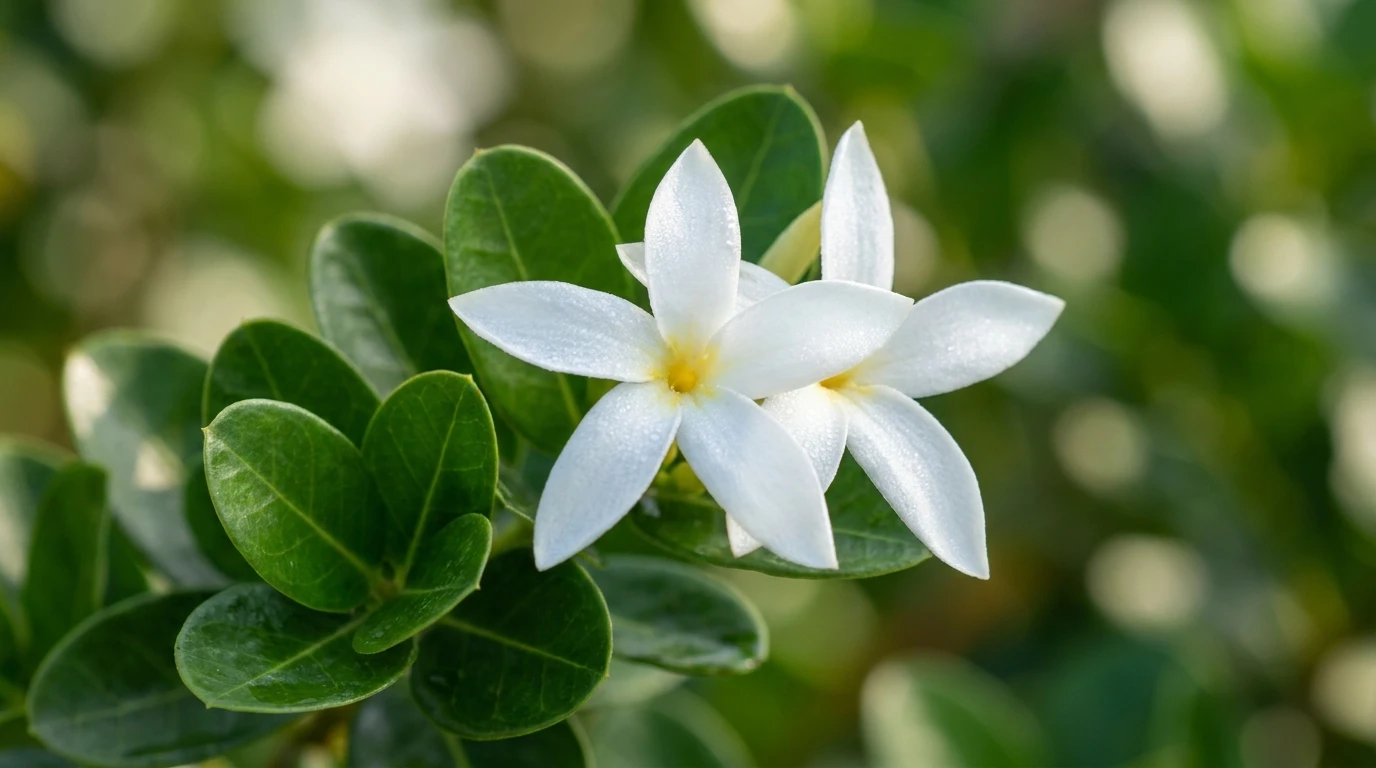
Alpine Nurseries describes Desert Star as producing a prolific display of simple white perfumed flowers through summer. Plantmark calls the flowers white and star shaped, while Nursery Near Me describes the scent as jasmine-like and strongest through the warm months.
The flower shape is one reason the cultivar works so well near entrances, patios and paths. Five white petals stand out strongly against the thick dark-green foliage.
The straight species is also known for fragrance. Botanical descriptions of Carissa macrocarpa record fragrant white flowers, and South African botanical references describe the scent as similar to orange blossom.
On our own layouts, we would rather put a scented shrub near a place people actually use than hide it at the back of an inaccessible bed.
Red fruit follows the flowers
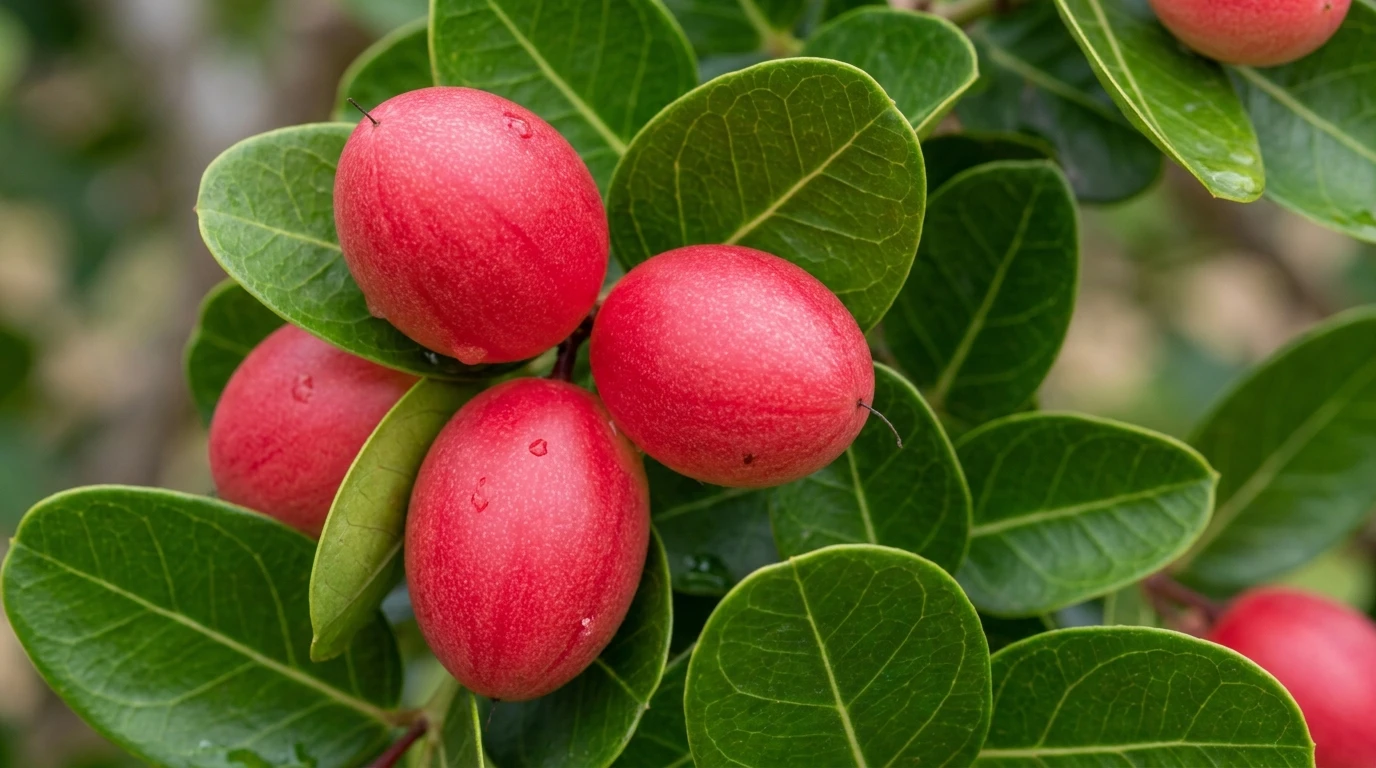
Plantmark, Alpine Nurseries, Kingdom Horticulture and Nursery Near Me all describe Desert Star producing red to red-purple fruit after flowering. Alpine says the fruit reddens when ripe and is edible, while Plantmark identifies the mature fruit as edible and bird attracting.
Nurseries Online places the red berries mainly in autumn, while broader Natal Plum sources describe fruit through the warmer months and into autumn depending on climate.
Fruit production will vary from plant to plant and with pollination, pruning and climate. A heavily clipped hedge may also sacrifice some flowers and therefore some fruit.
Only fully ripe Natal Plum fruit should be eaten
This is the safety point we would put beside every edible-fruit claim.
Daleys Fruit Tree Nursery says Natal Plum fruit should be left until it is fully ripe before eating because latex in under-ripe fruit is acrid, irritating and may cause reactions in some people. The Rare Fruit Club of Western Australia goes further and warns that unripe fruit and the white latex should not be consumed.
The safest practical rule is therefore straightforward: eat only correctly identified, fully ripe fruit that has developed its mature red to dark-red colour and softened appropriately. Do not eat green or under-ripe fruit.
Published descriptions of the sap itself are not completely consistent. Some botanical sources describe the species’ latex as non-toxic, while other horticultural and poison references treat the sap as a minor toxicity or irritation concern. We would therefore avoid unnecessary skin or eye exposure and would not treat the milky sap as edible.
Because of the latex warning, unripe-fruit warning and small thorns, we would also discourage pets from chewing any part of the plant or eating fallen unripe fruit. Ripe fruit being edible for people does not make the whole shrub a pet-food plant.
Desert Star is compact, but it is not reliably thornless
This is another point where the cultivar should not be oversold.
Nurseries Online specifically warns that Desert Star has small thorns on the stems and recommends keeping it away from play areas and paths where people may brush directly against it. Nursery Near Me also notes small forked spines.
The straight species is naturally spiny. Kew-linked botanical descriptions record forked or bifurcated spines, and the Natal Plum has historically been used as a defensive hedge partly because of those thorns.
We therefore would not describe Desert Star as spineless unless the nursery supplying the actual clone explicitly guarantees thornless stock.
For a boundary hedge the small spines can be useful. Beside a children’s play space or a narrow path where legs and hands regularly brush the foliage, we would choose a softer plant.
Full sun to part shade both work
Plantmark lists full sun to semi-shade. Kingdom Horticulture gives full sun to part shade, and Nurseries Online recommends full sun to a little shade.
For the densest habit, heavier flowering and best fruiting potential, we prefer good light. Part shade can still produce a handsome evergreen shrub, especially in hot Australian gardens where some afternoon protection reduces heat load.
Deep shade is different. Desert Star may remain alive, but we would not expect the same compact flowering hedge produced in brighter conditions.
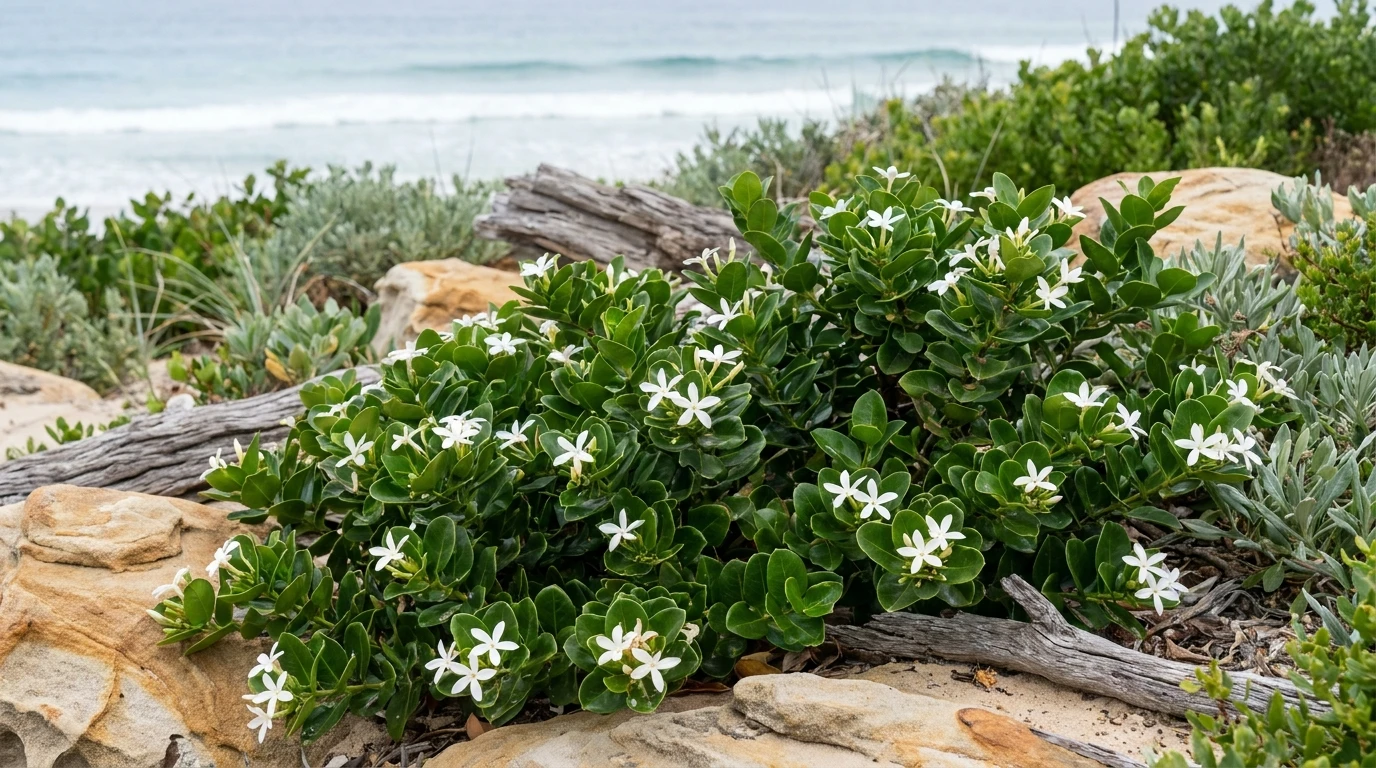
Free drainage is the common soil requirement
Plantmark lists Desert Star for a broad range of soils but specifically requires well-drained conditions. Kingdom Horticulture also specifies well-drained soil, while Nurseries Online says well-drained, humus-rich soil is ideal but that the plant tolerates poorer soils with suitable care.
Alpine Nurseries highlights the species’ adaptation to dry environments and coastal conditions, including sandy soils.
For us, drainage is more important than trying to make the soil extremely rich. Desert Star is selected partly for toughness; sitting its roots in stagnant wet soil defeats that strength.
On heavy clay, we improve the broader planting area rather than dig isolated pockets that can hold water. On sandy coastal soils, mulch and organic matter can help establishment moisture last longer.
Drought tolerance improves once the roots establish
Alpine Nurseries specifically markets Desert Star for water-wise landscapes and notes its drought and heat tolerance. Nursery Near Me describes it as drought tolerant once established, and Nurseries Online gives it moderate drought tolerance after establishment.
A new 140 mm plant is a different situation. Its roots occupy a small nursery volume and need regular moisture while moving into the surrounding soil.
We water properly through establishment, then lengthen the intervals once fresh growth shows the root system is working beyond the original pot.
After that, Desert Star becomes useful in dry, exposed gardens precisely because it does not need a constantly damp root zone.
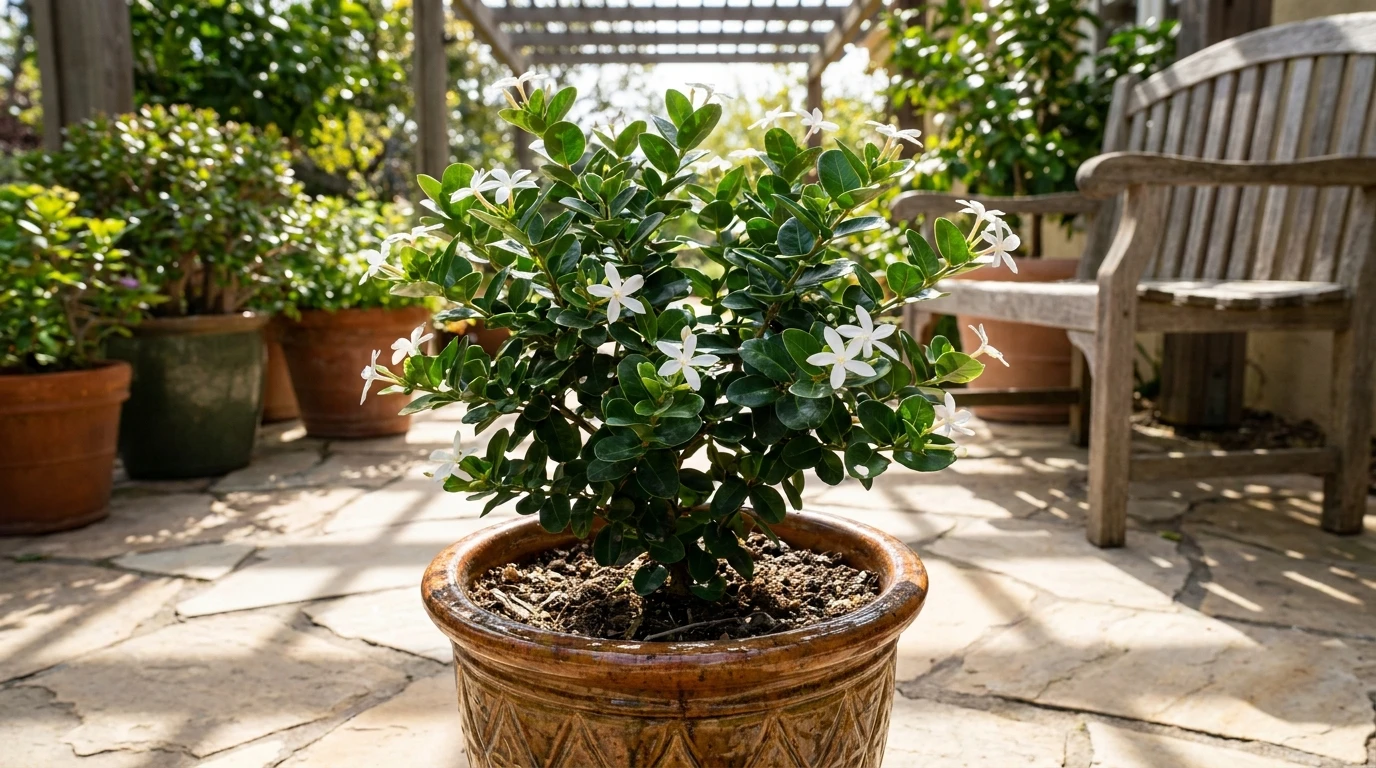
Coastal salt and wind tolerance are real strengths
Alpine Nurseries specifically recommends Desert Star for coastal Australia and notes its ability to handle salt-laden winds. Plantmark calls the cultivar tolerant of coastal conditions, and Nursery Near Me describes it as both salt and wind tolerant.
The species itself comes from coastal and dry shrubland habitats in southern and eastern Africa. That background helps explain why the foliage is thick, glossy and leathery rather than soft and thin.
On exposed coastal jobs, that foliage is valuable. A plant may still need careful watering while new, but once established it can cope with conditions that burn many conventional flowering shrubs.
Frost is the climate limitation to respect
Nurseries Online clearly lists Desert Star as not frost tolerant. Alpine Nurseries recommends planting where it is protected from frost or cold conditions.
Broader Natal Plum sources generally describe the species as subtropical to warm-climate material rather than a plant for repeated hard frosts.
We would therefore treat Desert Star as a strong choice for coastal, subtropical, warm-temperate and Mediterranean-style gardens, but a cautious choice in exposed inland frost districts.
A sheltered wall, courtyard or warm microclimate can improve the odds in marginal areas, but we would not invent a minimum safe temperature for this cultivar because the Australian Desert Star sources do not provide one.
It makes an unusually versatile low hedge
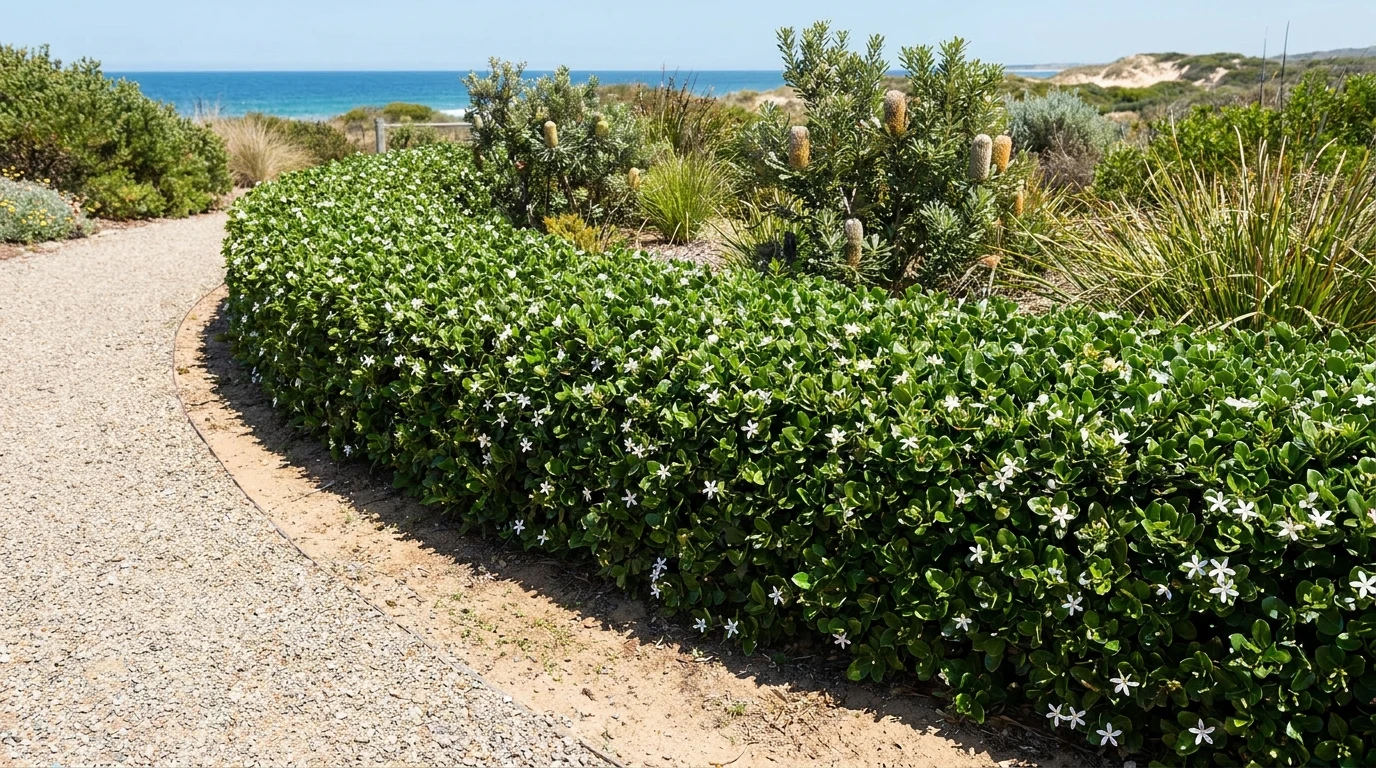
Nurseries Online recommends Desert Star as a low hedge or groundcover, Plantmark lists hedging and screening among its uses, Kingdom Horticulture recommends low hedges and borders, and Alpine highlights edging and border planting.
Its evergreen foliage is naturally dense and the shrub responds well to trimming. That gives us a choice between a softer rounded form and a more controlled hedge line.
For a clipped hedge, we start tip-pruning while the plants are young so branching develops lower down. Waiting until the shrubs become tall and open before beginning to shape them is much harder.
Prune lightly after flowering and fruiting
Alpine Nurseries recommends a light prune after flowering and fruiting to maintain shape and promote fresh growth. Nurseries Online similarly recommends light pruning immediately after flowering when shape or size needs correction.
We would not shear Desert Star continuously if edible fruit and flowers are part of the reason for growing it. Every aggressive trim removes potential flower and fruiting wood.
For a purely formal hedge, that trade-off may be acceptable. For an ornamental or edible-fruit shrub, we allow a more natural flowering cycle and prune more selectively.
Pots and rockeries suit its compact habit
Kingdom Horticulture lists containers and rockeries among Desert Star’s recommended uses. Plantmark describes it as suitable for small gardens and containers, and Alpine Nurseries specifically promotes the cultivar for edging and filling compact borders.
A pot works particularly well where drainage is controlled and frost protection may occasionally be needed. It also makes the glossy foliage and white flowers easier to appreciate at close range.
Container plants naturally need more frequent watering than established shrubs in open ground because the available root volume is limited.
Where Desert Star fits—and where we would choose something else
| Garden job | Desert Star fit | Why |
|---|---|---|
| Low evergreen hedge | Excellent | Dense habit and Australian nursery spacing guidance around 80 cm–1 m |
| Low border or mass planting | Excellent | Nursery Near Me lists about 60 cm spacing and a compact 0.6 m × 1 m habit |
| Coastal garden | Excellent | Alpine, Plantmark and Nursery Near Me all support salt and coastal tolerance |
| Dry water-wise garden | Very good | Strong drought tolerance once established |
| Rockery or large pot | Very good | Compact habit, glossy foliage and fragrant flowers suit close viewing |
| Edible ornamental garden | Good with caution | Fully ripe red fruit is edible, but unripe fruit and latex require care |
| Narrow path or children’s play edge | Poor fit | Current Australian sources report small forked thorns |
| Hard-frost inland garden | Poor to cautious fit | Australian Desert Star sources advise frost protection |
| Pet grazing area | Cautious choice | Do not allow chewing of plant material or unripe fruit because of latex and toxicity/irritation warnings |
For us, Desert Star is at its best where toughness and neatness have to coexist: hot front gardens, salt-exposed coastal beds, low evergreen borders and compact hedges that still give fragrance and seasonal fruit.
Its safety limitation is manageable as long as it is not hidden behind the word “edible”. The fully ripe fruit is the edible part; green or under-ripe fruit should be left alone, damaged stems produce milky latex, and the plant may carry small thorns.
Frequently asked questions
How big does Carissa ‘Desert Star’ grow?
Australian nursery figures vary. Nursery Near Me gives about 60 cm high × 1 m wide, Kingdom Horticulture lists approximately 1 m × 1 m, while Plantmark and Nurseries Online allow a broader mature size of about 1–2 m high × 1–2 m wide. Regular pruning can keep it toward the lower end.
How far apart should Desert Star be planted?
Nursery Near Me recommends about 60 cm spacing for low borders and mass planting. Nurseries Online recommends around 80 cm to 1 m for a dense hedge. Closer planting gives quicker coverage; wider spacing gives each mature shrub more room.
When does Carissa ‘Desert Star’ flower and fruit?
Alpine Nurseries describes a strong display of fragrant white flowers through summer, while Nurseries Online gives spring and summer. Red fruit follows the flowers and is commonly seen into autumn, with timing varying in warmer climates.
Is Desert Star thornless?
No reliable Australian source supports calling it completely thornless. Nurseries Online reports small thorns on the stems, and Nursery Near Me notes small forked spines. Keep it back from narrow paths and play areas where people may brush directly against the branches.
Is the fruit of Carissa ‘Desert Star’ edible?
The fully ripe red fruit is edible according to Alpine Nurseries, Plantmark and Australian fruit-growing sources. Daleys advises leaving Natal Plum until fully ripe because latex in under-ripe fruit is acrid and irritating, while the Rare Fruit Club of Western Australia warns against eating unripe fruit.
Is Carissa macrocarpa toxic to pets or people?
Treat the shrub cautiously. Australian sources agree that only fully ripe fruit should be considered edible and that damaged plant parts produce white milky latex. Published sources differ on the degree of sap toxicity, so avoid ingesting plant material other than correctly identified fully ripe fruit, avoid eye contact with sap, and do not allow pets to chew the plant or eat unripe fruit.
Does Desert Star tolerate drought and coastal conditions?
Yes, once established. Alpine Nurseries promotes Desert Star for water-wise and coastal gardens, while Plantmark and Nursery Near Me also describe strong coastal, salt and drought tolerance. New plants still need regular establishment watering.
Is Carissa ‘Desert Star’ frost tolerant?
It is better suited to warm climates. Nurseries Online lists Desert Star as not frost tolerant, and Alpine Nurseries recommends protecting it from frost and cold conditions. Use a sheltered microclimate in marginal areas rather than relying on an unsupported minimum-temperature figure.


