
Leptospermum Tea Tree Australia: Species, Sizes, Hedging & Care

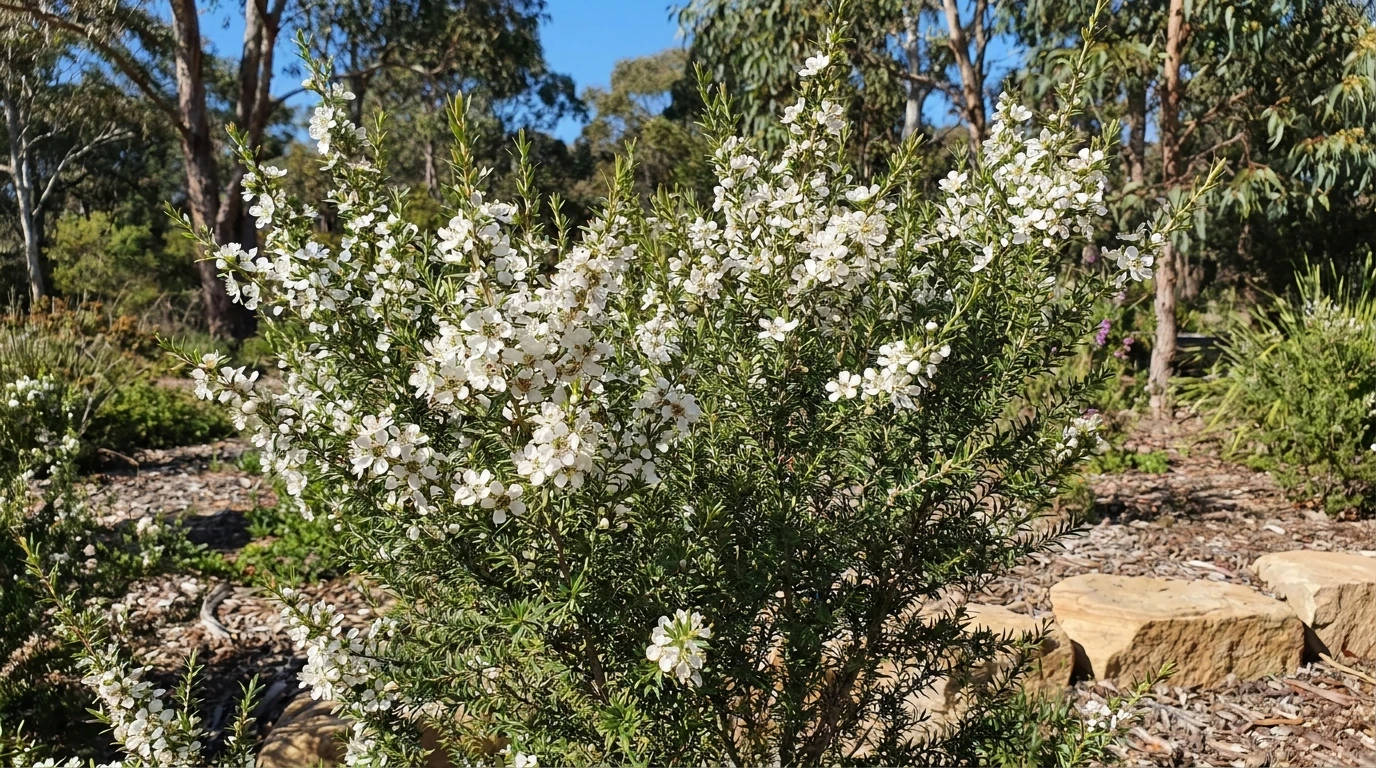
“Tea tree” is not one predictable garden plant. Australian Leptospermum and closely related former Leptospermum species range from low cascading shrubs under 1 m to coastal trees around 5–8 m, so the right plant depends on whether you need a flowering feature, low mound, hedge, windbreak, coastal screen or habitat shrub.
For a compact ornamental, Leptospermum ‘Pink Cascade’ is a low weeping form; for a medium weeping screen, ‘Cardwell’ sits around the 1.5–3 m class in Australian references; straight Leptospermum petersonii is commonly a 3–5 m lemon-scented screen; and the plant long sold as Leptospermum laevigatum can reach roughly 5–8 m and is one of Australia’s toughest coastal tea trees.
The naming needs care too. Australian Plants Society notes that a major 2023 revision moved a number of former Leptospermum species into new genera. Coastal Tea Tree, for example, is now treated in Australian botanical literature as Gaudium laevigatum, although nurseries and older garden references still widely use Leptospermum laevigatum. Kew’s Plants of the World Online continues to recognise species such as Leptospermum scoparium, L. petersonii and L. polygalifolium within Leptospermum.
There is no single mature size for “tea tree”
This is the most important planning point in the whole genus. A gardener can buy two plants both labelled “tea tree” and end up with one low enough to spill over a rock and another capable of becoming a small tree.
| Plant | Published Australian size | Best garden role |
|---|---|---|
| Leptospermum scoparium | About 2 m high × 1–2 m wide; Australian Plants Society gives about 2 m × 1 m, while ANBG gives up to about 2 m × 2 m | Flowering shrub, small hedge, bee garden |
| Leptospermum ‘Pink Cascade’ | Low weeping shrub; Australian Native Plants Society describes it as a small cascading cultivar, while Australian Native Nursery lists about 0.3 m high × 1.5 m wide | Rockeries, walls, foreground planting |
| Leptospermum polygalifolium | About 1–4 m high × 1–3 m wide according to the Australian National Botanic Gardens | Feature shrub, screen, habitat planting |
| Leptospermum ‘Cardwell’ | About 1.5–3 m high; Domus Nursery lists 1.5–2 m, Arbornet 2–3 m, and Australian Plants Society up to about 3 m | Weeping feature, informal screen, windbreak |
| Leptospermum polygalifolium ‘Pacific Beauty’ | About 1.5 m high × 2 m wide from the Australian National Botanic Gardens; older Australian Plants material allows roughly 2–2.5 m spread | Cascading shrub, large rockery, coastal planting |
| Leptospermum ‘Copper Glow’ | About 3 m high × 2 m wide in Mountain View Nursery and Rockbank Nursery listings | Screen, foliage feature, informal hedge |
| Leptospermum petersonii | About 5 m high × 3–4 m wide in Plantmark and Mountain View Nursery; other Australian growers commonly give 3–5 m | Lemon-scented screen, small tree, windbreak |
| Gaudium laevigatum (syn. Leptospermum laevigatum) | About 5 m high × similar spread in Australian Native Plants Society material; Australian Plants Society NSW records plants to about 8 m | Coastal windbreak, large screen, habitat shrub/tree |
That table is why we never design from the common name alone. On Garden Green jobs, the full botanical or cultivar name goes onto the plant list before spacing is calculated. “Tea tree at 1 m centres” means nothing until we know which tea tree.
The taxonomy has changed, but nursery labels have not all caught up
Australian Plants Society explains that the traditional Leptospermum group was revised in 2023. A number of species were moved into new genera including Gaudium, Aggreflorum, Leptospermopsis and Apectospermum.
The most relevant garden example is Coastal Tea Tree. It is still routinely sold and searched as Leptospermum laevigatum, but Australian Native Plants Society now profiles it as Gaudium laevigatum, with the older name shown as a synonym.
We keep the familiar nursery name where it helps gardeners identify the plant they already own, but we do not pretend the taxonomy has stood still.
Leptospermum scoparium is the classic flowering tea tree
Australian Plants Society describes Leptospermum scoparium as a medium shrub around 2 m high × 1 m wide, with white or occasionally pink or red flowers in spring. The Australian National Botanic Gardens gives a similar maximum height around 2 m and notes spring to early-summer flowering.
This is the species behind many highly ornamental garden selections. Its familiar pink, red and double-flowered cultivars are often what people picture when they hear “ornamental tea tree”.
For a small flowering hedge or feature shrub, that 2 m-class habit is far more manageable than a 5 m lemon-scented or coastal tea tree. Australian Plants Society also notes good bee attraction, which makes it useful in pollinator-focused gardens.
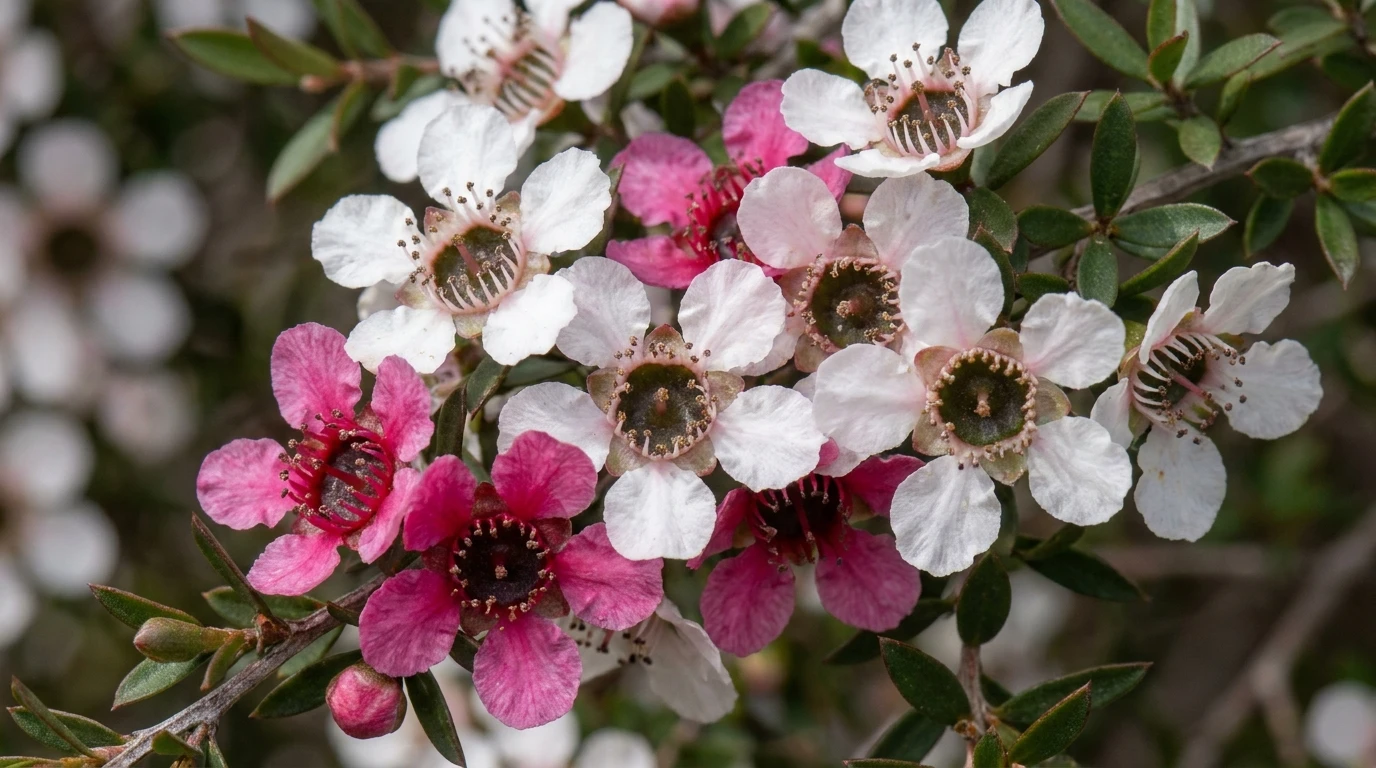
‘Pink Cascade’ is a low ornamental, not a screening shrub
Australian Native Plants Society describes ‘Pink Cascade’ as an attractive small shrub with a weeping habit, believed to be a hybrid between Leptospermum polygalifolium and L. continentale. Its pink flowers are about 15 mm across and occur mainly from late spring into early summer.
Australian Native Nursery gives one cultivated size of roughly 0.3 m high × 1.5 m wide, reinforcing how different this plant is from upright tea trees used for screening.
We use this type of cultivar where the stems can spill: over a low retaining edge, through rocks or at the front of a native bed. Trying to turn it into a privacy hedge would be fighting the cultivar’s natural architecture.
Cardwell is the weeping tea tree for a medium screen
‘Cardwell’ has been grown in Australia for decades and is associated with Leptospermum polygalifolium subsp. tropicum. Australian Plants Society describes a dense weeping shrub up to about 3 m high × 3 m wide.
Current nursery figures are commonly a little smaller. Domus Nursery gives 1.5–2 m high × 1.5–2 m wide, while Arbornet gives around 2–3 m high. Plantmark describes approximately 2 m × 2 m in its product text.
That puts ‘Cardwell’ in a useful middle category: large enough for a genuine informal screen, but still much smaller than some tree-form tea trees. Its weeping branches also soften a boundary better than a rigidly upright hedge.
Australian National Botanic Gardens material describes the Cardwell form as popular in tropical and subtropical gardens while also growing in cooler climates.
‘Pacific Beauty’ works where you want width without much height
The Australian National Botanic Gardens lists Leptospermum polygalifolium ‘Pacific Beauty’ at about 1.5 m high × 2 m across. Older Australian Plants material describes the cascading form spreading about 2–2.5 m and carrying white flowers about 20–30 mm across.
ANBG also records useful salt-spray resistance, which gives it a role in coastal gardens where a lower broad shrub is needed rather than a tall windbreak.
On our own planting plans, this is the sort of tea tree we would use to cover visual width, soften a bank or create a broad flowering layer without blocking a window.
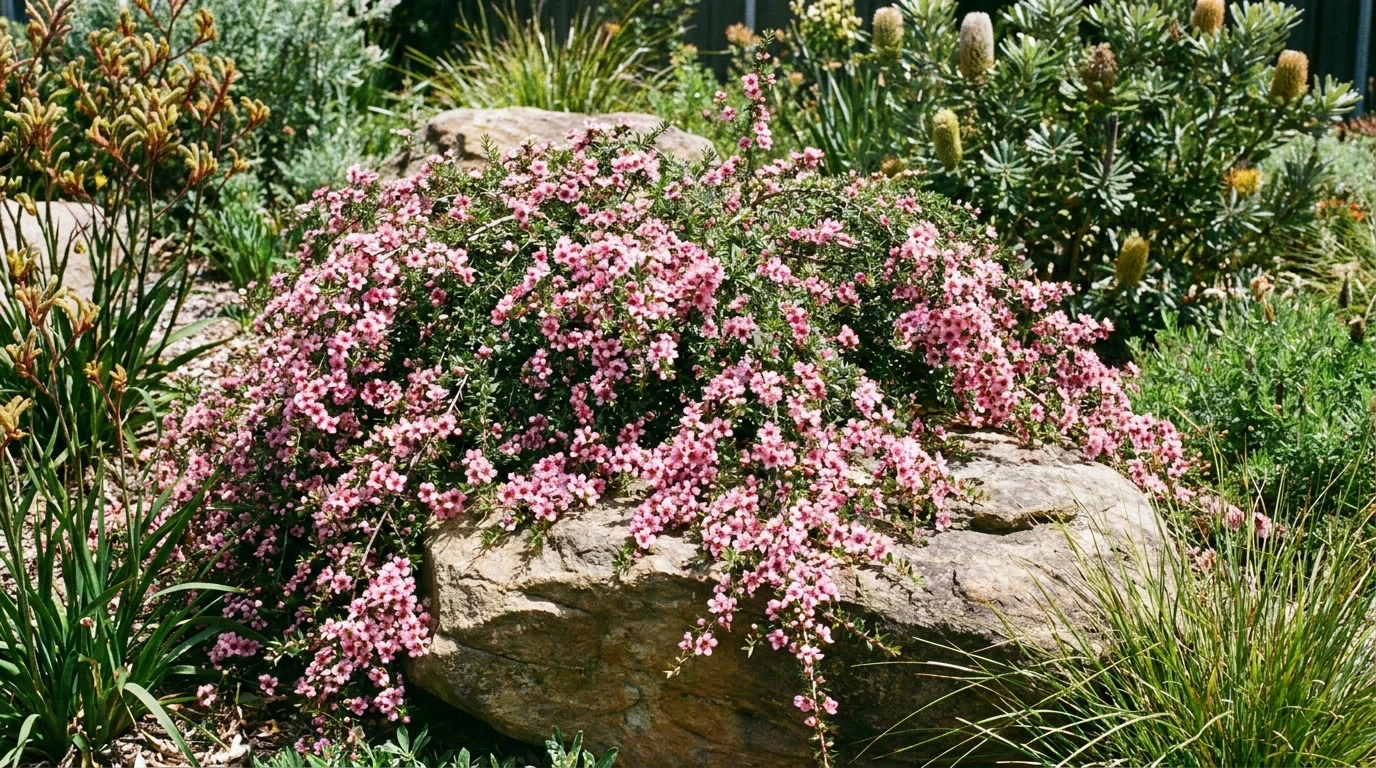
Copper Glow needs a label check because Australian naming is inconsistent
‘Copper Glow’ is popular for bronze-copper foliage and white spring flowers, but current Australian nursery naming is not completely consistent. Mountain View Nursery and Rockbank Nursery list it as Leptospermum polygalifolium ‘Copper Glow’ at about 3 m high × 2 m wide. Plantmark currently lists a plant under Leptospermum petersonii ‘Copper Glow’.
Older Australian Plants material also associates ‘Copper Glow’ with L. polygalifolium and describes an open shrub to roughly 3 m.
Because the retail naming is inconsistent, we would not assume two nursery plants labelled “Copper Glow” are botanically identical without checking the supplier’s propagation source and full label. The reliable garden-level information is that the commonly sold Australian form is a medium screening shrub around the 3 m class with copper-toned foliage and white spring flowers.
Lemon-scented Tea Tree is a real screen or small tree
Leptospermum petersonii sits at the larger end of everyday garden tea trees. Plantmark describes it at approximately 5 m high × 3 m wide, while Mountain View Nursery gives 5 m × 4 m. Australian advanced-tree suppliers commonly publish a mature height around 4–6 m.
The leaves release their characteristic lemon fragrance when crushed, and current Australian nurseries place flowering mainly through spring and early summer.
For us, this is a plant for a genuine screen, windbreak or small-tree position. It can be pruned smaller, but choosing a 5 m species for a permanently 1 m hedge creates unnecessary work.
Coastal Tea Tree is one of the toughest options—but check whether it belongs in your region
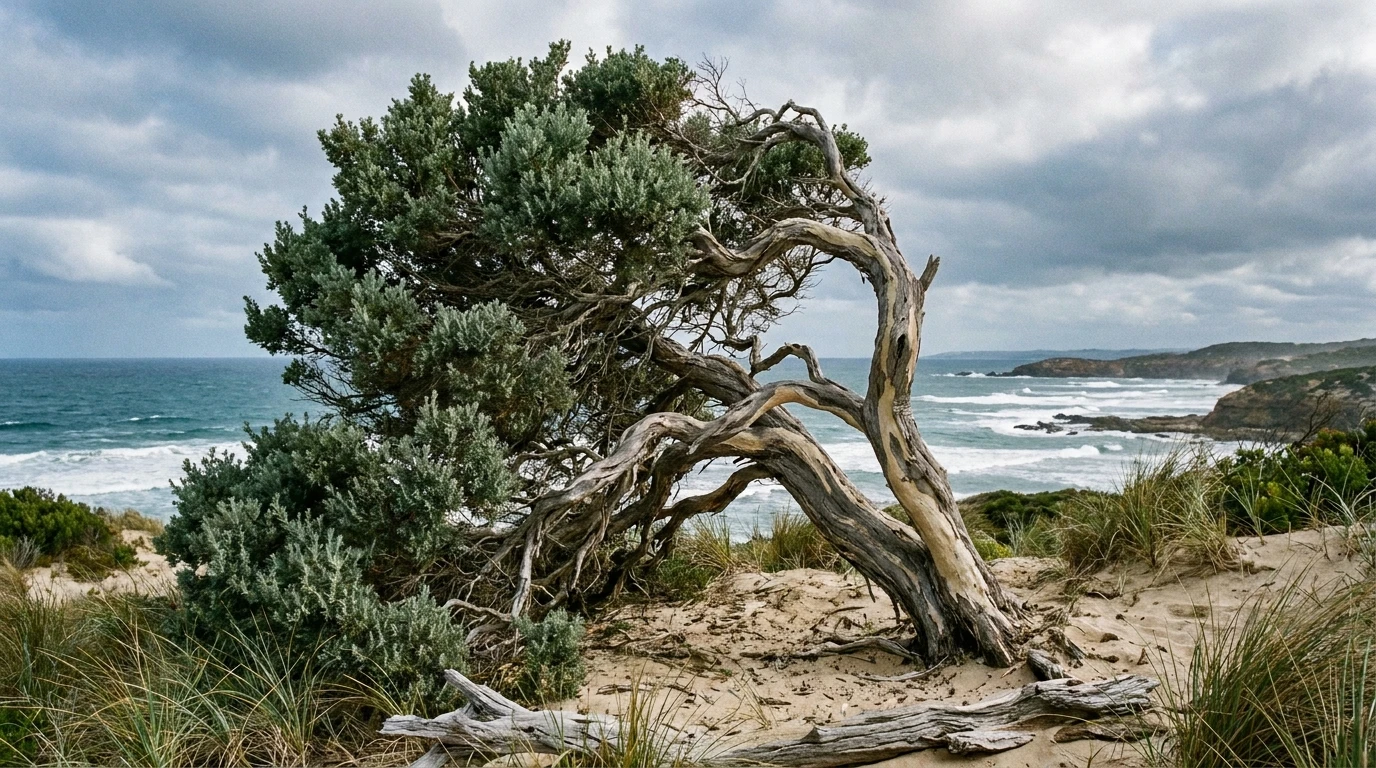
The plant traditionally known as Leptospermum laevigatum, now treated as Gaudium laevigatum in current Australian botanical literature, is one of the best-known coastal windbreak plants.
Australian Native Plants Society describes it as a large bushy shrub to about 5 m high × 5 m wide, while Australian Plants Society NSW records plants to about 8 m high. Portsea Estate Nursery describes it as a bushy shrub or twisted small tree to approximately 6 m.
Its salt tolerance is exceptionally well documented. Australian botanical references describe it growing naturally on coastal dunes and tolerating salt spray, strong wind and exposed shore conditions.
There is an important ecological catch. Australian Native Plants Society notes that Coastal Tea Tree is an environmental weed in southern Western Australia and South Australia and is naturalised outside parts of its native range. We would not recommend it beside sensitive bushland in a region where local authorities treat it as invasive simply because it is an Australian native somewhere else.
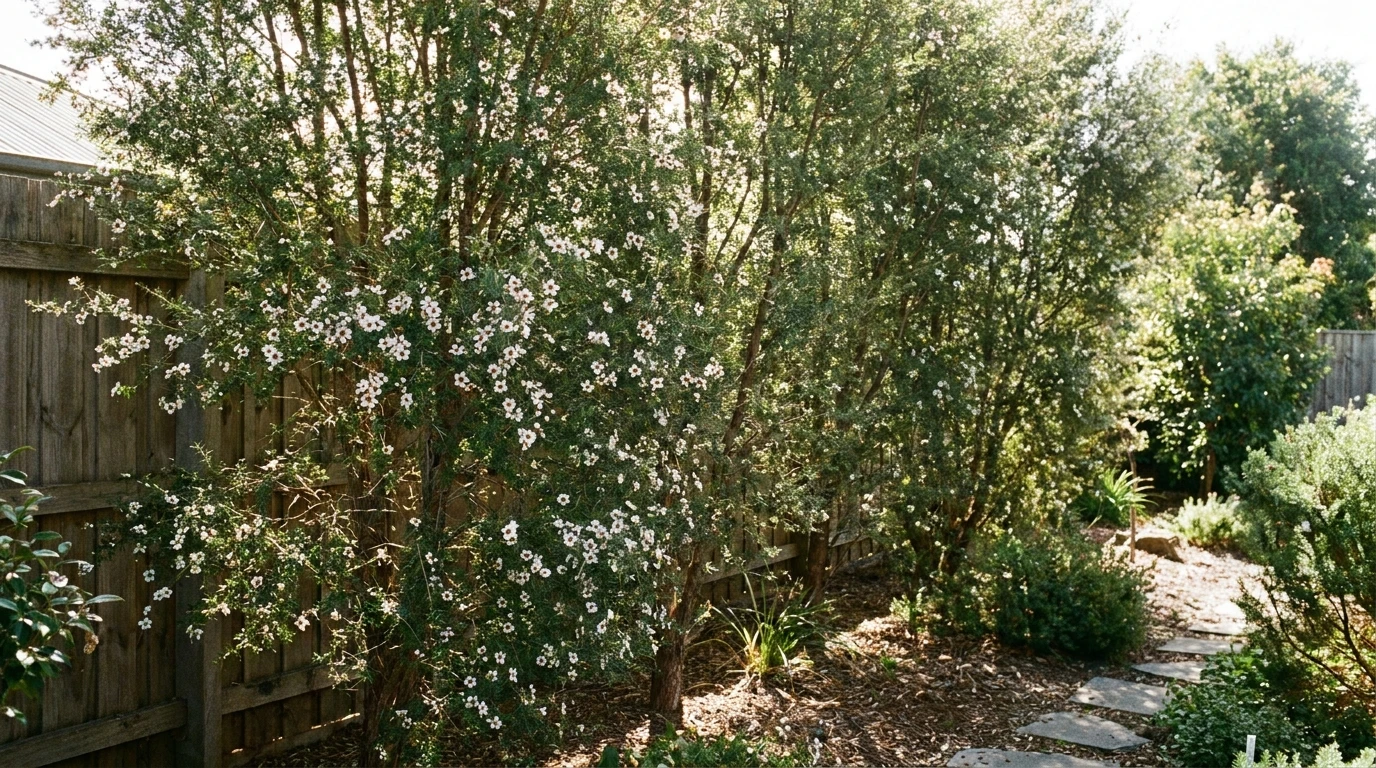
There is no single growth rate for tea tree
This is the honest numerical limitation of a genus guide. A low ‘Pink Cascade’, a 2 m L. scoparium, a 3 m ‘Copper Glow’ and a 5 m L. petersonii cannot sensibly share one centimetres-per-year figure.
Some Australian nurseries describe L. petersonii as fast growing, and one advanced-tree supplier publishes an approximate 30–60 cm per year estimate for that species. Plantmark similarly calls ‘Cardwell’ fast growing. Those figures and labels belong to those plants and production systems; they are not a growth rate for the whole tea-tree group.
On Garden Green jobs, we judge establishment by extension growth, density and how quickly neighbouring shrubs begin performing the role they were planted for. We would rather leave a genus-wide growth figure blank than invent one that is wrong for half the plants in the guide.
Most garden tea trees flower best in sun
Full sun is the safest general starting point for strong flowering, although many tea trees accept part shade. Australian Plants Society recommends full sun to part shade for L. scoparium; Plantmark gives full sun to semi-shade for L. petersonii; Domus Nursery gives full sun to part shade for ‘Cardwell’; and Australian Native Plants Society says ‘Pink Cascade’ performs in full sun or light shade.
We favour the brighter position when flowers and dense screening matter. A tea tree may survive in heavier shade, but open branching and fewer flowers are poor outcomes if the original job was to build a flowering screen.
Drainage is the safest common soil rule
Tea trees occupy a remarkably wide range of natural habitats, including coastal dunes, creeklines and periodically wet acidic soils. Australian National Botanic Gardens notes that the broader genus has species adapted to everything from coastal habitats to high mountain country.
For the commonly cultivated garden forms, well-drained soil is still the safest shared recommendation. Australian Native Plants Society says ‘Pink Cascade’ performs best in moist, well-drained soil. Plantmark recommends well-drained loam or sandy soil for L. petersonii, and Arbornet specifically favours very free-draining conditions for several screening forms.
We do not translate “tea trees can grow near water” into “all tea trees like stagnant garden soil”. Species and provenance matter. In a home garden, an aerated root zone with reliable moisture is safer than a planting hole that remains waterlogged.
Frost tolerance varies by species
There is no honest genus-wide frost temperature. The Australian National Botanic Gardens historically rated L. scoparium as frost hardy to about -7°C under normal-rainfall conditions, and gives the same historical rating for L. polygalifolium.
Mountain View Nursery describes straight L. petersonii as frost hardy, while its dwarf form is listed as light-frost tolerant. Portsea Estate Nursery describes Coastal Tea Tree as frost tolerant.
| Plant | Published frost guidance |
|---|---|
| Leptospermum scoparium | ANBG historical cultivation rating to about -7°C |
| Leptospermum polygalifolium | ANBG historical cultivation rating to about -7°C |
| L. petersonii | Mountain View Nursery lists frost hardy |
| L. petersonii dwarf forms | Current nursery guidance commonly lists light-frost tolerance |
| Gaudium laevigatum | Australian coastal references describe useful frost tolerance |
We treat those ratings as plant-specific guidance rather than permission to assume every ornamental cultivar has inherited the same cold tolerance.
Tea trees are excellent habitat plants when the species fits the site
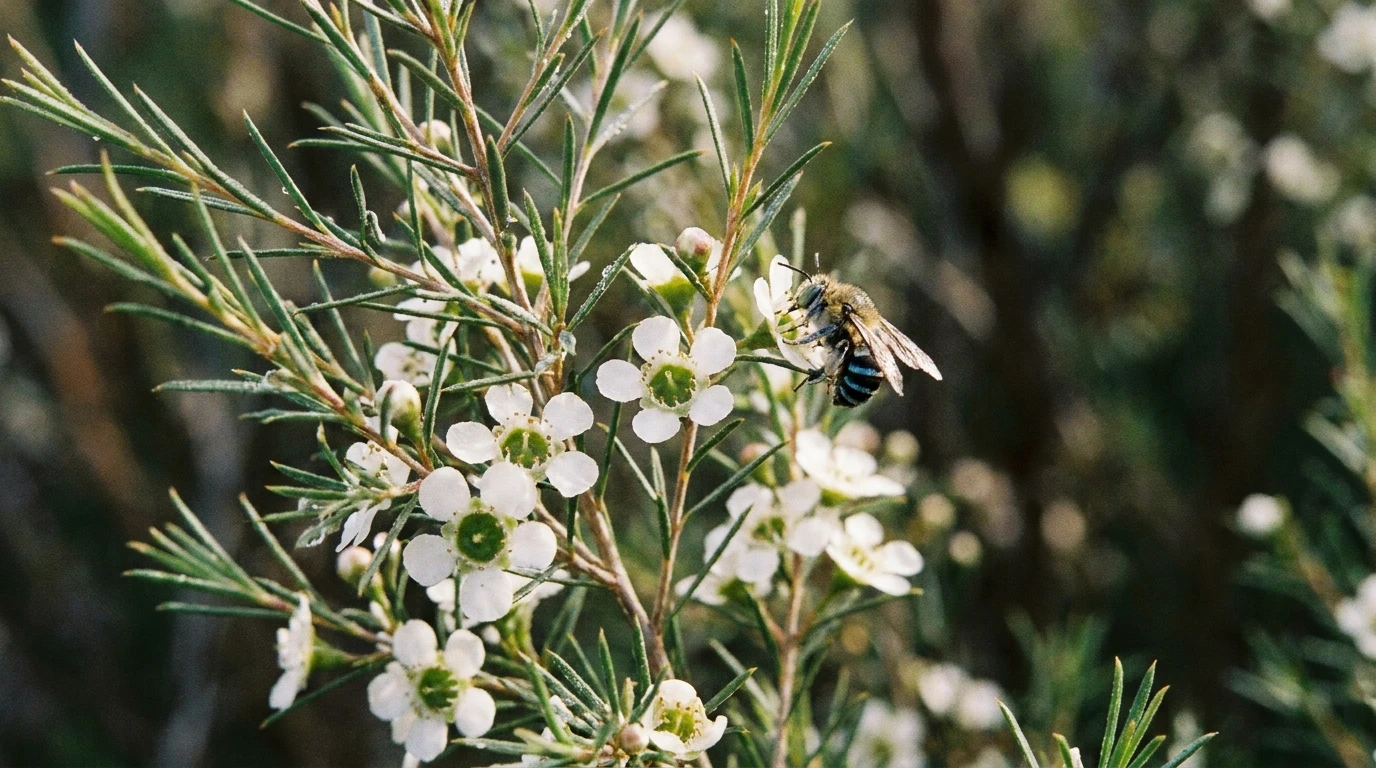
The small flowers are valuable to bees and other insects, while dense branching can create useful shelter for small birds. Mountain View Nursery specifically describes ‘Copper Glow’ as attracting bees, butterflies and other pollinators, and Australian Plants Society notes strong bee attraction for L. scoparium.
Coastal Tea Tree can also create substantial habitat structure because it develops into a large dense shrub or small tree.
In our own habitat plantings, we prefer locally appropriate tea trees over choosing only by flower colour. A species indigenous to the district can provide the ornamental function while fitting the surrounding ecology more naturally.
Myrtle Rust is the disease worth recognising
Leptospermum and its close tea-tree relatives belong to the Myrtaceae family. Australia’s Department of Agriculture, Fisheries and Forestry identifies tea trees among the Myrtaceae plants at risk from Myrtle Rust, caused by Austropuccinia psidii.
The strain already present in Australia was first detected in 2010 and has since spread through eastern Australia, Tasmania, the Tiwi Islands and parts of northern Western Australia. DAFF describes characteristic symptoms on susceptible Myrtaceae as yellow spore pustules on young growth, followed by distorted leaves, shoot dieback, stunting and, in severe susceptible hosts, plant death.
If we see suspicious bright-yellow pustules on fresh tea-tree shoots, we do not carry infected cuttings around the garden or between properties. Myrtle Rust spores move readily on plant material, clothing, tools and equipment.
Not every brown leaf or dead twig is Myrtle Rust. Tea trees can also suffer from scale, webbing caterpillars and root problems. The distinctive yellow pustules on susceptible young tissue are the warning sign that deserves closer identification.
Webbing caterpillar can ruin the look of ornamental forms
Australian Plants Society specifically notes that L. scoparium cultivars can be prone to webbing caterpillars. The Australian Native Plants Society profile for ‘Pink Cascade’ is interesting because it says that cultivar appears relatively resistant to the pest compared with some other Leptospermum cultivars.
On ornamental tea trees, webbing and dead foliage caught inside the canopy can make an otherwise healthy plant look terrible very quickly. Small infestations are easier to physically remove before they spread through the shrub.
Pruning depends on the tea tree you planted
Most garden tea trees respond well to regular shaping, but the safe intensity differs. Australian Native Plants Society says Coastal Tea Tree can be pruned severely if necessary. By contrast, Australian Plants Society notes that L. polygalifolium used as a hedge prefers light pruning and may not respond well to heavy cutting.
That is why we reject one generic instruction such as “cut all tea trees back hard after flowering”.
Our normal approach is to start early with light tip-pruning. That encourages denser branching while keeping foliage on the plant. Once a hedge is mature, we shape it regularly enough that it never needs a desperate cut deep into bare old wood.
For cascading cultivars such as ‘Pink Cascade’ and ‘Pacific Beauty’, we prune selectively so the natural arching habit remains visible rather than turning them into clipped boxes.
For a hedge, choose the mature height before the flower colour
A tea-tree hedge can range from a low flowering edge to a 5 m windbreak. Matching species to the required height saves years of corrective pruning.
| Job | Tea tree we would consider | Why |
|---|---|---|
| Low cascading ornamental under 1 m | ‘Pink Cascade’ | Naturally low and spreading rather than upright |
| Broad low-to-medium ornamental | ‘Pacific Beauty’ | About 1.5 m high with a 2 m-plus cascading spread |
| Small flowering hedge around 1.5–2 m | L. scoparium forms or a verified compact cultivar | Naturally closer to the target scale |
| Weeping 1.5–3 m screen | ‘Cardwell’ | Dense arching habit and reliable white flowering |
| Bronze-foliaged 3 m screen | ‘Copper Glow’ | Copper foliage plus white spring flowers |
| Fragrant 3–5 m screen | L. petersonii | Lemon-scented foliage and genuine screening height |
| Large salt-exposed coastal windbreak | Gaudium laevigatum where locally appropriate | Excellent documented salt and wind tolerance |
On Garden Green jobs, this is the selection table that matters most. We would rather choose the right natural height first and get our preferred flower colour second than spend the life of the hedge cutting a 5 m species back to 1 m.
Coastal planting needs an ecological check as well as a toughness check
Coastal Tea Tree is an obvious example of why “Australian native” is not enough information. Its salt tolerance is exceptional, yet Australian Native Plants Society also records it as an environmental weed in southern Western Australia and South Australia and as naturalised in other regions.
‘Pacific Beauty’ offers another coastal option at a much smaller scale, with the Australian National Botanic Gardens specifically recording salt-spray resistance.
When we plant near bushland or dunes, we check local weed status and favour species indigenous to the district. Toughness is useful only if the plant also belongs in that landscape.
Which tea tree for which garden job?
| Garden requirement | Best fit from this guide | What to remember |
|---|---|---|
| Small pink-flowered cascading shrub | ‘Pink Cascade’ | Hybrid ornamental; not a screening plant |
| Manuka-style flowering shrub | L. scoparium or one of its cultivars | Check final cultivar size because ornamental forms vary |
| Medium white-flowered weeping screen | ‘Cardwell’ | Plan roughly in the 1.5–3 m class |
| Low broad white-flowered coastal shrub | ‘Pacific Beauty’ | Useful salt-spray tolerance and cascading form |
| Bronze foliage plus screening | ‘Copper Glow’ | Check the nursery’s botanical label because Australian naming is inconsistent |
| Lemon fragrance and 3–5 m privacy | L. petersonii | A genuine large shrub or small tree, not a low hedge |
| Harsh exposed coast | Coastal Tea Tree where environmentally appropriate | Very tough, but invasive outside parts of its native range |
| Habitat-focused native garden | Locally indigenous Leptospermum or relative | Local ecology matters more than choosing the showiest cultivar |
The practical lesson is that “tea tree” should be the start of the plant choice, not the end of it. Once the species or cultivar is known, size, soil, frost, pruning and landscape use become much easier to plan honestly.
Frequently asked questions
How big does an Australian tea tree grow?
There is no single tea-tree size. Australian references range from low cultivars such as ‘Pink Cascade’ at well under 1 m high, through Leptospermum scoparium around 2 m, to L. petersonii around 3–5 m and Coastal Tea Tree around 5–8 m. Always identify the species or cultivar before planning the space.
Which Leptospermum is best for a hedge?
For a smaller flowering hedge, Leptospermum scoparium forms are naturally closer to the right scale. ‘Cardwell’ suits an informal hedge or screen around the 1.5–3 m class, while L. petersonii is better where a genuine 3–5 m screen is wanted.
What is the difference between Cardwell and Copper Glow tea tree?
‘Cardwell’ is a weeping form associated with Leptospermum polygalifolium subsp. tropicum and is commonly listed around 1.5–3 m. ‘Copper Glow’ is valued for bronze-copper foliage and is commonly sold around 3 m high × 2 m wide. Australian nursery naming for ‘Copper Glow’ is inconsistent, so check the botanical label on the actual stock.
Is Coastal Tea Tree still called Leptospermum laevigatum?
It is still widely sold under the familiar name Leptospermum laevigatum, but current Australian botanical literature places it in the genus Gaudium as Gaudium laevigatum. Both names may therefore appear in Australian garden and nursery information.
Are tea trees frost tolerant?
Frost tolerance varies by species. Historical Australian National Botanic Gardens guidance rates Leptospermum scoparium and L. polygalifolium to about -7°C under its stated conditions, while current nursery sources describe L. petersonii and Coastal Tea Tree as frost tolerant. Do not apply one frost temperature to every tea-tree cultivar.
Do Leptospermum plants need full sun?
Most commonly grown garden tea trees perform best in full sun to part shade. Full sun usually gives denser growth and heavier flowering, while light shade is tolerated by many forms including ‘Pink Cascade’, ‘Cardwell’ and L. petersonii.
Can Myrtle Rust infect tea trees?
Yes. Australia’s Department of Agriculture, Fisheries and Forestry identifies tea trees within the Myrtaceae family affected by Myrtle Rust. Watch fresh growth for distinctive yellow spore pustules, distorted young leaves, shoot dieback and stunting, and avoid moving suspicious infected plant material between sites.
Should tea trees be pruned hard?
Not as a genus-wide rule. Coastal Tea Tree can tolerate severe pruning according to Australian Native Plants Society, while Australian Plants Society warns that Leptospermum polygalifolium used as a hedge can respond poorly to heavy cutting. Light regular pruning that retains foliage is the safer default unless the particular species is known to tolerate harder renovation.


