Rusty, Black or Velvety Spots on Magnolia Leaves: Algal Spot, Sooty Mould or Scorch?

Dark marks on a Teddy Bear Magnolia leaf do not all mean the same thing.
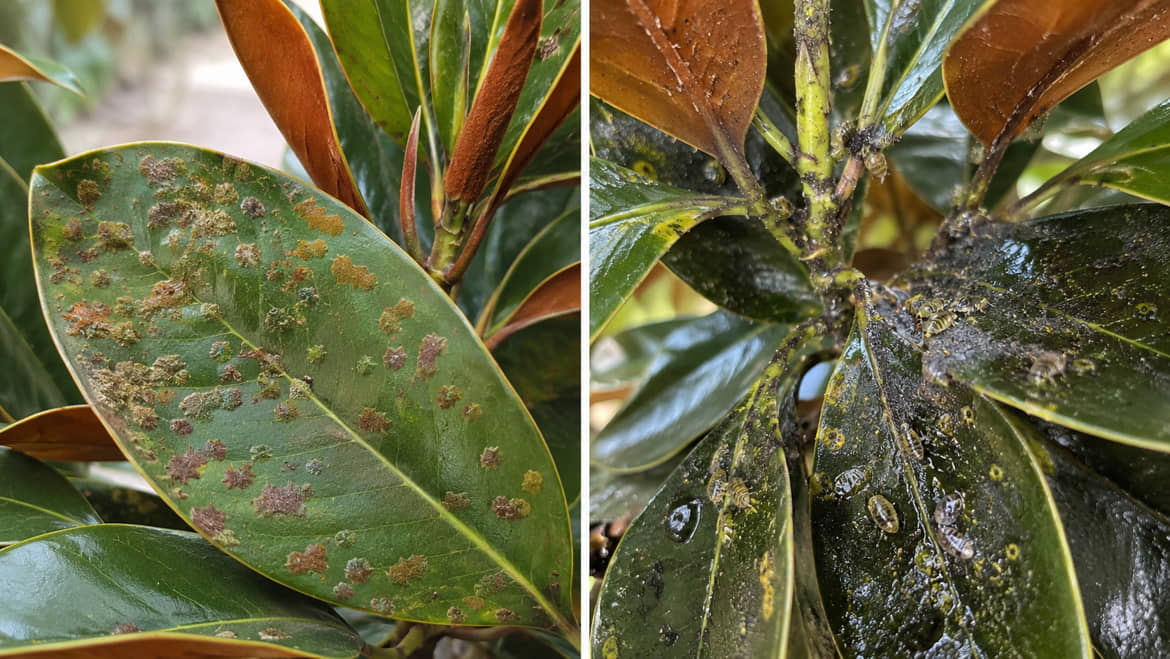
A black coating may be sooty mould growing on sticky insect honeydew. A fixed, raised patch that starts green or grey and turns rusty orange may be algal leaf spot. A dry tan area on the sun-facing side may be environmental scorch. The rusty-brown felt beneath healthy leaves may simply be normal Magnolia grandiflora foliage.
The fastest first check is simple:
Quick diagnosis: Touch the marked leaf and inspect both sides. If the surface is sticky and the black coating can be loosened or wiped away, look for honeydew-producing insects on stems and leaf undersides. If the patch is not sticky and feels fixed, raised, fuzzy or velvety, algal leaf spot becomes more plausible. Dry, flat damage on exposed foliage points more towards environmental stress than an insect coating.
Do not spray first and identify later. A product aimed at insects will not fix an algal colony, and a fungicide will not solve sticky honeydew while the insects producing it remain on the tree.
First Check: Is the Leaf Sticky?
Stickiness is one of the most useful clues because it separates a surface growing on sugary honeydew from many fixed leaf lesions.
Sticky leaves with a black coating
Inspect for:
- shiny or tacky leaf surfaces
- black, charcoal or grey film
- ants moving along stems
- small bumps or insects on twigs and leaf undersides
- sticky surfaces on plants, paving or furniture below the tree
- coating that loosens when gently wiped with a damp cloth
This pattern points towards honeydew-producing insects and secondary sooty mould.
Not sticky, with fixed or velvety patches
Inspect for:
- circular green, grey, orange or rust-brown patches
- a slightly raised, fuzzy, crusty or velvety texture
- patches that remain attached when gently rubbed
- spotting concentrated on older foliage
- symptoms becoming more noticeable after warm, wet or humid conditions
- similar marks on nearby leathery-leaved plants
This pattern may indicate algal leaf spot, although photographs or laboratory examination may be needed to distinguish it from fungal spotting and other surface growths.
Quick Symptom Table
| What you see | Sticky? | Typical location | What it may suggest | What to check next |
|---|---|---|---|---|
| Black or charcoal film that can be loosened or wiped | Usually yes | Upper leaf surfaces, stems and objects beneath the tree | Sooty mould growing on insect honeydew | Inspect stems and leaf undersides for aphids, soft scale or other sap-feeding insects |
| Shiny clear residue before black mould develops | Yes | Leaves, twigs and surfaces below infested growth | Fresh honeydew | Look above the sticky area for insects and ants |
| Raised or velvety green patches turning orange or rust-brown | Usually no | Leaf surface, often older foliage | Possible algal leaf spot | Check texture, humidity, leaf wetness, airflow and whether patches remain fixed |
| Flat brown or dark spots with a defined edge | No | Scattered across individual leaves | Possible fungal, bacterial or other leaf spotting | Photograph both sides and watch whether spots spread, merge or develop halos |
| Dry tan or brown patches on the exposed side | No | Outer or sun-facing foliage, especially near paving or walls | Heat, wind, salt or spray injury | Compare the damaged side with sheltered growth and review recent weather or chemical use |
| Uniform rusty-brown felt on the underside of otherwise healthy leaves | No | Lower surface across many healthy leaves | Normal Southern Magnolia foliage | Compare several undamaged leaves before treating |
| Yellowing around spots or early leaf drop | Variable | Individual affected leaves or a wider part of the canopy | More significant leaf stress or a developing health problem | Check drainage, root-zone moisture, overall vigour and whether branches are also declining |
| Spots plus cracking bark or an entire shoot dying | Not a useful clue | Leaves and the affected twig or branch | Problem may extend beyond the leaf surface | Inspect wood and branch health; consider professional diagnosis |
Velvety Green or Rusty Patches: Possible Algal Leaf Spot
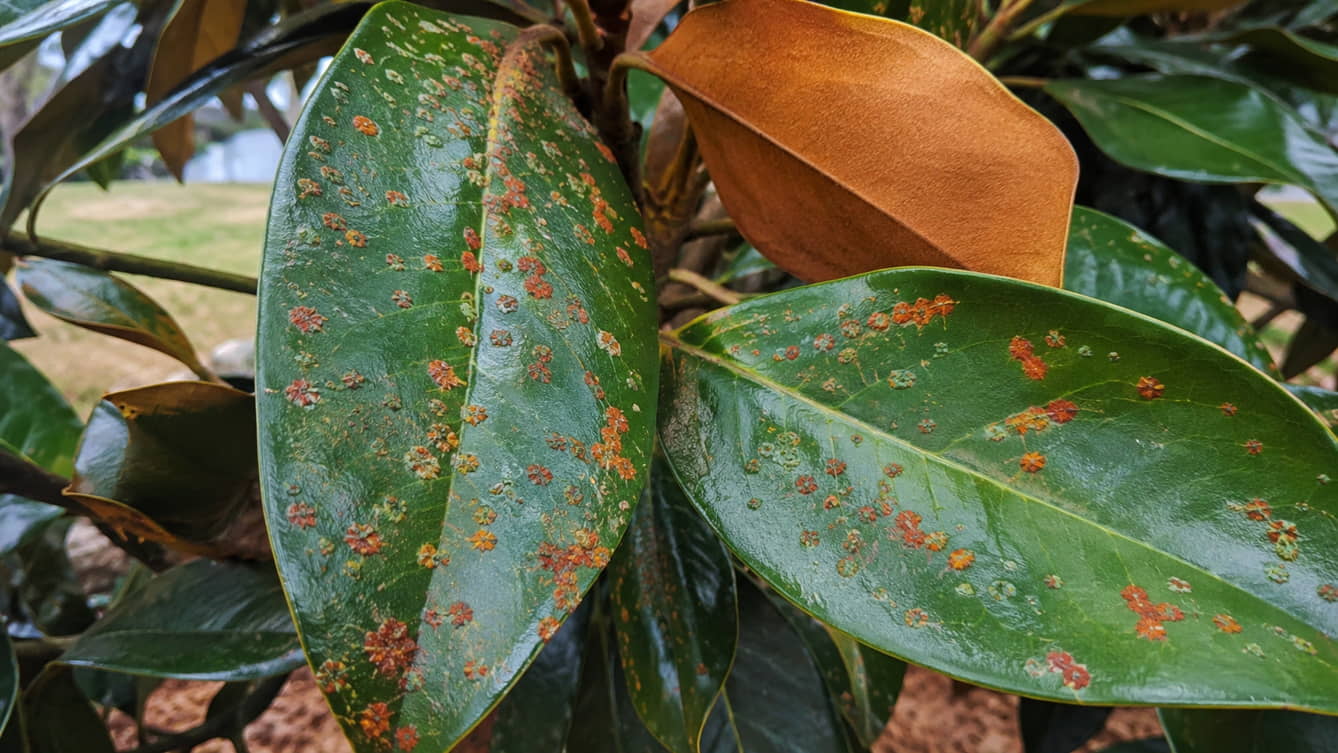
Southern Magnolia, Magnolia grandiflora, is a documented host of algal leaf spot caused by Cephaleuros virescens.
Despite the disease-style name, the organism is an alga rather than an insect. An insecticide will not control it.
Mississippi State University Extension describes early colonies as round, green and somewhat fuzzy or velvety. As they age, they can turn reddish-brown, while associated surface fungi may make some patches appear grey. Warm, humid weather and wet conditions support spread. (Mississippi State University Extension)
What algal leaf spot may look like
Look for:
- round or irregular cushion-like colonies
- green or grey patches when young
- orange, reddish-brown or rusty patches as they age
- a fuzzy, flaky, crusty or velvety surface
- fixed markings rather than a loose black film
- several spots merging into a larger patch
Missouri Botanical Garden similarly describes greyish, green, brown or orange cushion-like blotches that may become raised and velvety. (Missouri Botanical Garden)
These signs are useful clues, not a guaranteed diagnosis. Fungal growth can occur alongside the alga, and photographs alone may not separate every mixed infection.
Why it appears
Algal leaf spot tends to be more noticeable where the tree is already under stress or where foliage remains wet for long periods.
Possible contributing conditions include:
- warm, humid weather
- frequent wetting from rain or irrigation
- limited drying around dense foliage
- poor overall tree vigour
- repeated leaf wetness combined with heat
- infected fallen leaves remaining around the tree
Do not interpret this as a rigid climate rule. A humid Australian garden can provide suitable conditions, but a rusty spot is not automatically algal leaf spot.
What to do first
Start with the growing environment:
- compare affected and unaffected leaves
- remove badly marked fallen leaves from around the tree
- avoid repeatedly wetting the foliage when irrigating
- improve airflow only where nearby vegetation is genuinely overcrowded
- inspect drainage and root health
- avoid heavy pruning that creates additional stress
Many leaf spots are primarily cosmetic on an otherwise vigorous tree. Treatment decisions should depend on severity, spread and whether twigs or branches are also affected.
Black and Sticky Leaves: Honeydew and Sooty Mould
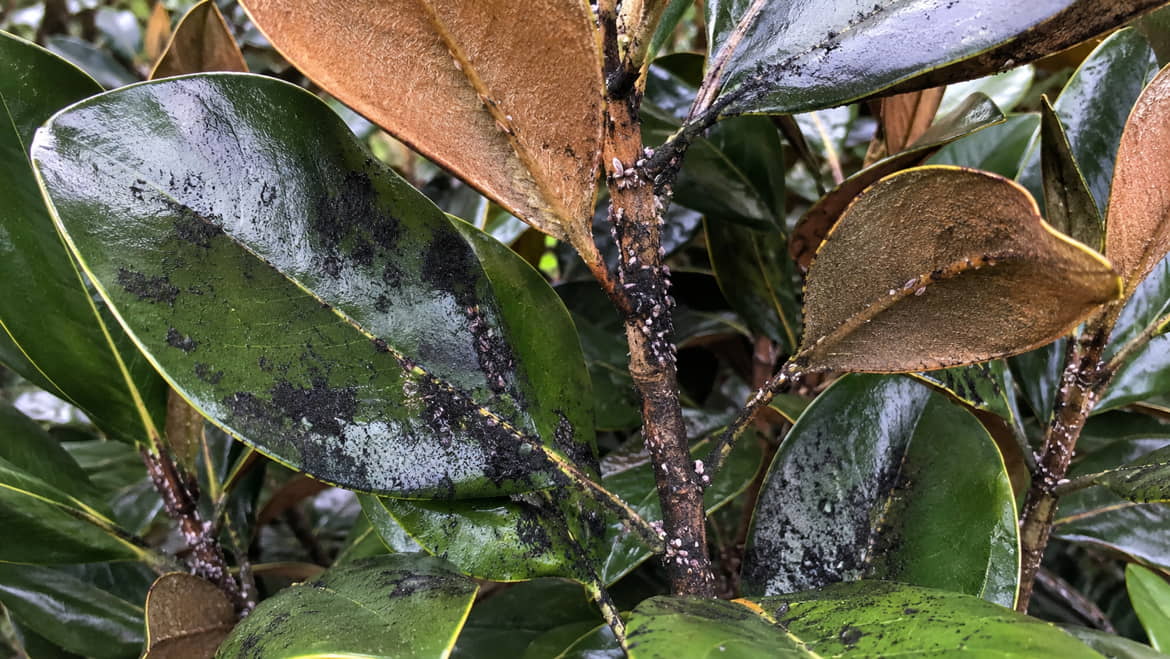
Sooty mould is not usually the original pest.
It is a dark fungal growth that develops on sugary honeydew left by sap-feeding insects such as aphids and some soft scale insects. University extension guidance notes that honeydew can coat leaves and nearby surfaces, attract ants and support black sooty mould. (University of Minnesota Extension)
Signs that point towards sooty mould
Look for:
- sticky or shiny foliage
- black film on the upper leaf surface
- ants moving along stems
- dark coating on plants or objects below infested growth
- small insects, shells or bumps on twigs and leaf undersides
- black growth that can be loosened or wiped from otherwise intact tissue
Sooty mould can often be physically washed or wiped from small accessible surfaces, but cleaning the leaf does not remove the source of the honeydew. The insects must be identified first. (University of Minnesota Extension)
Inspect before treating
Use a torch or phone camera to inspect:
- the underside of affected leaves
- young twigs
- branch junctions
- growth directly above the sticky foliage
- ants repeatedly visiting the same stems
Do not assume every small bump is a pest. Magnolia bark, buds and old leaf scars can also create natural raised features.
For the existing pest-management pathway, use our Teddy Bear Magnolia problems and fixes guide. That page already explains why the insect source matters more than the black coating itself.
Flat Brown or Dark Spots
A flat lesion is different from a cushion-like algal colony or a loose film of sooty mould.
Possible clues include:
- a defined dark edge
- a tan, grey or pale centre
- yellow tissue around the lesion
- spots merging as damage progresses
- leaf tissue becoming thin, brittle or dead
- spots that do not feel raised or velvety
These features may suggest fungal, bacterial or other leaf spotting, but visual similarity is common. Southern Magnolia diagnostic records include several fungal leaf spots, suspected bacterial spotting and environmental injury, which is why naming a pathogen from one photograph is unreliable. (Mississippi State University Extension)
Do not diagnose from colour alone
“Brown spot” is a description, not a diagnosis.
Before treating, record:
- whether the mark is on one leaf or spreading
- whether new or old leaves are affected
- whether the upper and lower surfaces look different
- whether the spot is flat, raised, sticky or powdery
- whether the same side of the canopy is affected
- whether recent irrigation, weather or spraying changed
A close photograph of both leaf surfaces is more useful than a general photograph of the whole tree.
Dry Brown Patches: Scorch, Wind, Salt or Spray Injury
Not every brown patch is alive or spreading.
Environmental damage is more likely when the affected area is:
- dry and papery
- concentrated on the exposed side of the tree
- worse beside reflective paving, walls or fencing
- strongest on outer leaves
- associated with hot wind or a sudden weather change
- shaped like droplets or spray contact
- limited to foliage reached by a recent garden chemical
Compare sheltered and exposed sides of the tree.
A sharp boundary between healthy and damaged foliage may reflect where heat, wind or spray reached, but that pattern is still only a clue. Root stress can make foliage more vulnerable to the same conditions.
Do not apply a fungicide to a suspected burn pattern. Review the site, irrigation, recent weather and any herbicide, cleaner or foliar product used nearby.
Our Teddy Bear Magnolia planting and establishment guide explains how drainage, planting depth and root-zone stress can affect the canopy.
The Rusty-Bronze Leaf Underside May Be Normal
Turn over several healthy Teddy Bear Magnolia leaves before diagnosing rust.
Magnolia grandiflora commonly has glossy green upper leaf surfaces and a fine rusty, bronze or red-brown felt beneath. The amount and colour vary between cultivars and individual leaves. University of Florida guidance describes the lower surface of Southern Magnolia foliage as having fine red-brown fuzz, while several compact cultivars are noted for bronze undersides. (UF/IFAS)
Normal bronze felt is more likely when:
- it covers the underside fairly evenly
- the upper surface remains healthy and green
- similar colouring appears across many leaves
- the texture follows the natural leaf surface
- there is no sticky residue, expanding lesion or dying tissue
A healthy bronze underside does not need treatment.
Concern is more justified when patches are irregular, raised, spreading, associated with yellowing, or accompanied by damage on the upper surface.
Check Whether the Mark Rubs Away
A gentle surface test can provide useful information.
Use a damp white cloth on one accessible affected leaf:
- a loose black coating that transfers to the cloth supports sooty mould
- sticky residue supports honeydew
- a fixed, textured or velvety colony is more consistent with a leaf lesion or algal growth
- healthy bronze felt on the underside should not be scrubbed away
Do not scrape aggressively. Damaging the leaf surface can make the result harder to interpret.
Wash your hands afterwards, especially if the tree has recently been sprayed.
What to Inspect Before Using Any Treatment
Before buying a product, record:
- whether the mark is sticky
- whether it wipes away
- whether it is flat or raised
- whether it is on the upper surface, underside, stem or branch
- whether insects or ants are present
- whether the damage is spreading
- whether the tree is otherwise growing normally
- whether the root zone remains wet or unusually dry
- whether a spray, fertiliser or cleaner was recently used nearby
- whether whole shoots or branches are declining
This is more useful than choosing a spray from a photograph alone.
Australian pesticide rule
Where chemical control is genuinely justified, use only an APVMA-registered product whose current label covers:
- the identified pest or disease
- ornamental-plant use
- the intended application method
The APVMA states that a use not specified on the product label has not been assessed or approved for that product, even where a similar product carries that use. (APVMA)
Do not copy an active ingredient, product name or seasonal application schedule from a North American article. Overseas timing advice may refer to a different insect, climate and regulatory system.
When It Is No Longer Only a Leaf-Surface Problem
Stop treating the issue as a cosmetic leaf spot when you see:
- cracking or sunken bark
- repeated lesions extending onto twigs
- an entire shoot or branch declining
- leaves wilting on one branch while the rest remains firm
- severe premature leaf drop
- weak new growth across the whole tree
- symptoms continuing despite improved growing conditions
Algal leaf spot can sometimes extend to twigs, while other branch problems require a different inspection process. (Mississippi State University Extension)
Do not diagnose canker, vascular disease or root failure from the leaf surface alone. An experienced arborist, plant-health laboratory or local diagnostic service may be more useful than repeated treatment.
If poor flowering appears alongside broader decline, use our Teddy Bear Magnolia not flowering guide after checking the tree’s overall health.
A Practical Order for Diagnosis
Use this sequence:
1. Touch the surface
Is it sticky, dry, powdery, raised or velvety?
2. Check whether it transfers
Does black material come away on a damp cloth, or is the patch fixed to the leaf?
3. Turn the leaf over
Is the colour simply the normal bronze felt beneath healthy Magnolia foliage?
4. Inspect the stems
Look for insects, ants, damaged bark or extension of the marking beyond the leaf.
5. Compare the canopy
Is damage scattered, concentrated on the exposed side, or limited to one branch?
6. Review recent conditions
Consider heat, wind, irrigation, prolonged leaf wetness and any chemical used nearby.
7. Treat only after identification
Do not use an insecticide on an algal patch, a fungicide on scorch, or a leaf treatment when the branch or roots are declining.
For the broader Teddy Bear Magnolia cluster, see our Teddy Bear Magnolia size and growth guide.
Frequently Asked Questions
What causes rusty or orange spots on Teddy Bear Magnolia leaves?
Raised or velvety green patches that age to orange or reddish-brown may indicate algal leaf spot. Normal Magnolia leaf undersides can also be rusty-bronze, so compare the upper and lower surfaces and check whether the mark is irregular, raised or spreading before treating.
How can I tell sooty mould from algal leaf spot?
Sooty mould is usually associated with sticky honeydew and forms a loose black coating that may be wiped or washed from the surface. Algal leaf spot is generally fixed to the leaf and may appear raised, fuzzy or velvety, changing from green or grey to orange or rust-brown.
Why are my Magnolia leaves black and sticky?
Black, sticky foliage often points towards honeydew from sap-feeding insects with sooty mould growing on the sugary residue. Inspect twigs and leaf undersides for insects and check for ants before treating the black coating itself.
Is the brown underside of Teddy Bear Magnolia leaves normal?
Often, yes. Southern Magnolia foliage naturally has a rusty, bronze or red-brown felt beneath the leaves. It is more likely to be normal when the colour is even across many healthy leaves and the upper surfaces remain green.
Do all Magnolia leaf spots need treatment?
No. Some markings are cosmetic, environmental or part of normal foliage. Identify whether the mark is sticky, raised, spreading or associated with wider decline before deciding whether treatment is needed.
Can algal leaf spot affect Magnolia branches?
It can sometimes extend beyond leaves and affect twigs. If spots are accompanied by cracking bark, twig lesions or an entire shoot declining, the problem needs a broader diagnosis rather than leaf-surface treatment alone.
When should I get a Magnolia leaf problem professionally diagnosed?
Seek professional help when symptoms are spreading rapidly, whole branches are declining, bark is damaged, the tree is structurally important, or repeated treatments have been attempted without a confirmed diagnosis.
Final Thoughts
The colour of a spot is not enough to identify it.
Start with texture and stickiness:
- sticky black film suggests honeydew and sooty mould
- fixed velvety green-to-rust patches suggest possible algal leaf spot
- flat dry damage suggests a leaf lesion or environmental injury
- uniform bronze felt beneath healthy leaves may be completely normal
Then inspect the insects, stems, root zone and recent conditions before treating anything.
The goal is not to name every mark from a photograph. It is to avoid applying the wrong treatment to the wrong problem.