
Photinia Red Robin Hedge in Australia: Size, Spacing, Care & Problems

Quick take
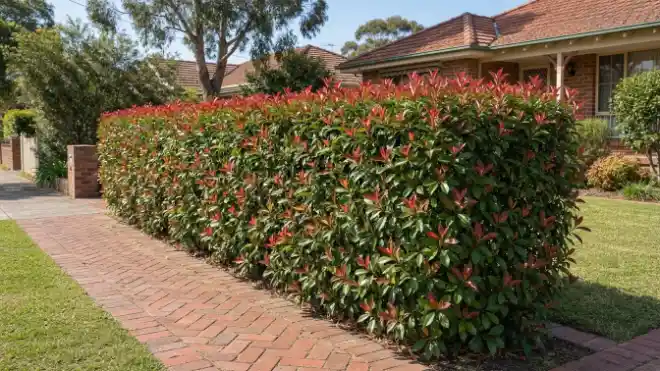
Photinia × fraseri ‘Red Robin’ is a fast, evergreen hedging shrub grown for its glossy red new growth. Left unclipped it can reach roughly 4–5 metres tall and wide, but as a clipped hedge most people keep it around 2 metres. Plant 60–80 cm apart for a dense formal hedge, or up to about 1–1.5 m for a looser screen or larger stock. It colours best in full sun, needs well-drained soil, and tolerates moderate frost once established. Its main weakness is a fungal leaf spot (Entomosporium) that flares up in wet, crowded, poorly-ventilated plantings — so good spacing, airflow and keeping foliage dry are the first controls; fungicide is not a substitute for correcting wet, crowded conditions.
| Botanical name | Photinia × fraseri ‘Red Robin’ |
|---|---|
| Type | Evergreen hedging / screening shrub |
| Size, unclipped | ~4–5 m high & wide |
| Height, commonly maintained | Around 2 m, depending on pruning |
| Spacing | 60–80 cm (dense hedge) to ~1–1.5 m (looser screen) |
| Position | Full sun for best red colour; tolerates part shade |
| Soil | Well-drained; resents wet feet |
| Frost | Moderate frost once established; soft growth is tender |
| Growth rate | Fast / vigorous |
| Main problem | Entomosporium leaf spot in wet, crowded plantings |
The honest answer is “it depends on whether you clip it.” Grown as an open shrub and left unpruned, Red Robin naturally reaches about 4–5 metres high and roughly as wide — the size botanic-garden plant profiles list for it in the ground with room to run. In practice almost nobody grows it that way. As a clipped hedge it’s usually held at around 2 metres, and it takes tight trimming happily, which is exactly why it became one of the most planted hedge shrubs in the country.
So when you read a label or nursery page, check whether the height quoted is the natural size or a maintained hedge height — they can differ by two or three metres. Plan your hedge around the height you’re willing to keep trimming to, not the biggest number on the tag.
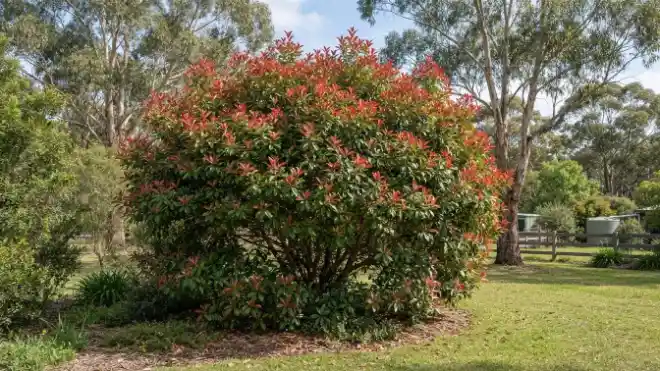
Spacing is a trade-off between how fast the hedge closes up and how much airflow each plant gets. What should decide it is the look you’re after (tight formal face vs soft screen), the pot size you’re planting from, and — importantly — airflow.
Spacing decision: err closer for a dense, private hedge, but not so tight that air can’t move along the row — stagnant, humid foliage is what invites leaf spot. Don’t just copy the plant’s mature width as your spacing, or you can end up with a sparse, gappy hedge.
| Spacing | What you get |
|---|---|
| 60–80 cm apart | Dense, formal clipped hedge that fills in quickly — the go-to for privacy |
| ~1–1.5 m apart | Looser, informal screen or larger advanced stock — slower to knit together |
At the nursery you’ll often see Red Robin beside something labelled Photinia Robusta, and the names aren’t always used consistently between growers — so treat these as general garden categories rather than rigid botanical facts. The figures below are nursery-reported ranges, and heights depend heavily on whether the plant is clipped.
| Red Robin | Plants sold as ‘Robusta’ | |
|---|---|---|
| Typical use | Clipped ornamental hedge | Taller windbreak or large screen |
| Habit | Denser, more compact | Taller, tougher, more upright |
| Height, natural / unclipped | ~4–5 m (nursery-reported) | Up to ~6 m (nursery-reported) |
| Height, commonly maintained | Around 2 m, depending on pruning | Kept taller as a screen |
| New growth | Bright red flush | Bright red flush |
| Best for | A dense, colourful hedge around 2 m | A 4–6 m boundary windbreak |
Because labelling varies, ask the nursery exactly what mature size and habit their stock is grown to, rather than assuming from the name alone.
Give Red Robin full sun if you can — it still grows in part shade, but the red new growth is brightest and the hedge stays densest in good light. The non-negotiable is drainage: like most photinias it resents wet feet, so improve heavy clay with compost and consider a raised bed in soggy spots. Water consistently until established, including through the first summer when rainfall is insufficient; once settled it’s fairly tough.
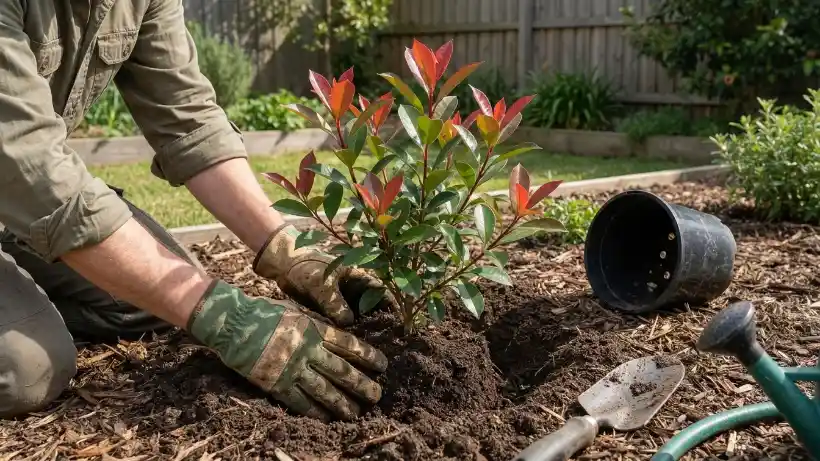
| Site factor | What Red Robin wants |
|---|---|
| Light | Full sun for the brightest red and densest growth; tolerates part shade |
| Soil & drainage | Free-draining; improve clay, avoid waterlogged spots |
| Frost | Moderate frost once established; protect soft new growth |
| Airflow | Room for air to move along the row to limit leaf spot |
On frost, be a little cautious with the numbers online. Photinia as a group is reasonably cold-hardy and Red Robin tolerates moderate frost once established; some general Bunnings guidance quotes cold tolerance to around −10 °C for photinias broadly, but treat that as a family-level figure rather than a guaranteed limit for this cultivar in your garden.
The red leaves everyone plants Red Robin for are new growth, so pruning is what keeps the colour coming — pruning encourages another flush of red new growth, and the plant responds well to regular clipping.
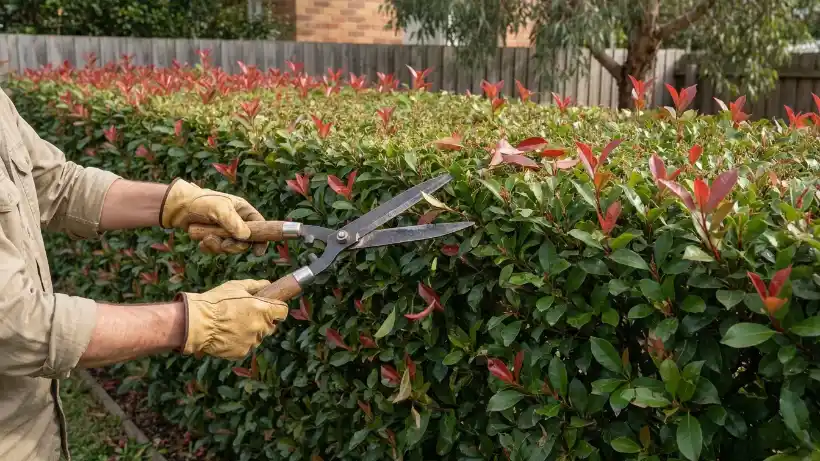
| Pruning goal | What to do |
|---|---|
| Drive the red flush | Light trims through the warm growing season; each trim pushes fresh red growth |
| Keep it dense | Informal hedge: one or two shaping trims; formal hedge: more frequent light trimming during active growth |
| Keep the base full | Trim sides as well as the top; keep the base slightly wider than the top so light reaches lower leaves |
| Timing | Time harder cuts for the warm months so soft red regrowth isn’t pushed straight into frost |
Timing tip: avoid hard pruning heading into your coldest weeks — soft new growth is the most frost-tender part of the plant.
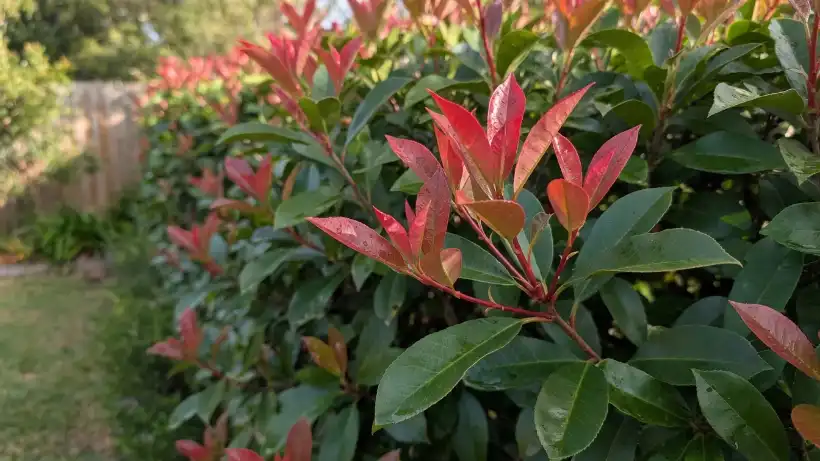
The one issue that catches Red Robin growers out is Entomosporium leaf spot, a fungal disease — and it’s worth being straight about it rather than pretending the plant is trouble-free. Small round red to reddish-purple spots appear on the newest leaves, often with a darker or reddish edge; on badly affected plants the spots merge into larger maroon blotches and leaves yellow and drop. It’s the new growth that’s most vulnerable. The pathogen can persist on infected foliage and fallen debris, while rain and overhead irrigation splash spores onto healthy new leaves; because Photinia is evergreen, infection can remain on attached foliage year-round. Dense planting with poor air circulation makes hedges more susceptible.
Leaf-spot prevention, in order of importance
Get the growing conditions right first — airflow, dry foliage and hygiene do more than any spray. Space for ventilation, water at the base rather than over the top, and rake up and bin fallen spotted leaves so they don’t carry the fungus into the next flush. A fungicide is a last resort, not a substitute for fixing wet, crowded conditions.
| What you see | First thing to check | Practical response |
|---|---|---|
| Round red-purple spots merging into maroon blotches on new leaves | Is the row crowded, humid or watered overhead? | Improve airflow, water at the base, remove and bin fallen spotted leaves; ask a professional about an AU-registered product if it persists |
| Yellowing leaves, widespread | Is the soil wet or poorly drained? | Fix drainage / stop overwatering; improve clay soils before replanting |
| Sticky or spotted soft growth | Scale or aphids on the new tips? | Manage with the same good-airflow, good-drainage approach; treat pests if needed |
We’re not going to tell you Red Robin is “disease-resistant,” because in warm, humid, crowded conditions it genuinely isn’t. Grown with room to breathe and sensible watering, though, most hedges stay clean and glossy.
✔ Good signs on the plant
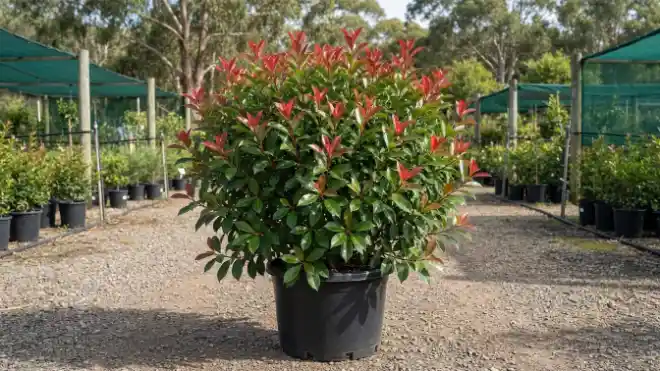
- Even, bright red new growth at the tips — this is normal and healthy, not a problem
- Glossy, dense foliage right down to the base
- Firm, well-rooted plant that isn’t pot-bound
- Stock the nursery can tell you the mature size and habit of
❌ Red flags to pass on
- Discrete circular spots with grey or brown centres
- Yellowing leaves, dark blotches, or premature leaf fall
- Thin, gappy foliage or a bare base
- Sparse roots, or roots circling a pot-bound plant
Red leaves alone are not a sign of disease — the red flush is exactly what Red Robin is grown for. Look for discrete spots, grey or brown centres, yellowing, blotches or premature leaf fall instead. These signs point to a possible problem and are not a diagnosis by appearance; if in doubt, ask a qualified nursery or garden professional.
Before you buy: decide your target hedge height and whether you want a dense formal hedge or a looser screen, then confirm the cultivar, expected unclipped size and recommended spacing with your supplier. For a very narrow bed, compare Red Robin with a purpose-bred narrow cultivar such as Thin Red™ (its breeder specifies two plants per linear metre for screening — a separate cultivar, so don’t apply that density to standard Red Robin).
- Ask what mature size and habit the stock is grown to — not just the cultivar name — so you’re choosing a true hedge form, not a windbreak type by mistake.
- Decide Red Robin (clipped ornamental hedge) vs a Robusta-type (taller windbreak) before you buy, based on the height you actually want.
- Match it to your conditions: full sun, free-draining soil, and room for air to move along the row.
Weighing Red Robin against other screens? It’s worth comparing it with a lilly pilly hedge or a murraya hedge, two of the other go-to choices for Australian gardens.
How big does Photinia Red Robin grow in Australia?
Unclipped it can reach about 4–5 m high and wide, but as a hedge it’s usually kept around 2 m with regular trimming.
How far apart should I plant Red Robin for a hedge?
About 60–80 cm apart for a dense clipped hedge, or up to roughly 1–1.5 m for a looser screen or from larger stock.
Is Photinia Red Robin fast growing?
Yes – it’s a vigorous evergreen that establishes and fills in quickly, which is a big part of why it’s such a popular hedge.
Why does my Red Robin have red spots on the leaves?
Red spots can be caused by Entomosporium leaf spot, especially where foliage stays wet and airflow is poor, but appearance alone is not a diagnosis. Improve ventilation, water at the base, remove fallen leaves, and seek qualified advice if the problem persists.
When should I prune Photinia Red Robin?
Trim lightly through the warm growing season to encourage fresh red growth and keep the hedge dense; avoid hard pruning right before frost.
What’s the difference between Red Robin and Photinia Robusta?
Nursery naming varies, but Robusta is generally sold as the taller windbreak type and Red Robin as the more compact, commonly clipped ornamental hedge.
Does Photinia Red Robin need full sun?
It grows in part shade but colours up best and stays densest in full sun.
Is Red Robin frost hardy?
It tolerates moderate frost once established; soft new growth is the most frost-tender, so don’t prune hard going into cold weather.
Reviewed note: size and spacing figures for Red Robin vary between Australian nurseries and botanic-garden sources because they depend on whether the plant is clipped and on local conditions; we’ve given ranges rather than single numbers. Leaf-spot guidance combines Australian horticultural advice with university plant-pathology sources. Always check the plant label, supplier guidance and your local growing conditions before planting a new hedge.

