
Grevillea ‘Scarlet Moon’ Australia: Size, Flowers & Care Guide

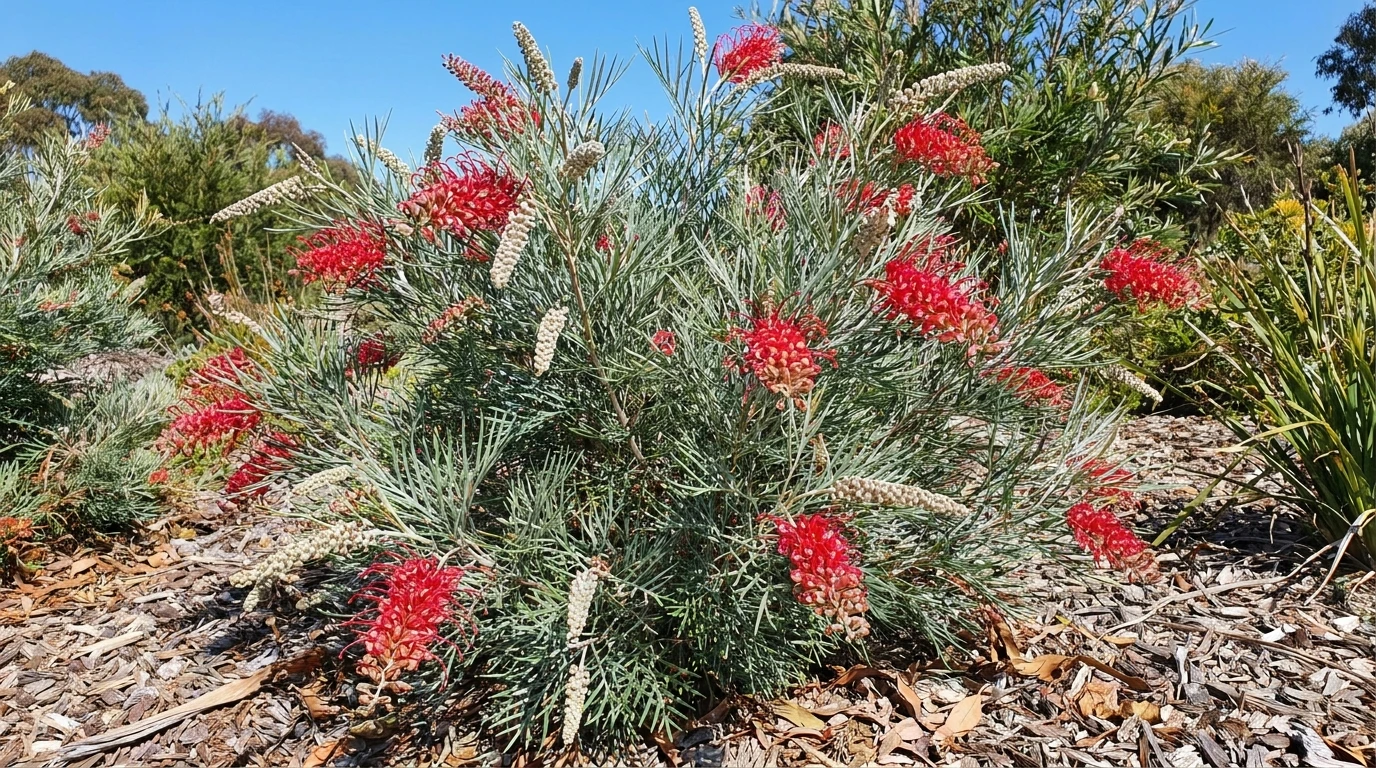
Grevillea ‘Scarlet Moon’ is a genuine Kings Park-bred hybrid that matures at about 1.6 m high × 1.6 m wide, flowers in scarlet-red toothbrush clusters across the year and works best in full sun with freely drained soil. Kings Park gives the cultivar at 1.6 × 1.6 m; Mountain View Nursery publishes the same dimensions, while Ladybird Nursery lists a similar mature height of about 1.5 m.
That makes ‘Scarlet Moon’ a useful middle-sized Grevillea: large enough to work as an informal screen or substantial feature shrub, but compact enough for mixed beds and large containers. On our own native-garden work, this is the size class we like when a low groundcover will disappear but a 3–4 m Grevillea would dominate the planting.
There is also an important naming point. ‘Scarlet Moon’ is not a species called Grevillea scarlet moon. IP Australia records it as the accepted Grevillea hybrid variety ‘GR34’, with Scarlet Moon as its synonym, bred through the Botanic Gardens and Parks Authority. Friends of Kings Park records complex parentage involving Grevillea nivea, G. banksii, G. formosa and G. pteridifolia.
Scarlet Moon is a documented hybrid, not a nursery marketing name
IP Australia provides the clearest identity record. Its Plant Varieties Journal lists the plant as a Grevillea hybrid, variety ‘GR34’, with Scarlet Moon as the synonym. The application was received in 2015 and accepted in 2016, with the Botanic Gardens and Parks Authority recorded as the title holder.
Friends of Kings Park gives the breeding story behind that formal record. Scarlet Moon came from the Kings Park breeding program and has complex parentage involving the rare Western Australian Grevillea nivea, together with G. banksii, G. formosa and G. pteridifolia.
For us, that matters because it prevents a common content mistake: copying the soil, frost or growth characteristics of one parent species and presenting them as if they automatically belong to Scarlet Moon. This guide uses cultivar-specific evidence wherever it exists.
How big does Grevillea ‘Scarlet Moon’ actually grow?
The breeder-linked Australian sources are unusually consistent. Kings Park lists the shrub at 1.6 m high × 1.6 m wide. Mountain View Nursery gives the same 1.6 × 1.6 m dimensions, while Guildford Garden Centre also uses 1.6 × 1.6 m. Ladybird Nursery gives a similar height of about 1.5 m, and Princess Fancy Plants allows approximately 1.8 × 1.8 m.
| Australian source | Published mature size | How we use the figure |
|---|---|---|
| Kings Park | 1.6 m high × 1.6 m wide | Primary breeder-linked planning figure |
| Mountain View Nursery | 1.6 m high × 1.6 m wide | Independent current nursery agreement |
| Guildford Garden Centre | 1.6 m high × 1.6 m wide | WA retail confirmation |
| Ladybird Nursery | About 1.5 m high | Useful eastern-Australian nursery estimate |
| Princess Fancy Plants | Up to about 1.8 m high × 1.8 m wide | Upper practical nursery estimate |
One current Australian retail listing gives a much larger figure of 4 m high × 2 m wide, but that sits well outside the breeder-linked information and the cluster of stronger Australian nursery records. We would not use that outlier to design a garden.
For planning, we treat Scarlet Moon as a shrub in roughly the 1.5–1.8 m class. That leaves enough room for the natural canopy without turning a compact cultivar into a constant pruning project.
It is an informal screen, not a narrow formal hedge
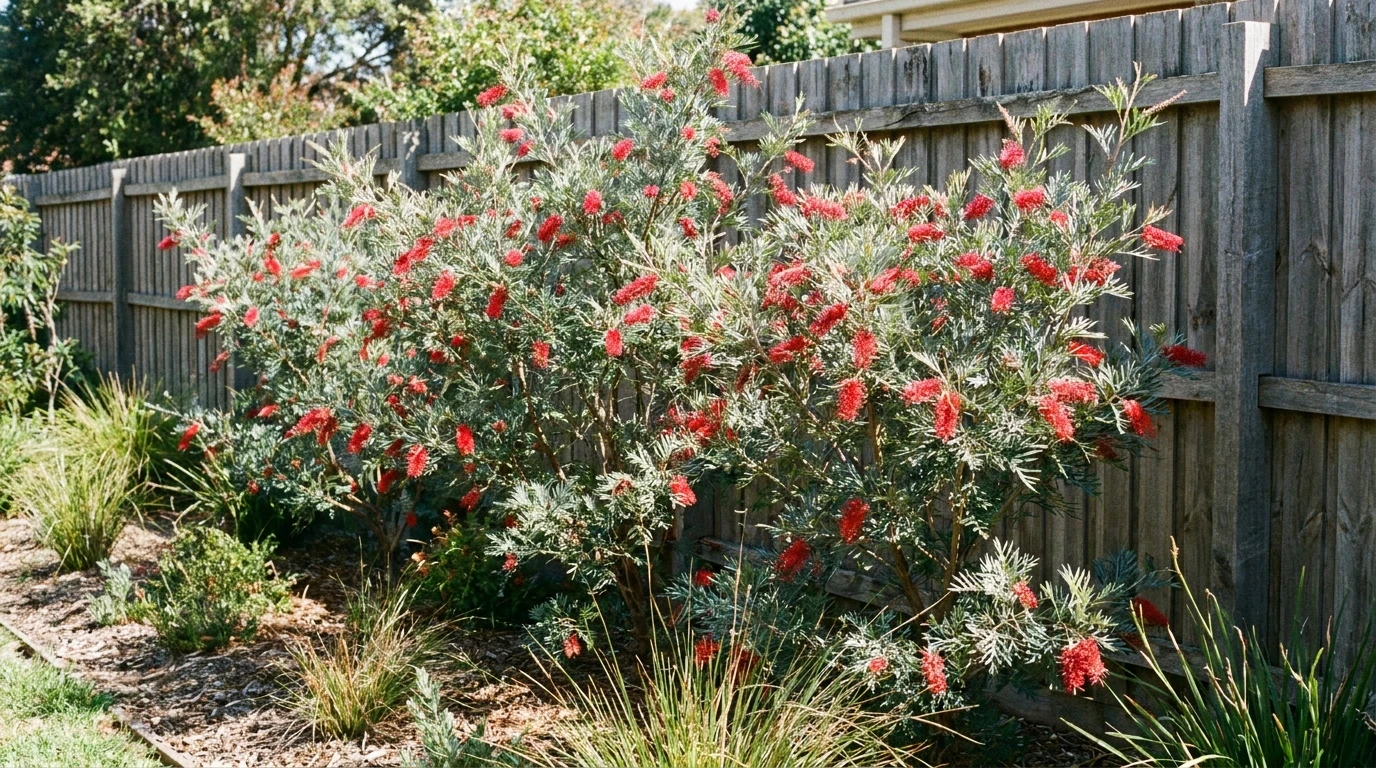
Kings Park specifically recommends Scarlet Moon for informal screening, and Friends of Kings Park makes the same recommendation. Its roughly 1.6 m height and width give it enough body to interrupt sightlines without creating a tall wall.
We like that role because the plant looks better when some of its natural shape is retained. The scarlet flower clusters sit out from the foliage and lose some of their impact if every shoot is repeatedly sheared into a hard rectangular face.
Where we want a continuous informal row, we plan from the published mature width rather than inventing an exact cultivar spacing rule. Strong Australian sources do not publish one authoritative Scarlet Moon hedge spacing figure.
| Design goal | How we would use Scarlet Moon | Why |
|---|---|---|
| Single feature shrub | Allow roughly 1.5–1.8 m of mature canopy space | Matches breeder and nursery size guidance |
| Loose informal screen | Allow neighbouring mature canopies to approach or lightly overlap | Preserves flowers and natural form |
| Rigid 1 m formal hedge | Choose another naturally dense hedge plant | Repeated shearing sacrifices much of Scarlet Moon’s flowering character |
| Mixed native bed | Use as the medium-height flowering layer | Fits between groundcovers and larger shrubs |
The flowers are the main reason to plant it
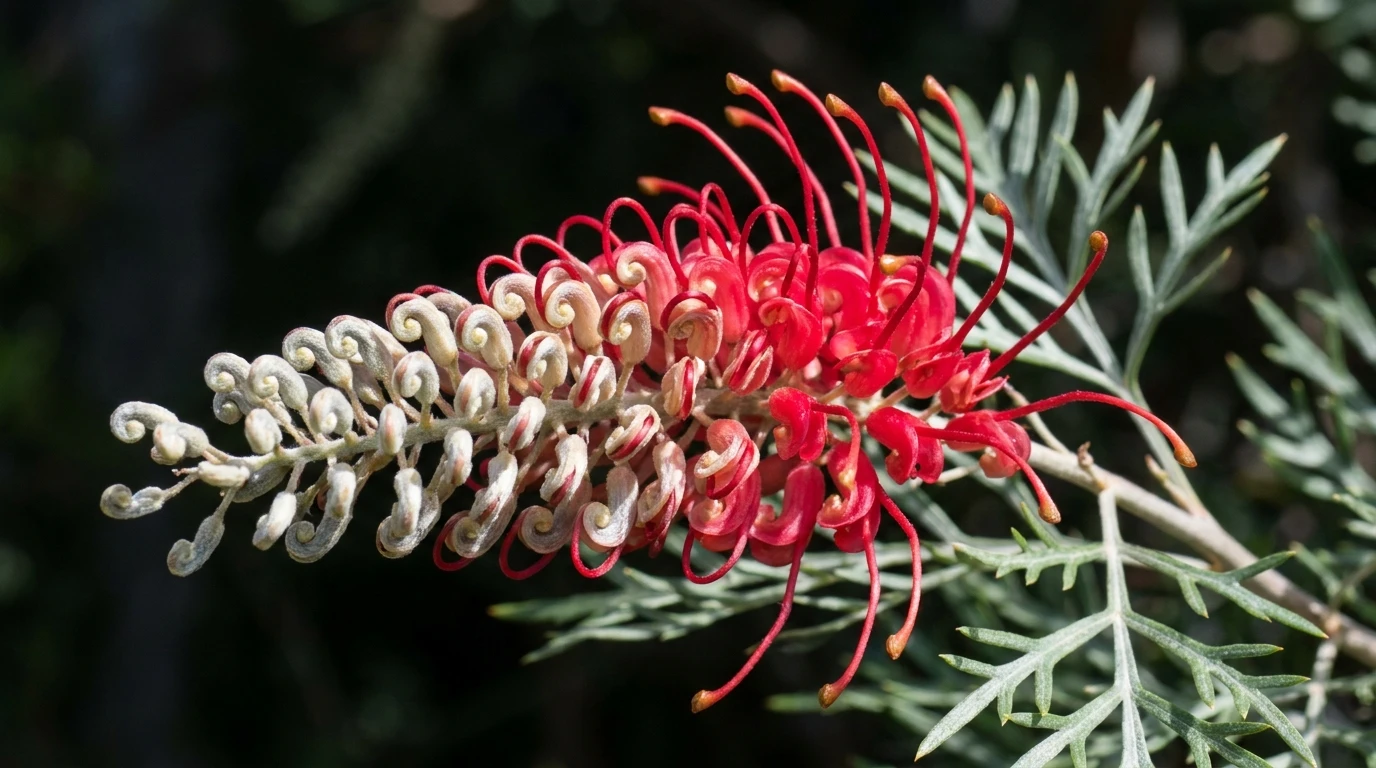
Kings Park describes Scarlet Moon as producing large scarlet flowers throughout the year. Friends of Kings Park also records year-round flowering, and Mountain View Nursery repeats the same cultivar-specific pattern.
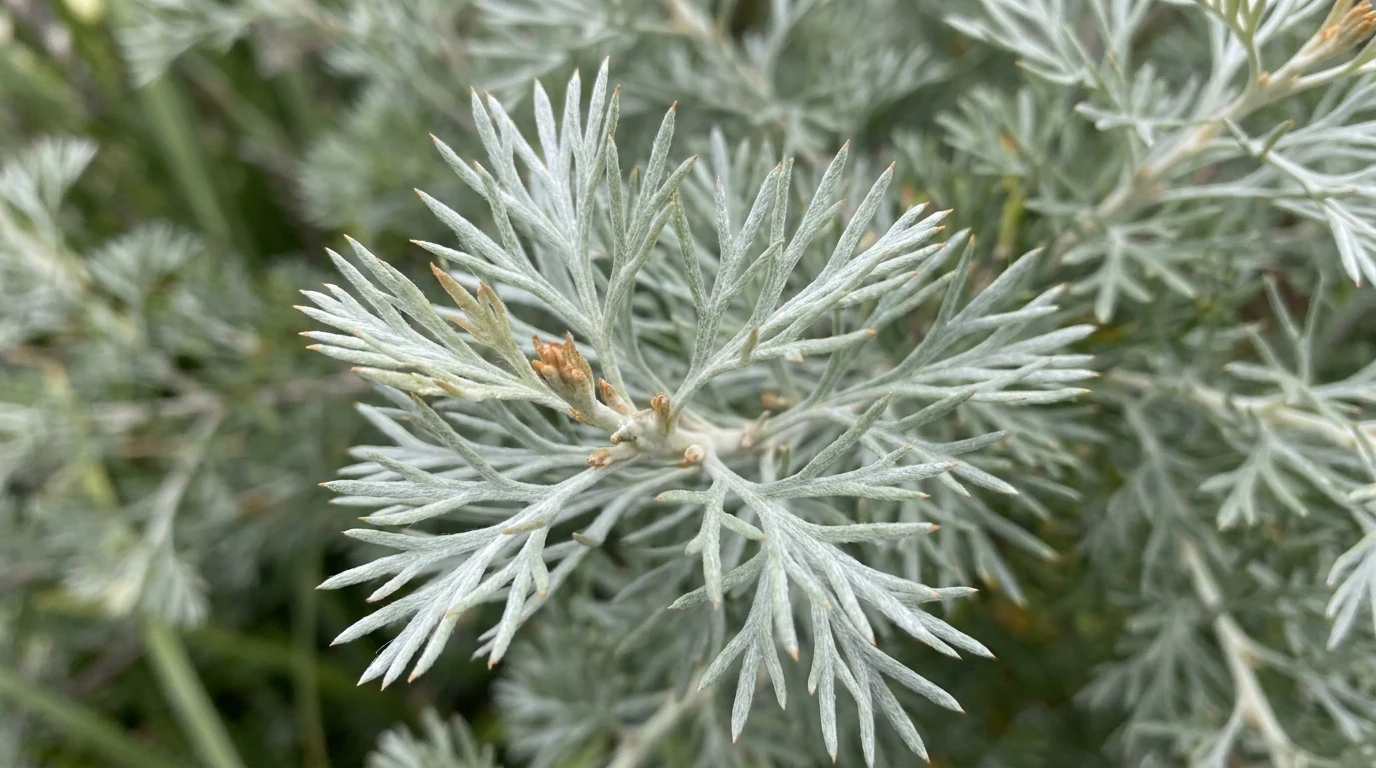
The flower clusters are the toothbrush type, with pale to white buds opening into vivid scarlet-red flowers. Against the silvery-green to vibrant green divided foliage, the contrast is unusually strong even by Grevillea standards.
“Flowers throughout the year” should be read as the cultivar’s capacity for repeated flowering, not a promise that every plant will carry the same number of blooms every week of the year. In our experience with repeatedly flowering natives, flush intensity still responds to weather, recent pruning, establishment stage and available light.
That is why we think of Scarlet Moon as a long-season flowering shrub rather than a plant with one short annual display.
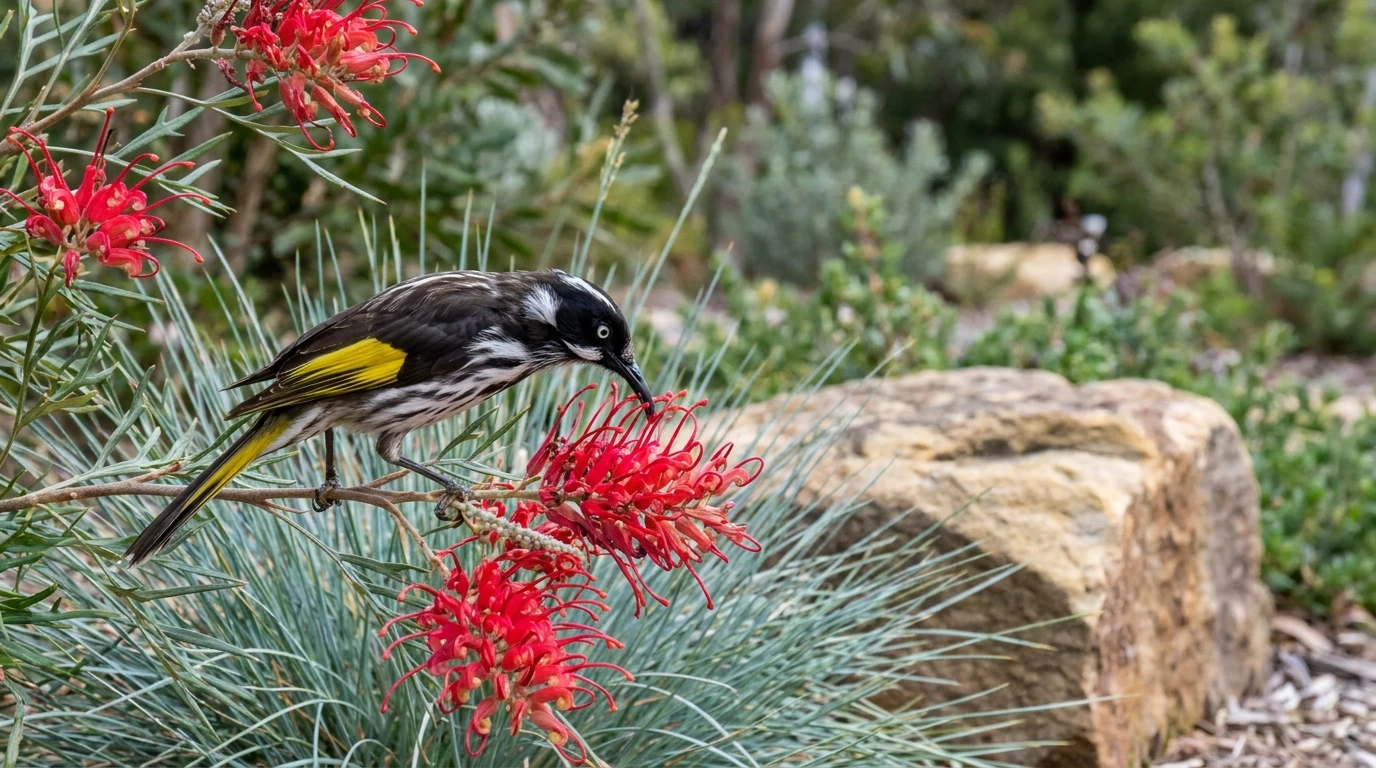
Birds and nectar-feeding insects are part of the package
Kings Park specifically describes Scarlet Moon as bird attracting. Friends of Kings Park says it is highly attractive to birds and nectar-loving insects, while Mountain View Nursery makes the same wildlife claim.
This is one of the reasons we prefer flowering Grevilleas in mixed native gardens instead of building every screen from foliage-only shrubs. A Scarlet Moon can provide medium-height structure and a recurring nectar resource in the same space.
On our own layouts, we get a better wildlife garden by combining it with plants that flower at different heights and seasons rather than expecting one cultivar to provide every habitat need.
Full sun is the safest default
Kings Park recommends full sun and well-drained soil for Scarlet Moon. Friends of Kings Park also says it grows best in full sun but can tolerate some shade for part of the day. Princess Fancy Plants lists full sun to part shade.
For the strongest flower display and densest shrub, we would choose the sunnier suitable position. Part-day shade can still work, but we would not tuck Scarlet Moon into deep shade and expect breeder-profile flowering.
In practice, we also look at surrounding growth. A position that is sunny when the garden is new can become significantly shaded after neighbouring shrubs and trees mature.
Drainage matters more than making the soil rich
Kings Park specifies well-drained soil. Friends of Kings Park goes a step further and says Scarlet Moon grows best in well-drained acidic soil, while Princess Fancy Plants notes well-drained soil with some clay or humus content.
That tells us the plant has some soil flexibility, but not an appetite for stagnant roots.
On Garden Green jobs, we are more cautious about a permanently wet planting hole than about lean native soil. If heavy clay holds water for long periods, we improve the broader drainage or raise the planting position rather than digging a deep pocket of soft mix that behaves like a bucket.
We also avoid heavily enriching the planting hole with high-phosphorus general garden fertilisers. Scarlet Moon is a Grevillea, and Grevilleas belong to the Proteaceae family, where phosphorus sensitivity is an established horticultural concern.
Use a native fertiliser, and keep the feeding modest
Kings Park recommends a slow-release native fertiliser every 6–12 months. Mountain View Nursery publishes the same 6–12 month feeding interval, as does the Scarlet Moon plant-tag information carried by Princess Fancy Plants.
That is enough nutrition guidance for this cultivar. We would not improve on it by creating a more complicated monthly feeding program.
For us, spring is the obvious time to assess an established plant. If growth is healthy and flowering is good, there is no need to keep adding fertiliser simply because the calendar allows it. If feeding is required, we use a low-phosphorus product labelled for Australian natives and follow the manufacturer’s rate.
Water regularly while it establishes, then back away
Friends of Kings Park describes Scarlet Moon as drought tolerant once established. That phrase contains the important timing: drought tolerance comes after the root system has moved beyond the nursery pot.
We water thoroughly at planting, then monitor the original root ball and surrounding soil as the shrub establishes. A fresh 140 mm or 200 mm nursery plant has nowhere near the drought resilience of the same shrub after several seasons in open ground.
Once established, we lengthen the watering interval and use deep watering during genuinely dry periods rather than keeping the root zone continuously damp.
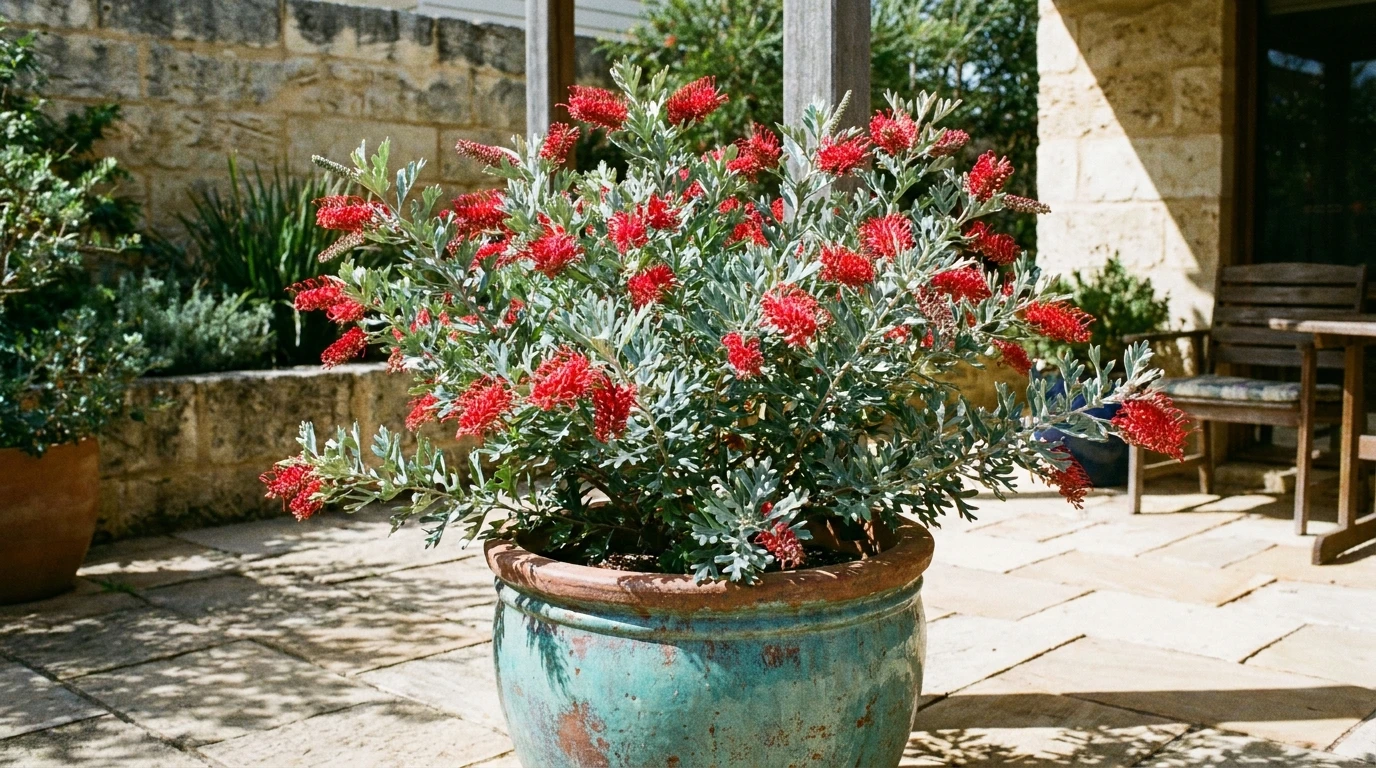
A container-grown Scarlet Moon needs closer attention. The same drought-tolerant genetics are working inside a finite volume of potting mix that can dry much faster than garden soil.
Scarlet Moon genuinely works in a large pot
Friends of Kings Park specifically recommends Scarlet Moon for an outdoor pot or well-lit patio. Mountain View Nursery also lists it for a larger decorative container, and Guildford Garden Centre includes decorative patio pots among its uses.
That recommendation makes sense at the published mature size. A roughly 1.6 m shrub is substantial enough to look like a real feature plant without immediately becoming tree-scale.
In pots, drainage becomes even more important. We use a free-draining native mix, unrestricted drainage holes and enough container volume that the mature shrub is not constantly drying out or becoming top-heavy.
For a container plant, we also expect more regular watering and feeding than for an established Scarlet Moon growing in open ground.
Light pruning is better than repeated hard correction
Kings Park recommends light pruning to maintain a dense, compact habit. Friends of Kings Park also advises light pruning to maintain shape or keep the plant compact, and Guildford Garden Centre makes the same recommendation.
This fits how we manage medium Grevilleas. We would rather shorten vigorous tips and shape the plant progressively than allow a shrub to outgrow its site and then rely on severe renovation.
Light pruning also encourages more branching points, which gives the shrub a fuller outline. If flowers are important, we avoid repeatedly shearing every fresh tip on a rigid schedule because those shoots are also carrying the ornamental display.
The honest limitation: there is no reliable annual growth rate or hard-frost temperature
Australian Scarlet Moon sources are strong on mature size but weak on two figures gardeners often search for: exact centimetres of annual growth and an exact minimum frost temperature.
Mountain View Nursery lists the cultivar as light frost tolerant. A Sunshine Coast nursery gives the same general light-frost description. Friends of Kings Park says Scarlet Moon is suitable for most Australian climates, but does not publish a minimum temperature.
We would not turn those statements into an invented “safe to -3°C” or “grows 40 cm per year” claim. The evidence does not support either number.
Our practical interpretation is that Scarlet Moon suits many warm-temperate, Mediterranean and subtropical gardens and can handle light frost once established, but hard-frost inland gardens need more caution. Likewise, healthy extension growth should be judged across the active season rather than against an unsupported national centimetres-per-year target.
Coastal gardens are a reasonable fit
Mountain View Nursery specifically lists Scarlet Moon as coastal tolerant. That is useful cultivar-specific evidence rather than a generic assumption based on the Grevillea genus.
We would still avoid the most exposed salt-blasted position for a newly planted shrub until it establishes. Coastal tolerance describes what the mature plant can handle; it does not remove the normal establishment period.
In near-coastal gardens, a sunny position with airflow and free drainage plays to the cultivar’s strengths.
Scarlet Moon standard and Scarlet Moon shrub are different products
Australian nurseries also sell Scarlet Moon grafted as a standard or weeping feature plant. Great Ocean Road Nursery, for example, sells a 300 mm Scarlet Moon standard and explains that the graft height determines the trunk height while the flowering growth hangs from the head.
That product should not be confused with the normal shrub form described at roughly 1.6 × 1.6 m. A standard has a trained or grafted trunk and a different visual role even though the flowering cultivar above the graft is Scarlet Moon.
When ordering online, we check whether the listing says shrub, grafted or standard before applying any size or placement advice.
Scarlet Moon versus a larger Grevillea
| Garden requirement | Scarlet Moon fit | Why |
|---|---|---|
| Feature shrub around 1.5–1.8 m | Excellent | Matches breeder-linked mature dimensions |
| Long-season scarlet flowers | Excellent | Kings Park records flowering throughout the year |
| Bird-friendly mixed native bed | Excellent | Cultivar is specifically documented as bird attracting |
| Loose informal screen | Very good | Enough width and density without becoming tree-scale |
| Large decorative container | Very good | Kings Park-linked sources specifically support container use |
| 3–4 m privacy barrier | Poor fit | The cultivar is naturally much shorter |
| Rigid formal hedge | Poor fit | Repeated shearing wastes much of its flower display and natural habit |
| Severe hard-frost site | Cautious choice | Current cultivar sources support light frost, not a hard-frost threshold |
For us, Scarlet Moon makes the most sense when the garden actually needs a medium flowering shrub. It is compact enough to live comfortably in a suburban bed, large enough to provide real structure, and distinctive enough to justify using it as a feature rather than simply another green screen.
Frequently asked questions
How big does Grevillea ‘Scarlet Moon’ grow?
Kings Park, Mountain View Nursery and Guildford Garden Centre all publish a mature size of about 1.6 m high × 1.6 m wide. Princess Fancy Plants gives an upper nursery estimate around 1.8 × 1.8 m, so we plan Scarlet Moon as a shrub in roughly the 1.5–1.8 m class.
Is Grevillea ‘Scarlet Moon’ a genuine cultivar?
Yes. IP Australia records it as a Grevillea hybrid variety named ‘GR34’, with Scarlet Moon as its synonym, and records the Botanic Gardens and Parks Authority as the title holder. Friends of Kings Park documents its release through the Kings Park breeding program.
Does Grevillea ‘Scarlet Moon’ flower all year?
Kings Park and Friends of Kings Park both describe Scarlet Moon as flowering throughout the year. Individual gardens will still show heavier and lighter flushes depending on climate, pruning, light and establishment stage.
Does Scarlet Moon need full sun?
Kings Park recommends full sun, while Friends of Kings Park says the cultivar can tolerate some shade for part of the day. For the densest growth and strongest flowering, full sun is our preferred starting position.
Is Grevillea ‘Scarlet Moon’ frost tolerant?
Mountain View Nursery lists Scarlet Moon as light frost tolerant. Current cultivar-specific sources do not publish a trustworthy minimum-temperature figure, so we would not claim hard-frost tolerance without local evidence.
Can Grevillea ‘Scarlet Moon’ grow in a pot?
Yes. Friends of Kings Park recommends Scarlet Moon for outdoor pots and well-lit patios, while Mountain View Nursery also lists it for large decorative containers. Use a free-draining native mix and allow enough container volume for a shrub around 1.6 m wide.
How often should Scarlet Moon be fertilised?
Kings Park recommends a slow-release native fertiliser every 6–12 months as required, and Mountain View Nursery publishes the same interval. Use a low-phosphorus product formulated for Australian native plants and follow the label rate.
Can Grevillea ‘Scarlet Moon’ be used as a hedge?
It works best as an informal screen rather than a tightly clipped formal hedge. Kings Park specifically recommends informal screening, and the cultivar’s roughly 1.6 m height and width allow neighbouring shrubs to form a loose flowering barrier while retaining their natural shape.

