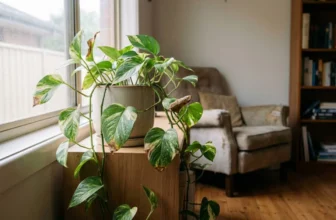
There is nothing quite as frustrating as watching your lush, beautiful indoor vine slowly turn into a long, bald string. From dry Melbourne apartments running reverse-cycle heating all winter, to the harsh Perth sun, to low-light Sydney units, a leggy Devil’s Ivy is a common problem in Australian homes.
To fix a leggy plant, you just need to do three things:
- Find the root cause of the stretching.
- Prune strategically to force bushy new growth.
- Adjust your care routine for our local seasons.
Here is how to work out why the vines have become bare and what you can do to encourage fuller growth.
Click below to know more
Why Do Vines Become Leggy in the First Place?
Before reaching for the pruning snips, it helps to understand the biology of your Epipremnum aureum.
In its natural habitat, Devil’s Ivy is a tropical climber that scales massive trees to reach the jungle canopy. When you place it in a dark hallway or a corner far from a window, it triggers a survival response called etiolation.
- The Search for Light: The plant stops using energy to grow wide, lush leaves. Instead, it pours all its energy into growing the stem as fast and as long as possible, desperately searching for a brighter light source.
- Increased Internode Spacing: As it stretches, the gap between each leaf node (internode) becomes wider, creating a sparse appearance.
- Shedding: To conserve energy in the dark, the plant will naturally shed its older leaves near the base, resulting in a completely bald stem.
Will Bare Vines Ever Regrow Leaves?
Usually not on the bare stem itself.
Once a mature vine loses a leaf, that bare section may remain sparse. Pruning above a healthy node can encourage branching, but it does not guarantee that a new leaf will emerge from the exact same position. While dormant buds exist along the stem, they rarely activate on an older, bare vine unless the plant is subjected to heavy stress or aggressive pruning.
Leaving a two-metre bald vine dangling in your living room will not fix itself; pruning remains the most reliable option.
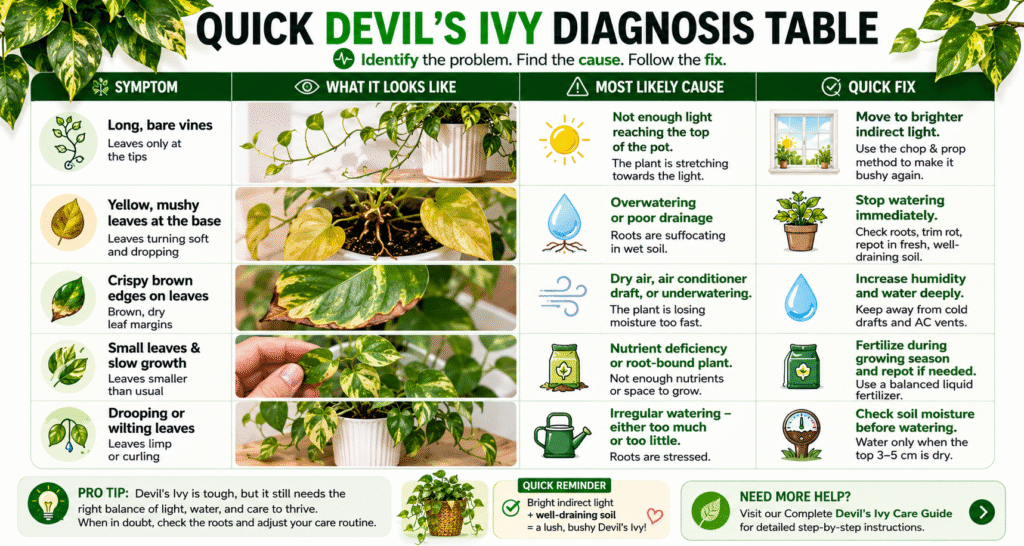
Quick Devil's Ivy Diagnosis Table
A leggy vine is often accompanied by other subtle cries for help. Use our expanded diagnostic table below to identify exactly what your plant needs.
For a complete breakdown of watering schedules and lighting, visit our ultimate Devil’s Ivy Care Australia Hub.
Step 1: Fix the Light Before You Prune
If your plant stays in the same dark corner, pruning alone will not solve the problem. The new growth will immediately stretch and become leggy again.
Before you make a single cut, ensure the top of the pot (where the soil meets the stems) is receiving adequate light.
- The Best Windows: East-facing windows are usually a reliable choice in Australia — though what is actually outside the window (a wall, fence or tree) matters just as much as the direction it faces. They provide gentle, bright morning sun without the scorching heat of an afternoon western exposure.
- Managing Harsh Light: If you only have a North or West-facing window (which can be brutal in a Perth or Brisbane summer), soften the light with sheer curtains to prevent leaf burn.
- No Windows? If you are in a dark hallway, invest in a full-spectrum LED grow light or get into the habit of rotating your pot to a brighter room twice a week. Read our full Light Requirements Guide to dial this in.
Step 2: Prune the Bare Vines
Once the light is sorted, cut the bare vines back. Pruning above a node encourages the plant to push new shoots from that point, which is how a straggly plant becomes a full one. Use clean, sharp scissors or secateurs, and cut just above a healthy node — the small bump on the stem where a leaf meets the vine.
Pruning encourages branching, but it does not replace light. If the plant stretched because the corner is dark, cutting it back only gives you shorter stretched growth.
Using Healthy Cuttings to Rebuild a Fuller Pot
Do not bin the leafy ends you cut off. If a vine has become long and bare, you can take healthy stem cuttings that include at least one node and use them to rebuild the pot — rooting them and planting them back into the top of the mother pot is what turns a straggly plant into a bushy one.
Rooting speed varies with temperature, light, the condition of the cutting and the propagation method, so judge readiness by healthy root development rather than by a fixed number of days. For the complete method — water versus soil, and exactly where to cut — see our Devil’s Ivy propagation guide.
If you end up with more cuttings than you need, dispose of the surplus responsibly — Devil’s Ivy can regrow from any stem section containing a node, so do not tip spare cuttings or propagation water into the garden, a drain or bushland. See is Devil’s Ivy a weed in Australia? for safe disposal.
Step 3: The “Bobby Pin” Trick (Simple Layering)
If you are too nervous to cut your plant, or want an expert botanical hack, use the “Simple Layering” method.
Because Devil’s Ivy is a natural creeper, its nodes can root where they make good contact with damp mix.
- Gently take a long, leggy vine and loop it back up onto the top of its own soil.
- Ensure the bare nodes are pressing directly against the dirt.
- Use rust-proof pins (or standard hair bobby pins) to pin the stem securely down.
- Keep the mix lightly moist rather than saturated.
- The Result: Rooting time varies, so look for firm attachment and healthy new growth instead of relying on a fixed timetable.
Australian Seasonal Advice & Timelines
Your location and the current season can affect how quickly the plant responds.
- Spring and Summer: Whether you are in humid Queensland or temperate Sydney, this is the prime time to prune. Major pruning is usually easier during active growth, but the plant’s condition matters more than a fixed date.
- Autumn and Winter: Growth often slows in cooler, darker conditions. If you prune in June or July in Victoria or Tasmania, the plant may sit completely dormant for months. Unless it is an emergency, save your major pruning for September.
Common Mistakes That Keep Devil's Ivy Leggy
❌ Mistakes That Keep Your Devil’s Ivy Leggy
Keeping the plant in a windowless hallway forces it to stretch desperately for light.
Vines left untrimmed for years naturally shed older leaves, leaving only bare stems behind.
Soggy soil suffocates roots, preventing the plant from having the energy to produce lush foliage.
Dense, garden-variety dirt lacks the aeration roots need for vigorous, bushy growth.
Applying too much fertiliser to a low-light plant causes root burn rather than new leaf growth.
Thick layers of dust block photosynthesis, starving the plant of the energy needed for new leaves.
How to Keep Devil’s Ivy Bushy Year-Round (Preventative Care)
Stop the problem before it starts by incorporating these habits:
- Rotate Every Few Weeks: Give all sides of the plant equal access to window light.
- Give it a Pole: Plants produce significantly larger, closer-spaced leaves when they climb upward rather than trail downward. Check out our Climbing Guide for adding a moss pole.
- Spring Feeding: Feed during active growth according to the product label. Extra fertiliser will not correct low light or replace pruning.
- Repot When Rootbound: If roots are circling the bottom of the pot, it’s time to upgrade by a few centimetres.
Final Verdict: A Fuller, Bushier Devil’s Ivy Starts with the Right Approach
A leggy Devil’s Ivy doesn’t mean you’ve failed—it simply means your plant is responding to its environment. In most Australian homes, the biggest culprits are insufficient light, inconsistent pruning, and overwatering rather than neglect.
The good news is that Devil’s Ivy is remarkably resilient. With brighter indirect light, a strategic prune, and simple techniques like propagation or layering, even a sparse plant can recover into a lush, cascading feature over time.
Remember, healthy growth doesn’t happen overnight. Be patient, make small adjustments, and let your plant do the rest. With the right care, your Devil’s Ivy can once again become the vibrant, low-maintenance indoor centrepiece it’s famous for across Australian homes.
Still have questions? Explore our complete Devil’s Ivy Care Guide for expert advice on watering, lighting, propagation, climbing, and long-term maintenance, or leave a comment below—we’re always happy to help fellow Australian plant lovers grow with confidence.

FAQS: How to fix Devil's Ivy "Leggy" with Bare Vines
Will bare vines ever regrow leaves?
Usually not. Once a leaf drops, that node rarely produces a new one — although a dormant bud can occasionally reactivate in good conditions, so it is not quite never. Realistically, new growth comes from the growing tips. Pruning and using healthy cuttings can help rebuild a fuller pot, especially when long bare sections are unlikely to improve through light changes alone. Prune the bare vine to force fresh, bushy growth from the top.
Does extra fertiliser fix bald vines?
No. Light creates foliage, not fertiliser. Feeding a plant sitting in a dark room will only cause root burn.
Should I cut all leggy vines at once?
Avoid removing a large proportion of healthy growth in one session. For a severely leggy plant, staged pruning may reduce stress and preserve enough foliage for continued growth. The plant needs its remaining leaves to photosynthesise and survive the pruning shock.
Why is only the top of my plant bushy?
If trailing vines hang into the shadows below a window sill, the plant intentionally drops lower leaves to conserve energy.
When should I prune in Australia?
Spring and Summer. Avoid Winter pruning, especially in cooler states like Victoria, as dormant plants recover far too slowly.
Can a severely leggy plant recover?
Yes. With healthy soil, aggressive pruning, and a move to bright indirect light, it will push out new shoots rapidly.
Why are the gaps between leaves so huge?
This is “etiolation.” The plant is stretching in desperation to find a brighter light source. Move it closer to a window.
Does the “bobby pin” trick actually work?
Yes! Pinning bare nodes directly to damp topsoil encourages them to root and shoot new leaves, creating a bushier crown.
Can I use cuttings to make a leggy Devil’s Ivy look fuller?
Yes. Healthy node cuttings can be rooted and planted back into the pot, but rooting time varies with temperature, light and the condition of the cutting. Use the dedicated propagation guide for the complete method rather than relying on a fixed timetable.
Can AC drafts cause legginess?
Not directly, but cold split-system drafts rapidly dry out leaves, causing them to crisp and drop, leaving stems completely bare.
Will a moss pole stop my plant going leggy?
Yes. Allowing Devil’s Ivy to climb upward mimics its natural habitat, producing significantly larger and closer-spaced leaves.
What is the best window for Devil’s Ivy?
An east-facing window is usually a reliable choice in Australia. It provides bright morning light without harsh, leaf-burning afternoon heat.
Yellow leaves instead? If the foliage is turning yellow rather than going leggy or needing a trim, that is usually a watering or root problem — see Why Your Devil’s Ivy Leaves Are Yellow (And How to Fix Root Rot).
ℹ️ Two things worth being clear about
- Not all bare vine is “leggy”. Long gaps between leaves on new growth means the plant is reaching for light. But an old, established vine that has simply shed its oldest leaves over several years is normal ageing, not a light problem. Look at where the bareness is: new growth, or the old end?
- Pruning encourages branching — it does not replace light. Cutting back will make the plant push side shoots, but if the light is still poor those shoots will come through just as stretched. Fix the light first, then prune. And pruning is only one repair route: propagating the cuttings and planting them back into the top of the same pot is often the fastest way to a full-looking plant.