
Grass Plants Australia: Native Ornamental Grasses & Strappy Plants Guide

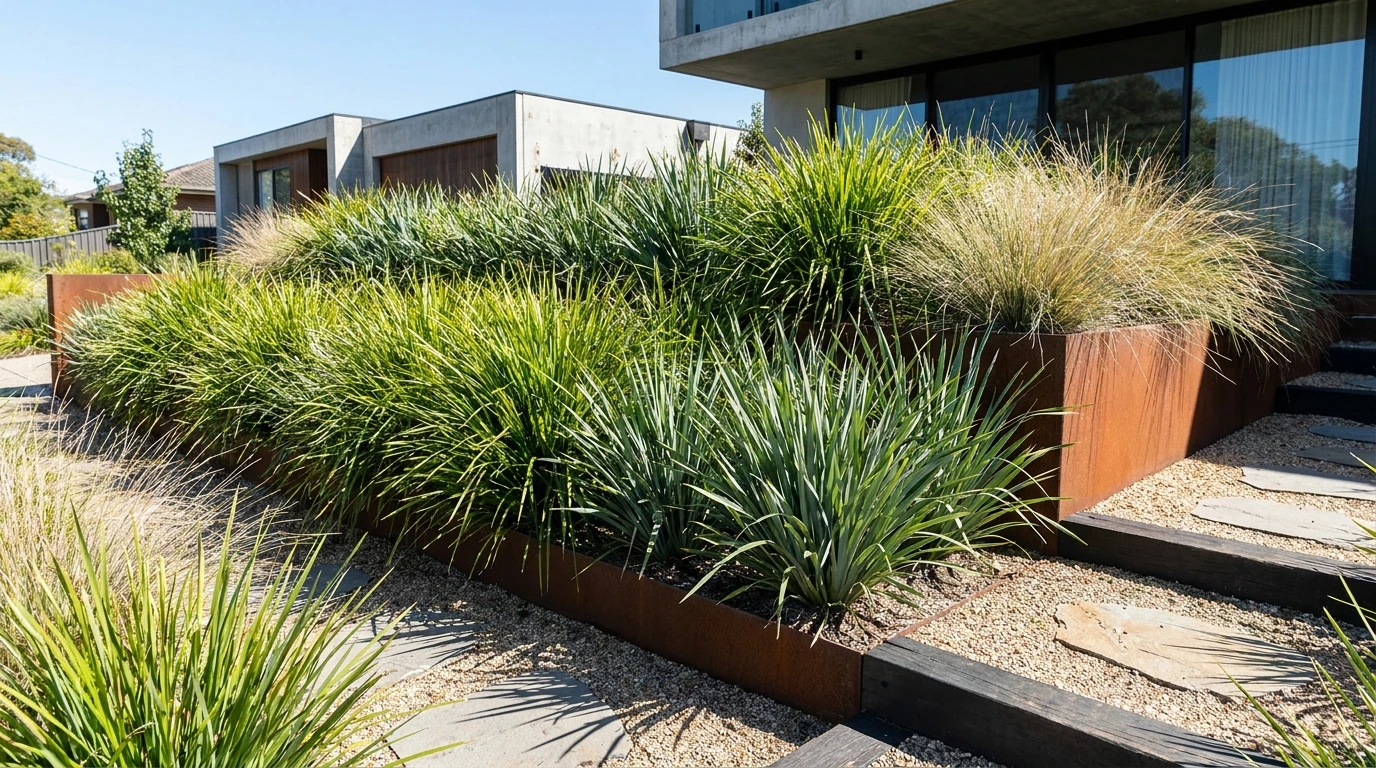
“Grass plants” in Australian gardens usually means a mix of true grasses, sedges, rushes and strappy-leaf plants rather than one botanical group. For most landscapes, the safest starting shortlist is native Lomandra for tough mass planting, Dianella for compact strappy foliage and flowers, Poa for soft blue-green tussocks, Themeda for naturalistic native grassland character, and Carex or Ficinia where moisture, coastal exposure or rain-garden performance matters.
The other half of the decision is weed risk. Some exotic ornamental grasses are attractive but need much more caution. Pampas Grass, Cortaderia selloana, is recognised by Weeds Australia as an invasive environmental weed across multiple Australian states, while African Fountain Grass, now accepted botanically as Cenchrus setaceus and widely known by the synonym Pennisetum setaceum, is a declared weed in New South Wales, Queensland and Western Australia. We would not substitute those plants into a landscape just because they have dramatic plumes.
For us, the practical rule is simple: choose the plant by its final height, moisture tolerance, climate and maintenance requirement first, then choose the foliage colour and flower head. A 40 cm Dianella border, an 80 cm Ficinia mass and a 1.5 m flowering Kangaroo Grass are all sold as “grass plants”, but they do completely different jobs.
Not every “grass plant” is actually a grass
Botanically, true grasses belong to the Poaceae family. Poa, Themeda, Miscanthus and the various fountain grasses are true grasses. Lomandra and Dianella are not grasses at all; they are strappy-leaf flowering plants used in similar landscape roles. Carex and Ficinia are sedges, not grasses.
That distinction is more than botanical trivia because it affects how the plants handle pruning, moisture and shade. Many true ornamental grasses respond well to an annual hard cut-back. Lomandra often needs only occasional rejuvenation. Dianella is usually cleaned by removing old leaves rather than being scalped every winter. Carex and Ficinia can tolerate moisture conditions that would be a poor fit for some dryland grasses.
| Landscape group | Examples | Botanical type | Typical garden role |
|---|---|---|---|
| Strappy native plants | Lomandra, Dianella | Not true grasses | Borders, mass planting, pots, low-maintenance landscaping |
| Native tussock grasses | Poa, Themeda | True grasses | Naturalistic gardens, slopes, habitat planting, movement |
| Native sedges/rush-like plants | Carex, Ficinia | Sedges | Rain gardens, coastal planting, damp sites, architectural clumps |
| Exotic ornamental grasses | Miscanthus, some Cenchrus/Pennisetum types | True grasses | Feature plumes and seasonal movement; weed status must be checked |
Real sizes: the common Australian landscaping choices
One of the biggest mistakes we see is choosing plants from nursery photos without checking scale. Some “grass plants” finish at 40 cm; others send flower stems above 1.5 m.
| Plant | Published Australian size | Named Australian source | Best use |
|---|---|---|---|
| Tanika® Lomandra | About 50–65 cm high × 50–65 cm wide | Ozbreed current specification guidance | Mass planting, borders, dry slopes, shade-tolerant strappy planting |
| Lime Tuff Lomandra | Medium Lomandra in roughly the 50–90 cm height class | Ozbreed Lomandra range guidance | Compact upright mass planting and contemporary borders |
| Little Jess™ Dianella | About 40 cm high × 40 cm wide | Ozbreed | Low borders, compact mass planting, residential gardens |
| Cassa Blue® Dianella | About 50 cm high × 40 cm wide | Ozbreed | Blue-foliage feature, mass planting, pots |
| Eskdale Poa | About 60 cm high × 50 cm wide | Ozbreed regional catalogue | Soft blue tussocks, slopes, mass planting |
| Kingsdale™ Poa | About 45 cm high × 45 cm wide | Ozbreed regional catalogue | Lower blue tussock, coastal and erosion-control planting |
| Carex appressa | About 1 m high × 1 m wide; Plantmark profile also places mature plants broadly in the 1–2 m class | Plantmark | Rain gardens, wet-dry transition zones, naturalistic drainage planting |
| Themeda triandra | Foliage commonly around 30–60 cm; flowering stems can reach about 1.5 m | Plantmark | Native meadow, habitat garden, summer colour and movement |
| Ficinia nodosa | About 80 cm high × 80 cm wide | Plantmark | Coastal planting, streetscapes, mass planting, wet-dry sites |
| Native Cenchrus/Pennisetum-type ornamental grasses | Some current Ozbreed selections are around 60–100 cm high and wide, with flower stems to about 1.5 m | Ozbreed | Feature tussocks, plume effect, erosion control |
Those numbers show why “grass plant” is too broad to use as a spacing or height specification. A Little Jess Dianella and a flowering Themeda may both look grassy in a landscape photo, but the final vertical effect is completely different.
Lomandra is the workhorse for low-maintenance mass planting
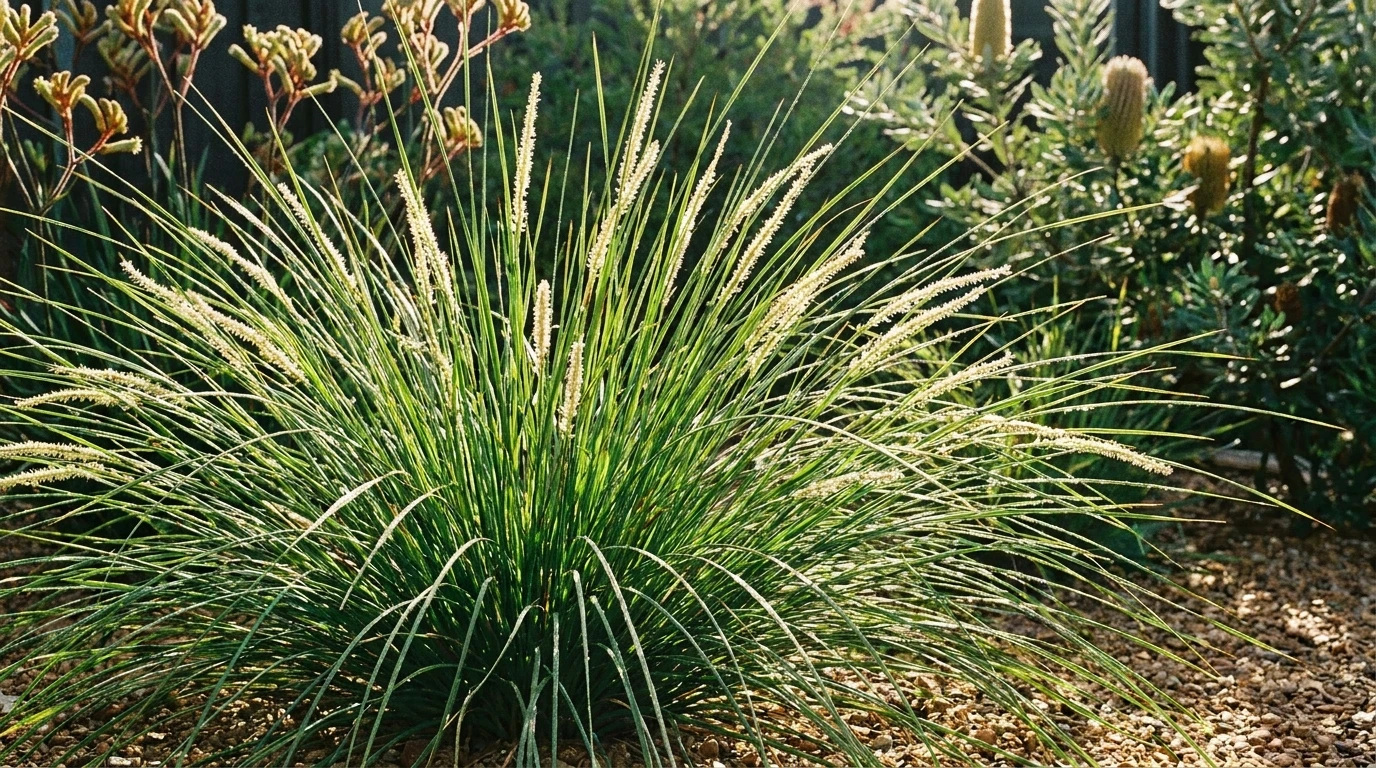
Lomandra is one of the most commonly used strappy plants in Australian commercial and residential landscaping because selected cultivars combine drought tolerance, neat evergreen foliage and relatively low maintenance.
Ozbreed’s current specification material places improved Tanika-type Lomandra at about 50–65 cm high × 50–65 cm wide, with approximately 3–6 plants per square metre or 2–3 plants per linear metre depending on the design.
Ozbreed’s Lomandra range places Lime Tuff among medium plants, broadly within the 50–90 cm height class. It is more upright and lime-green than the soft arching Tanika look.
For us, Lomandra works best where the garden needs structure without constant seasonal attention: roadsides, driveways, dry slopes, mass beds and broad contemporary borders.
The biggest maintenance mistake is cutting healthy Lomandra to the ground every year simply because it looks like a grass. Ozbreed’s current guidance for improved Tanika material only recommends a severe rejuvenation cut when required, often on a multi-year cycle rather than annually.
Dianella gives a lower, more flowering strappy layer
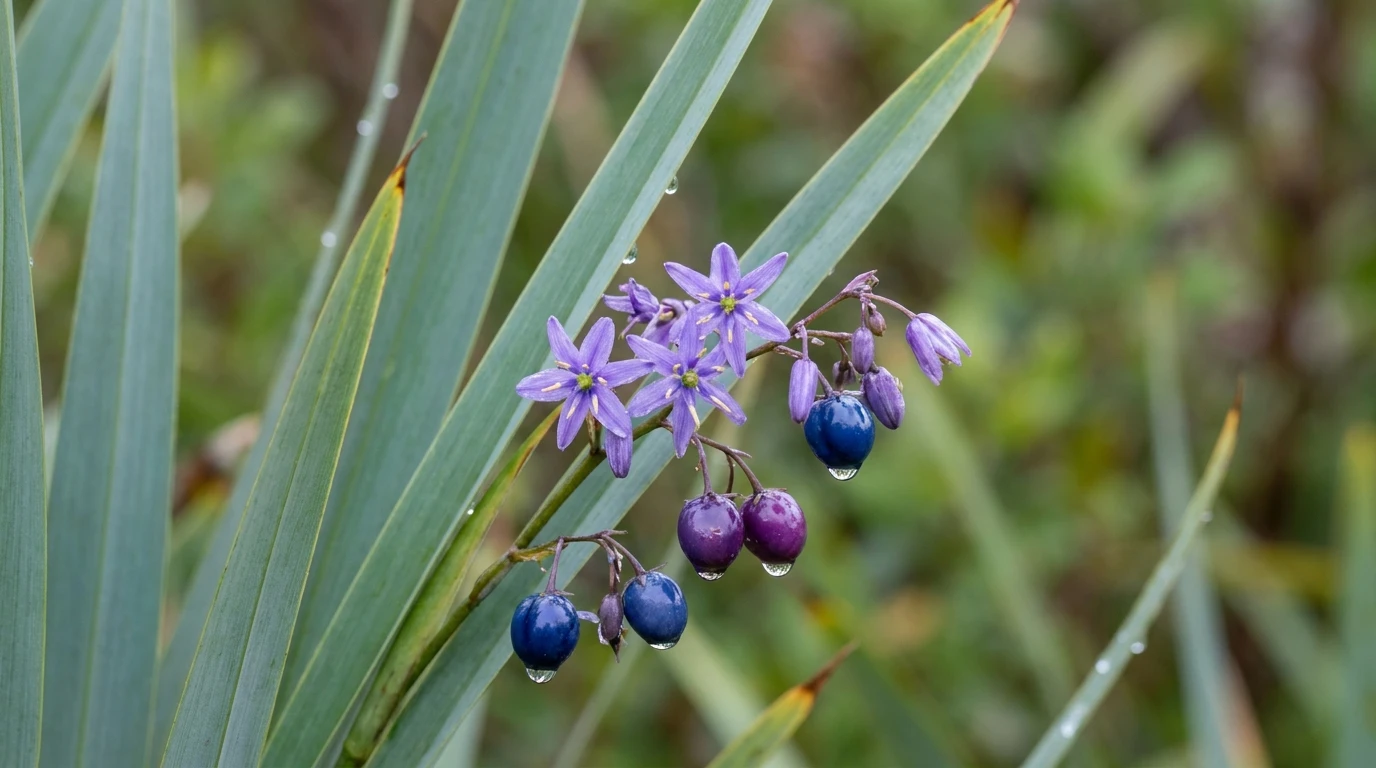
Dianella generally sits lower than large Lomandra and adds blue-green foliage, purple flowers and berries. It is often the better choice for a border where a 70–90 cm tussock would feel too heavy.
Ozbreed lists Little Jess™ Dianella caerulea at approximately 40 cm high × 40 cm wide, with planting densities around 6–10 plants per square metre. Its purple flowers are listed from September to November.
Cassa Blue® is slightly taller at about 50 cm high × 40 cm wide, with Ozbreed also recording purple-and-yellow flowers from September to November.
We use Dianella for lower massing, around paths, in pots and beneath more open shrubs. The blue-foliage forms can also create stronger contrast than ordinary dark-green strappy plants.
Site selection still matters. Ozbreed specifically warns that Cassa Blue is less reliable for broad mass planting north of Sydney and in Queensland unless the garden is well maintained and has free-draining soil. A cultivar performing beautifully in Adelaide should not automatically be treated as a humidity-proof Queensland plant.
Poa gives the soft blue native-grass effect
Poa is one of our favourite groups where the design needs movement rather than the stiff architecture of Lomandra.
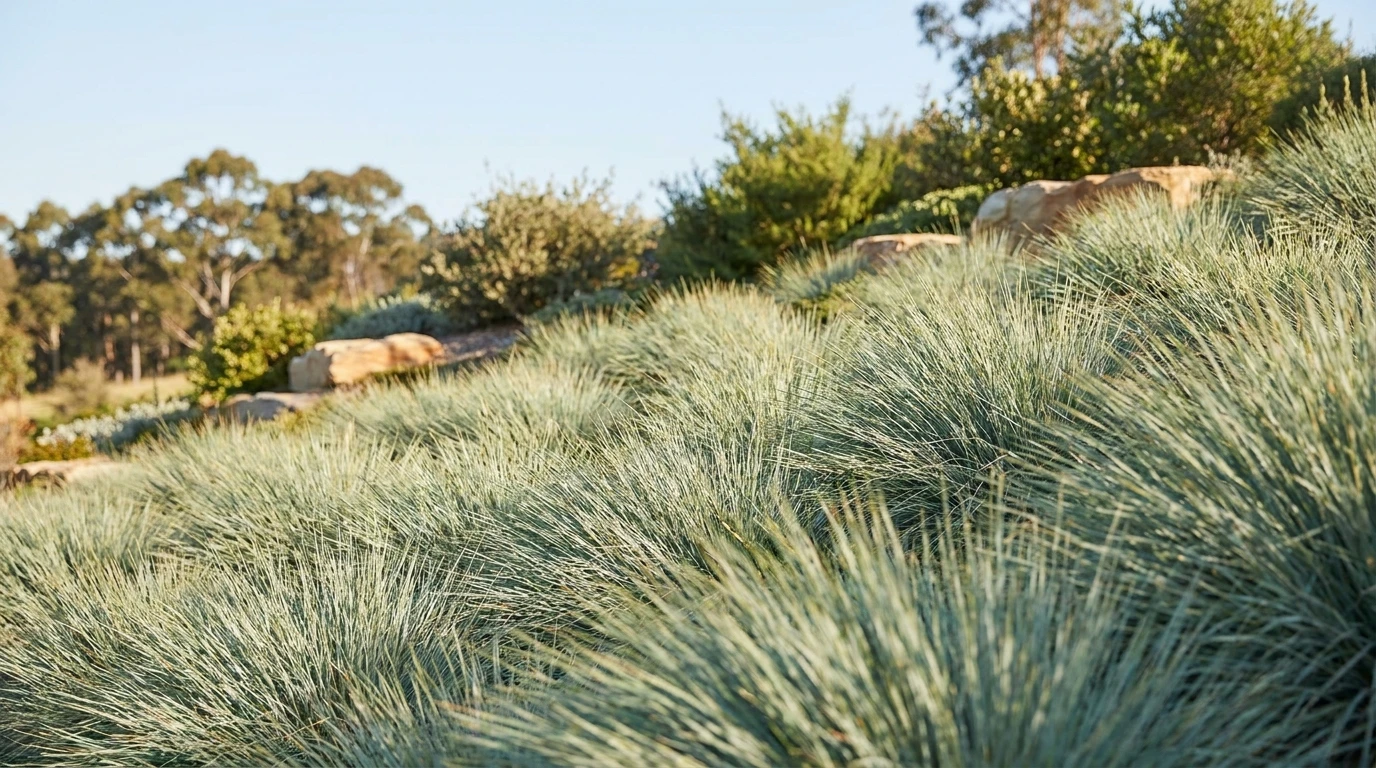
Ozbreed lists ‘Eskdale’ Poa labillardierei at approximately 60 cm high × 50 cm wide. ‘Kingsdale’ Poa poiformis is smaller at about 45 cm × 45 cm.
Both are used for mass planting, borders and slopes. Ozbreed describes Kingsdale as useful for erosion control and coastal applications, while Eskdale is widely used as a tough mass-landscape Poa.
The maintenance pattern is more grass-like than Lomandra. Ozbreed recommends cutting Eskdale and Kingsdale back to about 15 cm above ground in autumn or late winter to refresh the foliage.
On our jobs, that annual reset is one reason Poa looks better in designs where seasonal change is acceptable. A freshly cut Poa bed can look sparse for a short period before new leaves rebuild the tussock.
Kangaroo Grass is for naturalistic movement, not permanent green neatness
Themeda triandra, Kangaroo Grass, is a genuine native warm-season grass. Plantmark describes the foliage as green-grey, turning orange-brown through summer, with reddish-brown flower spikelets from approximately December to February.
Plantmark places the foliage broadly around 30–60 cm high and wide, while its flowering display can reach roughly 1.5 m high.
That seasonal colour change is part of the appeal, not a sign the plant has failed. If a client wants a permanently clipped bright-green border, Kangaroo Grass is the wrong aesthetic. If they want an Australian meadow effect with copper-orange summer colour, seed heads and movement, it can be exceptional.
We use it in habitat gardens, larger native beds, rockeries and naturalistic mass planting rather than forcing it into a formal edging role.
Carex is useful when the site moves between wet and dry
Carex appressa, Tall Sedge, is a strong example of why sedges deserve their own category. Plantmark describes it at about 1 m high × 1 m wide in practical landscape use and notes tolerance of both wet and dry soils.
That makes it particularly useful around rain gardens, drainage lines, swales, wetland edges and periodically wet depressions where many ornamental grasses are unreliable.
Plantmark recommends full sun to semi-shade and describes spring seed heads above the upright arching foliage.
We would not use Tall Sedge in a tiny 40 cm border and then spend years clipping it down. Its value comes from letting the larger tussock create vertical texture in a moisture-responsive planting.
Ficinia nodosa is one of the better native coastal “grass plants”
Ficinia nodosa, formerly widely sold as Isolepis nodosa, is commonly called Knobby Club Rush or Knotted Club Rush. It is a native sedge with cylindrical foliage rather than flat grass blades.
Plantmark gives a practical mature size of about 80 cm high × 80 cm wide, with a broader profile in the 60 cm–1 m class. Cream flower clusters appear near the tips of the foliage through spring and summer.
Plantmark specifically recommends it for coastal planting, streetscapes and mass planting and notes tolerance of both wet and dry soils.
This is one we like near exposed coastlines because the structure remains architectural without relying on soft broad leaves that are easily torn by wind.
There is no single sun or moisture rule for “grass plants”
The genera in this roundup occupy very different ecological niches. The useful approach is to match the plant to the site instead of applying one generic “full sun, well drained” instruction.
| Plant group | Light | Moisture / soil strength |
|---|---|---|
| Tanika-type Lomandra | Full sun to moderate shade | Very adaptable; sandy to clay soils, with cultivar-specific disease cautions in poorly drained humid sites |
| Little Jess / Cassa Blue Dianella | Full sun to part shade | Broad soil tolerance; free drainage becomes more important for some cultivars in humid regions |
| Eskdale / Kingsdale Poa | Full sun to part shade | Broad soil tolerance; suited to cool-season and temperate landscape use |
| Themeda triandra | Full sun to light shade | Prefers well-drained conditions; deep-rooted and drought-adapted once established |
| Carex appressa | Full sun to semi-shade | Particularly useful across wet-to-dry soil conditions |
| Ficinia nodosa | Full sun to semi-shade | Tolerates wet and dry situations and coastal exposure |
On Garden Green jobs, this table is more useful than the nursery category “ornamental grass”. We start with the difficult condition—shade, salt, waterlogging, drought or slope—and let that eliminate unsuitable plants.
Shade changes the shortlist
Lomandra and Dianella are usually our first strappy groups when the site has part shade. Ozbreed places improved Tanika material from full sun to moderate shade, while Little Jess and Cassa Blue Dianella also tolerate part shade.
Many showy true ornamental grasses flower and hold their best shape in brighter conditions. If the site is deeply shaded, choosing them for their advertised flower plumes usually leads to disappointment.
Carex can also earn a place where there is part shade and moisture, especially in drainage-oriented designs.
For coastal gardens, choose plants with real salt evidence
Ozbreed’s salt-tolerance testing found useful salt tolerance among several strappy and grass cultivars, including Tanika Lomandra, Cassa Blue Dianella and Eskdale Poa. Kingsdale Poa is also specifically promoted for coastal use.
Plantmark recommends Ficinia nodosa for coastal planting, and Carex appressa is suitable for protected coastal sites.
We still separate “coastal” from “direct salt blast”. A plant performing 2 km inland is not automatically suitable on an exposed dune face. For the harshest sites, local provenance and species naturally associated with coastal vegetation remain the safer choice.
Cut-back schedules should follow the plant, not the category
One of the easiest ways to make a strappy garden look rough is to give every plant the same annual haircut.
| Plant | Useful Australian maintenance guidance |
|---|---|
| Tanika-type Lomandra | Ozbreed generally treats hard rejuvenation as occasional, often every 3–10 years if required |
| Little Jess Dianella | Ozbreed describes very low maintenance and very infrequent rejuvenation |
| Cassa Blue Dianella | Remove older leaves annually as needed rather than automatically scalping the whole clump |
| Eskdale Poa | Ozbreed recommends cutting to about 15 cm above ground in autumn or late winter |
| Kingsdale Poa | Ozbreed also recommends an annual cut to about 15 cm in autumn or late winter |
| Native plume grasses such as Cenchrus purpurascens selections | Ozbreed recommends annual late-winter trimming for some cultivars |
In our maintenance work, we remove damaged leaves first and only perform a full cut-back when the species or cultivar responds well to it. A clean Lomandra that still looks excellent gains nothing from being cut to the ground because the calendar says “grass pruning season”.
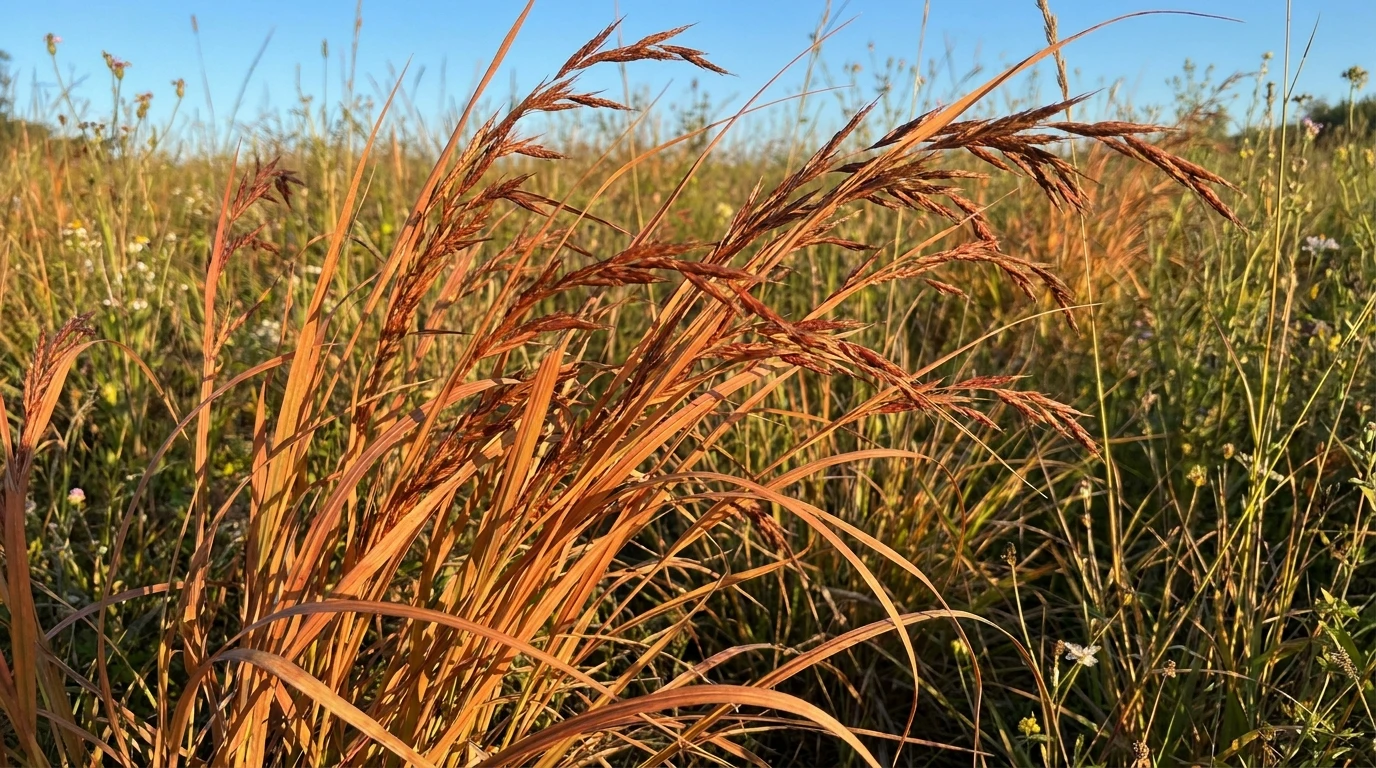
Miscanthus can be beautiful, but it is an exotic design choice
Miscanthus species and cultivars are widely used internationally for tall flower plumes and autumn movement. They are true grasses and can create a dramatic 1–2 m-class feature depending on cultivar.
They are not Australian natives. That does not automatically make every Miscanthus cultivar a declared weed, but it changes how we use them near natural areas.
We prefer sterile or demonstrably low-seeding cultivars where available and would check current state or local weed guidance before planting large numbers beside bushland, waterways or conservation reserves.
Where the goal is simply tall feathery movement, native or non-invasive Australian landscape grasses can often deliver the same design effect with less ecological uncertainty.
“Pennisetum” needs a species-level weed check
This is one of the most important information-gain points in the roundup. The old nursery name Pennisetum covers plants with very different weed status.
African Fountain Grass, historically sold as Pennisetum setaceum, is now accepted as Cenchrus setaceus. Weeds Australia records it as a declared weed in New South Wales, Queensland and Western Australia.
Queensland authorities list African Fountain Grass as Category 3 restricted matter, which means it must not be distributed or released into the environment except where authorised.
That does not mean every plant formerly called Pennisetum is the same weed. Australian ornamental selections based on Pennisetum alopecuroides, now commonly treated as Cenchrus purpurascens, are different taxa. Ozbreed, for example, markets Australian native selections including Cream Lea®, Nafray® and Purple Lea®.
| Name you may see | What it actually means | Our approach |
|---|---|---|
| Pennisetum setaceum | Synonym of Cenchrus setaceus, African Fountain Grass | Avoid; declared weed in NSW, QLD and WA |
| Pennisetum alopecuroides / Cenchrus purpurascens selections | Different species group with Australian ornamental cultivars | Assess the exact cultivar and local status rather than confusing it with African Fountain Grass |
When a nursery label only says “fountain grass”, we want the full botanical name before buying it.
Pampas Grass is not worth the weed risk
Weeds Australia describes Pampas Grass, Cortaderia selloana, as a large invasive perennial grass reaching approximately 4–6.5 m high and nearly as wide. It was introduced as an ornamental and windbreak but now invades bushland, wetlands, stream banks and other vegetation communities.
Each plume can produce more than 100,000 seeds, and Weeds Australia records wind or water dispersal over distances up to approximately 25 km.
Brisbane City Council treats Pampas Grass as pest vegetation and describes plants with flowering stems around 2–6 m high. NSW regional weed guidance includes restrictions requiring eradication and preventing trade or release in affected areas.
For us, there is no reason to design around that risk when native and lower-risk ornamental grasses can provide height, movement and plumes without deliberately planting a recognised environmental weed.
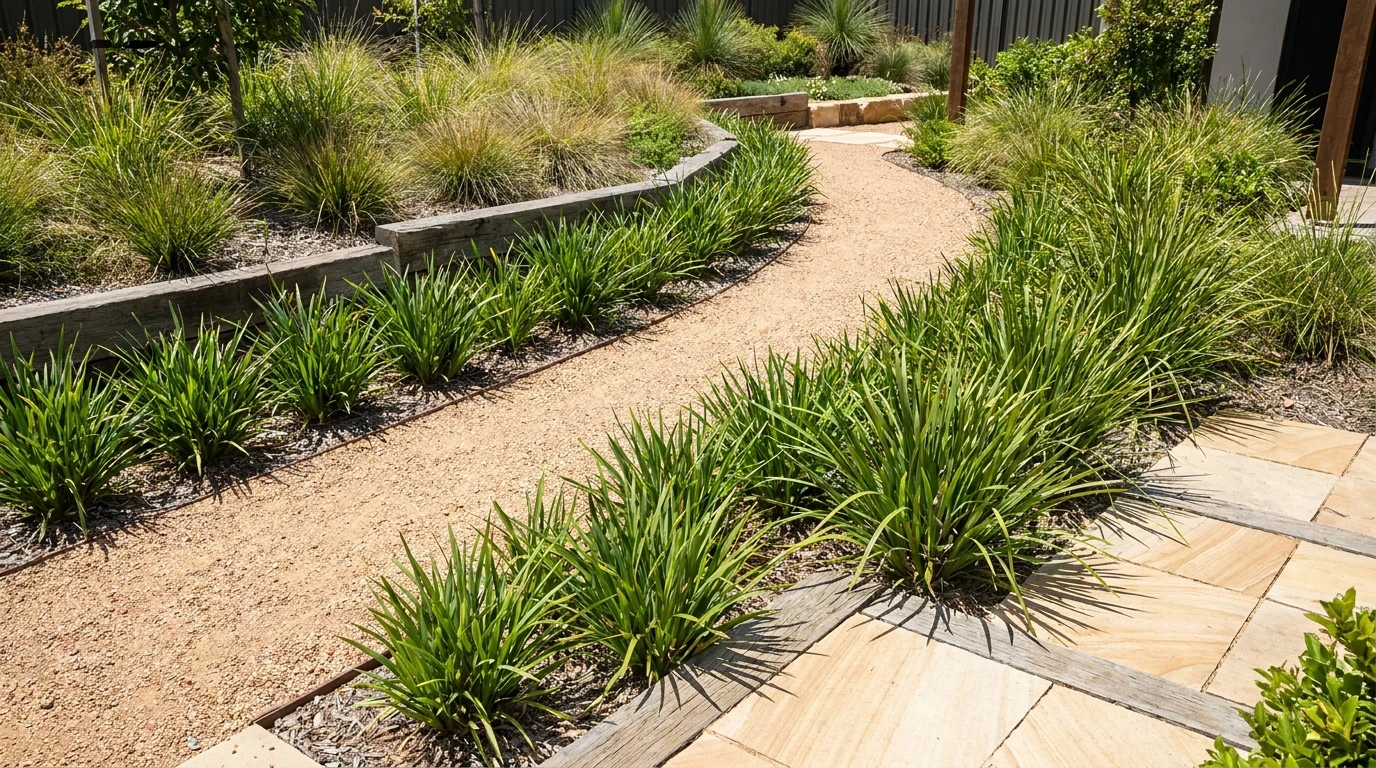
Native plume grasses can replace the Pampas/Miscanthus look
Ozbreed specifically markets Cream Lea® Cenchrus purpurascens as an Australian native alternative to Miscanthus or Pampas Grass. Its current Victorian specification gives about 60–100 cm high × 60–100 cm wide, with flower stems reaching around 1.5 m.
The same guide recommends annual trimming in late winter, full sun to part shade and documents drought and frost tolerance.
That is the design logic we favour: if the client wants pale plumes and arching movement, first see whether a suitable native ornamental grass can provide the visual result before reaching for an invasive or ecologically questionable exotic.
Which grass plant for which job?
| Garden job | Good starting choice | Why |
|---|---|---|
| Low 40–50 cm border | Little Jess Dianella, Cassa Blue Dianella, Kingsdale Poa | Compact published dimensions and clean mass-planting habit |
| 50–70 cm contemporary mass planting | Tanika-type Lomandra, Eskdale Poa | Tough, repeatable forms with established Australian landscape use |
| Blue foliage feature | Cassa Blue Dianella, Eskdale or Kingsdale Poa | Strong foliage contrast without needing flowers |
| Shade / under open trees | Lomandra, selected Dianella, Carex where moisture suits | Better shade tolerance than many true ornamental grasses |
| Rain garden or wet-dry swale | Carex appressa, suitable Lomandra cultivars | Carex handles wet-dry transitions particularly well |
| Exposed coastal garden | Ficinia nodosa, Kingsdale Poa, salt-tested Lomandra/Dianella | Documented coastal or salt tolerance |
| Erosion-control slope | Kingsdale Poa, Lomandra, native plume grasses | Dense fibrous root systems and mass-planting suitability |
| Native meadow / habitat garden | Themeda triandra, Poa, locally indigenous grasses | Seasonal movement, seed heads and ecological value |
| Large architectural pot | Lomandra, Dianella, compact Poa | Clumping habit works well without aggressive spreading |
| Tall plume effect | Native Cenchrus selections or another locally safe ornamental grass | Can provide movement without planting Pampas Grass |
The best “grass plant” is often the one that naturally finishes at the right height
For us, this is the main design lesson. If the garden needs a 45 cm border, start with a plant that naturally lives in that layer. If it needs a one-metre rain-garden tussock, choose a plant designed for that moisture and scale.
Trying to keep a large ornamental grass permanently small through repeated cutting usually creates more work and a rougher plant. Using a compact Dianella where a tall Themeda belongs creates the opposite problem: the planting never develops the vertical presence the design needed.
We would rather choose the natural height correctly and prune for freshness, not use pruning as a permanent correction for choosing the wrong plant.
One final weed check before buying ornamental grass
Plant names change, old nursery labels persist and common names such as “fountain grass” can hide completely different species. Before buying an exotic ornamental grass, particularly one with abundant seed heads, check the full botanical name against current state weed guidance.
The clearest examples are African Fountain Grass and Pampas Grass. Weeds Australia records Cenchrus setaceus as declared in NSW, Queensland and Western Australia, while Pampas Grass is recognised as an environmental weed across much of Australia.
Where a native or non-invasive alternative does the same landscape job, that is normally the option we would choose.
Frequently asked questions
What are the best grass plants for Australian gardens?
For many landscapes, strong native starting choices include Lomandra for tough mass planting, Dianella for compact strappy borders, Poa for soft blue tussocks, Themeda triandra for naturalistic native grassland character, Carex for wet-dry sites and Ficinia nodosa for coastal and architectural planting.
Are Lomandra and Dianella actually grasses?
No. They are strappy-leaf flowering plants rather than true grasses, but Australian landscapers commonly group them with ornamental grasses because they perform similar visual and functional roles in borders, mass plantings and low-maintenance gardens.
How big does Tanika Lomandra grow?
Ozbreed’s current improved Tanika specification gives approximately 50–65 cm high × 50–65 cm wide. Current planting guidance is around 3–6 plants per square metre or 2–3 plants per linear metre, depending on the design.
What is a good ornamental grass for shade?
For part shade, Lomandra and selected Dianella cultivars are often safer than showy true grasses. Ozbreed places Tanika-type Lomandra in full sun to moderate shade, while Little Jess and Cassa Blue Dianella also tolerate part shade. Carex can be useful where shade combines with extra moisture.
Should ornamental grasses be cut back every year?
Not all of them. Ozbreed recommends annual autumn or late-winter cut-back to about 15 cm for Eskdale and Kingsdale Poa, while many Lomandra and Dianella cultivars need only occasional rejuvenation or removal of old leaves. Pruning should follow the species or cultivar, not the generic label “grass plant”.
Is Fountain Grass a weed in Australia?
African Fountain Grass, Cenchrus setaceus and its older synonym Pennisetum setaceum, is a declared weed in New South Wales, Queensland and Western Australia according to Weeds Australia. Do not confuse it with different Australian ornamental Cenchrus/Pennisetum-type species and cultivars.
Is Pampas Grass a weed in Australia?
Yes. Weeds Australia describes Cortaderia selloana as an invasive environmental weed found across multiple Australian states. Plants can reach roughly 4–6.5 m, and individual plumes can produce more than 100,000 seeds capable of travelling long distances.
What can I plant instead of Pampas Grass?
For a similar soft plume effect, consider a non-invasive native ornamental grass suited to your region. Ozbreed specifically promotes Cream Lea® Cenchrus purpurascens as a native alternative to Miscanthus or Pampas Grass; its published size is about 60–100 cm high × 60–100 cm wide, with flower stems reaching around 1.5 m.

