
Dichondra repens Australia: Native Lawn Substitute & Groundcover Guide

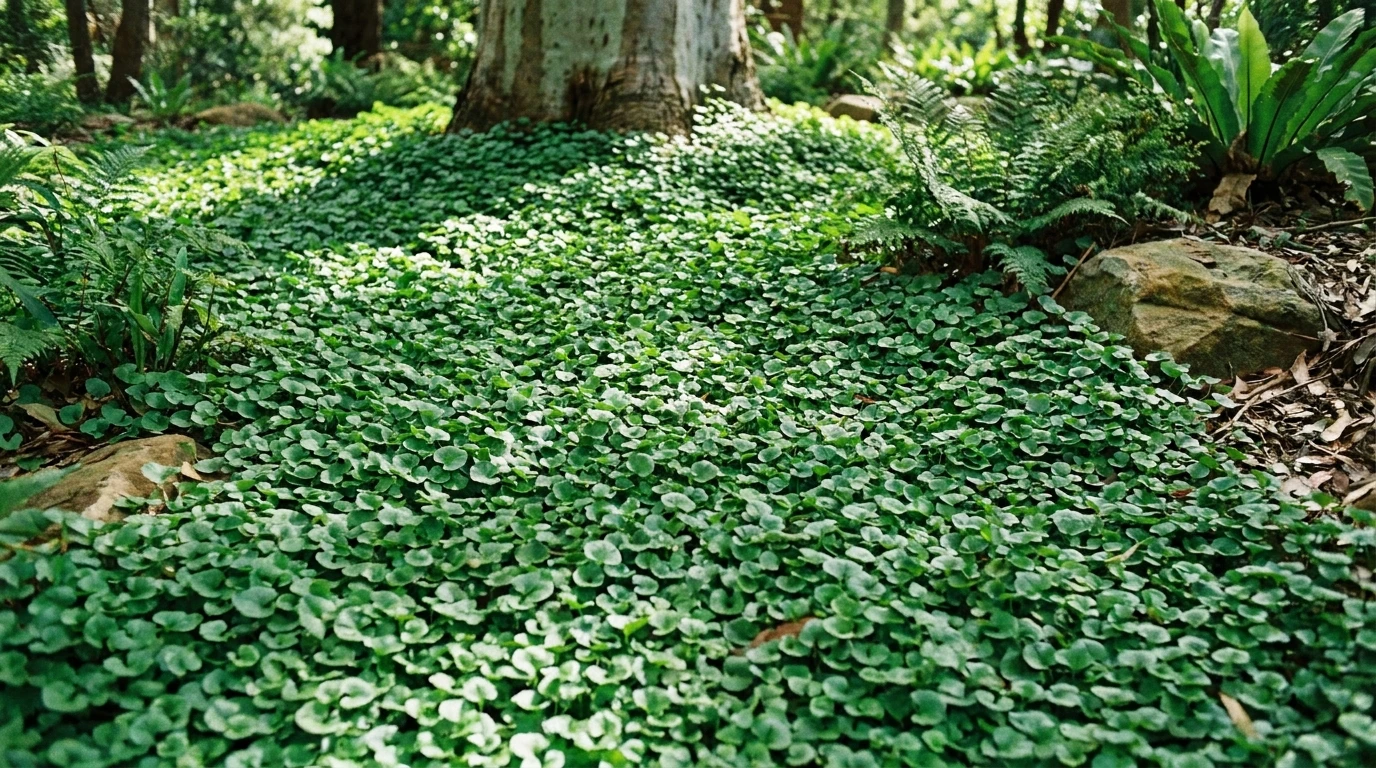
Dichondra repens, or Kidney Weed, is a very low Australian native groundcover that usually sits below about 10 cm and can form a soft green lawn substitute in sun, part shade and places where conventional turf struggles. Western Australian Government landscape guidance uses a planning size of about 10 cm high × 30 cm wide, Federation University’s indigenous-plant guide gives about 10 cm high × 20 cm wide, and Plant Tiles Australia reports plants ranging from roughly 5–100 mm high depending on light, moisture and traffic.
Its strongest advantage is shade tolerance. Gardening Australia specifically recommends native Dichondra repens beneath trees and in both sun and shade, while Australian lawn-seed suppliers position it for damp or low-light areas where ordinary lawn grasses thin out.
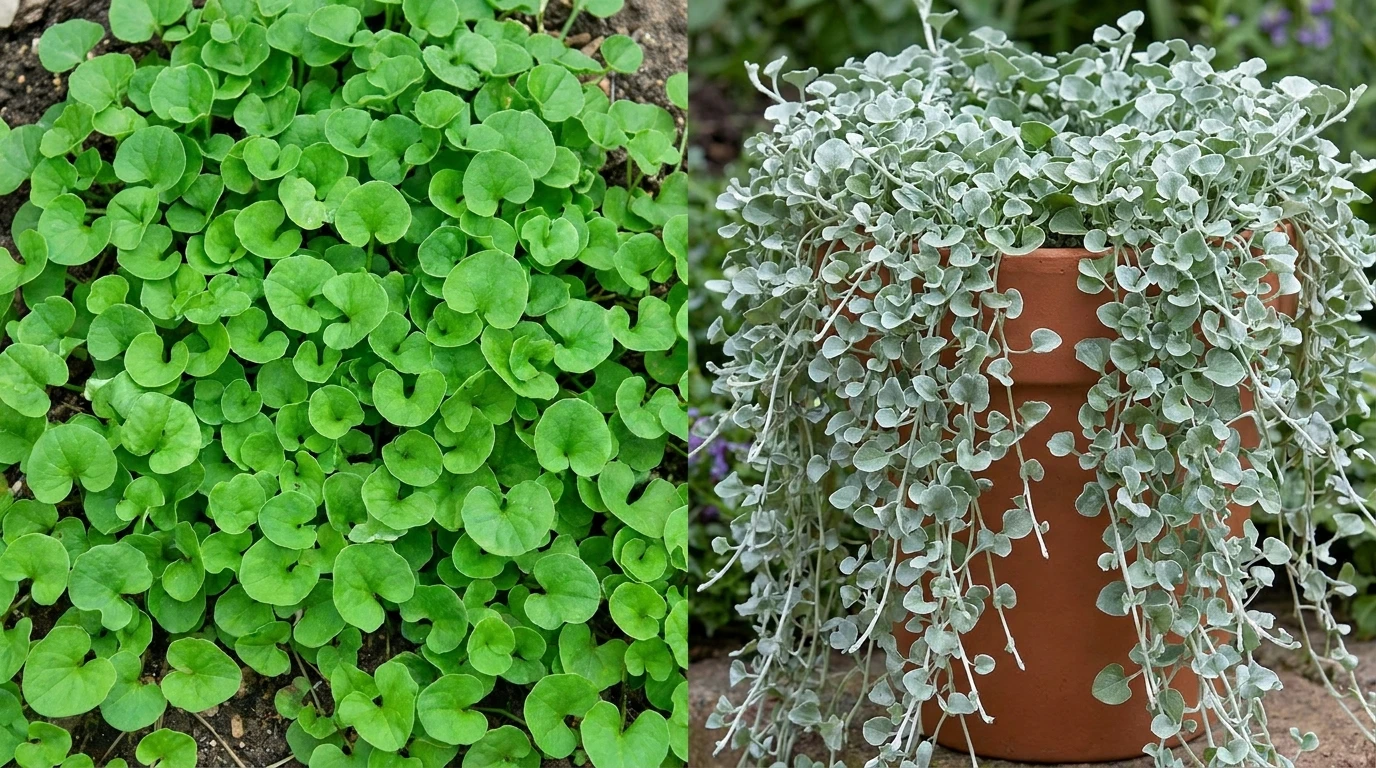
It is also frequently confused with Dichondra argentea ‘Silver Falls’. They are not the same plant. Dichondra repens is the green native Kidney Weed used as a groundcover and low-traffic lawn substitute. ‘Silver Falls’ is the silver trailing form of the American species Dichondra argentea, grown mainly for hanging baskets, retaining walls and ornamental spillover.
Dichondra repens is an Australian native, not a lawn grass
Kew’s Plants of the World Online accepts Dichondra repens J.R.Forst. & G.Forst. in the family Convolvulaceae and records it as native to New South Wales, Queensland, South Australia, Tasmania, Victoria and Western Australia, as well as New Zealand and several Indian Ocean islands.
Gardening Australia describes it as native and widespread through Australia except the Northern Territory. Australian Plants Society NSW also treats Kidney Weed as an Australian native creeping groundcover.
Botanically, it is not a grass at all. It is a broadleaf perennial that creeps by runners, rooting at nodes as stems move across the soil.
That distinction matters when we use it as a “lawn”. It can create a green walkable surface, but it does not have the same wear recovery, mowing response or drought behaviour as Kikuyu, Couch or Zoysia turf.
It stays genuinely low
Australian sources consistently place Dichondra repens in the very-low groundcover layer.
| Australian source | Published size | What it tells us |
|---|---|---|
| WA Government landscape guidance | About 10 cm high × 30 cm wide | Useful planning figure for landscape groundcover use |
| Federation University indigenous-plant guide | About 10 cm high × 20 cm wide | Ballarat-region garden reference |
| Plant Tiles Australia | About 5–100 mm high | Shows how height changes with light, moisture and traffic |
| McKays Grass Seeds | About 2–100 mm high | Commercial lawn-use range |
| Garden Express | About 10 cm high | Current nursery groundcover estimate |
The spread figure on one small nursery plant is less useful than it looks because the runners keep rooting beyond the original crown. Given time, individual plants merge into a continuous mat.
On our own installations, we think in terms of coverage rather than mature plant width. Once neighbouring runners meet, the original boundaries between individual plants disappear.
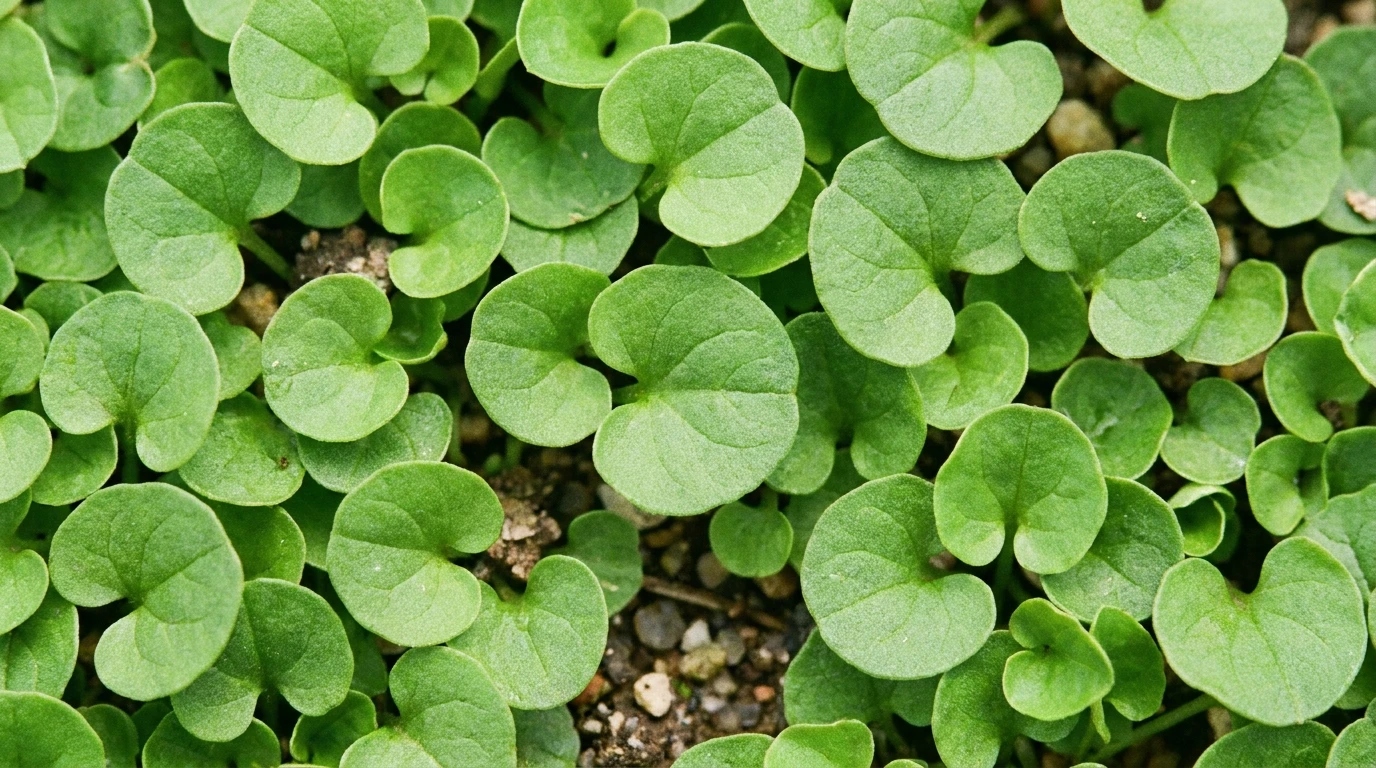
The biggest advantage is shade tolerance
Gardening Australia says Dichondra repens works in full sun and shade and specifically recommends it under trees where a conventional lawn can struggle. Bunnings similarly lists full sun to shade, while Akers of Lawn highlights outstanding shade tolerance.
McKays positions Dichondra as a lawn alternative for low-light areas and notes that growth can become thinner and slower in heavily shaded sections than in sunnier parts of the same planting.
This is where we find Dichondra most useful. A patchy lawn under trees often fails because there is not enough light for the turf species being used. Replacing that area with a plant naturally comfortable in part shade makes more sense than repeatedly reseeding the same grass.
Shade does change the look. Plant Tiles Australia notes that leaves can become larger and the mat taller in shade as the plant reaches for light.
Sun works too—but moisture demand increases
Australian Plants Society NSW says Dichondra repens can be used as a lawn substitute in full sun, but also notes that it needs ample water to perform at its best. Nurseries Online makes the same distinction: sunny plantings need more reliable moisture, while shaded plants often cope with less drying.
This is an important correction to the idea that every native groundcover is automatically drought-proof.
In a cool shaded courtyard, Kidney Weed can stay lush with relatively modest irrigation. In exposed summer sun, the same green carpet loses water much faster.
On jobs, we therefore match irrigation to exposure rather than giving every Dichondra area one watering schedule.
Seed and plugs give very different establishment experiences
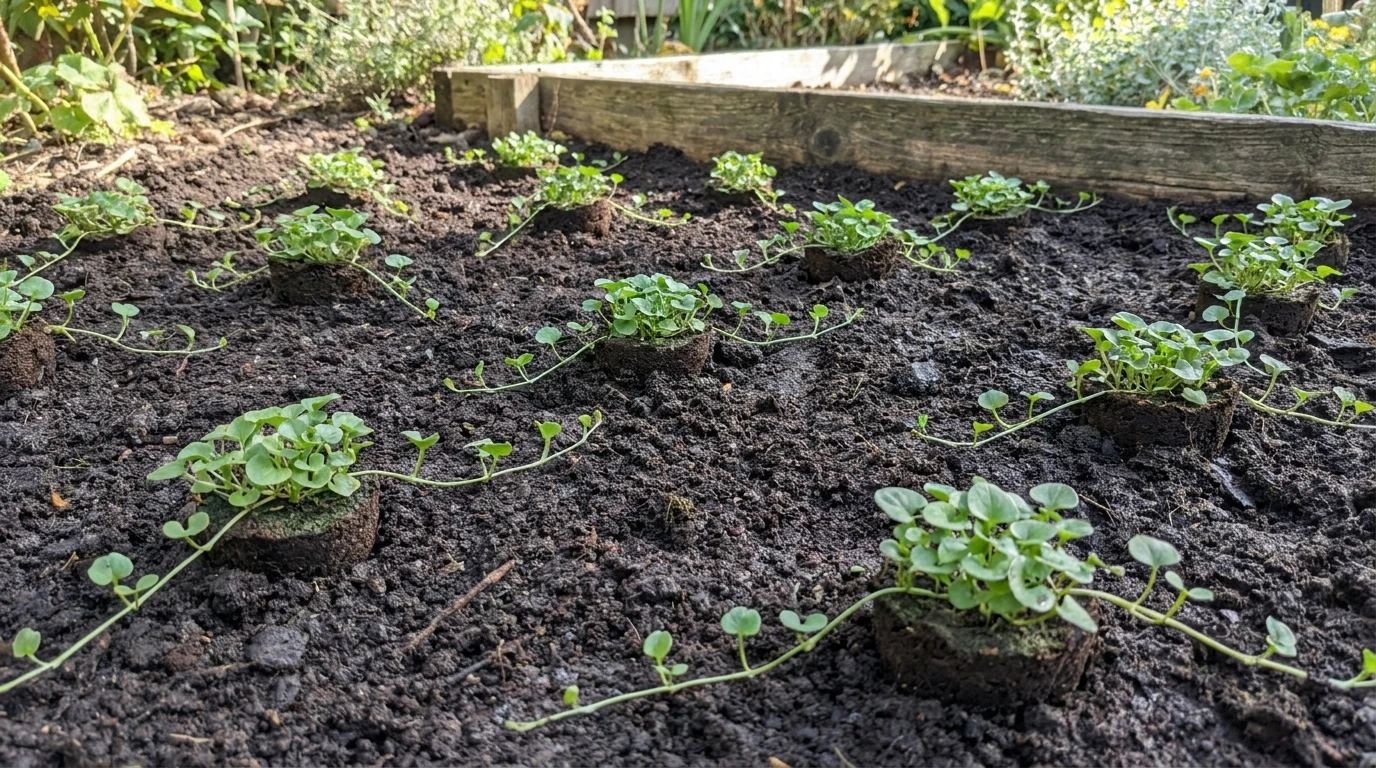
Dichondra repens can be established from seed, division, nursery pots or pre-grown plant tiles. Australian Plants Society NSW confirms propagation by both division and seed.
Akers of Lawn recommends a seed rate of approximately 1 kg per 100 m², equivalent to about 10 g/m². Naracoorte Seeds gives the same 1 kg per 100 m² rate for Dichondra lawn establishment.
| Establishment method | Published guidance | Practical trade-off |
|---|---|---|
| Seed | About 1 kg per 100 m² from Akers of Lawn and Naracoorte Seeds | Economical over larger areas but bare soil needs careful weed control during establishment |
| Individual plugs / tubestock | Gardening Australia says a few tubestock plants can colonise a large area within about a year in suitable conditions | Easy to place around trees, rocks and irregular garden beds |
| Divided larger plants | Gardening Australia notes larger pots can be split into smaller clumps | Useful for multiplying planting material across a small project |
| Pre-grown plant tiles | Plant Tiles Australia sells established mats for immediate coverage | Highest upfront cost but avoids waiting for widely spaced plants to join |
The honest caveat is that there is no trustworthy Australia-wide “full coverage in exactly X weeks” figure. Gardening Australia says tubestock can colonise a large area within about a year, but soil, season, irrigation, temperature and planting density all change the result.
Seed can germinate and still take time to produce a dense finished surface. Akers specifically warns that weeds should be controlled before establishment because removing them becomes difficult once the Dichondra mat develops.
Prepare the area like a lawn even though it is not grass
Akers of Lawn recommends eliminating weeds before sowing and preparing a lightly raked, even seedbed. That is sensible whether we use seed or plugs.
We do not plant Dichondra into an existing mixture of Couch, Kikuyu and broadleaf weeds and expect it to win immediately. Young runners need access to soil, light and moisture before they can create the dense mat that later suppresses weeds.
For plug planting, we remove competing weeds, loosen compacted soil where needed and establish the plants before allowing the area to dry heavily.
The better the early weed control, the less selective hand-weeding is required once the runners begin knitting together.
Well-drained soil plus consistent moisture is the useful combination
Akers of Lawn recommends well-drained soil and deep watering and warns that shallow watering can leave Dichondra vulnerable to moisture stress. Western Australian Government landscape guidance also specifies well-drained soil.
Australian Plants Society NSW says the plant adapts to a range of soils but grows best with ample water.
Those points fit together. Kidney Weed likes moisture, but the aim is a hydrated, aerated root zone—not stagnant soil.
On heavy clay, we improve drainage and surface structure. On sand, we add organic matter where appropriate so the soil does not dry immediately after irrigation.
Dichondra can make a no-mow lawn—but mowing is still an option
Gardening Australia calls Dichondra repens a low-water, no-mow lawn substitute. Bunnings also says no mowing is required, and Plant Tiles Australia promotes it as an instant no-mow lawn alternative.
That does not mean mowing damages it. Akers of Lawn gives a maintained mowing height of approximately 15–40 mm depending on use and traffic. Plant Tiles Australia says it can be mown a few times a year if a lower, tidier surface is preferred.
| Look you want | Maintenance approach |
|---|---|
| Natural soft Kidney Weed carpet | Leave unmown and trim only where runners cross edges |
| Neater lawn-style surface | Occasional mowing is possible |
| Very low maintained surface | Akers of Lawn gives about 15–40 mm as a mowing range |
For us, one of the main reasons to plant Dichondra is to stop mowing awkward places. If the new surface is going to be cut every week like Couch, much of the maintenance advantage has been lost.
Foot traffic is where the “lawn substitute” claim needs context
Bunnings describes Dichondra repens as suitable for light foot traffic. McKays also positions it for low-traffic lawn areas. Western Australian Government landscape guidance recommends groundcovers including Dichondra for low-traffic areas and at least very light pedestrian use.
Plant Tiles Australia says established mats can take moderate traffic, so there is some variation in commercial guidance.
We would plan conservatively. Occasional walking, children crossing the area or light garden use is very different from daily football, a dog repeatedly running the same route or the main path from the back door.
For repeated traffic, we put stepping stones through the Dichondra and let the hard surface carry the concentrated wear.
Between pavers is one of its strongest uses
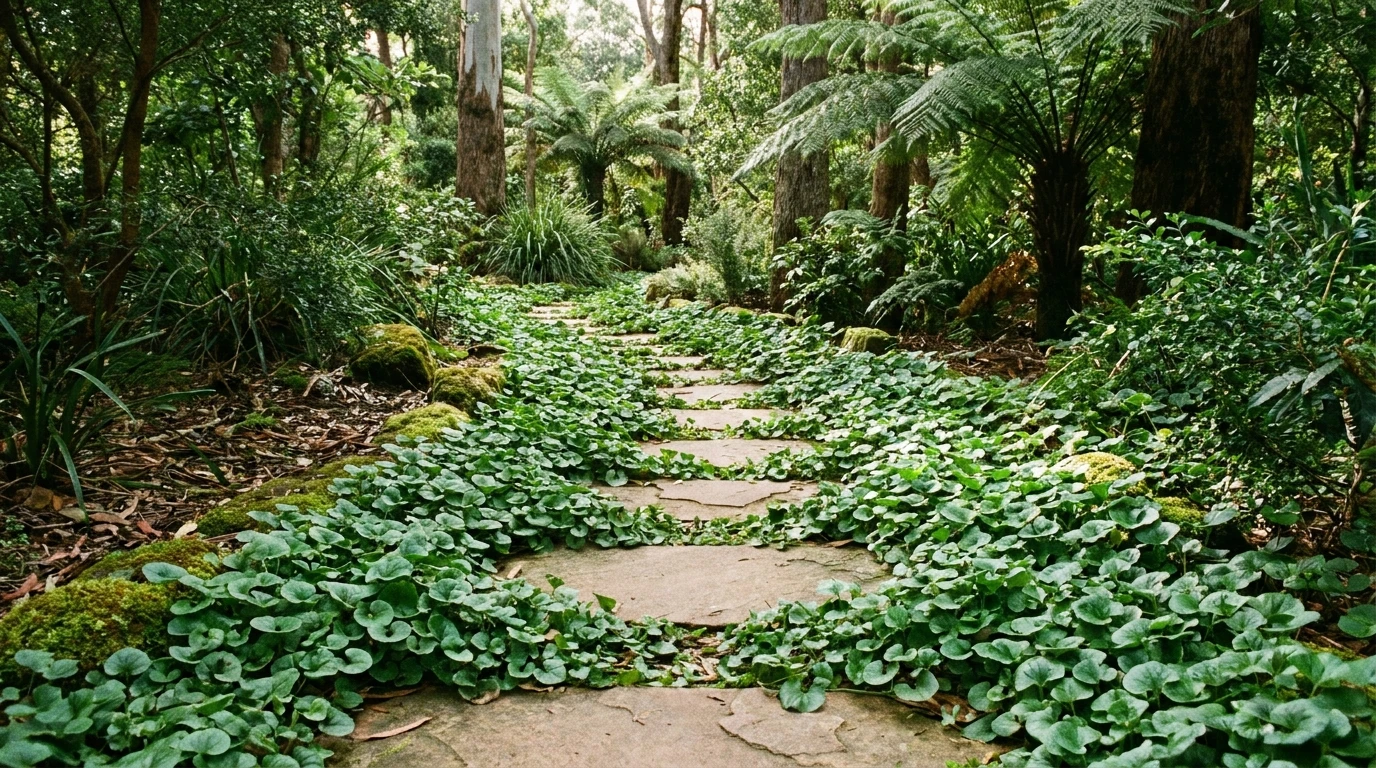
Gardening Australia specifically recommends Dichondra repens between pavers. Bunnings sells it in its Step-ables groundcover range for paths and paving gaps, while Plant Tiles Australia also recommends it around stepping stones.
The low foliage softens the edge of hard landscaping without creating the long floppy stems of taller groundcovers.
On our own paving layouts, we keep the finished soil surface slightly below the top of the stone so foliage has somewhere to sit without immediately becoming the main wear surface.
Where the route receives constant footsteps, we make the pavers broad enough that people naturally walk on stone rather than on the plant.
It works especially well beneath trees
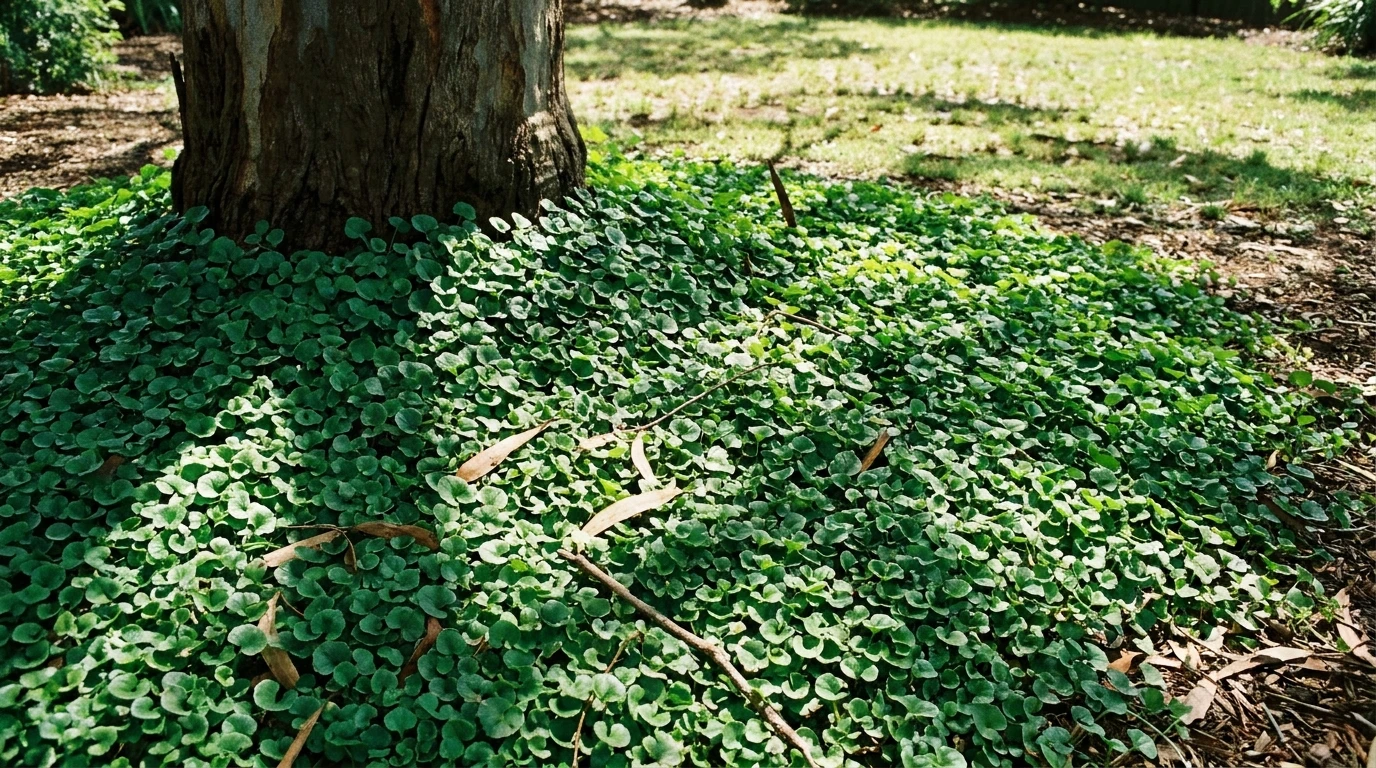
Gardening Australia highlights under-tree planting as one of the best applications for native Kidney Weed. Akers of Lawn also recommends it for shady corners beside buildings and beneath trees where ordinary lawns thin out.
That use suits the natural ecology of the plant. It can create a continuous green floor beneath an open canopy where a sun-demanding turf species remains patchy.
Tree roots still matter. We avoid deep cultivation that damages established roots and instead use small plugs or divided plants placed into suitable gaps in the root zone.
It can suppress weeds once coverage is dense
Australian Plants Society NSW calls Dichondra useful for suppressing weeds, and Akers of Lawn likewise notes that it fills gaps and creates dense cover.
The key phrase is “once coverage is dense”. During establishment, bare areas can still germinate weeds, which is why seedbed preparation matters so much.
In our own plantings, we expect more hand-weeding at the beginning and much less after runners have covered the exposed soil.
Dichondra can also spread into garden beds where it is not wanted. Australian Plants Society NSW notes that it can become invasive within cultivated beds, so edging or occasional runner removal may be needed.
Frost tolerance is better than its soft foliage suggests
Plant Tiles Australia lists established Dichondra repens as frost hardy to approximately -9°C. McKays describes established plants as frost tolerant, and Garden Express also lists frost tolerance.
The -9°C figure is a commercial Australian supplier rating rather than a universal damage threshold for every provenance and site, so we would not promise identical performance in every cold garden.
In cooler climates, McKays says the plant can look thinner or browner during winter even when it survives. Growth strengthens again as warm-season conditions return.
Drought tolerance is moderate, not unlimited
Gardening Australia says established native Kidney Weed can take serious drought before the leathery foliage begins to wilt. McKays describes the plant as only moderately drought hardy and recommends irrigation during drought and summer stress.
Those observations are not contradictory. An established plant can survive drying, but keeping a lawn substitute lush and green requires more moisture than merely keeping the plant alive.
In shade, evaporation is lower and the mat can stay green with less water. In full exposed sun, irrigation demand rises.
We design the watering system according to the appearance expected. A resilient native groundcover allowed to fluctuate seasonally needs less irrigation than a permanently lush green lawn effect.
Dichondra repens and ‘Silver Falls’ are not interchangeable
This is the most common identity mistake in garden content about Dichondra.
Kew’s Plants of the World Online records Dichondra repens as native across southern and eastern Australia. Kew records Dichondra argentea, the species behind ‘Silver Falls’, as native from the south-western United States through Mexico and parts of South America.
Domus Nursery explicitly lists Dichondra argentea ‘Silver Falls’ as exotic and gives a mature size around 5–10 cm high × 0.9–1.2 m spread. Plantmark lists Silver Falls at about 10 cm high with trailing stems to around 80 cm.
| Feature | Dichondra repens | Dichondra argentea ‘Silver Falls’ |
|---|---|---|
| Foliage | Green kidney-shaped leaves | Silver-grey foliage |
| Australian status | Native | Exotic; species native to the Americas |
| Best-known use | Lawn substitute, shade groundcover, between pavers | Hanging baskets, pots, retaining-wall spillover |
| Light | Full sun to shade | Best ornamental silver colour in brighter positions; current AU nurseries also use part shade |
| Traffic use | Light pedestrian use when established | Primarily ornamental, not a lawn substitute |
| Typical growth effect | Roots along the ground to create a carpet | Long silver cascading stems |
Gardening Australia makes the same distinction: green native D. repens works beneath trees and between pavers, while exotic silver D. argentea ‘Silver Falls’ is better treated as a sunny trailing ornamental for rockeries and spillover.
Seed versus plugs: which would we choose?
For a broad, prepared lawn-style area, seed can make economic sense. The Australian seed suppliers checked consistently use approximately 1 kg per 100 m².
For an irregular area beneath trees, between rocks or around paving, we prefer plugs or divided plants because we can place growth exactly where it is needed without disturbing the entire surface.
Plant tiles make sense when immediate green coverage matters more than the initial plant cost.
| Project | Our preferred establishment method | Reason |
|---|---|---|
| Large prepared lawn-style area | Seed | Efficient coverage where a clean seedbed can be prepared |
| Under established trees | Plugs or divided pots | Less disturbance to existing roots |
| Between stepping stones | Small plugs | Easy to position in individual gaps |
| Instant lawn alternative | Plant tiles | Pre-grown coverage avoids waiting for runners to meet |
| Irregular garden bed | Plugs / divided larger pots | Plants can be concentrated where coverage is needed first |
Where Dichondra repens fits—and where we would choose something else
| Garden job | Dichondra repens fit | Why |
|---|---|---|
| Shady lawn substitute | Excellent | One of its clearest advantages over many turf grasses |
| Under established trees | Excellent | Gardening Australia specifically supports this use |
| Between stepping stones | Excellent | Low growth and light traffic tolerance suit paving gaps |
| No-mow green groundcover | Excellent | Naturally stays below about 10 cm in many conditions |
| Living mulch in a shaded bed | Very good | Dense runners can suppress weeds and protect soil |
| Sunny lawn with irrigation | Good | Performs well but needs more moisture than in shade |
| Sports lawn or heavy dog-run corridor | Poor fit | Australian guidance generally supports light rather than repeated heavy traffic |
| Dry exposed lawn with no supplementary water | Cautious choice | Can survive drought better than its appearance suggests, but lush green coverage needs moisture |
| Silver hanging-basket display | Wrong species | Use exotic Dichondra argentea ‘Silver Falls’ instead |
For us, Dichondra repens is strongest where traditional lawn is already asking too much of the site: under trees, beside buildings, between stepping stones or in passive green spaces that do not need sports-turf durability. Its value is not simply “no mowing”; it is the ability to make a convincing green surface in places where many grasses struggle.
Frequently asked questions
How high does Dichondra repens grow?
Australian landscape references generally put Dichondra repens below about 10 cm high. WA Government guidance uses about 10 cm, Federation University gives 10 cm, and Plant Tiles Australia reports a broader 5–100 mm range depending on light, moisture and traffic.
Is Dichondra repens native to Australia?
Yes. Kew’s Plants of the World Online records Dichondra repens as native to New South Wales, Queensland, South Australia, Tasmania, Victoria and Western Australia. Gardening Australia also describes Kidney Weed as a widespread Australian native.
How long does Dichondra repens take to cover an area?
There is no reliable Australia-wide coverage time. Gardening Australia says a few tubestock plants can colonise a large area within about a year under suitable conditions. Seed, plug spacing, season, shade, temperature, irrigation and weed competition can all make establishment faster or slower.
Can Dichondra repens grow in shade?
Yes. Shade tolerance is one of its strongest advantages. Gardening Australia recommends it beneath trees and in both sun and shade, while Australian lawn-seed suppliers specifically use Dichondra for low-light lawn areas where ordinary grasses struggle.
Can you walk on a Dichondra lawn?
Yes, for light use. Bunnings and McKays recommend Dichondra repens for light foot traffic, while Plant Tiles Australia reports moderate traffic tolerance in established mats. For repeated heavy use, use stepping stones or a tougher turf species.
Does Dichondra repens need mowing?
No mowing is required if you like its natural low carpet. Gardening Australia and Bunnings both promote it as a no-mow lawn substitute. If a shorter lawn-style finish is wanted, Akers of Lawn gives a mowing height of roughly 15–40 mm.
Is Dichondra repens the same as Silver Falls?
No. Dichondra repens is the green Australian native Kidney Weed used for lawns and groundcover. ‘Silver Falls’ is Dichondra argentea, an exotic American species with silver foliage grown mainly in hanging baskets, pots and as cascading ornamental groundcover.
Can Dichondra repens be grown from seed?
Yes. Australian Plants Society NSW confirms propagation by seed as well as division. Akers of Lawn and Naracoorte Seeds both recommend approximately 1 kg of seed per 100 m² for lawn establishment, with careful weed control before and during establishment.


