Best value

Babingtonia Virgata Dwarf Form: Best Pots, Soil, and Care Tips

Love the look of lush, native Australian greenery but don’t exactly have a sprawling backyard to plant a massive 4-meter hedge?

The perfect solution is the Babingtonia Virgata Dwarf Form.

While the full-sized species is famous for massive privacy screens (check out our Complete Babingtonia Virgata Care Guide for details), this miniature variety brings that same rugged toughness to tight courtyards and balcony pots.

But beware: container gardening is unforgiving. Trap this native in a cheap plastic pot or generic supermarket soil, and it will crisp up and die in days.

best  solution is Babingtonia-Virgata-Dwarf-Form.
best solution is Babingtonia-Virgata-Dwarf-Form.

Babingtonia Virgata Dwarf

🌿 IDEAL GROWING CONDITIONS 🌿

Thrives in the right conditions for healthy growth and beautiful blooms.

☀️

CLIMATE

MILD

Prefers mild to warm climates. Ideal in temperate to subtropical regions.

🌡️ Ideal Temp: 15°C – 28°C
🌱

DROUGHT

HIGH TOLERANCE

Low water needs once established. Tolerates dry periods exceptionally well.

💧 Water Wise Native
❄️

FROST

SENSITIVE

Not frost hardy. Protect from frost and freezing winter winds.

🌡️ Keep Above 5°C
🌬️

AIRFLOW

GOOD

Prefers good airflow to promote healthy growth and reduce disease risk.

💨 Well Ventilated

🌿 BEST RESULTS: Plant in a sunny to lightly shaded spot with good airflow. Protect from extreme cold and ensure well-draining soil.

How to grow potted Dwarf Twiggy Heath Myrtle

If you want a thriving, bird-attracting feature plant, you need the right setup. Here is exactly how to choose the right pot, the perfect soil chemistry, and the care routine to make your potted Dwarf Twiggy Heath Myrtle thrive.

🌿 Snapshot: The Potted Powerhouse

When Australian gardeners look for a ‘Dwarf Heath Myrtle’ or ‘Dwarf Twiggy Myrtle,’ they want a resilient, no-fuss native that delivers massive greenery in a tight space. Here is exactly what this compact, evergreen powerhouse shrub brings to your garden:

• Hardiness & Resilience:
Unlike fussy exotic plants, this tough Aussie native is built to handle the intense glare of a hot balcony or the heavy wind tunnel of an apartment high-rise.

• Compact Size & Shape:
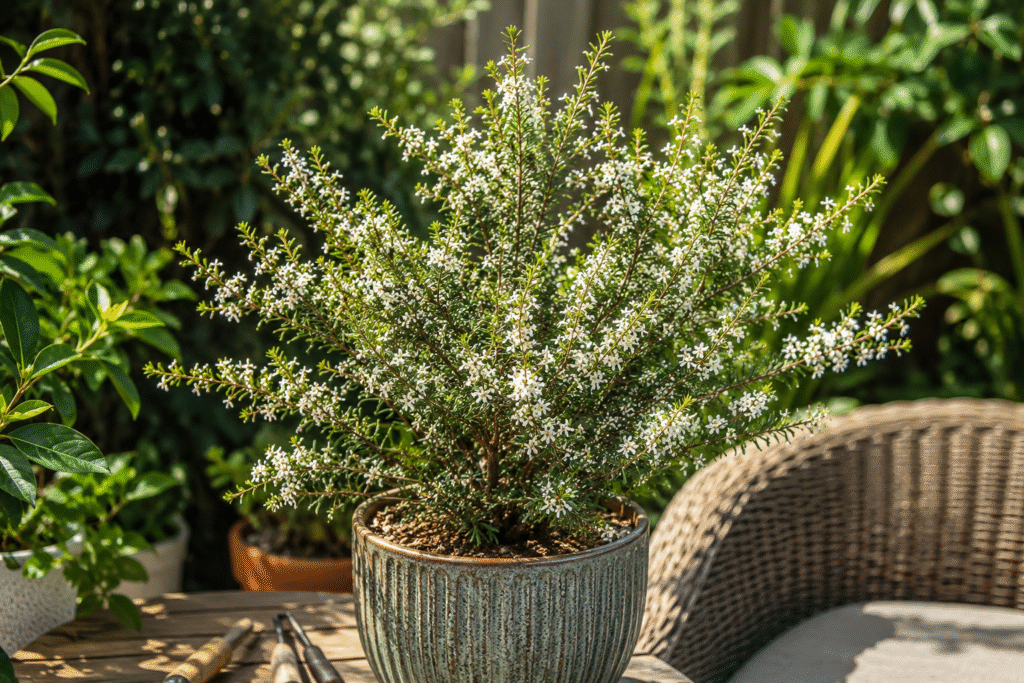
Perfect for tight courtyards and patio pots. It naturally grows into a neat, tight mound between 30cm and 1 meter tall, meaning you never have to prune it aggressively.

• Eye-Catching Foliage:
It features very fine, needle-like deep green leaves. As a brilliant visual bonus, the fresh spring growth emerges with an attractive bronze tint.

• Wildlife-Friendly Flowers:
It explodes with masses of tiny, star-shaped white flowers from late spring through summer. The blooms have a light honey scent that acts as a magnet for native bees, butterflies, and small birds.

The Problem: Traditional hedging plants are genetically wired to grow massive root systems. When forced into a pot, they quickly become “root-bound,” cracking expensive terracotta and demanding heavy pruning every month to fit the space.

The Solution: Dwarf cultivars of the Babingtonia Virgata Dwarf Form.—sold under nursery names like Gardengreen’, Howie’s Feathertips’ or ‘Compacta’—are ideal container shrubs.
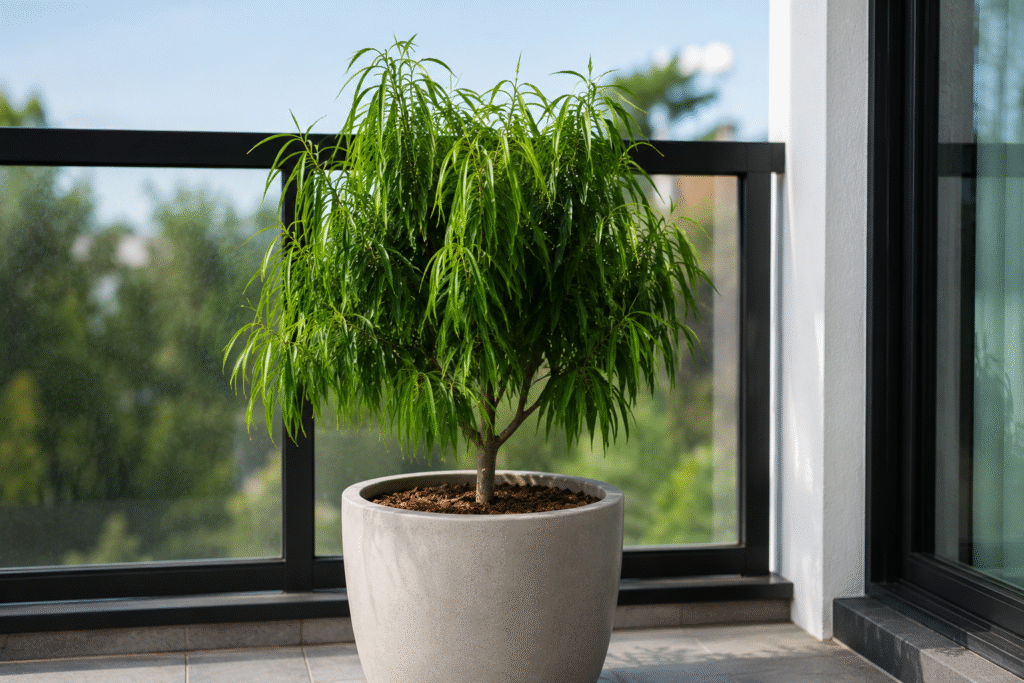
Babingtonia-Virgata-Twiggy-Heath-Myrtle-dwraf-for-balcony-in-Australia
  • Perfect Proportions: They naturally max out at 1 meter high and 1 meter wide. They form a dense, rounded mound of fine green foliage without ever requiring a chainsaw or aggressive hedging shears.
  • The Summer Floral Show: Despite their miniature stature, they punch well above their weight in spring and summer. They produce an explosion of delicate, honey-scented white flowers, transforming your stark apartment balcony into a feeding ground for local native bees and butterflies.
  • Wind and Glare Resistance: High-rise balconies often suffer from brutal wind tunnels and intense reflective glare from glass windows. The dwarf Babingtonia’s fine, tough foliage is built to withstand these harsh coastal and urban microclimates.

The Problem: This is where 90% of container gardeners fail. Australian natives evolved in some of the most nutrient-poor soils on the planet. If you plant your Babingtonia Virgata Dwarf Form in a standard, “premium” potting mix (pumped full of synthetic fertilisers), the high phosphorus levels will physically burn the roots. The leaves will turn yellow, drop off, and the plant will perish.

The Solution: You must use a certified, low-phosphorus Native Potting Mix. A potted plant cannot send its roots deep into the earth to find what it needs, so the soil you provide is its entire universe.
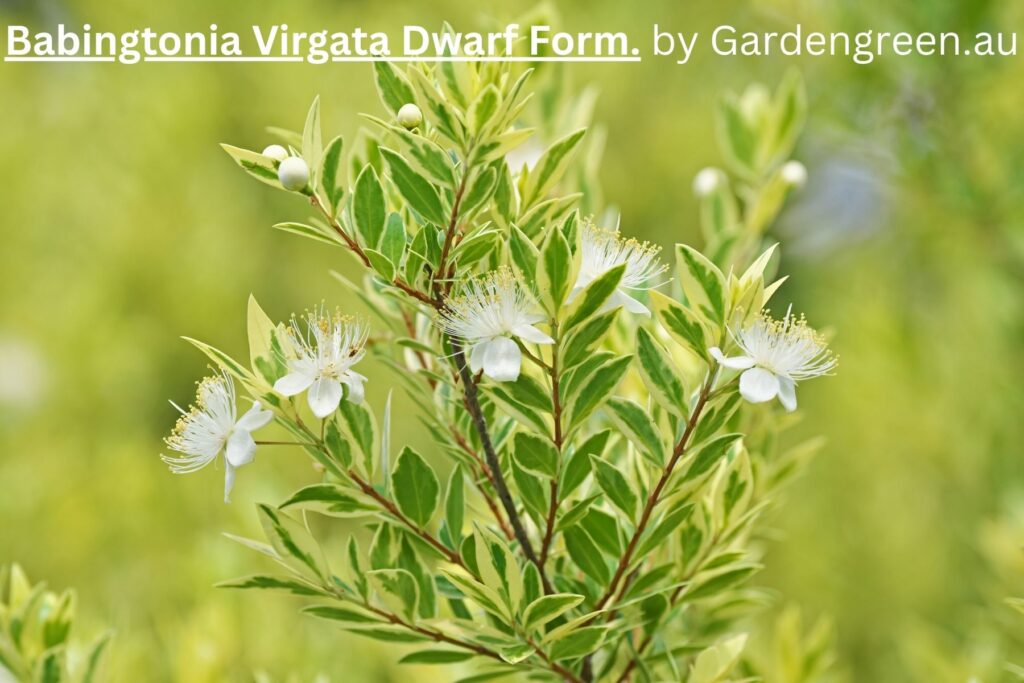
how to grow are and prune Babingtonia Virgata (Twiggy Heath Myrtle

Because botanists have continually reclassified this native plant, shopping for the dwarf variety can be frustrating. To make sure you buy the miniature container plant and not a massive 4-meter hedge, look for these names on the nursery tag:

Botanical NamesDwarf CultivarsCommon Names
• Babingtonia virgata
• Baeckea virgata
• Sannantha virgata
• Baeckea virgata ‘Nana’
• Baeckea virgata ‘Compacta’
• Dwarf Baeckea
• Fairy Lights Plant
• Dwarf Heath Myrtle

For optimal growth, the Dwarf Babingtonia performs best when you replicate its native Australian habitat. While it is incredibly tough, container growing requires a bit more environmental awareness.

If you notice the fine leaves turning yellow, this is often a direct result of poor drainage, overwatering, or a nutrient imbalance. You can fix this immediately by improving drainage with added sand or gravel in your potting mix.

This variety thrives in mild to warm climates, specifically hitting its peak growth in temperate to subtropical regions between 15°C and 28°C.

While standard ground-planted bushes can handle a chill, the potted dwarf form is not frost hardy. You must protect it from bitter cold winds and ensure the ambient temperature stays above 5°C during the depths of winter.

High-rise balconies are great for this, as the plant prefers good air circulation to promote healthy foliage and significantly reduce the risk of fungal diseases.

✔️ Pros of Potted Dwarf Babingtonia

  • High drought tolerance once established.
  • Requires minimal pruning to maintain shape.
  • Produces a stunning display of flowers in summer.
  • Compact growth habit suits balconies and courtyards.
  • Shallow root system is pot-friendly.
  • Excellent feature plant for small gardens.
  • Attracts bees and other beneficial pollinators.
  • Evergreen foliage provides year-round interest.

❌ Cons to Consider

  • Sensitive to frost and prolonged cold conditions.
  • Performs poorly in heavy, waterlogged soil.
  • Prefers low-phosphorus native plant potting mixes.
  • May require occasional watering during extended dry periods.
  • Flowering can be reduced in heavily shaded locations.
  • Container-grown plants may need repotting every few years.

Dwarf Babingtonia vs. Related Varieties

Understanding the subtle differences between the botanical cousins of the Twiggy Heath Myrtle will ensure you buy the exact right plant for your container.

Plant VarietyGrowth HabitBest Landscaping Use
Dwarf BabingtoniaDense and highly compact.Ideal for balcony containers and tight paved borders.
Standard Baeckea VirgataLarger shrub with a more open structure.Suited for massive boundary landscaping.
Sannantha MinimaA very small, ground-hugging form.Perfect as a spreading ground cover.
The perfect solution is the Babingtonia Virgata Dwarf Form.
  1. Premium Native Potting Mix (Low P): The gold standard for potted natives. This blend contains wetting agents to ensure water penetrates the tight root ball during a January heatwave, rather than running uselessly down the inside of the pot.
  2. Organic Native Soil Improver: If you are filling a massive, custom-built wooden planter box, blend this organic compost with a well-draining sandy loam to create the ultimate free-draining environment.
  3. Slow-Release Native Fertiliser (6-Month Feed) Throw away your liquid chemical feeds! Simply drop a handful of these low-phosphorus pellets onto the topsoil twice a year (in early Spring and Autumn) to ensure vibrant green foliage.

Paved courtyards act like heat sinks. If you place your native in a small, dark-coloured plastic pot and leave it facing the harsh afternoon sun, the temperature inside can exceed 50°C. The sun will physically cook the root system.

Choose a pot that is large enough to insulate the roots, made from the right material, and features superior drainage. Never buy a pot smaller than 40cm wide for a dwarf native.

  • The Modern Winner: Lightweight Fibreglass & Resin Pots. They replicate the high-end look of polished concrete or stone, but weigh next to nothing, making them the safest choice for apartment balconies with strict weight limits. Opt for light grey, white, or mint green to reflect sunlight away from the root zone.
  • The Traditional Choice: Thick Terracotta Pots. Terracotta is porous, allowing the roots to breathe and the soil to drain rapidly. However, because the pot breathes, the soil will dry out much faster. If you use terracotta, you must be prepared to water more frequently during the peak of summer.
  • For the Busy Professional: Self-Watering Trough Planters. If you travel frequently or are notoriously bad at remembering watering schedules, a self-watering trough is a lifesaver. Crucial tip: Ensure the overflow drainage valve is permanently open. Natives like moist soil, but if they sit in a stagnant pool of water, they will succumb to root rot.

Unlike their deep-rooted cousins in the garden, potted plants dry out incredibly fast. During its first 8 weeks in the pot, water your Dwarf Babingtonia deeply 2 to 3 times a week. Once established, check the soil moisture with your finger; if the top 5cm is bone dry, give it a long soak until water pours freely out of the bottom drainage holes.

While the dwarf form stays naturally compact, a very light “tip-prune” (snipping off just the top 2-3 cm of growth) directly after it finishes flowering in late summer will encourage thicker, denser foliage for the winter season.

Even the fastest-growing dwarf natives take a full growing season to puff out and look perfectly styled in their new pots. If you are styling an outdoor entertainment area for a party this weekend, or staging your property for a real estate photoshoot, you do not have time to wait for a plant to grow.

The Solution: The high-end, artificial alternative.

Don’t Have Time to Wait for it to Grow?

Skip the messy potting mix, the stressful watering schedules, and the waiting game. Transform your stark balcony into a lush, green oasis today with our premium, UV-stabilized Artificial Potted Shrubs. Engineered specifically to survive harsh Australian balcony heat without fading, peeling, or cracking, they provide an instant, zero-maintenance architectural feature.

Shop Gardengreen Artificial Potted Plants Now

FAQS: Dwarf Twiggy Heath Myrtle

How tall does the Dwarf Babingtonia Virgata grow in a pot?

In a container, dwarf varieties like ‘Compacta’ or ‘Howie’s Feathertips’ usually peak at 80cm to 1 meter in height and width. This natural, rounded mound shape makes them the perfect low-maintenance feature plant for tight Australian courtyards.

What is the best pot size for a dwarf Twiggy Heath Myrtle?

Start with a pot that is at least 40cm to 50cm wide. This provides enough soil volume to insulate the sensitive native roots against brutal summer heatwaves and prevents the potting mix from completely drying out within hours.

How often should I water my potted native on a hot balcony?

During a hot Australian summer, balcony pots dry out rapidly. Check the soil every 2 to 3 days; if the top 5cm is bone dry, give it a deep soak until water runs out the bottom drainage holes. In winter, reduce watering to once a week.

Will the roots of a dwarf Babingtonia crack my terracotta pot?

No. Unlike large hedging trees, the dwarf Twiggy Heath Myrtle has a fine, shallow, and non-aggressive root system. It is perfectly safe for premium terracotta, fiberglass, or expensive ceramic planters.

Why are the leaves on my potted Babingtonia turning yellow and dropping?

This is almost always caused by phosphorus toxicity from using a standard potting mix or generic chemical fertilizers. Flush the soil immediately and switch to a certified low-phosphorus native potting blend.

Can I grow a dwarf Babingtonia indoors as a houseplant?

No. Australian natives require excellent airflow and direct sunlight to thrive. Keeping it indoors will quickly lead to fungal diseases, pest infestations, and fatal leaf drop. Always place it outdoors on a sunny or partly shaded balcony.

Can this plant survive intense high-rise balcony winds?

Yes! The fine, tough foliage of the Babingtonia is highly wind-resistant, making it an excellent choice for exposed apartment balconies and windy coastal courtyards where broad-leafed tropical plants would get shredded.

Do dwarf varieties still produce the famous white flowers?

Absolutely. Despite their miniature size, dwarf forms produce a prolific display of delicate, honey-scented white flowers throughout late spring and summer, attracting local native bees right to your balcony.

How do I stop my potted balcony shrub from blowing over in a storm?

If you live on a windy high-rise floor, use a heavy, thick-walled terracotta pot instead of lightweight plastic. Alternatively, place a heavy layer of river stones at the bottom of a fiberglass pot before adding your soil to permanently anchor the plant.

When is the right time to repot my miniature Babingtonia?

Repot your shrub every 2 to 3 years during early Spring, well before the intense summer heat arrives. Only move it up to a pot that is one size larger (about 5cm to 10cm wider) to avoid shocking the sensitive root system.

How do I fix hydrophobic (water-repellent) potting mix?

If water simply pools on the surface and runs down the inside edges of your pot without soaking in, the soil is severely dry. Apply a native-safe soil wetter (wetting agent) immediately to allow water to penetrate back into the root ball.

Is the Dwarf Twiggy Heath Myrtle safe for balcony pets?

Yes. Like the standard full-sized form, the dwarf Babingtonia Virgata is considered completely non-toxic to dogs and cats, making it a stress-free addition to pet-friendly apartment balconies.

“`

We will be happy to hear your thoughts

      Leave a reply

      Garden Green Australia - Stay Green Always
      Logo
      Compare items
      • Total (0)
      Compare
      0
      Shopping cart