Looking for a dense Australian privacy hedge without wasting money on the wrong plant?
When it comes to boundary screening, two popular native choices stand out:
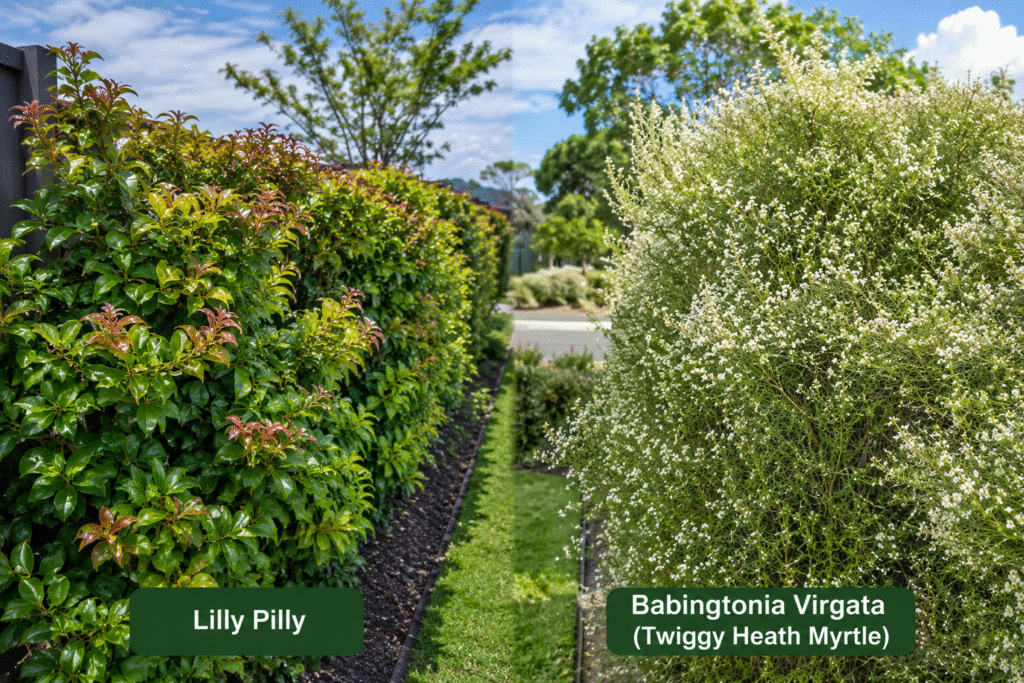
Lilly Pilly and Babingtonia Virgata (Twiggy Heath Myrtle).
Both can create an attractive hedge, but they differ in growth, maintenance, pest resistance, and long-term care. Choosing the right one can save you time, money, and ongoing maintenance.
In this comparison, we’ll look at the key differences to help you decide which plant is best for your garden.
Must Read: Before comparing them, check out our Complete Babingtonia Virgata Care Guide to understand its soil, watering, and growing requirements.
Before deciding on your boundary hedge, ensure you understand the complete growth habit, soil needs, and long-term care of the Twiggy Heath Myrtle.
Choosing the wrong plant can become an expensive long-term mistake. The decision you make today will determine whether you spend future weekends relaxing on your patio or constantly dealing with pests, pruning, and ongoing maintenance.
Before comparing them directly, it’s worth understanding the complete growth habit, root behaviour, and long-term care requirements of the Heath Myrtle. For a deeper dive, read our Complete Babingtonia Virgata Care Guide.
However, if you’re currently standing in a nursery trying to decide between these two popular screening plants, this head-to-head comparison will give you a clear answer.
Privacy Hedge Visual Scorecard
🌿 Babingtonia vs. Lilly Pilly: Long-Term Performance Review 🌿
A detailed visual “score” for an Aussie native hedge based on homeowner pain points.
NEIGHBOR BLOCKING
DENSITYHow fast and effectively it blocks all visual gaps.
Forms a dense wall right to ground level.
Aggressive height can lead to bare stems (“leggy”) at the base.
PRUNING WORK
EFFORTTotal annual time spent hedging and managing height.
Needs a single annual tip-prune after flowers fade.
Requires frequent, aggressive hedging to prevent “leggy” growth.
POOL SAFETY
MESSRisk of messy berries dropping on paving/skimmer boxes.
Tiny, dry flowers blow away cleanly. No staining berries.
Fleshy purple/pink berries drop, staining paving and clogging filters.
FINANCIAL HEALTH
VALUETotal cost of extra fertilizers, pest sprays, and replacement plants.
100% pest immune. Zero budget needed for pesticides or excessive fertilizer.
Requires costly chemical sprays and stem injections to fight disfiguring psyllids.
🏆 ULTIMATE RESULT: The Babingtonia dominates in low-mess, zero-pest reliability, making it the superior choice for pool areas, paved courtyards, and busy families. The Lilly Pilly wins only for massive rainforest properties with very rich soil where extreme height is required fast.
Growth Rate: Which Plant Creates Privacy Faster?
When you want privacy, you usually want it as quickly as possible.
Both plants are widely known for their rapid growth, but they perform quite differently over a five-year period.
| Feature | 🌿 Babingtonia Virgata | 🍃 Lilly Pilly |
|---|---|---|
| Growth Rate | Moderate-Fast (1m per year) | Very Fast (up to 2m per year) |
| Pest Resistance | 100% immune to Psyllids. | Highly susceptible to Psyllid blisters. |
| Maintenance | Low (annual tip-prune only). | High (requires frequent hedging). |
| Mess Factor | Dry, tiny flowers. Safe for pools. | Fleshy berries that drop and stain paving. |
| Soil Needs | Adaptable. Thrives in poor, sandy soil. | Demands rich, well-watered soil. |
Lilly Pilly
Depending on the cultivar—such as ‘Resilience’ or ‘Backyard Bliss’—a healthy Lilly Pilly can grow between 1 and 2 metres per year when planted in fertile soil and supplied with regular watering and fertiliser.
It is a vigorous and hungry plant that responds exceptionally well to rich soil conditions and ongoing feeding.
Babingtonia Virgata (Twiggy Heath Myrtle)
The Twiggy Heath Myrtle takes a slightly more measured approach, typically producing around 1 metre of dense growth each year.
While it may reach the finish line slightly later than a Lilly Pilly, it naturally develops a tighter and more compact screen. This creates better privacy from ground level upward and often eliminates the need for constant pruning to encourage thick growth.
Click the link below to learn more about:
🍂 Why Is My Babingtonia Virgata Dying? (Brown Leaves & Easy Fixes)Pest Resistance and Maintenance
For many Australian homeowners, this is where the real winner emerges.
Not planting a massive 10-meter boundary? If you just have a small courtyard, you can get the exact same benefits with a smaller plant.
📖 Read Our Guide: Dwarf Babingtonia Virgata in PotsThe Lilly Pilly Challenge
The biggest drawback of Lilly Pilly is its vulnerability to pests.
According to NSW Government urban forestry documentation, the notorious Lilly Pilly Psyllid (Trioza spp.) can cause significant damage to popular Syzygium species, including Syzygium australe and Syzygium paniculatum.
These infestations are particularly common when plants become stressed during periods of hot, dry weather.
The pest causes blister-like lumps and deformities on new growth, leaving foliage covered in unsightly pimples that can seriously affect the appearance of an otherwise beautiful hedge.
In severe cases, chemical treatments such as imidacloprid stem injections may be required to control outbreaks.
The Babingtonia Advantage
This is where Babingtonia Virgata shines.
Unlike Lilly Pilly, it is naturally immune to Lilly Pilly Psyllid.
Once established, its tough, fine foliage helps discourage many common sap-sucking pests, making it one of the lower-maintenance native screening plants available.
Another major advantage is its adaptability.
While Lilly Pilly generally prefers rich, loamy soil and reliable summer watering, Babingtonia Virgata is capable of thriving in poor sandy soils, coastal conditions, and neglected sites where many other hedging plants struggle to survive.
For low-maintenance gardens, many homeowners prefer Babingtonia Virgata vs Lilly Pilly.
The Verdict: Pros & Cons
Babingtonia Virgata
- Zero risk of Psyllid pests.
- Extremely drought tolerant.
- Forms a dense screen right to the ground.
- No messy berries.
- Slower initial growth than Lilly Pilly.
- Sensitive to phosphorus-rich fertilisers.
Lilly Pilly
- Extremely fast vertical growth.
- Attractive reddish-bronze new foliage.
- Can be shaped into formal hedges.
- High risk of Psyllid infestations.
- Needs regular watering in summer.
- Requires frequent pruning.
Babingtonia Virgata vs Lilly Pilly are two of Australia’s most popular privacy hedge plants.
Establishment Cost: Creating a 10-Metre Privacy Screen
For large boundary plantings, establishment costs can vary because both plants require different spacing.
Lilly Pilly Investment
Because Lilly Pilly grows aggressively and develops substantial width, plants can generally be spaced between 1 and 1.5 metres apart.
For a 10-metre boundary, this typically requires around 8 to 10 plants.
At approximately $25 per 200mm pot, the total plant cost is usually between $200 and $250.
Babingtonia Virgata Investment
To create a dense, gap-free privacy screen, Babingtonia Virgata should generally be planted closer together at approximately 80cm spacing.
For the same 10-metre boundary, you’ll need roughly 12 plants.
At around $20 per 200mm pot, the total plant cost is approximately $240.
While the initial investment is similar, the tighter planting arrangement helps create the dense screening effect that makes Babingtonia Virgata such a popular choice for privacy-focused landscapes.
Planning a Massive Boundary Hedge?
Digging 20 holes in hard Australian clay is back-breaking work. Ensure your expensive new hedge survives the summer by having it installed professionally with the correct soil conditioners and irrigation lines.
FAQS about <strong>Lilly Pilly vs Babingtonia Virgata (Twiggy Heath Myrtle).</strong>
Which grows faster: Lilly Pilly or Babingtonia Virgata?
The Lilly Pilly generally grows slightly faster, capable of putting on up to 1.5 to 2 meters a year in ideal conditions with heavy feeding. The Babingtonia grows at a reliable 1 meter per year but tends to form a denser lower canopy without aggressive pruning.
Does Babingtonia Virgata get the pimply leaf disease?
No. The pimply blisters found on hedging plants are caused by the Lilly Pilly Psyllid. Babingtonia Virgata is completely immune to this specific pest, making it a stress-free alternative.
Which hedge is better for planting around swimming pools?
Babingtonia Virgata is far superior for pool areas because it produces tiny, dry flowers. Lilly Pillies produce fleshy, squishy berries that fall onto paving, causing slip hazards and deep purple stains.
Can I mix Babingtonia and Lilly Pilly in the same trench?
It is not recommended. Lilly Pillies are aggressive feeders that require high phosphorus, while Babingtonia is a native that suffers from phosphorus toxicity. Their conflicting soil and fertilizer needs make them poor trench companions.
Which plant is more drought tolerant in Australia?
The Babingtonia Virgata is significantly more drought-tolerant once established. Lilly Pillies are naturally rainforest plants and require regular, deep watering during hot Australian summers to look their best.
Do both of these hedges attract native birds?
Yes, but in different ways. Babingtonia attracts small nectar-feeding birds and thousands of native bees with its summer flowers, while the Lilly Pilly attracts larger fruit-eating birds with its winter berries.
Which hedge handles coastal salt winds better?
Babingtonia Virgata’s fine, needle-like foliage makes it incredibly resistant to salt spray and harsh coastal winds. Broad-leafed Lilly Pillies often suffer from leaf-burn if planted directly on the coastline.
Which is cheaper to buy in bulk?
Because they are so common, Lilly Pilly tubestock can sometimes be found a few dollars cheaper per plant. However, the Babingtonia saves you money long-term due to lower water bills and zero need for expensive chemical pest sprays.
How far apart should I plant them for a privacy screen?
Plant Lilly Pillies approximately 1 meter to 1.5 meters apart to allow for their wide growth habit. Plant Babingtonia Virgata slightly closer, around 80cm to 1 meter apart, to ensure an impenetrable visual block.
Which hedge requires more pruning?
The Lilly Pilly requires significantly more pruning. To stop it from becoming ‘leggy’ and bare at the bottom, it needs frequent hard hedging. Babingtonia naturally retains a tight, dense, bushy shape with only light annual tip-pruning.
Are both of these plants safe for dogs?
Yes, both the Lilly Pilly and the Babingtonia Virgata are considered entirely non-toxic to dogs and cats, making them completely safe for family backyards.
Zero Pests. Zero Waiting.
Why wait three years for your hedge to block out the neighbours? Skip the watering, ignore the soil testing, and get your privacy back today. Transform your ugly fence instantly with our premium, UV-stabilized Artificial Green Wall Panels.