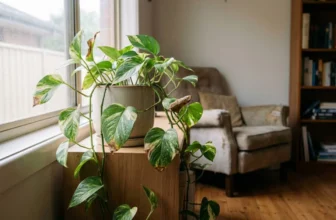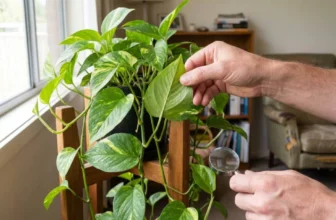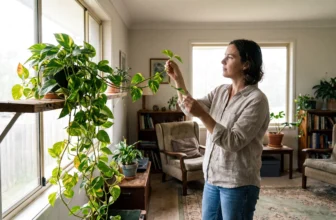
In the wild, Devil’s Ivy does not hang decoratively from a shelf — it heads up a tree trunk, gripping the bark with aerial roots as it goes. Give it something to climb indoors and you are working with that natural habit rather than against it.
What a support actually does is give the plant structure and something for those aerial roots to hold. In good light, a climbing plant tends to grow more upright and can produce larger leaves as it matures. But a pole is not a magic switch. Light remains the main limiting factor indoors, and a support on its own does not deliver giant leaves or split foliage.
And to be clear about something a lot of plant content gets wrong: a trailing Devil’s Ivy is not failing, sulking or defective. Trailing is a perfectly healthy way to grow this plant. Climbing is a choice about the look you want and the space you have — not a rescue mission.
If you want the full picture on light, watering and feeding first, start with our complete Devil’s Ivy care guide for Australia.
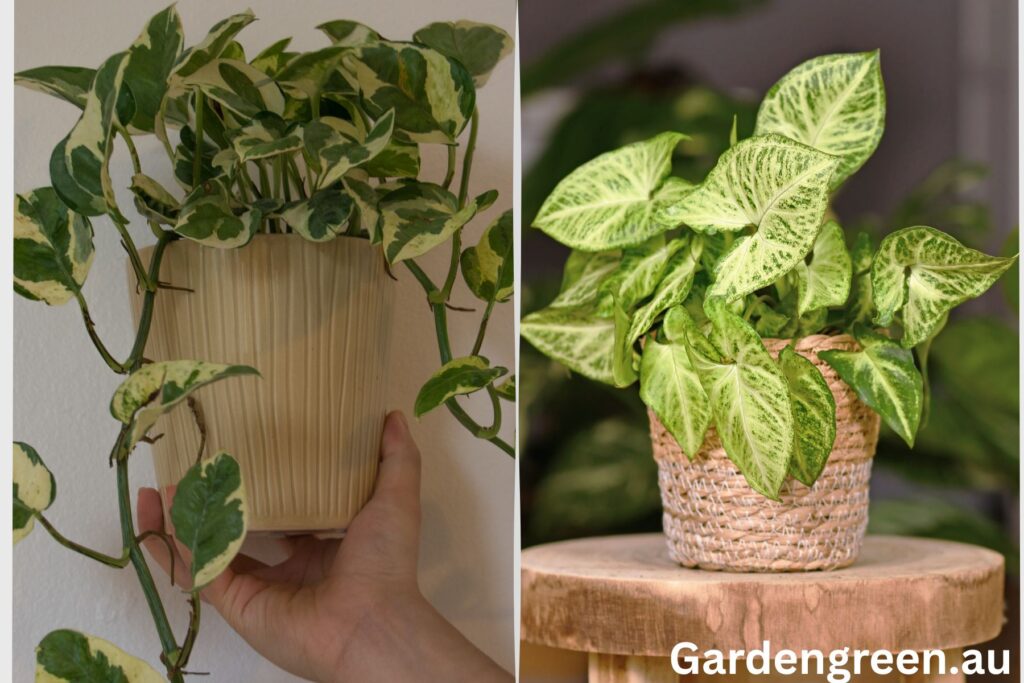
⚖️ Trailing vs Climbing: What to Expect
🪵 Choosing a Support
There is no single right answer here. Each option suits a different situation, and the best one depends on your room, your plant and whether you rent.
🔆 Light, Maturity and Leaf Size
This is the section that matters most, and it is the one usually skipped.
- A support does not fix poor light. Put a pole in a dim corner and you will get a plant climbing a pole with small leaves. Sort the light out first.
- Leaf size depends on several things at once — light, the plant’s maturity, the cultivar you have, its general health, and how well the roots are doing. A support is one factor among those, not the whole story.
- Indoor plants may simply stay juvenile. Many Devil’s Ivy plants kept inside stay in their juvenile form, and that is a normal outcome rather than a failure.
- Split leaves are possible on some mature plants, but they are not something we would promise you. Indoors, with typical household light, expect larger and more upright growth rather than the dramatic fenestration you see in photos of plants growing up rainforest trees.
If the plant is stretching with big gaps between the leaves, that is a light problem before it is a support problem — see why your Devil’s Ivy is leggy. And if you are not sure whether your spot is bright enough, our guide to what “low light” really means gives you a simple test.
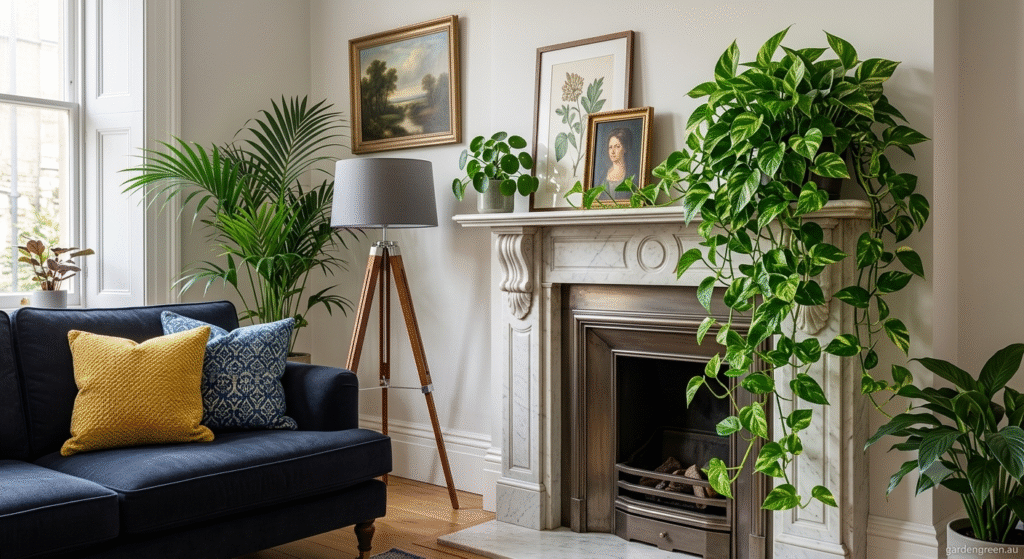
💧 Moisture: The Pole and the Pot Are Different Things
A lot of confusion comes from treating the pole as if it were the plant’s water supply. It is not.
- A true sphagnum moss pole may be lightly dampened when you water, if you want to encourage the aerial roots to attach.
- Coir poles and trellises do not need constant moisture. Trying to keep them wet achieves little.
- A saturated pole is a problem, not a goal. Poles kept permanently wet encourage mould, a musty odour and fungus gnats. If little dark flies are already hovering around the mix, see our Devil’s Ivy pest guide.
- The potting mix still needs watering on its own terms — based on how the mix and the plant actually are, not on a schedule.
- Pole moisture is not a substitute for root-zone watering. The roots in the pot are what keep the plant alive.
🌱 Feeding a Climbing Plant
- Seaweed tonic is a biostimulant, not a complete fertiliser. It has its place, but it will not feed the plant on its own.
- Use a balanced indoor-plant fertiliser according to the label directions.
- Skip the rigid fortnightly routine. Feed while the plant is actively growing, and go by how it is actually doing.
- Reduce or pause feeding when growth slows, particularly through winter.
- Overfeeding will not compensate for low light. A plant in a dark corner is short of light, not short of fertiliser — and pushing more feed at it tends to build up salts in the mix instead.
🧱 Walls, Paint and Renting
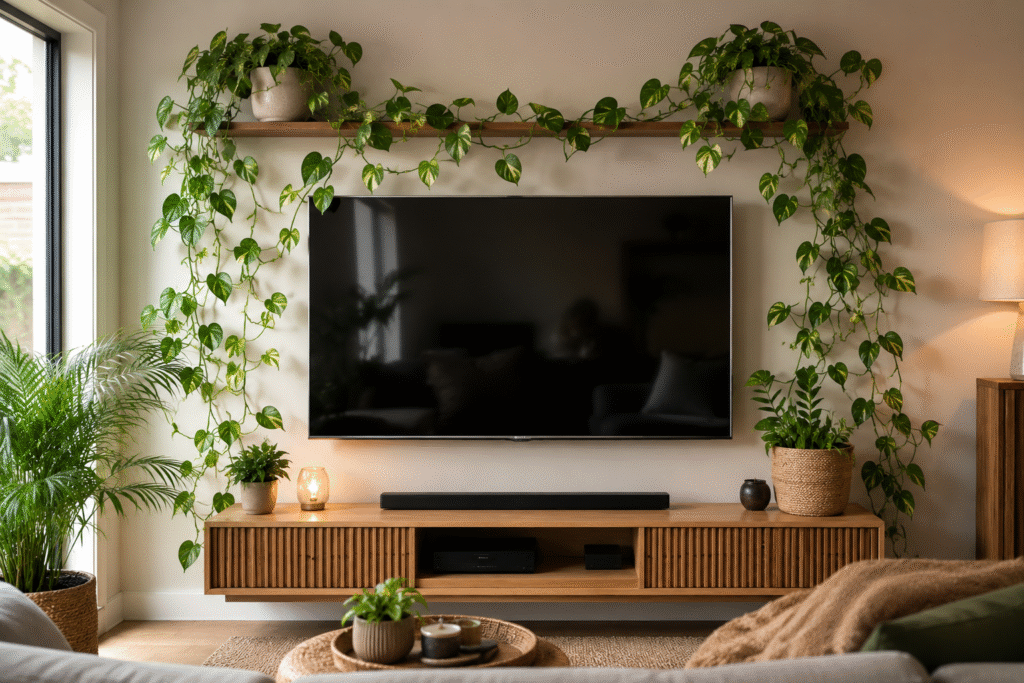
- Clips can lift paint when you remove them, especially on older or poorly-adhered paintwork.
- Aerial roots can grip textured or porous surfaces — render, brick, unsealed masonry — more readily than smooth painted plaster.
- The risk to masonry varies with the condition of the surface. Sound, well-pointed brickwork is a very different proposition from old, crumbling mortar. It is not a given that the plant will cause damage.
- Smooth, removable supports are the safer choice in a rental. A freestanding pole or a trellis leaning against the wall gives you the look without attaching the plant to the wall itself.
- Inspect it from time to time rather than leaving vines attached indefinitely and forgetting about them. Roots that have been gripping the same spot for years are harder to remove cleanly.
⏳ How Long Does It Take?
Honestly: it depends, and anyone giving you a week-by-week schedule is guessing. Growth rate is driven by light, warmth, the season, the health of the roots and the plant’s maturity — and those vary enormously from home to home.
What you can reasonably expect: in a bright spot during the warm months, a healthy plant will put on noticeable new growth and start to hold onto its support. In a dim room, or over a cool winter, progress may be slow to the point of looking stalled — and that is the light and the season talking, not a fault in the plant. Judge it by whether the new growth is healthy, not against a calendar.
⚠️ Common Mistakes
- Forcing old, stiff vines sharply against a pole. Mature stems snap. Train the newer, flexible growth and let the old vines trail if they will not bend.
- Fixing directly to fragile paint. Test one clip in an inconspicuous spot before you commit to a whole wall.
- Expecting split leaves quickly. Indoors this may not happen at all, and it is not a sign you have done something wrong.
- Feeding heavily to force growth. This does not work, and salt build-up in the mix brings its own problems.
- Ignoring root-zone drainage because you are focused on the pole. The pot is still where the plant lives.
❓ Frequently Asked Questions
❓ Does Devil’s Ivy need a moss pole?
No — it grows perfectly well trailing. A pole is worth adding if you want more upright growth and the possibility of larger leaves, and if the light is good enough to support that.
❓ Will a moss pole make the leaves larger?
It can contribute, in the right conditions. Larger leaves depend on light, maturity, cultivar and overall health — the pole supports that process rather than causing it. In a dim room, a pole on its own will not change leaf size.
❓ Can it damage walls?
It depends on the surface. Aerial roots grip textured and porous materials more readily, and clips can lift fragile paint on removal. Sound masonry in good condition is a much lower risk than old, crumbling mortar. Inspect it periodically rather than assuming either the best or the worst.
❓ Should the moss pole stay wet?
It should not stay saturated. A true sphagnum pole can be lightly dampened when you water if you want the aerial roots to attach; coir poles and trellises do not need it. A permanently wet pole invites mould and fungus gnats.
❓ Can I train an old trailing vine to climb?
Sometimes, but be gentle. Older stems are stiff and snap easily. It is often easier to train the newer growth, or to take cuttings and start fresh — see our propagation guide.
❓ Is a coir pole or a moss pole better?
Neither is universally better. Sphagnum holds moisture and encourages attachment but needs more attention; coir is lower-maintenance but less grippy. Choose based on how much upkeep you will realistically do.
❓ Will climbing stop legginess?
Not on its own. Legginess is caused by insufficient light — a plant will stretch on a pole just as it stretches off one. Improve the light first; the support then helps with structure.
❓ Can renters train Devil’s Ivy on a wall?
Yes, with care. Use a freestanding pole or a leaning trellis rather than attaching the plant to the wall, or use removable fixings and test them on a small area first.