Yellow leaves on Devil’s Ivy can result from normal ageing, prolonged wet mix, underwatering, low light, root crowding, fertiliser or salt stress, pests or root damage. Root rot becomes more likely when yellowing occurs alongside wet mix, drooping, soft stems, a sour smell or dark, mushy roots.
A yellow leaf is a symptom, not a diagnosis. One older lower leaf turning yellow on an otherwise healthy plant is normal ageing and needs nothing done about it. What matters is the pattern — how many leaves, where on the plant, and what the potting mix is doing. Get that right and the right action is usually obvious. Guess, and you can turn a minor problem into a dead plant by repotting or watering a plant that needed neither. For the wider picture, see our complete Devil’s Ivy care guide for Australia.
Start With the Pattern, Not the Colour
| Pattern | More likely explanation |
|---|---|
| One older lower leaf yellowing | Normal ageing |
| Several leaves yellowing while the mix stays wet | Root stress or possible root rot |
| Yellowing with dry mix and limp foliage | Underwatering — see the watering guide |
| Pale, stretched growth in a dim position | Low light — see the light guide |
| Yellowing with sticky residue or visible insects | Pest activity — see the pest guide |
| Yellowing after heavy feeding, or a crust on the mix | Fertiliser or salt stress — often with brown tips |
| Yellowing soon after repotting | Root disturbance, watering mismatch or an oversized pot |
The Wet-Versus-Dry Question
This is the most useful thing you can establish, and it is the fork the whole page turns on. Before anything else, find out what the potting mix is actually doing.
How to check: check the upper mix, the weight of the pot, and how long the root zone has remained wet. In deep pots, a dry surface can hide wet mix below — so do not rely on the surface alone, and do not rely on a fixed finger depth.
- Water based on the pot and root-zone condition, not on a schedule.
- Do not assume root rot — dry mix points away from it.
- Check whether the mix has gone hydrophobic and is shedding water down the sides.
- Avoid repeated small sips. Water properly, then leave it alone.
- Do not add more water.
- Empty any runoff from the cover pot or saucer.
- Check that the inner pot actually has drainage.
- Note how long the pot has stayed wet — unusually long is the warning sign.
- Look for soft stems, a sour smell and widespread decline.
Work Out Which Situation You Are In
Check the mix and the plant, then choose. This is a guide, not a substitute for looking at the roots.
When Root Rot Is Genuinely Likely
Root rot is a real problem and it does kill plants. It is also over-diagnosed, because a yellow leaf is frightening and the internet is confident. No single symptom proves rot. Look for the cluster:
- the mix stays wet for unusually long periods
- roots are soft, dark or mushy
- there is a sour or stagnant smell
- the lower stems feel soft
- yellowing is widespread rather than one old leaf
- the plant continues to decline even after you withhold water
- roots separate or slough off when handled
Drooping while the mix remains wet is a strong warning of root stress or possible root damage, but root rot should be confirmed by the wider symptom pattern and, where justified, by root inspection. Poor oxygenation, compacted mix, cold stress and drainage failure can all produce root stress before obvious mushy rot has set in. What is clear is that the plant is not thirsty — watering it again while the mix is wet makes things worse.
How to Inspect the Roots
Inspection is not surgery. Do it calmly, and only when the symptoms justify it — root disturbance is itself a cause of yellowing.
- Remove the inner pot, or slide the plant out, carefully.
- Support the root ball rather than pulling on the stems.
- Loosen only enough mix to see the roots.
- Distinguish firm roots from soft, dark or decayed tissue. Healthy roots are firm and pale; rotted roots are dark, soft, and come apart easily.
- Avoid stripping all the healthy mix away unnecessarily.
If needed, rinse only enough to distinguish healthy roots from decayed tissue. Do not scrub or aggressively wash healthy roots.
If Damaged Roots Are Confirmed
- Trim only the clearly soft, dark or decayed roots, using clean tools.
- Preserve firm, healthy roots — they are what the plant will rebuild from.
- Use fresh, free-draining potting mix.
- Choose a pot only slightly larger than the remaining root system.
- Make sure excess water can escape.
- Do not leave the pot standing in runoff.
- Avoid fertilising until the plant shows stable growth.
- Hydrogen peroxide. You may see it recommended as a root treatment online, but reliable houseplant guidance does not require it, and incorrect concentrations may damage living root tissue. This guide does not recommend a peroxide root drench.
- Cinnamon, bleach or fungicide by default.
- Aggressive root disinfecting. What saves the plant is removing decayed tissue, giving the roots air and fixing the drainage and watering that caused the problem.
- Automatic upsizing. A bigger pot holds more wet mix around fewer roots, which is the opposite of what a recovering plant needs.
Watering After Repotting
This is where people undo the rescue. After repotting, check the moisture level and the root condition rather than watering automatically. If the fresh mix is already evenly moist, allow it to begin drying before watering again. A plant with a reduced root system uses less water than it did before, so the pot will dry more slowly than you expect. See the watering guide for how to judge that.
Fertiliser, Salts and When Flushing Is Appropriate
A white crust on the mix or pot, repeated heavy feeding, and browning at the tips may suggest salt accumulation. Flushing may help only when the mix drains freely and the root system is not already waterlogged or collapsing.
- Run water through only if drainage is working.
- Let the excess escape fully.
- Do not flush a saturated pot. You would be adding water to a root system that is already suffocating.
- Compacted or collapsed mix may need repotting instead.
- Resume feeding according to active growth and the product label — not a fixed calendar.
If the main symptom is dry, crispy leaf edges rather than yellowing, see brown crispy tips.
Yellow Leaves After Repotting
Yellowing that starts shortly after a repot usually has a mundane explanation:
- root disturbance from the move itself;
- an oversized pot holding wet mix around too few roots;
- fresh mix that holds more water than the old mix, so your usual watering is now too much;
- a change in light at the same time as the repot;
- root damage that already existed before you repotted;
- the temporary loss of an older leaf, which is normal.
Keep the conditions stable and watch the new growth. Do not repot again to fix a repot.
What Recovery Looks Like
Recovery speed depends on how much healthy root tissue remains, the season, light, temperature and the severity of the original problem. Look for firmer stems, stable existing foliage and healthy new growth rather than expecting improvement on a fixed schedule.
- Existing yellow leaves will not turn green again. That tissue is finished.
- Success is judged by stabilisation and new growth, not by the old leaves.
- Continued decline while the mix is wet justifies another root and drainage check.
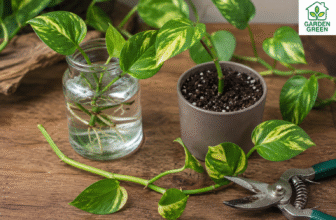
If the plant is too far gone, healthy vine sections can often be saved as cuttings — see how to propagate Devil’s Ivy.
What Not to Do
- Do not water automatically because a leaf is yellow.
- Do not flush already waterlogged mix.
- Do not use peroxide or household disinfectants on roots.
- Do not remove every yellowing leaf immediately.
- Do not move the plant into a much larger pot.
- Do not fertilise a severely stressed root system.
- Do not assume tap water is the cause from yellowing alone.
- Do not rely on a fixed recovery calendar.
Frequently Asked Questions
Older lower leaves yellowing one at a time is usually normal ageing. The plant sheds its oldest leaves as it grows. It becomes a concern when several go at once, when new growth is affected, or when the mix is staying wet.
Read the mix, not the leaf. Yellowing with a wet, heavy pot and soft or drooping foliage points to too much water. Yellowing with a dry, light pot and limp leaves points to too little. A plant drooping while the mix is wet is the classic overwatering signal.
No. A single yellow lower leaf on an otherwise healthy plant is not evidence of rot. Root rot is indicated by a cluster of signs — wet mix, sour smell, soft stems, dark mushy roots and widespread decline — not by one leaf.
You can remove leaves that are fully yellow, soft or badly damaged if they detach easily. It is cosmetic. Do not strip every yellowing leaf immediately, and do not assume removing leaves treats the cause.
Often yes, if enough firm healthy root tissue remains and you fix the drainage and watering that caused it. Recovery depends on how much root survives, not on a fixed timeline. If very little healthy root remains, saving healthy vine sections as cuttings is usually the better bet.
No — check the moisture level and root condition first. If the fresh mix is already evenly moist, let it begin drying before watering again. A plant with fewer roots uses less water than it did before.
Yes. Excessive or frequent feeding, or feeding a stressed plant, can contribute to salt accumulation and root damage. Do not feed a plant that is actively declining.
Only if you have reason to suspect salt build-up and the mix still drains freely. Do not flush a pot that is waterlogged or whose mix has collapsed — that makes a root problem worse.
Yellowing alone is not evidence that tap water is responsible. Water hardness varies by area and many Devil’s Ivy plants cope with ordinary tap water. Rule out watering consistency, feeding and root condition first.
Look beyond water. Low light, root crowding, pests, or a mix that has gone hydrophobic and is shedding water rather than absorbing it can all cause yellowing in a pot that feels dry.
When the symptoms justify it: the mix stays wet unusually long, the plant droops while wet, several leaves deteriorate together, there is a sour smell, the stem base is soft, or the decline followed a recent repot.
Sources
- University of Minnesota Extension — diagnosing houseplant problems, including overwatering and root damage.
- Colorado State University Extension — houseplant pests, where yellowing has a pest cause.
- University of Wisconsin Horticulture — persistently moist growing medium and fungus gnats.