You need a privacy screen, and you need it yesterday. You want to block out the neighbours, hide an ugly fence, or muffle the noise from a busy road.
If you ask any local nursery for the fastest-growing, thickest hedge in Australia, they will hand you a Ficus Hillii.
The Brutal Truth About Ficus Hillii privacy hedge
Planting Ficus Hillii in the wrong spot can cost you tens of thousands of dollars in cracked house foundations and destroyed underground plumbing.
Because Ficus trees possess one of the most aggressive, water-seeking root systems in Australia.
But do not panic—there is a safe way to do this.
When understand it correctly, a Ficus Hillii hedge transforms into a lush green, and nearly impenetrable privacy screen in record time. You just need the right local strategy.
In this ultimate expert guide, we are solving the major Ficus problems so you can plant with confidence. You will discover:
The Australian Blueprint: How to plant, prune, and maintain your hedge to survive our harsh local extremes—from Melbourne clay to Perth sand.
The Variety Secret: How choosing the right plant (like the upright ‘Flash’) saves your driveway space.
The Root Defense System: The exact depth and type of root barrier you need to keep your plumbing 100% safe.
The Ficus Reality Check: Pros & Cons
Review this quick problem-solving checklist to ensure it is the right plant for your specific property.
Why It’s a Winner
- Grows up to 1+ metre per year, providing ultra-fast privacy.
- Creates a dense, impenetrable noise and wind barrier.
- Highly drought-tolerant once roots are established.
- Responds brilliantly to heavy, formal pruning.
- Thrives in almost all Australian climates, from QLD humidity to VIC cold.
The Hidden Dangers
- Aggressive roots will destroy nearby terracotta pipes and pools.
- Requires strict pruning 2-3 times a year; you cannot ignore it.
- If left unpruned, it reverts to a massive, 15m canopy tree.
- Pruning a mature hedge creates a massive amount of green waste.
- Susceptible to Thrips in humid/warm weather.
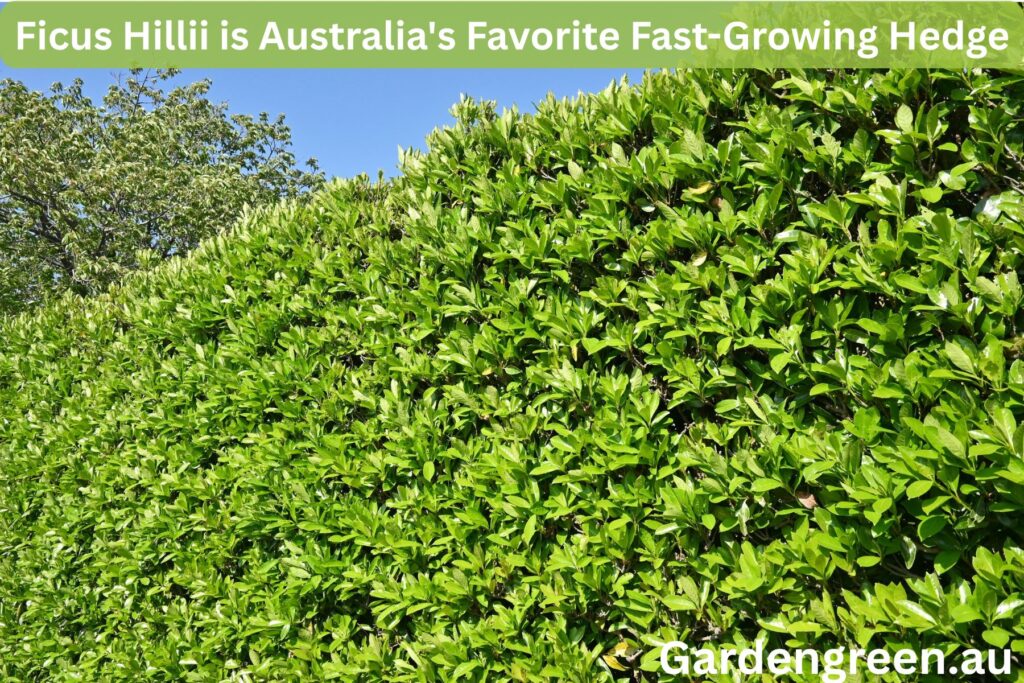
Why Ficus Hillii is Australia’s Favorite Fast-Growing Hedge
Australian gardeners lack patience when it comes to privacy. We don’t want to wait five years to stop the neighbors from looking directly into our backyard.
The Ficus macrocarpa var. hillii solves the “waiting game” problem. It is a robust, evergreen native that thrives in our harsh conditions.
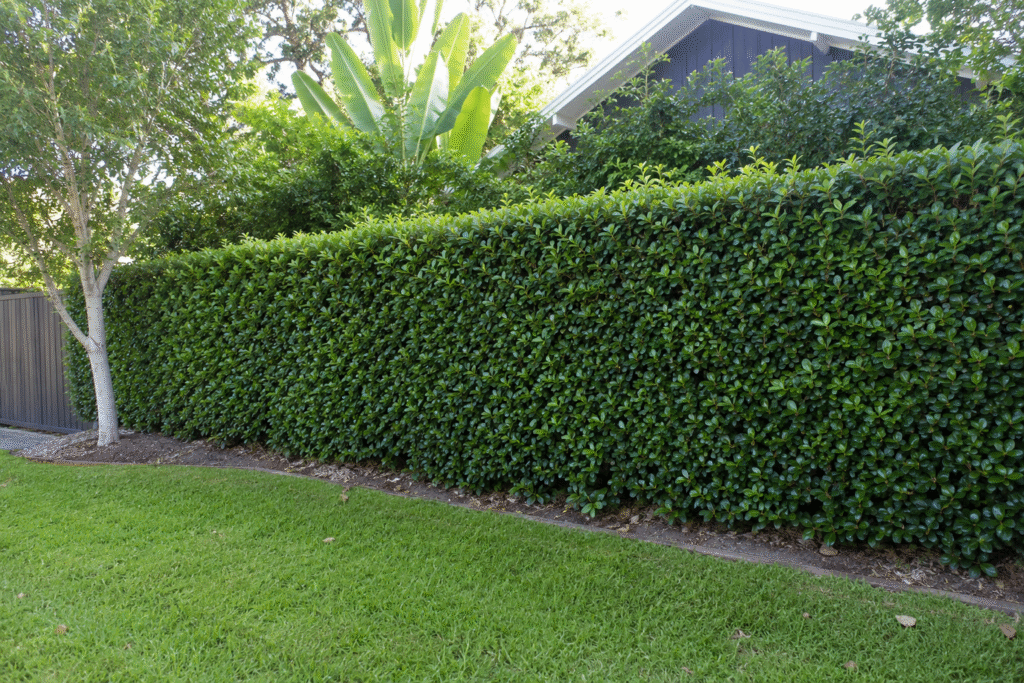
Once established, it can push out over a meter of dense, leafy growth in a single year. It creates a solid wall of green that absorbs traffic noise, blocks harsh winds, and instantly elevates a basic fence line into a high-end landscape feature.
Top Ficus Hillii privacy hedge Varieties
Not all Ficus plants are built the same. Grabbing whatever is cheapest at the garden center can leave you with a sprawling canopy tree rather than a neat hedge. Here are the two proven winners for Australian screens.
1. Ficus Hillii ‘Flash’
The Problem-Solver for Tight Spaces: If you have a narrow driveway or a small suburban block, ‘Flash’ is your ultimate weapon.
- Why it works: It has an upright, columnar growth habit. Instead of growing wide and eating up your lawn space, it shoots straight up.
- The Look: Bright, vibrant, emerald-green foliage with a lightning-fast growth rate.
2. Ficus Hillii ‘Emerald’
The Problem-Solver for Massive Walls: If you have a large acreage or need to completely block out a two-story house next door, ‘Emerald’ is the heavy lifter.
- Why it works: It grows slightly wider and denser than the ‘Flash’ variety, filling horizontal gaps much faster.
- The Look: Features darker, glossier leaves and creates a thicker, more impenetrable physical barrier.
How Much Does a Ficus Hillii privacy hedge Cost? (2026 Budget Guide)
Before you map out your trench, you need to know what this will cost. Nurseries sell Ficus in various pot sizes, and the old saying applies: you are paying for time.
- Tube Stock (Under $10 per plant): These are tiny, 15cm tall plants. They are incredibly cheap if you are planting a 50-meter boundary on a farm, but you will have to wait 3 to 4 years for a reliable privacy screen.
- 140mm to 200mm Pots ($15 to $35 per plant): The sweet spot for most suburban homeowners. At this size, the plant is usually 40cm to 60cm tall, has a robust root system, and will suffer less transplant shock.
- Advanced 300mm to 400mm Pots ($80 to $150+ per plant): These are “instant hedges.” They are already 1.5 meters tall. Buying these is expensive, but it literally buys you two years. If you need immediate privacy from a new two-story build next door, this is the investment to make.
How to Plant a Ficus Hillii privacy hedge
Planting a hedge is an investment. If you get the spacing or the soil wrong on day one, your privacy screen will look patchy and weak for years.
Spacing Requirements
- The Common Trap: Planting them too far apart to save money, resulting in permanent gaps where you can still see the fence.
- The Expert Fix: For a dense, locked-in privacy screen, plant them exactly 1 meter apart. If you are trying to grow a massive, tall windbreak on a larger property, you can stretch them to 1.5 meters apart, but be prepared to wait longer for them to join.
Soil Preparation
- The Common Trap: Dropping a Ficus straight into hard Melbourne clay or dry Perth sand and expecting it to thrive.
- The Expert Fix: Ficus trees are tough, but they hate sitting in a bathtub of rotting clay. If you have heavy clay soil, dig a continuous trench (not just individual holes), mix in Gypsum, and plant them on a slight mound to encourage drainage. In sandy soils, dig in generous amounts of organic compost and a quality soil wetter to hold moisture around the young roots.
The Weekend Warrior Planting Protocol (Step-by-Step)
- The String Line: Never eyeball a hedge. Run a string line from end to end to keep your trench perfectly straight.
- The Trench: Dig a continuous trench rather than individual holes. This allows the roots to interlock more quickly, creating a stronger, more unified hedge.
- Tease the Roots: When pulling the Ficus out of its nursery pot, the roots will likely be bound in a tight circle. Gently tease and break the bottom roots apart with your fingers so they grow outward into the soil rather than form a continuous strangling circle.
- Backfill and Stomp: Backfill with your amended soil and use your boots to stomp around the base of the plant gently. This removes hidden air pockets that can dry out the roots underground.
Essential Care and Maintenance
Once they are in the ground, Ficus hedges are remarkably self-sufficient—if you follow these basic seasonal rules.
Watering Schedule & Mulching
- The Establishment Phase (First 12 Weeks): They need deep, consistent watering. Soak the root zone 2–3 times a week (more during a blistering summer heatwave). Pro Tip: Apply a 50mm layer of pine bark mulch around the base to stop the Australian sun from evaporating the water.
- The Mature Phase: Once established, they are incredibly drought-tolerant. A deep soak once every couple of weeks during summer is usually enough.
Fertilizing for Maximum Growth
To get that explosive, fast-tracking privacy screen, you need to feed the engine.
- The Diet: Apply a slow-release, nitrogen-rich granular fertilizer in early Spring and again in late Summer. Nitrogen promotes heavy, green, leafy growth. Wash it in well immediately to prevent burning the surface roots.
Pruning and Shaping
- The Reality Check: A Ficus Hillii wants to be a 15-meter-tall, sprawling shade tree. You are forcing it to be a box.
- The Fix: You must prune it 2 to 3 times a year.
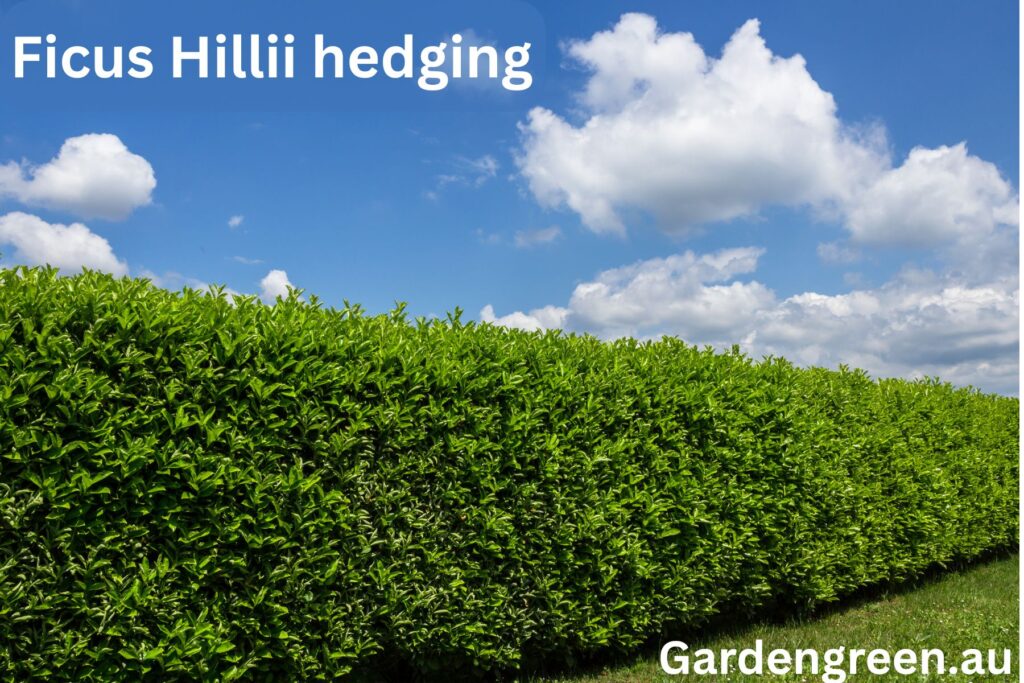
- The Expert Trick (The ‘A-Shape’): Always prune your hedge into a slight “A-Shape” (wider at the bottom, slightly narrower at the top). If the top of the hedge is wider than the bottom, it casts a shadow over its own lower leaves. Without sunlight, the bottom half of your hedge will drop its foliage and turn into bare, ugly sticks.
The Ficus Warning: Managing Aggressive Root Systems
This is the most critical section of this guide. Do not skip it.
The Danger!
Ficus trees have relentless, water-seeking root systems. If you plant them near aging terracotta pipes, fiberglass pools, or directly against your house slab, they will find the moisture and break the infrastructure.
In fact, many local Australian water authorities strictly warn against planting Ficus species near sewerage mains.
The Legal Requirement:
Before you dig a 10-meter trench along your boundary, you must use the free Australian Dial Before You Dig (1100.com.au) service. Hitting a buried NBN fiber cable or a gas line will cost you thousands in fines.
The Solution for Safe Planting:
- Keep Your Distance: Never plant a Ficus Hillii within 3 to 4 meters of underground plumbing, septic systems, or swimming pools.
- Use a Root Barrier: If you must plant near a paved driveway or a retaining wall, install a high-density HDPE plastic root barrier. The barrier must go at least 600mm to 800mm deep into the trench during planting to physically force the roots to grow down, not out.
- Keep Them Pruned: A plant’s root system directly mirrors its canopy. By keeping your hedge pruned to 2 or 3 meters tall, you dramatically restrict how far and how aggressively the roots will spread underground.
Common Pests and Problems
Even the toughest Australian natives run into issues. Here is what to watch out for.
Thrips and Psyllids
- The Symptoms: You will notice leaves curling, blistering, or turning silver/grey. Thrips and Psyllids love attacking the soft, sugary new growth on a Ficus.
- The Fix: Do not reach for heavy, toxic chemicals immediately, as this kills beneficial ladybugs. Spray the hedge thoroughly with Eco-Oil or Neem Oil at the first sign of curling leaves. You must spray underneath the leaves where the bugs hide.
Leaf Drop in Winter
- The Panic: Gardeners in cooler states like Victoria, ACT, or Tasmania often panic when their lush Ficus starts dropping yellow leaves in July.
- The Reality: While Ficus Hillii is evergreen, it naturally sheds older leaves during cold snaps or frosty mornings to conserve energy. As long as the branches aren’t dying back entirely, a little winter shedding is completely normal.
Ficus Hillii privacy hedge vs. Lilly Pilly: Which Hedge is Best?
This is the ultimate showdown at the Australian garden center. Which one should you actually buy?
- Choose Ficus Hillii privacy hedge if: You need ultra-fast growth, you want a very formal, dense, bright green box hedge, and you have plenty of safe space away from pipes and pools.
- Choose Lilly Pilly if: You are worried about invasive roots but still want a native privacy screen. A Lilly Pilly is a much safer alternative near plumbing, boundary walls, and house foundations.
Want to explore the safer alternative? Read our complete guide here: 👉 Lilly Pilly Hedge Guide
The Parliament of Western Australia has an official government hazard document that explicitly states: “The major issue with Ficus is the extremely invasive root system… it will seek out water sources [and] cause problems with water pipes, drains and sewerage pipes.”
The Official .gov.au Link to Use:
In fact, official government hazard reports, such as those published by the Parliament of Western Australia, strictly warn that Ficus root systems will aggressively seek out underground moisture, causing severe damage to water pipes, drains, and building foundations if planted without root barriers.
FAQS about Ficus Hillii privacy hedge care guide
How fast does a Ficus Hillii grow in Australia?
Once established, a Ficus Hillii can grow over 1 metre per year in ideal conditions with adequate watering and nitrogen-rich fertiliser.
Are Ficus Hillii roots invasive?
Yes, they are highly aggressive and water-seeking. They should never be planted within 3 to 4 metres of pipes, pools, or house foundations without a deep, high-density root barrier.
How far apart should I space Ficus Hillii for a hedge?
For a dense, formal privacy screen, plant them exactly 1 metre apart. For a larger, more informal windbreak on acreage, space them 1.5 metres apart.
Why are my Ficus Hillii leaves turning yellow and dropping?
Yellowing leaves are usually caused by overwatering leading to root rot in heavy clay, severe underwatering during summer establishment, or natural seasonal shedding during cold winter snaps.
Can I grow Ficus Hillii in planter boxes or pots?
Yes, growing Ficus ‘Flash’ in large trough planters is an excellent way to get a privacy screen on a balcony or near a pool without worrying about invasive roots damaging plumbing.
How often should I prune a Ficus hedge?
To maintain a dense, formal box shape and prevent it from reverting into a massive tree, you should prune your Ficus hedge 2 to 3 times a year during the warmer growing seasons.
What is the difference between Ficus ‘Flash’ and ‘Emerald’?
‘Flash’ has a narrow, upright, columnar growth habit with bright green leaves, perfect for tight driveways. ‘Emerald’ grows wider and denser with darker leaves, making it better for large boundary walls.
When is the best time to plant a Ficus hedge in Australia?
The safest times to plant are early Spring or Autumn. Avoid planting during the peak 40°C summer heat to prevent severe transplant shock and root stress.
Does Ficus Hillii grow well in Melbourne?
Yes, it adapts well to Melbourne’s climate but must be planted with Gypsum to ensure good drainage in heavy clay soils. It may naturally drop some leaves during heavy winter frost.
How deep should a root barrier be for Ficus Hillii?
To safely protect nearby infrastructure, install a high-density HDPE plastic root barrier at least 600mm to 800mm deep along the trench to physically force the aggressive roots downwards.
Is Ficus Hillii toxic to dogs and cats?
Ficus sap can be mildly toxic to pets, causing skin irritation or stomach upset if the leaves are chewed. Monitor pets around newly pruned hedges where sap is exposed.
How do you revive a dying Ficus Hillii hedge?
Check the soil moisture first using the knuckle test. Do not apply strong chemical fertilisers; instead, apply a liquid seaweed tonic to reduce root shock and lightly trim back dead wood to encourage new growth.